
A natural gas power plant burns natural gas to turn a generator. The fuel can fire a gas turbine, run a reciprocating engine, or heat a boiler whose steam spins a steam turbine. That machine, the prime mover, shapes how efficient the plant is, how fast it starts and the role it usually plays.
The rest of a gas power plant looks much the same from type to type: a gas supply, a generator, a step-up transformer and a switchyard. For a buyer, the type decides which machines go on the list, from turbines to the multi-megawatt engines on the gas engine pages.
Key Takeaways
- The prime mover defines the plant. Turbine, combined-cycle, engine and steam plants share a generator, transformer and switchyard but differ in efficiency, start time and how often they run.
- On GE Vernova's 7E.03, a steam cycle adds 56% output for 0.3% more fuel. Net ratings: 90 MW simple cycle, 140 MW 1x1 combined cycle (ISO, LHV, 60 Hz).
- The four gas engines cited are 9.4–11.4 MW units. They are rated 9,388–11,377 kW at 60 Hz and 48.7–51.6% electrical efficiency, each on its OEM's basis.
- Combined-cycle plants do most of the gas-fired generating. From EIA's 2025 capacity and capacity factors, they supplied an estimated 83% of gas-fired output.
- Turbines need far higher gas pressure than engines. Gas turbines take 100–500 psig, with a compressor, against 1–75 psig for reciprocating engines in EPA's CHP technology catalog.
What a natural gas power plant is#
A natural gas power plant is a power station whose generators are driven by gas-fired machines. Table 4.08.A of the EIA Electric Power Annual 2025 groups the US fleet into four natural gas technologies: combined cycle, gas turbine, steam turbine and internal combustion. Each is a different prime mover, or a combination of two.
Natural gas was the largest single source of US utility-scale electricity in 2025. In Table 3.1.A of the EIA Electric Power Annual 2025, released 21 Oct 2026, it fueled 1,811,004 thousand MWh of the 4,425,029 thousand MWh of net generation at utility-scale facilities. That is 40.9%, or about 41% in EIA's rounding. EIA's Electricity in the United States page defines utility scale as plants with at least 1 MW of generating capacity.
The machines differ more than the plants do. The gas turbine pages cover the turbine models in this article one by one.
How a gas plant turns fuel into power#
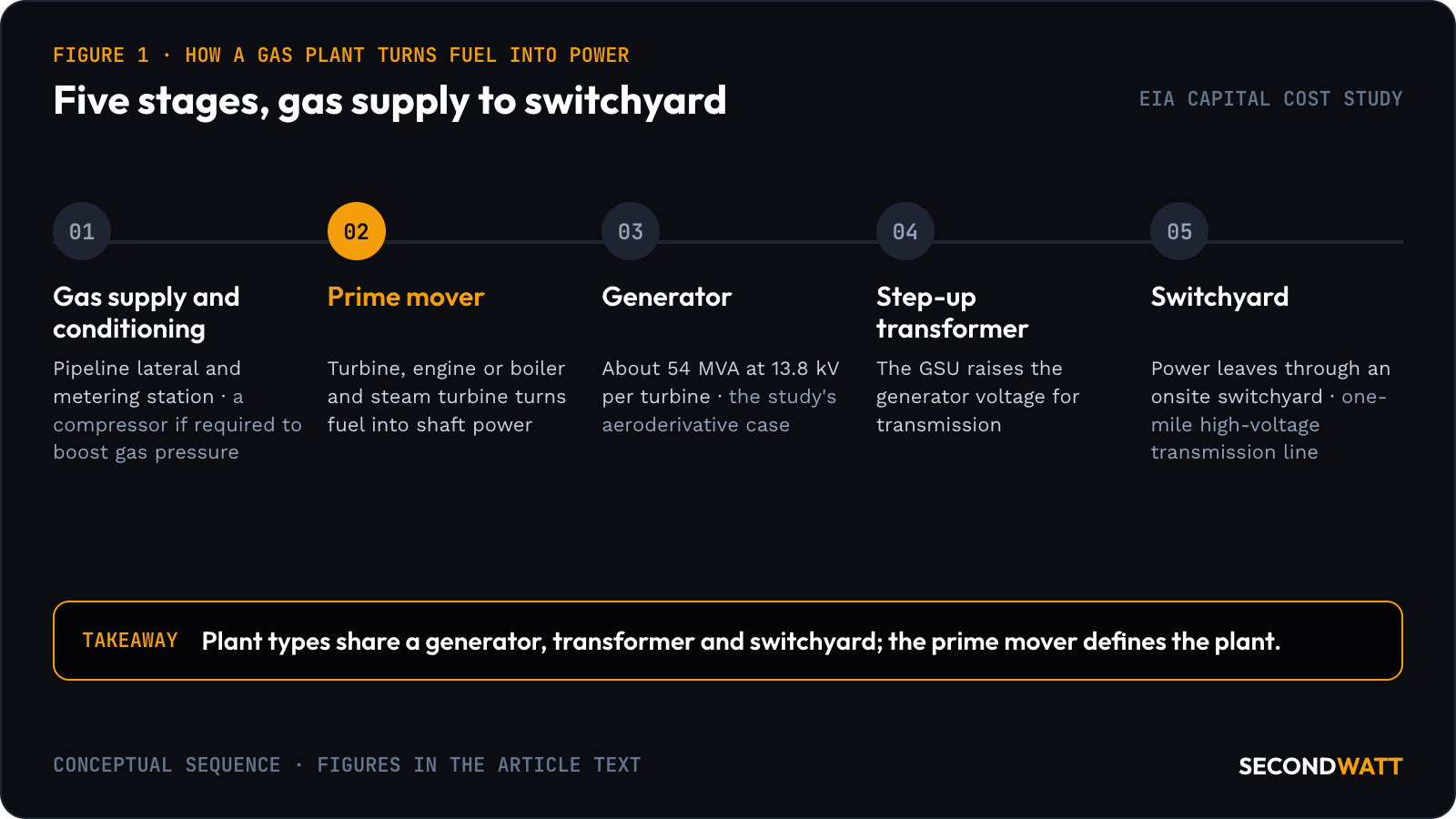
A gas plant moves energy through five stages: gas supply and conditioning, the prime mover, the generator, the step-up transformer and the switchyard. Each stage appears in the reference plants of EIA's capital cost study, prepared by Sargent & Lundy. The study's Final Rev A, titled Capital Cost and Performance Characteristic Estimates, is dated 6 Dec 2023.
Gas arrives through a pipeline lateral and a metering station. The study's aeroderivative plant assumes a half-mile pipeline and a dedicated metering station. Turbines may need more pressure than the pipeline delivers: for its LM2500 dual-fuel conversion, GE Vernova lists an off-package gas fuel compressor "if required to boost gas pressure", with a coalescer/dehumidifier and/or a filter/scrubber skid. The fuel requirements guide covers gas quality and pressure.
The prime mover turns fuel into shaft power. A gas turbine burns the gas directly, an engine burns it in cylinders, and a steam unit burns it under a boiler. EIA's explainer on how electricity is generated describes a combined-cycle system as one that uses combustion gases from one turbine to generate more electricity in another.
The prime mover drives the generator. In the study's aeroderivative case, each turbine has its own 60 Hz generator rated about 54 MVA at 13.8 kV. In single-shaft combined-cycle systems, both turbines may drive a single generator, EIA notes. The balance-of-plant guide covers the systems around these machines.
Generator step-up transformers (GSUs) then raise the generator voltage for transmission. The GSU specification guide and the GE Prolec GSU page cover their ratings.
Power leaves through an onsite switchyard. The study's aeroderivative case also assumes a one-mile high-voltage transmission line from the plant.
The main plant types#
The table maps EIA's four natural gas categories, plus CHP as a configuration, to their equipment. Turbine ratings from GE Vernova use the lower heating value (LHV), while EIA typically uses gross heat content, the higher heating value (HHV).
Natural gas plant types: prime mover, role, OEM efficiency and EIA fleet heat rate (GE Vernova fact sheets GEA35773 05/2025 and GEA35743 09/2025, 7E and 9HA pages; Wärtsilä, Bergen and Jenbacher pages; EIA Electric Power Annual 2025, Tables 4.08.A and 8.2)#
| EIA category | Prime mover | Role, from EIA or OEM | Efficiency as the OEM rates it (basis) | EIA 2025 average tested heat rate (Btu/kWh) | Start-time claim (OEM's) | Article that covers it |
|---|---|---|---|---|---|---|
| Gas turbine (simple cycle) | Aeroderivative or heavy-duty frame turbine | Generally used to meet peak load (EIA) | 33.8% (7E.03, 60 Hz) to 44.0% (9HA.02, 50 Hz); net, LHV, ISO | 10,975 | 5 minutes (LM6000 PF+ Sprint fast start); 100% load in under 10 minutes (7E) | Peaker plants |
| Combined cycle | Gas turbine, HRSG and steam turbine | 58.7% capacity factor in 2025 (EIA) | 52.4% (7E.03 1x1, 60 Hz); net, LHV, ISO | 7,535 | 35 minutes, rapid-response hot start (7E.03 1x1) | Simple vs combined cycle |
| Internal combustion | Reciprocating gas engines | Baseload, balancing renewables, cyclic and peak (Wärtsilä, INNIO) | 48.7–51.6%, 60 Hz (four models, each on its OEM's basis) | 8,853 | 30 seconds to grid, under 2 minutes to full load (Wärtsilä fast start) | Turbines vs engines |
| Steam turbine | Gas-fired boiler and steam turbine | 19.6% capacity factor in 2025 (EIA) | Not stated | 10,293 | Not stated | Conversions |
| CHP (a configuration) | Turbine or engine with heat recovery, or boiler and steam turbine | Sites with year-round coincident power and heat loads (EPA) | Can exceed 80% total, power plus useful heat (EPA) | Not applicable | Not stated | Not applicable |
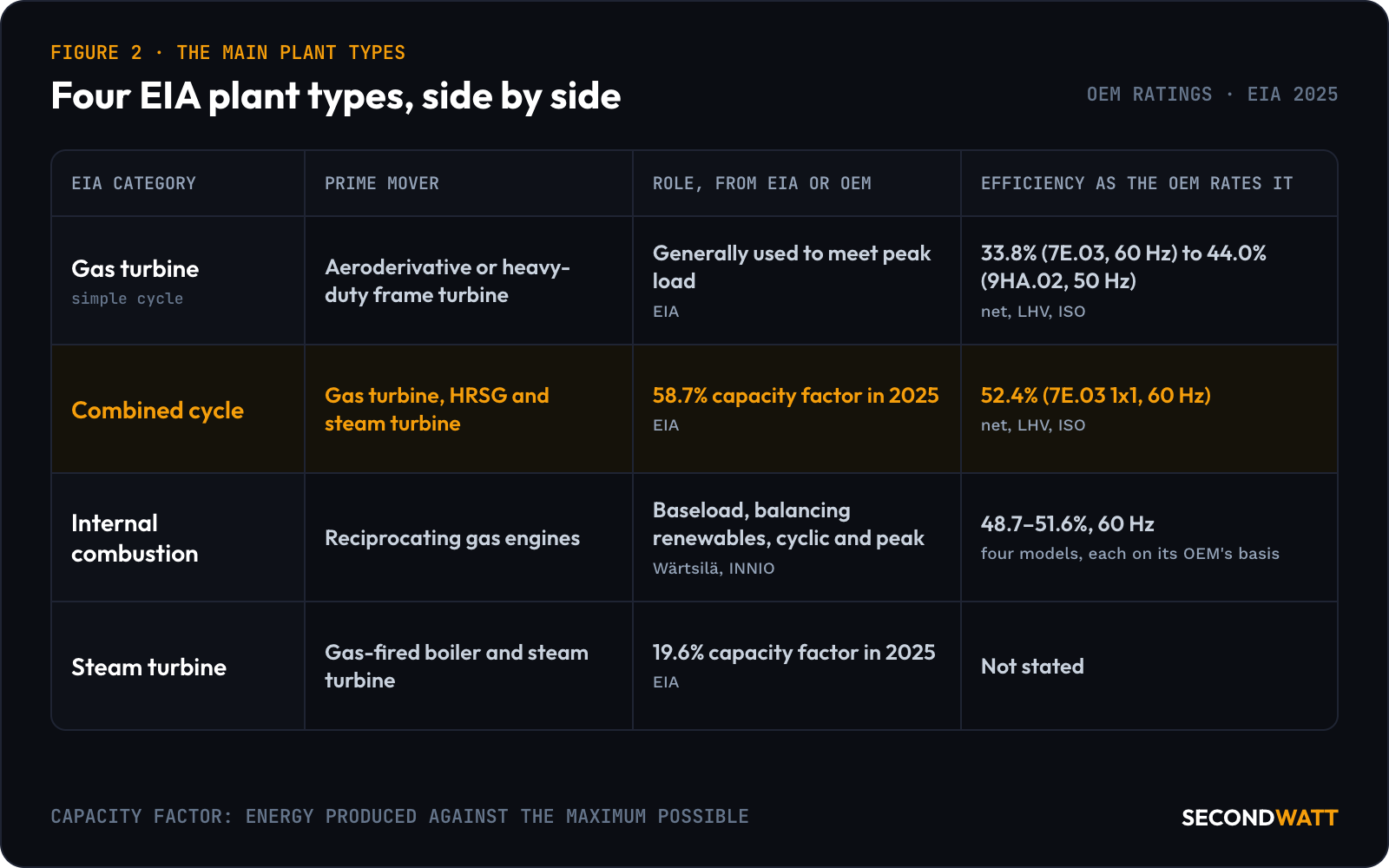
The two efficiency columns do not compare directly. OEM figures are ratings at ISO or the OEM's reference conditions, and the engine pages do not all state a heating-value basis. EIA's tested heat rates are reported at full load and weighted by net summer capacity, according to EIA Table 8.2 and the EIA glossary.
CHP is a configuration of the same machines. In EPA's turbine and engine systems, heat recovery devices capture the machine's heat, usually as steam or hot water. EPA also lists boiler and steam turbine systems, in which steam leaving the turbine can supply useful heat. CHP can achieve efficiencies over 80% and is best suited to facilities with year-round coincident power and thermal loads, according to EPA's overview of CHP.
Simple-cycle gas turbine power plants#
A simple-cycle gas turbine power plant exhausts its turbine's hot gas without recovering it. Natural gas combustion turbines are more expensive to operate than other plant types but can respond quickly when needed, EIA notes in a Today in Energy article of 1 Oct 2013. They tend to run for short-term increases in demand during ramping, or when loads and prices are higher.
Simple-cycle ratings for four GE Vernova turbines (GE Vernova fact sheets GEA35743 and GEA35742, 09/2025; 7E and 9HA product pages)#
| Model | Class | Net output, simple cycle | Net efficiency and heat rate (LHV) | Frequency | Start-time claim |
|---|---|---|---|---|---|
| LM6000 PF+ Sprint | Aeroderivative | 56.9 MW, ISO, natural gas | 41.0%; 8,328 Btu/kWh | 50/60 Hz | 5-minute fast start |
| LMS100 PA+ | Aeroderivative, intercooled | 115.8 MW, ISO, natural gas | 43.9%; 7,773 Btu/kWh | 60 Hz | 8 minutes to full load |
| 7E.03 | Heavy-duty frame | 90 MW, ISO, natural gas | 33.8%; 10,107 Btu/kWh | 60 Hz | 23-minute rapid-response hot start; 100% load in under 10 minutes |
| 9HA.02 | Heavy-duty frame, H-class | 571 MW, ISO, natural gas | 44.0%; 7,740 Btu/kWh | 50 Hz | 23-minute rapid-response hot start |
GE Vernova's LM6000 and LMS100 fact sheets state that the aeroderivative ratings include inlet and exhaust losses and exclude balance-of-plant equipment. The 9HA.02 figure is a 50 Hz rating on GE Vernova's 9HA page.
GE Vernova's 7E page shows two start figures for the 7E.03: a 23-minute rapid-response hot start, and fast-start capability that "can deliver up to 100% load in less than 10 minutes". The same page lists Frame 7E and 7EA among the former names of GE Vernova's 7E turbines, which is why the 7E.03 row links to the Frame 7EA / 7E.03 page.
Aeroderivative turbines generally have faster start-up times, faster ramp rates and higher efficiencies than industrial frame turbines, according to EIA's cost study. Industrial frame sizes reach over 400 MW of output in 60 Hz models, far above the largest aeroderivative, and frames are less costly per kW. The aeroderivative vs industrial guide and the peaker plant guide cover the choice and the duty.
Combined-cycle plants#
A combined-cycle plant sends the gas turbine's exhaust through a heat recovery steam generator, and the steam drives a steam turbine. In EIA's 2x2x1 reference plant, two H-class turbines feed two HRSGs and one steam turbine generator. The plant, Case 5 in EIA's capital cost study, uses a wet cooling tower. Air-cooled condensers are often chosen where makeup water is scarce or expensive, the study notes.
GE Vernova's May 2025 7E fact sheet rates the 7E.03 both ways on one basis: net plant, ISO conditions, natural gas, LHV, 60 Hz. In simple cycle the 7E.03 is rated at 90 MW net output and 10,107 Btu/kWh. In a 1x1 combined cycle, the plant is rated at 140 MW net output and 6,514 Btu/kWh.
Worked example, fuel input on that basis (net output × net heat rate):
90 MW net output × 10,107 Btu/kWh = 909.6 MMBtu per hour, simple cycle.
140 MW net output × 6,514 Btu/kWh = 912.0 MMBtu per hour, 1x1 combined cycle.
The fuel input differs by 0.3%, while net output rises by 50 MW, or 56% (140 ÷ 90 = 1.56). The steam cycle turns exhaust heat into that extra power. The trade is start time: the 1x1 plant's rapid-response hot start is listed at 35 minutes, against 23 minutes for the turbine alone in simple cycle.
52.4% — GE Vernova's net efficiency for a 7E.03 in a 1x1 combined cycle (ISO, natural gas, LHV, 60 Hz), against 33.8% for the same turbine in simple cycle.
The simple-cycle vs combined-cycle comparison and the heat rate guide take the cycle choice and the efficiency math further.
Reciprocating engine plants#
A reciprocating engine power plant combines several gas engine generating sets, such as the four 60 Hz units below. Each OEM rates its engine on its own basis, and the table keeps each one.
Gas engine ratings at 60 Hz, four models (Wärtsilä 31SG and 34SG pages; Bergen B36:45V page; Jenbacher J920 FleXtra page)#
| Model | Electrical output, 60 Hz | Electrical efficiency | Rating basis (OEM's) |
|---|---|---|---|
| Wärtsilä 20V31SG | 11,377 kW rated | 51.6% | Generator terminals; 100 kPa, 25 °C suction air, 30% relative humidity; without engine-driven pumps; power factor 1.0 (site); 5% tolerance on efficiency |
| Wärtsilä 20V34SG | 9,388 kW rated | 48.8% | As for the 31SG |
| Bergen B36:45V20 | 11,280 kW, 720 r/min | 48.9% nominal | 100% load including two engine-driven pumps; engine power per ISO 3046 and ISO 8528; generator per IEC 60034, power factor 1 |
| Jenbacher J920 FleXtra | 9,542 kW | Up to 48.7% | Generator terminals, full load; energy input per DIN ISO 3046 and DIN 6271, +5% tolerance |
The Wärtsilä figures are from its 31SG page and 34SG page. The others are from the Bergen B36:45V page and the Jenbacher J920 FleXtra page. Bergen's current fact sheet, dated 9/2026, gives the same 11,280 kW and 48.9% at 100% of maximum continuous rating, power factor 1.0.
Those bases matter when engines are compared side by side. Bergen's figure includes two engine-driven pumps; Wärtsilä's figures exclude engine-driven pumps.
Splitting a plant into units changes part load. The 31SG's minimum load is 10% at unit level and 1% at plant level, per Wärtsilä. Jenbacher says its multiple-engine concept, combined with a 2-minute engine start-up, provides flexible power from baseload to cyclic and peak operations.
Engines also take gas at lower pressure. Table 1-3 of EPA's September 2017 Catalog of CHP Technologies gives 1–75 psig for reciprocating engines, against 100–500 psig with a compressor for gas turbines. Packaged engine plants are covered under power blocks.
How the US gas fleet is used#
Natural gas power generation in the US leans on combined-cycle plants. Capacity factor compares a fleet's net generation with its available capacity, so it measures energy produced against the maximum possible. It does not count hours run.
US natural gas capacity factors and capacity by technology, 2025 and 2024 (EIA Electric Power Annual 2025, Table 4.08.A, released 21 Oct 2026; values final)#
| EIA technology category | 2025 capacity factor | 2024 capacity factor | 2025 time-adjusted capacity (MW, summer) |
|---|---|---|---|
| Natural gas combined cycle | 58.7% | 60.5% | 292,281.3 |
| Natural gas gas turbine | 13.6% | 13.9% | 134,388.3 |
| Natural gas steam turbine | 19.6% | 19.9% | 76,503.5 |
| Natural gas internal combustion | 18.0% | 18.0% | 6,595.2 |
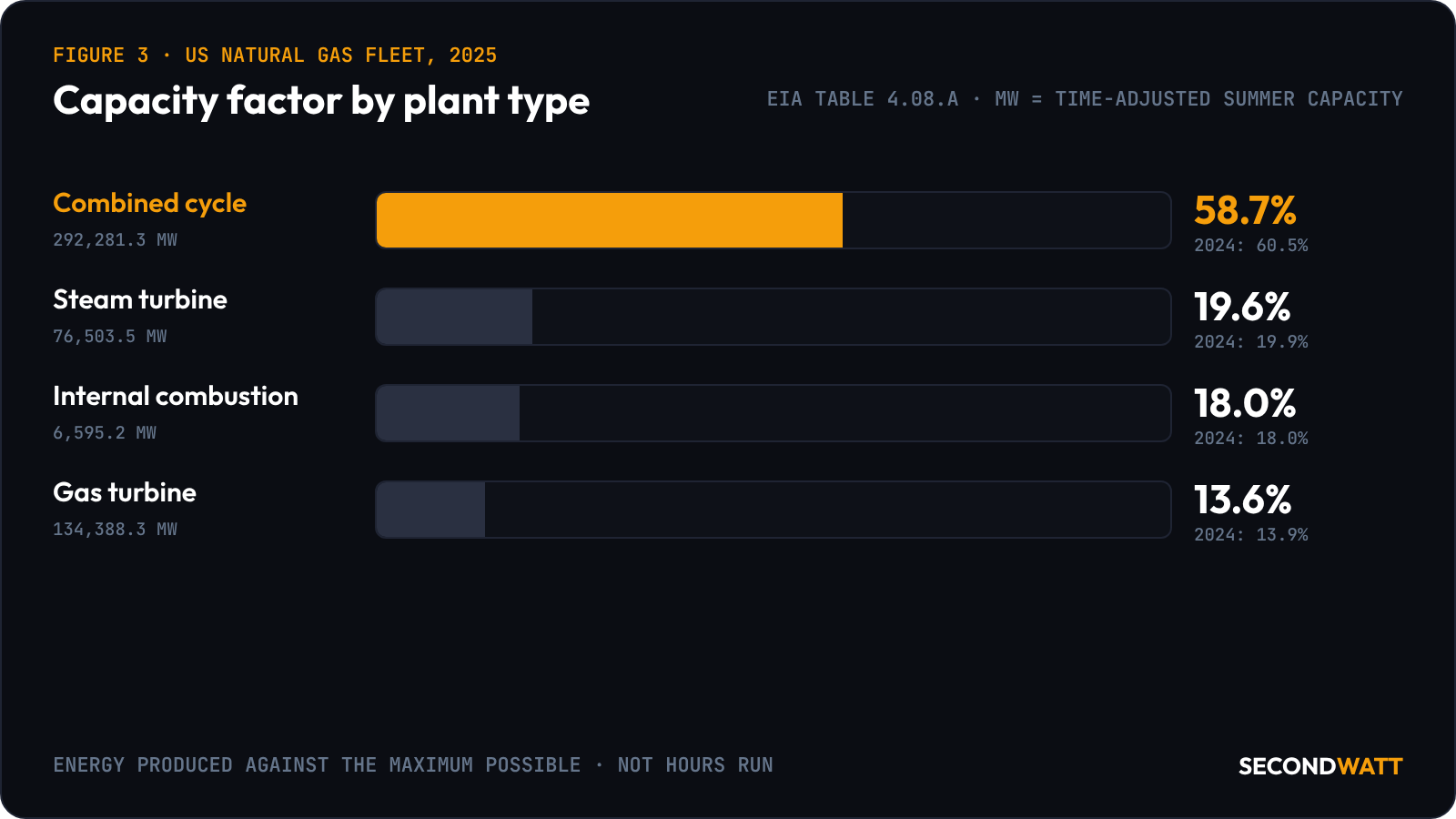
58.7% — the 2025 capacity factor of US natural gas combined-cycle plants, against 13.6% for natural gas combustion turbines, in EIA's Electric Power Annual Table 4.08.A.
Combined-cycle plants held 57.3% of the four categories' time-adjusted capacity: 292,281.3 ÷ 509,768.3 = 0.573. Capacity times capacity factor approximates each fleet's average output over the year. On that basis, combined cycle supplied an estimated 83% of the four categories' combined output. It is SecondWatt's estimate from the table's rounded values.
Worked example, average output in 2025 (capacity × capacity factor):
Combined cycle: 292,281.3 MW capacity × 0.587 = 171,569 MW average output.
Gas turbine: 134,388.3 MW capacity × 0.136 = 18,277 MW average output.
Steam turbine: 76,503.5 MW capacity × 0.196 = 14,995 MW average output.
Internal combustion: 6,595.2 MW capacity × 0.180 = 1,187 MW average output.
Total average output, 206,028 MW; combined cycle's share, 171,569 ÷ 206,028 = 0.833. Over 8,760 hours, that total is about 1,805,000 thousand MWh, within 0.4% of the natural gas generation in Table 3.1.A. That table counts generation by fuel rather than by generator type, so the match is a rough check. The combustion turbine fleet is the second largest by capacity and supplied an estimated 9% of the output, which fits the peaking role in the peaker plant guide.
On-site gas plants for data centers#
The same machines can run behind the meter, where a data center generates its own power. The behind-the-meter guide and the bridge power guide cover the grid side.
Bergen gives one engine example. Its 4 June 2025 release describes an order commitment for twelve B36:45V20 engines, each with 11.2 MW of electrical output at 60 Hz in the project's first phase, configured as an (n+3) system for a US AI data center. The plant is planned behind the meter, with over 130 MW of initial capacity, and is expected to go live in 2026.
Twelve engines at 11.2 MW output each give 134.4 MW. The release's 11.2 MW per engine sits below the 11,280 kW rating on Bergen's B36:45V page.
Packaged gas engine blocks are another route, covered in the mtu 20V4000 power block article. The emissions permitting guide covers air permits for on-site turbines.
FAQ: natural gas power plants#
How much does a natural gas power plant cost to build?#
An industrial frame combustion turbine plant with 419 MW of capacity has a total overnight cost of $1,158 per kW (2025 dollars) in EIA's Annual Energy Outlook 2026 assumptions, and a 211 MW-capacity aeroderivative plant $2,275 per kW. A multi-shaft combined-cycle plant with 1,227 MW of capacity is $1,032 per kW, and a single-shaft plant with 627 MW of capacity $1,086 per kW. All are in 2025 dollars, before regional multipliers and excluding interest. The figures are from Table 3 of EIA's AEO2026 Electricity Market Module assumptions, published April 2026.
EIA raised these inputs for AEO2026. Its update applied about a 40% increase to simple-cycle turbine costs and 20% to combined-cycle costs, against the original inputs from the 2024 Sargent & Lundy report. The update rests mainly on a Brattle Group and Sargent & Lundy study for PJM, which found supply shortages and tight materials and labor markets.
How efficient is a natural gas power plant?#
On EIA's capacity-weighted average tested heat rates, combined-cycle units convert about 45% of their fuel energy into electricity at full load: 3,412 ÷ 7,535 = 45.3%. EIA sets out the formula in its FAQ on power plant efficiency. On 2025 tested heat rates, it gives 31.1% for gas turbines, 38.5% for engines and 33.1% for gas-fired steam units.
EIA typically uses gross heat content (HHV). Section 2 of EPA's CHP catalog puts natural gas HHV about 10% above LHV, so 50% LHV equals about 45% HHV. Convert an LHV rating before comparing it with these fleet figures.
How long does it take to build a gas power plant?#
Lead times are 3 years for combined-cycle plants and 2 years for combustion turbines in Table 3 of EIA's AEO2026 assumptions. Equipment slots can set the pace before construction starts; the turbine backlog guide tracks OEM delivery times.
Can natural gas power plants run on hydrogen?#
Some can, by their OEMs' claims. GE Vernova's fact sheets list up to 100% hydrogen capability for the LM6000 and up to 30% for the LMS100. Its 9HA page states 50% hydrogen capability with a pathway to 100%. The capability figures in these GE Vernova documents do not say whether they are by volume or by heat input.
Wärtsilä states its basis. Its hydrogen power plant page says the 31SG-H2 engine runs "with hydrogen blends of up to 25% volume before conversion", and a conversion package allows 100% hydrogen operation.
What is the difference between a gas plant and a peaker plant?#
A peaker is a role; a gas plant is a technology. A 1 Oct 2013 EIA Today in Energy article notes that peaking units tend to run infrequently and for short periods, and have much lower capacity factors than baseload units. The same machine can serve either role: GE Vernova presents the 7E.03 for peaking, cyclic and baseload operation.
Sourcing equipment for a gas plant#
SecondWatt publishes equipment research and helps buyers source power equipment; it earns a fee when a sale it arranges closes. If you are planning a plant, send a request that names the prime mover, rating basis and frequency you need, so offers can be compared like for like. If you own a turbine leaving service, the gas turbine seller page explains how SecondWatt works with owners.