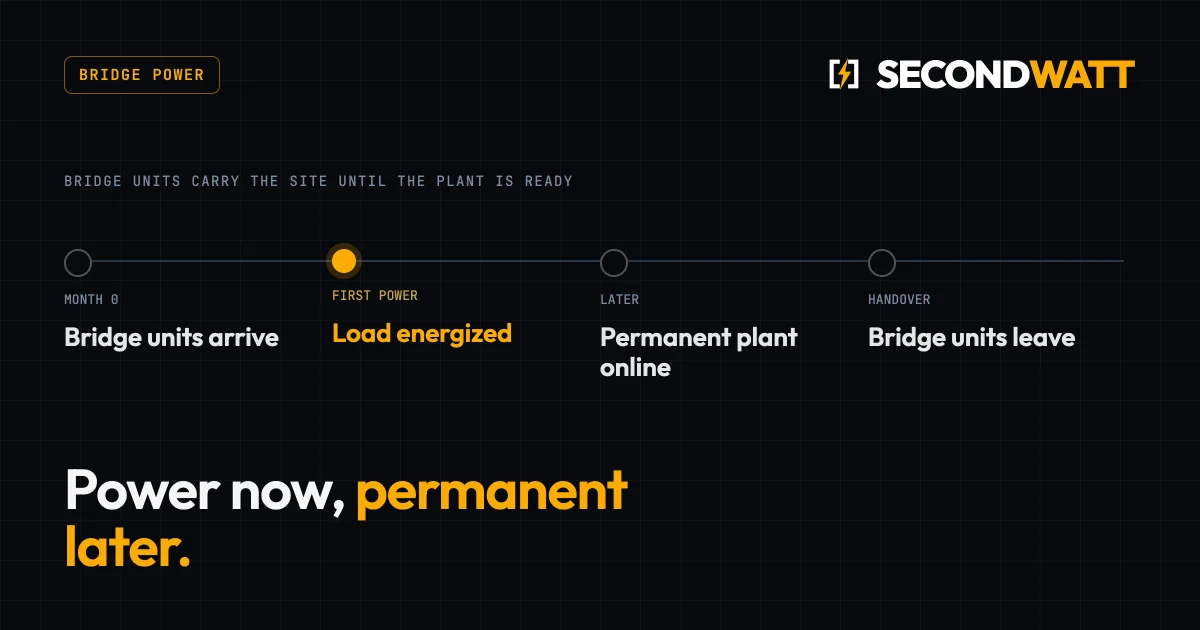
Bridge power for data centers can bring an initial operating phase online while permanent utility service is still being developed. A credible 12-month plan starts with a site that can receive fuel, obtain operating approvals and complete its electrical and cooling systems within that window. The first commitment should be a defined block of customer-ready IT capacity supported through the required outage conditions.
An expansion with established infrastructure deserves a different schedule from a greenfield campus needing a gas lateral and substation. The assessment below separates those starting positions, explains which equipment offers can shorten procurement, and tests whether opening early pays for the bridge. Regulatory discussion is U.S.-focused; the international project example illustrates deployment scope rather than a transferable permitting timeline.
Key Takeaways
- Start with site readiness. Existing fuel and electrical infrastructure strengthen a 12-month plan; unresolved off-site construction makes the date conditional.
- Count delivered capacity through an outage. In the worked example, seven 4.5 MW net units retain 27 MW with one unit unavailable.
- Buy a documented path to service. Operating, stored, incomplete and refurbishment-dependent packages carry different procurement obligations.
- Commission the complete power path. Generation, protection, UPS systems and cooling must demonstrate the intended operating behavior together.
- Price the months of earlier service. In the hypothetical commercial example, four operating months recover the bridge's one-time cost; six produce a positive contribution.
Which sites can support bridge power within 12 months#
Use three planning classifications before requesting equipment. These procurement judgments reflect the site's readiness. A credible target requires dated commitments from the parties responsible for delivery.
Site readiness and the first achievable milestone#
| Starting position | Planning assessment | First milestone to pursue |
|---|---|---|
| Existing campus; fuel service confirmed; compatible electrical capacity; approval path established | Credible candidate | An additional operating data hall |
| Prepared site; equipment identifiable; fuel or electrical scope still unresolved | Conditional | A defined first phase after the missing dependency has a supported date |
| Greenfield site; new gas lateral, major substation work or material approvals unresolved | Not yet supported | Feasibility and enabling works before an operating-date commitment |
Construction power, commissioning power and customer-ready service are separate milestones. Temporary generation that keeps contractors working does not establish that the site can run an occupied data hall. Likewise, supplying a load bank establishes only the performance covered by that test.
For the operational milestone, specify the initial IT demand, total facility demand, voltage, frequency and permissible interruptions. Include the behavior required during maintenance and equipment failure. This prevents a supplier's proposed generating capacity from becoming an unsupported customer-capacity commitment.
A phased project has a smaller initial scope to coordinate. It also needs an expansion design: later equipment deliveries must connect without creating an unacceptable outage for the first tenant.

What completed deployments establish#
A Dublin data center installation with 14 MW of gas generation, medium-voltage equipment and battery storage was completed in 12 weeks from contracting to commissioning, according to Aggreko's case study. The provider reports that the project addressed a delayed grid connection and included operating support.
The 14 MW figure describes installed generation. Calculating supported IT capacity also requires the facility loads and outage requirements. The reported interval starts at contracting, so earlier site development sits outside that 12-week claim.
Fuel cells provide another reported deployment example. A fully operational system was delivered to Oracle in 55 days during 2025, according to Bloom Energy's April 2026 announcement. That vendor claim concerns an individual system; it does not establish the starting condition or delivery schedule of a new campus.
For your project, compare a supplier's proposed schedule with the same milestones: authorization, equipment release, installation, first power and accepted operation. A short installation claim is useful only within that larger sequence.
Choose a generation arrangement for the operating duty#
Reciprocating gas engines warrant evaluation when incremental blocks fit the load ramp and maintenance plan. Multiple units can provide flexibility, but they also require coordinated cooling, exhaust, fuel distribution and controls. Evaluate the fleet with the required units unavailable.
Packaged gas turbines warrant evaluation when a larger generation block fits the site's load and infrastructure. When comparing gas turbine options, identify the complete package and site-specific net output for each LM2500 or LM6000 offer. Use the mobile turbine procurement guide for package-specific selection and exit questions.
Diesel generators can serve construction, testing or an operating bridge when their rating, fuel logistics and approvals fit that use. Confirm the offered unit's continuous or prime duty rather than sizing from a standby label. The Cummins QSK60 specifications distinguish application ratings within one diesel product family; the required rating remains specific to the offered configuration.
Fuel cells belong in the comparison when a supplier can commit capacity, fuel requirements, installation and operating support. Compare the complete power architecture and the service obligation through the bridge period, including any transition or relocation requirements.
Batteries and UPS systems serve a defined continuity or power-management function alongside the energy supply. An assumed 20 MW, 20 MWh of usable battery capacity provides one hour at 20 MW in idealized arithmetic before additional losses or reserve allowances. The data center storage guide explains how to specify both power and energy.
Decide whether the equipment offer can shorten procurement#
Secondary-market procurement can remove a manufacturing dependency when an identified package fits the project. The useful comparison is the remaining work between the asset's present condition and accepted service at the receiving site. Labels such as used, refurbished or available now do not define that work.
Equipment condition and the commitment required#
| Offered asset | Evidence needed before relying on its date | Schedule decision |
|---|---|---|
| Operating package at another site | Test records, release date, removal scope and transport plan | Include shutdown, dismantling and recommissioning |
| Complete package in storage | Preservation logs, component inventory, inspection and recommissioning scope | Resolve storage-related work before fixing installation dates |
| Engine or incomplete package | Missing-equipment list and dated supply commitments | Track every missing component as a separate dependency |
| Package requiring refurbishment | Defined repair scope, parts allocation, shop slot and acceptance procedure | Use the full repair-and-test schedule |
These are buying checks, not a ranking of condition labels. A complete stored package with strong records may present a clearer path than operating equipment whose owner has not committed to release it. An attractive engine price can become an expensive schedule decision if its generator, controls or exhaust system must be sourced separately.
At shortlist stage, ask the seller to identify what is physically included, who controls the asset and what must happen before dispatch. Tie inspection access and acceptance to the specific equipment. Require the party responsible for installation to acknowledge the package boundaries before purchase.
Keep the price comparison on the same scope. The used gas turbine cost guide helps separate package asking prices from installed project costs.
Calculate how much IT load the plant can support#
Size the plant at a named delivery point, such as the data center's incoming medium-voltage bus. All facility loads downstream of that point must fit, including cooling and electrical losses. Deduct generation auxiliaries and upstream losses when establishing the plant's net delivery.
PUE is an annual-energy ratio and does not, by itself, establish peak facility demand. Build the design-condition load schedule instead of multiplying IT nameplate demand by an annual efficiency target. The DOE data center design guide explains that annual basis.
For an illustrative first phase, assume 20 MW of IT demand and 25 MW of total facility demand at the receiving bus. The resulting facility-to-IT power ratio is 1.25 for this design condition. It is an example input rather than an asserted annual PUE.
Assume seven generating units, each delivering 4.5 MW net to that bus under the specified site conditions. The upstream losses and generation auxiliaries are already deducted from that figure.
Illustrative capacity through generating-unit outages#
| Operating condition | Units available | Net bus capacity (MW) | Arithmetic IT ceiling at 1.25 ratio (MW) |
|---|---|---|---|
| All units available | 7 | 31.5 | 25.2 |
| One unit unavailable | 6 | 27.0 | 21.6 |
| Two units unavailable | 5 | 22.5 | 18.0 |
With one unit unavailable, the plant retains 2 MW above the assumed 25 MW facility demand. With two unavailable, it falls short by 2.5 MW. A maintenance outage followed by another failure therefore requires additional capacity, an agreed load reduction or a different service commitment.

This is a steady-state capacity check. Shared fuel infrastructure, electrical faults and the response to a sudden generator trip still require engineering assessment. For turbines, establish site-specific net output before using a brochure rating in the calculation.
Close the dependencies that control the date#
Fuel service#
A nearby pipeline does not establish a usable fuel connection. The supply commitment needs volume, pressure, gas quality, connection scope and a service date. Include compression and conditioning loads, plus the power needed to start them before the main plant is running.
For scale, a hypothetical plant delivering 25 MW at a net heat rate of 9,000 Btu/kWh on a lower-heating-value basis requires 225 MMBtu per hour, or 5,400 MMBtu over 24 hours. Use the selected package's actual consumption curve for contracting. That volume also determines whether a transported-fuel proposal has a workable receiving and replenishment plan.
Transported CNG or LNG can bridge a missing pipeline connection, but introduces receiving equipment and delivery logistics. These virtual-pipeline arrangements are described in Caterpillar's bridge-power guidance. Compare fuel interruption cases alongside generating-unit outages.
Operating permission#
Set the permit scope from the actual equipment, fuel and operating hours. U.S. stationary turbines, stationary engines and nonroad engines have distinct regulatory requirements, and state and local agencies issue most data center air permits. Start with the EPA's data center air-regulation resources.
Routine service while waiting for the grid should not be assumed to qualify as emergency operation. Trailer mounting also does not establish a blanket exemption: EPA notes that a portable engine remaining at one location for more than 12 months can become stationary, with additional provisions for seasonal sources. See EPA's stationary-engine guidance. Establish the applicable construction, operating, emissions and noise requirements before relying on a work sequence.
Electrical interfaces and cooling#
Track transformers, switchgear, protection, UPS equipment and cooling against the same service date. Frequency, voltage, grounding and fault duty must match the receiving system. An available transformer creates no schedule advantage if extensive modification or testing remains unplanned.
Define whether generation is isolated, briefly parallel during transfers, or continuously parallel with utility power. Non-export operation can still require interconnection review; PG&E, for example, maintains a non-export interconnection process. Apply the serving utility's requirements to the actual arrangement.
Build the schedule backward from accepted operation#
Use the first customer-ready phase as the endpoint. The following work windows allocate an illustrative 12-month plan from funded authorization and site access. The responsible parties must replace these planning assumptions with committed dates before they support a customer promise.
Months 0-3: establish feasibility and commit scope. Define the load and operating cases, resolve fuel feasibility, start approval applications and inspect the equipment shortlist. Commit procurement only when the remaining work and supplier interfaces are understood.
Months 1-5: complete design and secure required approvals. Coordinate fuel, civil, electrical and cooling designs with the selected packages. Include utility review where the operating arrangement requires it.
Months 3-10: prepare and install. Equipment preparation can proceed alongside authorized site work. Release construction activities according to their approval and design dependencies; complete fuel, electrical and cooling interfaces before integrated testing.
Months 10-12: test, correct and hand over. Reserve time for commissioning, correction of deficiencies and operational acceptance. A schedule that uses the entire window for construction has no allowance for a failed acceptance test.
The schedule can overlap workstreams only after their dependencies are satisfied. Equipment release, lawful construction, fuel availability and an operable cooling system each need their own completion evidence.

Agree the operating tests before shipment. They should cover black start, staged load additions, the largest generating-unit trip, UPS recovery and recharge, the required maintenance condition, and the transition to permanent power. Use simulations and controlled tests appropriate to each event.
Dynamic studies evaluate voltage and frequency behavior during events such as generator trips and motor starts, as described in GE Vernova's secure-islanding analysis. Assign one party responsibility for demonstrating the installed system's performance at the agreed delivery point.
Test whether earlier service pays for the bridge#
Compare the contribution from earlier customer service with the incremental bridge cost over the same period. Include fuel, rental or ownership, installation, operating labor, maintenance and removal. Allocate permanent equipment costs consistently and avoid counting the same cost in both the facility budget and bridge budget.
Consider the same 20 MW IT phase operating six months before its permanent supply becomes available. Assume full contracted use throughout that period. All amounts below are hypothetical 2026 USD inputs, not supplier quotations or market benchmarks.
Illustrative economics of six months of earlier service#
| Input or calculation | Hypothetical value (2026 USD unless stated) |
|---|---|
| Contribution after non-power operating costs, before bridge power | $100 per IT kW-month |
| Monthly contribution: 20,000 kW x $100 | $2,000,000 |
| Incremental recurring bridge cost per operating month | $1,500,000 |
| One-time mobilization, installation and removal | $2,000,000 |
| Monthly contribution after recurring bridge cost | $500,000 |
| Six-month result: 6 x $500,000 minus $2,000,000 | $1,000,000 |
| Break-even operating period: $2,000,000 / $500,000 | 4 months |
The recurring budget includes fuel, rental, operating labor and maintenance. The calculation assumes no charges outside the operating period, no residual asset value, and no financing or tax effects. Contractual standby charges or an obligation to rent for longer would need to be added.
At three months of earlier service, the same calculation produces a $500,000 shortfall. The opportunity depends on how many paying operating months the bridge actually creates. A later tenant ramp or earlier utility connection can reduce that benefit even when the equipment performs as intended.

Before signing, price an extension and define the exit. The bridge should end when permanent supply has passed its acceptance and transfer requirements. If the equipment will remain for backup or another phase, include the changed duty, approvals and modification costs in that decision.
FAQ: delivery and commercial decisions#
Does bridge power remove existing utility charges?#
Review the tariff and service agreement for minimum bills, reserved capacity, standby service and other continuing obligations. Those costs belong in the comparison even when on-site generation is supplying the facility.
Can interruptible computing reduce the initial generation requirement?#
It can change the design when the customer permits specific workloads to pause or shed. Define the affected loads and recovery sequence, while maintaining the service requirements for cooling, safety and noninterruptible IT.
What should a service contract say about replacement units?#
Define who supplies a substitute unit, where it can come from and which party pays for transport and reconnection. State the response obligation separately from uptime targets so the operating team knows what recovery resources are committed.
Request equipment for the first operating phase#
SecondWatt publishes equipment research and helps buyers source power equipment; it earns a fee when a sale it arranges closes. To request bridge-power equipment, provide the site region, first-phase IT and facility loads, target operating date, bridge duration, voltage, frequency, fuel-service status and outage requirements. Include the one-line diagram and approval status so offers can be evaluated against the same receiving-site conditions.