Solar Turbines Taurus 65
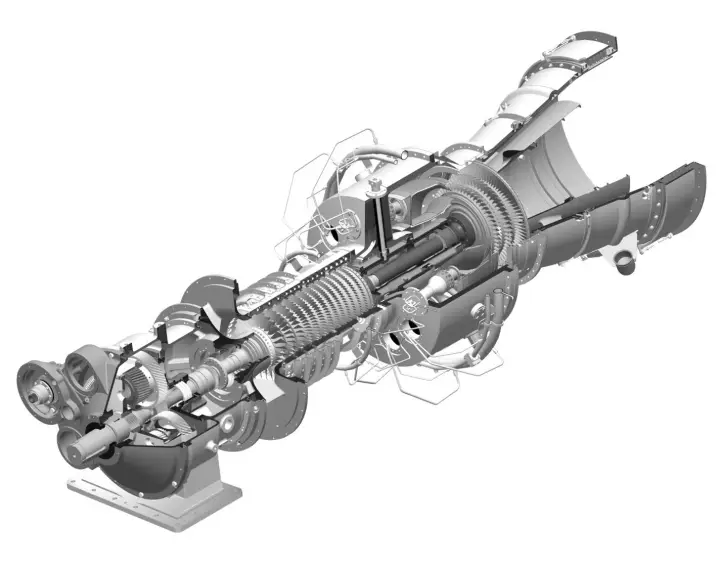
Solar Turbines Taurus 65 generator set, 6,500 kWe ISO base load; does not share a gas producer or turbine with the Taurus 60
This model is part of SecondWatt’s gas turbine research catalogue. Specifications and price observations are included where supported by sources. Equipment availability and commercial terms require confirmation.
Solar Turbines Taurus 65 gas turbine: 6,500 kWe ISO rating, family-lineage detail versus Taurus 60 and 70, overhaul guidance, and used-market pricing.
The Taurus 65 is Solar Turbines' newest and most efficient Taurus-family power-generation package, rated 6,500 kWe ISO base load at 10,945 kJ/kWh (10,375 Btu/kWh) heat rate, roughly 33% thermal efficiency. Introduced in 2006, it sits one output class above the higher-volume Taurus 60 and below the larger Taurus 70, and its OEM-documented design lineage answers the question a buyer cross-shopping the family actually needs answered: which machines share parts.
Per Solar's own 2008 ASME conference paper introducing the model, the Taurus 65's gas producer is an enhanced version of the Centaur 50 air compressor, while its turbine section is a newly designed three-stage turbine similar to the Taurus 70 turbine design. That means Taurus 65 is not a re-rated Taurus 60; it shares no gas producer or turbine with Taurus 60 despite the adjacent output class and shared family name, and hot-section parts do not cross over between them.
SoLoNOx (DLE) combustion is the only system listed on the current OEM page, with no Conventional alternative mentioned, unlike Taurus 60's page. No Taurus 65 appears in the state and federal air-permit dockets that document Taurus 60 and Taurus 70 installations, a signal of the thinner regulatory paper trail behind this newer model. The secondary market is thin to match: a MachineryTrader page listing 12 Solar Turbines units carried no Taurus 65 at all, and the only two published asking prices come from a single European marketplace.
Why it matters
A buyer assuming Taurus 60 and Taurus 65 share spares or an overhaul vendor because they carry the same family name is wrong, and that assumption costs money. Solar's own 2008 introduction paper documents an enhanced Centaur 50 compressor paired with a new three-stage turbine similar to Taurus 70's, not a Taurus 60 derivative. Planning a used-Taurus-65 overhaul against Taurus 60 parts availability or lead times will produce the wrong budget and the wrong timeline.
Who buys it
Oil and gas and industrial cogeneration operators buying new capacity choose Taurus 65 over Taurus 60 specifically for the efficiency gain, roughly 33% versus 31.5%, when fuel cost over the machine's life outweighs the lower acquisition liquidity. Used-equipment buyers are a much thinner segment than for Taurus 60, reflecting the newer design's smaller installed base and shorter time in the field since its 2006 introduction.
Role in the data center
Bridge or prime power block of roughly 6.5 MW per generator-set unit, chosen over the Taurus 60 when fuel cost over the machine's life outweighs acquisition liquidity: about 33% thermal efficiency against the Taurus 60's 31.5%. The trade is availability, since the used fleet is far thinner and the units that do surface are held by European brokers.
Key specifications
| ISO base-load electrical output | 6,500 kWe |
|---|---|
| Heat rate | 10,945 (10,375) kJ/kWh (Btu/kWh) |
| Thermal efficiency | approximately 33 % |
| Exhaust flow | 75,950 (167,440) kg/hr (lb/hr) |
| Exhaust temperature | 550 (1020) C (F) |
| Combustion system | SoLoNOx (DLE) system |
| Year introduced (OEM catalog) | 2006 year |
| Gas-producer lineage | enhanced Centaur 50 air compressor description |
| Turbine-section lineage | new 3-stage turbine, similar to Taurus 70 description |
Technical summary
ISO base-load output, generator set: 6,500 kWe. Heat rate: 10,945 kJ/kWh (10,375 Btu/kWh). Thermal efficiency (computed / OEM paper): approximately 33%. Exhaust flow / temperature: 75,950 kg/hr at 550 C (1020 F). Combustion system: SoLoNOx (DLE), no Conventional option listed. Gas producer lineage: enhanced Centaur 50 air compressor. Turbine lineage: new 3-stage turbine, similar to Taurus 70's design. Introduction: 2006 (OEM); ASME conference paper GT2008.
Major variations
Solar publishes a power-generation package for the Taurus 65; Solar publishes no mechanical-drive specification for the Taurus 65 on its current product pages, so a mechanical-drive configuration should be confirmed with Solar rather than assumed from the family pattern. SoLoNOx (DLE) is the only combustion system named on the current product page, with no Conventional alternative listed, a contrast with the Taurus 60 page that names both. That single-combustor listing is consistent with the model's 2006 introduction, after SoLoNOx had become Solar's default across new production.
Compatibility and dependencies
Taurus 65 shares no gas producer or turbine with the Taurus 60, per Solar's own 2008 ASME introduction paper: its compressor is an enhanced Centaur 50 core, and its turbine is a new three-stage design similar to the Taurus 70's. Hot-section parts, meaning blades, nozzles, and combustor liners, do not cross over between Taurus 60 and Taurus 65 despite the adjacent naming. Solar publishes nothing on whether the Taurus 65 package shares the Taurus 60 skid footprint or enclosure, so a site-retrofit plan should not assume it does.
Pricing and availability
Market price (seller asking and transaction prices from the last 24 months, one value per seller; not a quote). used, genset package: $417–$447 per kW ($2.63M–$2.82M per unit, at 6.3 MW), 2 sellers, latest Sep 2026, includes undated listings. Lead time, new: 36-60 months as of August 2026, per broader Solar and Caterpillar order-book conditions; confirm against Solar or an authorized distributor. Lead time, used or refurbished: Thin: three units total were on offer worldwide in August 2026, two of them priced, all held by European brokers.
Supply, delivery and overhaul
1 units listed without public prices.
- Manufacturer-wide delivery estimate: 29 months
Lifecycle and maintenance
Solar Turbines cites more than 30,000 overhauls completed fleet-wide, but publishes no Taurus 65-specific fired-hour interval for hot-section inspection or major overhaul, and no overhaul cost. One unit on the market shows 2,700 hours logged since a 2022 turbine and gearbox rebuild against 80,200 total package hours, implying the package and generator run several times longer between major work than the turbine core itself. Treat that as one observed data point rather than an interval.
Thermal and emissions profile
Solar publishes no Taurus 65-specific NOx or CO figure in ppmvd, and no installed Taurus 65 appears in the state and federal air-permit dockets that document Taurus 60 and Taurus 70 units. The OEM's current product page lists SoLoNOx (DLE) as the only combustion system for the Taurus 65, with no Conventional option mentioned, unlike the Taurus 60 page. The best available proxy is Solar's fleet-wide current-generation guarantee of 9 ppm NOx, 15 ppm CO, and 15 ppm UHC on natural gas, offered as a standard option across most currently manufactured models. The Taurus 65 remains in production, so that figure plausibly applies, but it is a portfolio-wide guarantee rather than a model-specific one and should be confirmed with Solar before a permit application relies on it.
Common failure points
- 3-stage turbine hot section (blades/nozzles) — coating loss or cracking on a design with a shorter field history than Taurus 60's turbine
- Combustor liner and SoLoNOx fuel injectors — NOx/CO drift between tests or visible injector coking
- Centaur-50-derived compressor section — VIGV actuator lag, fouling, or erosion affecting part-load efficiency
- Reduction gearbox — rising vibration or metal in oil analysis; at least one market unit shows a full gearbox rebuild alongside the turbine
- Generator windings and bearings (Leroy Somer on listed used units) — falling insulation resistance or bearing temperature rise
- Control and protection system — obsolete panel hardware limiting remote monitoring or parts support
- Independent parts sourcing for the turbine section — extended lead time versus Taurus 60 due to a thinner secondary market
Inspection checklist
Start count and cycling history: request this explicitly, since Taurus 65 listings disclose start counts far less often than Taurus 60 listings do. Borescope report from a Solar Turbines field service representative, covering all 3 stages of the turbine section the Taurus 65 does not share with the Taurus 60. Turbine blade and nozzle condition across all 3 power-turbine stages, the newer turbine-section design introduced with this model in 2006. Compressor condition: fouling, VIGV wear, and erosion on the Centaur-50-derived core, a lineage distinct from the Taurus 60's own 12-stage compressor.
Procurement channels
A MachineryTrader results page listing 12 Solar Turbines units, spanning Centaur 50, Taurus 60, Taurus 70, and Titan 130, carried no Taurus 65 at all, direct evidence of a markedly thinner secondary market than the Taurus 60's. Kitmondo, a European used-turbine marketplace, carried the only 3 Taurus 65 units on offer in August 2026: two with published EUR asking prices and one at contact for pricing. resale.info showed one further unit at around 125,000 hours, also contact for pricing.
Regional notes
The only Taurus 65 units on offer in August 2026 were held by European brokers in Turkey and Portugal, with no US-based listing on any broker channel. That contrasts with the Taurus 60, whose resale listings span the United States, Belgium, and China, and it means a US buyer should price transatlantic freight, 50 Hz to 60 Hz suitability, and import handling into any comparison against a domestically held frame.
Content owner: Gary Martin, SecondWatt