ABB GT11
Manufacturer: ABB
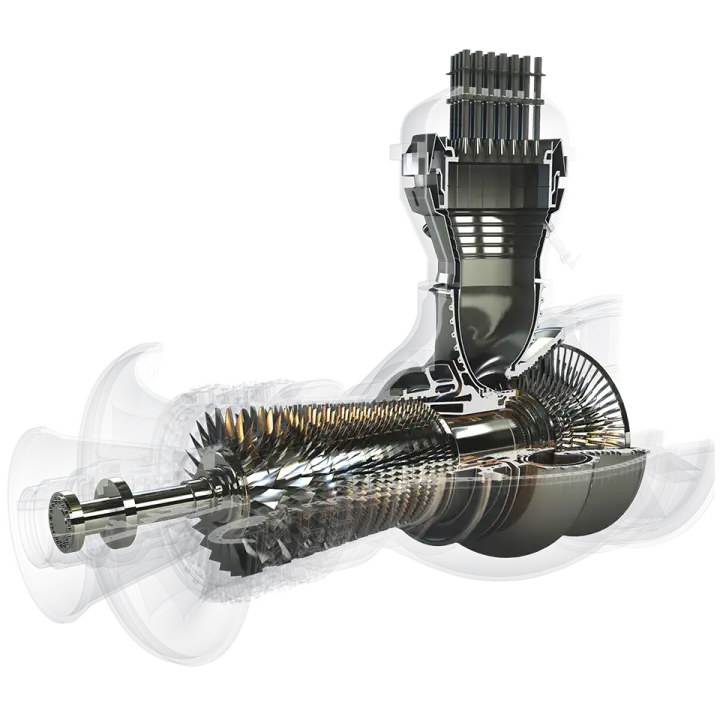
Brown Boveri's 60 Hz heavy-duty gas turbine family, from 1971-era peakers near 50 MW to the 115 MW GT11N2.
This model is part of SecondWatt’s gas turbine research catalogue. Specifications and price observations are included where supported by sources. Equipment availability and commercial terms require confirmation.
ABB GT11 heavy-duty gas turbine family: GT11C, D, D5, N and N2 ratings, fuel and NOx data, upgrade paths and fleet support from ASME, NETL and GE Vernova.
The ABB GT11 is the 60 Hz heavy-duty gas turbine family that Brown Boveri introduced to the market in 1971, with the 50 Hz GT13 as its sibling (ASME 98-GT-219). The first GT11 ran at Rainbow Lake, Canada, in 1970 at 32 MW and 3,600 rpm (POWER). By 1998 ABB counted 111 GT11D and 87 GT11N machines in simple-cycle and combined-cycle service (ASME 98-GT-219).
The GT11D5 is rated 73.3 MW at 31.4% efficiency and the GT11N 81.8 MW at 32.1% (ASME 98-GT-219). The GT11N2, introduced in 1993, delivers 115.4 MW gross at 33.6% efficiency and 10,150 Btu/kWh at ISO on natural gas at 60 Hz (NETL). Early-1970s GT11C and GT11D units carry nameplates of 48 MW and 52 MW with 13.8 kV air-cooled generators at 3,600 rpm (nameplate record).
The fleet passed from BBC to ABB in 1988, to Alstom in 2000 and to GE in 2015 (POWER). GE Vernova lists GT11D, GT11N and GT11N2 in its upgrade catalog, with a GT11DM turbine upgrade and a GT11N2 M package that extends service intervals to 48,000 equivalent operating hours (GE Vernova, GE Vernova).
Why it matters
Two facts define the GT11 for a buyer of used capacity. GE Vernova still catalogs upgrades for the GT11D, GT11N and GT11N2 (GE Vernova), and an independent provider has published a life-extension repair program for GT11D hot-section parts (EthosEnergy). About 200 machines were in service by 1998, which is the pool from which retired units come to market (ASME 98-GT-219).
Who buys it
Utilities and independent power producers run GT11 units in peaking and combined-cycle service; Taiwan Power Company operates 3 GT11D, 6 GT11NM and 2 GT11N2 across four combined-cycle blocks at Tung Hsiao (Alstom). GT11D fleets have operated on heavy fuel oil (EthosEnergy).
Key specifications
| Market introduction | 1971 |
|---|---|
| First unit | Rainbow Lake, Canada, 1970; 32 MW; 3,600 rpm |
| Fleet in operation, 1998 | 111 GT11D (from 1971); 87 GT11N (from 1987) units |
| GT11D5 output | 73.3 MW |
| GT11D5 efficiency | 31.4 % |
| GT11N output | 81.8 MW |
| GT11N efficiency | 32.1 % |
| GT11N2 gross output, 60 Hz, ISO | 115.4 MW |
| GT11N2 gross efficiency, 60 Hz, ISO | 33.6 % |
| GT11N2 gross heat rate, 60 Hz, ISO | 10,150 Btu/kWh |
| GT11N2 compressor pressure ratio | 15.5:1 |
| GT11N2 exhaust gas flow | 399 kg/s |
| GT11N2 exhaust gas temperature | 531 °C |
| GT11N2 NOx, natural gas, 15% O2 dry | < 25 vppm |
| GT11N2 NOx, #2 fuel oil, 15% O2 dry | 42 ppm |
| GT11N2 gross output, 50 Hz, ISO | 113.6 MW |
| GT11N2 gross efficiency, 50 Hz, ISO | 33.1 % |
| GT11N2 turbine footprint | about 10 × 5 m |
| GT11C nameplate, 1970s units | 48 MW |
| GT11D nameplate, 1970s units | 52 MW |
| Generator, 1970s units | 13.8 kV, air-cooled, brushless excitation, 3,600 rpm |
| GT11N2 M upgrade, service interval | up to 48,000 EOH |
| GT11N2 M upgrade, added output | up to 15 MW |
| GT11D on heavy fuel oil, row-1 erosion | about 5,000 EOH |
Major variations
GT11C and GT11D, 1971 onward: early units with nameplates of 48 MW and 52 MW (nameplate record). GT11D5: 73.3 MW at 31.4% efficiency (ASME 98-GT-219). GT11N, 1987: 81.8 MW at 32.1%; GT11NM: the 1998 uprate with a new turbine module (ASME 98-GT-219). GT11N2, 1993: 115.4 MW gross at 33.6%, 15.5:1 pressure ratio, 399 kg/s exhaust at 531 °C at 60 Hz, and 113.6 MW at 33.1% at 50 Hz (NETL).
Configurations and options
Simple cycle and combined cycle; Tung Hsiao pairs eleven GT11 units with four steam turbines across four blocks (Alstom). The GT11N2 SB combustor runs on natural gas or #2 oil, with an oil-dry mode at elevated NOx and water injection for peaking power at a fuel-to-water ratio of up to 2.2 (Alstom performance sheet). GE Vernova's GT11N2 M upgrade offers three switchable operating modes that trade lifetime against output (GE Vernova).
Compatibility and dependencies
The GT11 is the 60 Hz, 3,600 rpm member of the family; the GT13 is the 50 Hz sibling (POWER). 1970s units drive 13.8 kV air-cooled generators with brushless excitation (nameplate record). Liquid-fuel operation including heavy fuel oil is documented on GT11D fleets (EthosEnergy), and the GT11N2 is rated on natural gas and #2 oil (Alstom performance sheet).
Lifecycle and maintenance
ABB's 1998 uprating program replaced the turbine module of GT11N and GT11D5 machines to raise output and efficiency while holding reliability, availability and maintainability (ASME 98-GT-219). GE Vernova's GT11N2 M upgrade extends service intervals to up to 48,000 equivalent operating hours (GE Vernova). On a heavy-fuel-oil GT11D fleet, row-1 blades and vanes eroded at the leading edge and failed around 5,000 equivalent operating hours, traced to fuel contaminants and base-material overheating, and were returned to service under a repair and coating program (EthosEnergy).
Thermal and emissions profile
GT11N2 on natural gas: NOx below 25 vppm at 15% O2 dry at ISO; on #2 oil, 42 ppm, with an oil-dry operating mode at elevated NOx (NETL, Alstom performance sheet). GT11D fleets have run on heavy fuel oil (EthosEnergy).
Common failure points
- Row-1 turbine blades and vanes, GT11D on heavy fuel oil — Leading-edge erosion and oxidation; failures around 5,000 equivalent operating hours
Inspection checklist
Row-1 blade and vane leading edges for erosion and oxidation, especially on liquid-fuel units (EthosEnergy). Fuel contaminant history and fuel treatment on oil-fired units (EthosEnergy). Equivalent operating hours against the unit's service interval; upgraded GT11N2 units run to 48,000 EOH (GE Vernova). Generator voltage, cooling and excitation type on 1970s units (nameplate record).
Procurement channels
GE Vernova catalogs upgrades for GT11D, GT11N and GT11N2 (GE Vernova). EthosEnergy provides life-extension parts and repair for the GT11D (EthosEnergy). Used GT11 units appear on industrial surplus marketplaces (Surplus Record).
Regional notes
The GT11 is the 60 Hz member of the family, and NETL lists GT11N2 ratings at both 60 Hz and 50 Hz (NETL). Fleets operate in North America, where the first unit ran in 1970 (POWER), and in Taiwan at Tung Hsiao (Alstom).
Content owner: Gary Martin, SecondWatt