GE Frame 9E Gas Turbines (9E.03, 9E.04, Frame 9/1E)
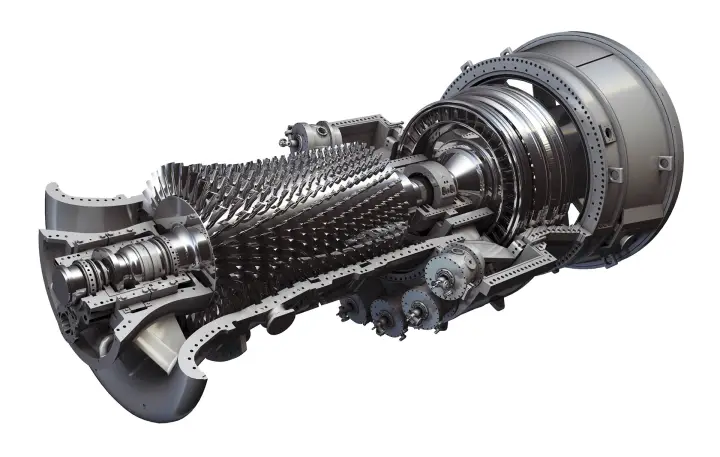
50 Hz E-class heavy-duty gas turbine: 132 MW 9E.03 and 147 MW 9E.04 per GE Vernova, 10-minute hot start and more than 50 fuels.
This model is part of SecondWatt’s gas turbine research catalogue. Specifications and price observations are included where supported by sources. Equipment availability and commercial terms require confirmation.
GE Frame 9E gas turbine: GE Vernova 9E.03 at 132 MW and 9E.04 at 147 MW, Baker Hughes Frame 9/1E, 50 Hz ratings, combined cycle and fuel options.
The Frame 9E (MS9001E) is GE's 50 Hz E-class heavy-duty gas turbine, a single-shaft machine driving its generator directly at 3,000 rpm. GE Vernova sells two current versions: the 9E.03, rated 132 MW net at 34.3% LHV (9,960 Btu/kWh) in simple cycle, and the 9E.04, rated 147 MW at 37.0% (9,233 Btu/kWh), which adds a 4-stage turbine module that fits the footprint of an installed 9E. Both are rated at ISO conditions on natural gas with a 10-minute hot start; combined-cycle plants reach 205-218 MW (1x1) and 412-439 MW (2x1) at 53.1-55.3%.
Baker Hughes builds the Frame 9/1E at 132 MW and 34.6% with 5 ppm NOx on DLN1+, a 17-stage compressor at a 13.1 pressure ratio, 14 reverse-flow combustion chambers and three turbine stages with air-cooled first- and second-stage nozzles and buckets. GE Vernova states the 9E runs on more than 52 types of fuel and can switch fuels under full load, and cites up to 100% hydrogen capability.
Baker Hughes uses the 9/1E for LNG mechanical drive (Qatargas and RasGas at Ras Laffan) and power-generation modules (Gorgon), and reports more than 700 units installed. The 9E is the 50 Hz counterpart of the 60 Hz 7EA and a different class from the 9HA.
Why it matters
The 9E combines 132-147 MW blocks, a 10-minute hot start and 42-50 MW/min ramp rates per GE Vernova with more than 52 fuel types and a large installed base. Assessment: the 9E.04's 37.0% simple-cycle efficiency narrows the gap to newer machines, and the upgrade fits existing 9E footprints; it is a 50 Hz product, so 60 Hz projects look to the 7EA.
Who buys it
Utilities and independent power producers in 50 Hz markets running simple-cycle, combined-cycle and cogeneration plants, industrial sites with low-grade or variable fuels, and LNG developers using the Baker Hughes Frame 9/1E as a compressor driver. Baker Hughes lists grid support, peaking, cyclic and base-load operating modes.
Role in the data center
Assessment: in 50 Hz markets, a 132-147 MW block for large campuses, usually in combined cycle; two units cover a 250-300 MW phase with no granular N+1. The 10-minute hot start and 42-50 MW/min ramp per GE Vernova support load following and grid support.
Key specifications
| Simple-cycle net output, 9E.03 / 9E.04, 50 Hz (GE Vernova) | 132 / 147 MW |
|---|---|
| Simple-cycle net heat rate, 9E.03 / 9E.04, LHV (GE Vernova) | 9,960 / 9,233 Btu/kWh |
| Simple-cycle net heat rate, 9E.03 / 9E.04, LHV (GE Vernova) | 10,508 / 9,741 kJ/kWh |
| Simple-cycle net efficiency, 9E.03 / 9E.04, LHV (GE Vernova) | 34.3 / 37.0 % |
| Ramp rate, 9E.03 / 9E.04 (GE Vernova) | 50 / 42 MW/min |
| Hot start, rapid response (GE Vernova) | 10 minutes |
| 1x1 combined-cycle net output, 9E.03 / 9E.04 (GE Vernova) | 205 / 218 MW |
| 1x1 combined-cycle net efficiency, 9E.03 / 9E.04 (GE Vernova) | 53.1 / 55.0 % |
| 2x1 combined-cycle net output, 9E.03 / 9E.04 (GE Vernova) | 412 / 439 MW |
| 2x1 combined-cycle net efficiency, 9E.03 / 9E.04 (GE Vernova) | 53.5 / 55.3 % |
| NOx / CO with ultra-low NOx option (GE Vernova) | 5 / 25 ppm |
| Fuel types burned (GE Vernova) | more than 52 fuels |
| Hydrogen capability (GE Vernova) | up to 100 % |
| 9E.04 turbine module (GE Vernova) | 4 stages |
| Output, Frame 9/1E, DLN1+, ISO (Baker Hughes) | 132 MW |
| Efficiency, Frame 9/1E (Baker Hughes) | 34.6 % |
| NOx, DLN1+ (Baker Hughes) | 5 ppm |
| Exhaust temperature (Baker Hughes) | 544 C |
| Shaft speed, direct drive (Baker Hughes) | 3000 rpm |
| Compressor stages / pressure ratio (Baker Hughes) | 17 / 13.1:1 stages / ratio |
| Combustion chambers, reverse flow (Baker Hughes) | 14 chambers |
| Hot-gas-path / major inspection (Baker Hughes) | 32,000 / 64,000 hours |
| Mean time between maintenance (Baker Hughes) | 32,000 or 1,300 factored fired hours or factored fired starts |
| Power-generation skids, GT / aux / generator, weight (Baker Hughes) | 220,000 / 45,000 / 207,000 kg |
| Units installed worldwide (Baker Hughes) | more than 700 units |
Technical summary
GE Vernova rates the 9E.03 at 132 MW net, 9,960 Btu/kWh (10,508 kJ/kWh) and 34.3% LHV, and the 9E.04 at 147 MW, 9,233 Btu/kWh (9,741 kJ/kWh) and 37.0%, at ISO conditions on natural gas, 50 Hz, with ramp rates of 50 and 42 MW/min and a 10-minute hot start. Combined cycle reaches 205 and 218 MW at 53.1% and 55.0% (1x1) and 412 and 439 MW at 53.5% and 55.3% (2x1). Baker Hughes rates the Frame 9/1E at 132 MW and 34.6% with 5 ppm NOx, 544 C exhaust and 3,000 rpm direct drive; the 17-stage compressor runs at 13.1:1 and the turbine has three stages. Baker Hughes gives hot-gas-path and major inspections at 32,000 and 64,000 hours.
Major variations
GE Vernova offers the 9E.03 (132 MW) and the 9E.04 (147 MW), whose newer 4-stage turbine module fits within the footprint of an installed 9E, so existing units can be upgraded. Baker Hughes offers the Frame 9/1E (132 MW) in power-generation and mechanical-drive packages with standard or DLN1+ combustion and a syngas option. GE Vernova's 5 ppm NOx figure assumes its ultra-low NOx option. The 9E is distinct from the 60 Hz Frame 7EA and from the 9HA H-class.
Configurations and options
Plants are built in simple cycle, 1x1 or 2x1 combined cycle, or cogeneration. Options that change price or lead time are the combustion system (standard, DLN1+ or ultra-low NOx), fuel systems for liquid, process or syngas fuels, the hydrogen case, the 9E.03 or 9E.04 rating, and for mechanical drive the compressor and helper skid. Baker Hughes' power-generation package is a gas-turbine skid, an auxiliary skid and a generator skid.
Compatibility and dependencies
Direct drive at 3,000 rpm serves 50 Hz grids without a load gearbox. Fuel systems must match the intended fuels, from natural gas to crude, residual and process gases. Baker Hughes' gas-turbine skid weighs 220,000 kg and its generator skid 207,000 kg, which sets heavy-lift and transport requirements, and combined-cycle plants need a heat recovery steam generator and steam turbine.
Planning price band
Modelled planning estimate: $0.15M–$0.66M/MW · $150–$660/kW · $19.8M–$87.12M per unit (9E.03 (simple cycle, 50 Hz), 132 MW; Used or refurbished, serviceable; very low confidence; gt-planning-v3, as of 2026-11-03). Private market information available. Not a quote or an observed sale price. Gas turbine generator-set package. Included auxiliaries, controls, emissions equipment (SCR), warranty and delivery terms vary by unit and are subject to confirmation. Not a project budget: BOP, installation and financing sit outside this band.
50 Hz E-class frame; same positioning as 7E. Private market information available.
What drives the price
New versus used; model (9E.03, 9E.04, Frame 9/1E or older 9E); combustor and fuel systems; fired hours, starts and rotor life; controls generation; simple-cycle or combined-cycle scope; heavy-lift transport and installation scope.
Lifecycle and maintenance
Baker Hughes rates its Frame 9/1E at 32,000 hours to hot-gas-path inspection and 64,000 hours to major inspection, with a mean time between maintenance of 32,000 factored fired hours or 1,300 factored fired starts. GE Vernova's 9E fact sheet does not state inspection intervals as of October 2026. The 9E.04 turbine module is designed to fit an installed 9E footprint, which makes upgrade-at-overhaul possible.
Thermal and emissions profile
GE Vernova cites 5 ppm NOx and 25 ppm CO for the 9E with its ultra-low NOx option, and Baker Hughes rates its Frame 9/1E at 5 ppm NOx on DLN1+. GE Vernova states the 9E burns more than 52 fuel types and cites up to 100% hydrogen capability; Baker Hughes lists high-hydrogen refinery and petrochemical fuels and up to 100% hydrogen with the standard combustor.
Common failure points
- Combustion liners, transition pieces and fuel nozzles — Cracking, wear or combustion dynamics, worse on heavy or process fuels
- First- and second-stage nozzles and buckets — Coating loss, oxidation, cracking or creep
- Rotor — Life consumed against OEM limits on older units
- Compressor — Fouling, erosion or blade damage
- Generator — Insulation ageing
9E.03, 9E.04 and Frame 9/1E
- GE Vernova's 9E.03 (132 MW, 34.3%) and 9E.04 (147 MW, 37.0%) and Baker Hughes' Frame 9/1E (132 MW, 34.6%) are current builds of the MS9001E design on different rating boundaries. The 9E.04's 4-stage turbine module fits an installed 9E footprint.
- Identify the manufacturer, model, combustor and upgrade history of any offered unit from records.
Fuels, emissions and combined cycle
- GE Vernova states the 9E burns more than 52 fuel types and cites 5 ppm NOx with its ultra-low NOx option. Combined-cycle plants reach 205-218 MW (1x1) and 412-439 MW (2x1) at 53.1-55.3% per GE Vernova.
Compare offers on
- Equipment identity — Manufacturer and model (MS9001E, 9E.03, 9E.04 or Frame 9/1E), serial numbers, build year and upgrade history.
- Condition — Fired hours and starts, fuels burned, combustion, hot-gas-path and major inspection reports, rotor life consumed.
- Combustion and fuel — Combustor generation and NOx guarantee, fuel systems and hydrogen case.
- Included scope — Turbine, generator, controls, auxiliaries, inlet and exhaust systems, enclosure, transformers and spares.
- Commercial basis — Currency, per-unit or lot price, quotation date, validity, location and delivery responsibilities.
- Costs outside the offer — Dismantling, heavy-lift transport, foundations, heat recovery, interconnection, permits and commissioning.
Seller checklist
- Nameplate photographs for turbine, gearbox and generator with model, build standard and serial numbers
- Operating hours, fired starts and trip history
- Hot-gas-path and major inspection reports with dates and findings
- Borescope reports and images
- Combustor configuration, fuel-system scope and any emissions test data
- Controls platform, software licences and drawings
- Generator test results and gearbox inspection records
- Service agreement status and transferability
- Preservation and storage records for stored units
- Included and excluded scope list with spares inventory
What sets the value
Value rests on records: nameplates and serial numbers, fired hours, starts and fuels burned, combustion, hot-gas-path and major inspection reports, rotor life records, combustor configuration with emissions tests, generator tests and controls upgrade history.
How much power does a Frame 9E produce?
GE Vernova rates the 9E.03 at 132 MW and the 9E.04 at 147 MW net in simple cycle at ISO conditions, 50 Hz; Baker Hughes rates its Frame 9/1E at 132 MW.
Can a 9E be used on a 60 Hz grid?
GE Vernova's 9E ratings are for 50 Hz, and Baker Hughes' Frame 9/1E drives its generator directly at 3,000 rpm for 50 Hz. The 60 Hz E-class machine is the Frame 7EA.
What fuels can a 9E burn?
GE Vernova states more than 52 fuel types, fuel switching under full load and up to 100% hydrogen capability; Baker Hughes lists syngas and process gas, distillate, crude and residual oil, and natural gas.
What are the 9E inspection intervals?
Baker Hughes rates its Frame 9/1E at 32,000 hours to hot-gas-path inspection and 64,000 hours to major inspection, with a mean time between maintenance of 32,000 factored fired hours or 1,300 factored fired starts.
Inspection checklist
Confirm the model (MS9001E, 9E.03, 9E.04 or Frame 9/1E), serial numbers, build year and manufacturer from the nameplates. Obtain fired hours, fired starts, fuels burned and trip history. Review combustion, hot-gas-path and major inspection reports and rotor life records. Identify the combustor and fuel systems. Check generator tests, vibration trends and controls generation. Agree acceptance criteria before payment.
Procurement channels
New units come from GE Vernova (9E.03, 9E.04) and Baker Hughes (Frame 9/1E, cited for LNG and power-generation modules). Assessment: used 9E units appear on the secondary market from retiring or repowering 50 Hz plants through dealers and brokers; confirm the manufacturer, combustor and upgrade history.
Regional notes
GE Vernova's 9E ratings are for 50 Hz, and Baker Hughes' Frame 9/1E drives its generator directly at 3,000 rpm for 50 Hz without a load gearbox. Baker Hughes cites installations at Ras Laffan in Qatar and the Gorgon project in Western Australia. Emissions limits follow the receiving country's permit regime.
Content owner: Gary Martin, SecondWatt