Solar Turbines Centaur 50
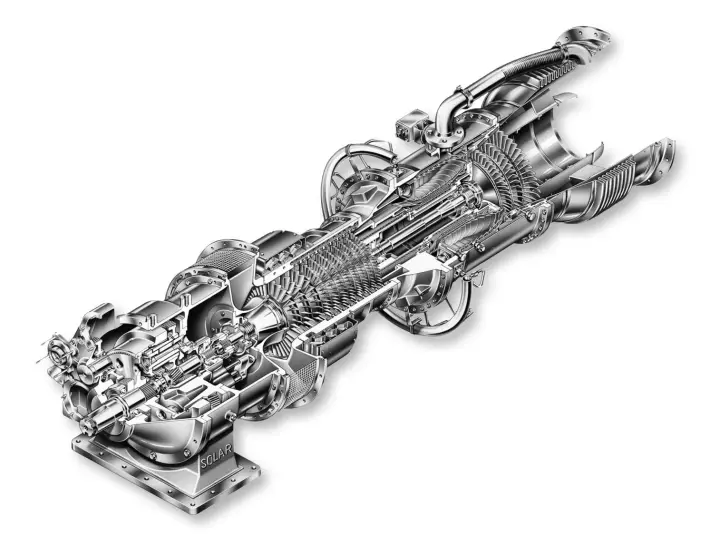
4,600 kWe ISO base-load generator set on the shared Centaur 40 and Taurus 60 skid, with a 21% ambient output swing
This model is part of SecondWatt’s gas turbine research catalogue. Specifications and price observations are included where supported by sources. Equipment availability and commercial terms require confirmation.
Solar Turbines Centaur 50 gas turbine: 4,600 kWe ISO rating, ambient derate data, SoLoNOx and BACT emissions figures, and verified used-market pricing.
The Centaur 50 is Solar Turbines' next step up from the Centaur 40: a single-shaft industrial gas turbine, main reduction gearbox, and synchronous generator with a permanent-magnet exciter, built onto one skid-mounted enclosure and rated 4,600 kWe ISO base load at 11,630 Btu/kWe-hr and 29.3% thermal efficiency. It shares its common engine skid with the Centaur 40 and Taurus 60, and the OEM's own ambient-temperature derate curve shows output swinging from roughly 5,100 kWe at -30C down to roughly 4,200 kWe at +45C, a spread on the order of 21% from cold to hot extremes.
Used-market listings surface at least three legacy nameplates converging on this same power class: T4501 on rebuilt 4,000 kW units, Type H / GSI-CH-ID on 1986-built 4,000 kW units, and EH-5701-59 on rebuilt 3,800 kW units, all sold as "Centaur 50" without a published OEM crosswalk connecting the designations. One T4501 listing states outright "Not SoloNox," a real flag that a meaningful share of the used fleet predates Solar's 1992 SoLoNOx rollout.
A California BACT permit for this model, using water injection plus SCR rather than SoLoNOx, runs 9 ppmvd NOx permitted and 4.2 ppmvd achieved, against a federal NSPS floor of 25 ppm for the >50 MMBtu/hr bin this frame falls into. Three published prices attach to this model: a $250,000 used unit near $58/kW, a $2,700,000 new/crated unit near $587/kW, and a euro-denominated rebuilt unit offered by a European broker. Solar publishes no overhaul interval in fired hours for this model; field-observed hours since rebuild ranged from roughly 3,000 to over 40,000 across used units.
Why it matters
The published ambient-temperature derate curve is the number a hot-climate buyer needs before sizing a site around the 4,600 kWe ISO nameplate: output falls to roughly 4,200 kWe at +45C, on the order of a 21% swing from the cold-ambient end of the curve. Layer in a used fleet where a real share of units predate 1992 SoLoNOx availability, evidenced by a broker listing that states "Not SoloNox" outright, and both sizing and permitting risk run higher than the nameplate alone suggests.
Who buys it
Oil and gas operators, industrial cogeneration sites, and data center developers who need more output than a Centaur 40 but cannot wait on a Taurus- or Mars-class order buy the Centaur 50 for its combination of a proven, well-parted small frame and above-average used-market depth relative to larger Solar packages. It is a common step-up choice for a buyer already standardizing on the shared Centaur/Taurus 60 skid family.
Role in the data center
Bridge or prime power block of about 4.6 MW per generator-set unit at ISO, feeding campus medium-voltage switchgear in multi-unit rows. Size the block off the derate curve rather than the nameplate: output falls to roughly 4,200 kWe at +45C, so a hot-site block needs unit count set against the warm-ambient figure, not the 4,600 kWe ISO rating.
Key specifications
| ISO electrical output | 4600 kWe |
|---|---|
| Heat rate | 11,630 (12,270) Btu/kWe-hr (kJ/kWe-hr) |
| Thermal efficiency | 29.3 % |
| Pressure ratio | 10.6 :1 |
| Exhaust flow | 151,410 (68,680) lb/hr (kg/hr) |
| Exhaust temperature | 950 (510) F (C) |
| Ambient derate, -30C to +45C | approx. 5,100 down to approx. 4,200 kWe |
| Main reduction drive output speed | 1500 / 1800 rpm (50 Hz / 60 Hz) |
| Generator configuration | 4-pole, 3-phase, 6-wire, wye, synchronous with PMG exciter description |
| Generator voltage, 60 Hz | 4160 / 6900 / 12,470 / 13,200 / 13,800 V |
| Generator voltage, 50 Hz | 3300 / 6600 / 11,000 V |
| Package weight | 83,300 (37,785) lb (kg) |
| Package height | 10'5" (3.2) ft-in (m) |
| SoLoNOx emissions warranty | 9 NOx / 15 CO / 15 UHC ppm |
| California BACT limit with water injection + SCR, Caltech | 9 NOx / 20 CO permit; 4.2 NOx / 46 CO achieved ppmvd @ 15% O2 |
Technical summary
ISO base-load electrical output: 4,600 kWe. Heat rate: 11,630 Btu/kWe-hr (12,270 kJ/kWe-hr). Thermal efficiency: 29.3%. Pressure ratio: 10.6:1. Exhaust flow / temperature: 151,410 lb/hr (68,680 kg/hr) at 950F (510C). Ambient derate: approximately 5,100 kWe at -30C to approximately 4,200 kWe at +45C. Combustion system: SoLoNOx (DLE) or conventional, factory option. SoLoNOx emissions warranty: 9 ppm NOx / 15 ppm CO / 15 ppm UHC. Main reduction drive output speed: 1,500 / 1,800 rpm (50 / 60 Hz). Package weight / height: 83,300 lb (37,785 kg) / 10'5" (3.2 m). Legacy nameplates in the used fleet: T4501, Type H / GSI-CH-ID, EH-5701-59.
Major variations
Used-market listings surface at least three legacy nameplates converging on this same power class: T4501 (or Centaur-T4501) on rebuilt 4,000 kW / 13,800 V units, with one listing stating explicitly "Not SoloNox"; Type H / GSI-CH-ID on separate 1986-built 4,000 kW units marketed under both that tag and "Solar Centaur 50" by the same broker; and EH-5701-59 on rebuilt 3,800 kW units from a different dealer. Solar publishes no crosswalk connecting T4501, Type H, or EH-5701-59 to the Centaur 50 name; the connection rests on their 3,800 to 4,600 kW ratings and consistent broker usage rather than on an OEM document, so confirm the engine designation with Solar before purchase.
Configurations and options
Combustion is ordered as SoLoNOx, a factory option since 1992 carrying a 9 ppm NOx / 15 ppm CO / 15 ppm UHC warranty, or as a conventional combustor; a large share of the used fleet predates 1992 and one broker listing states "Not SoloNox" outright. The reduction drive is built for 1,500 rpm (50 Hz) or 1,800 rpm (60 Hz) output, with generator voltage options of 4,160, 6,900, 12,470, 13,200 or 13,800 V at 60 Hz and 3,300, 6,600 or 11,000 V at 50 Hz. The generator is a 4-pole, 3-phase, 6-wire wye synchronous machine with a permanent-magnet exciter.
Compatibility and dependencies
The Centaur 50 generator set shares its common engine skid and 1500/1800 rpm reduction-gearbox family with the Centaur 40 and Taurus 60, per Solar's own product page and confirmed by EthosEnergy's service scope for the three models together. Package height is identical, 3.2 m / 10'5", across Centaur 40 and Centaur 50, which broadens shared-component parts availability but not turbine hot-section parts, which do not cross over between the two ratings.
Pricing and availability
Published price range: $250,000 - $2,700,000. Trend: stable All three published prices for this model are 2026 snapshots from different sellers, with no earlier public price series for comparison. No public price series exists for this model, so no directional trend can be established as of August 2026. Lead time, new: 36-60 months as of August 2026, per broader Solar and Caterpillar order-book conditions; confirm against Solar or an authorized distributor. Lead time, used or refurbished: Weeks; the new/crated unit on offer in August 2026 was listed as immediately available, unused inventory. Warranty, used: As-is is the norm on broker listings, none of which published warranty terms; Solar's Pre-Owned Equipment program offers warranty reinstatement on units routed through the factory exchange channel.
Supply, delivery and overhaul
4 units listed without public prices.
- Manufacturer-wide delivery estimate: 29 months
Lifecycle and maintenance
Solar publishes no Centaur 50-specific hot section or major overhaul interval in fired hours, and no overhaul cost in dollars. Field evidence shows a wide range of hours since rebuild across the used fleet, from roughly 3,000 package hours on a 1986-built unit to over 40,000 hours since a 2007 rebuild, which suggests these engines run well past 40,000 hours between major work under Solar's program. Against a used-market price as low as 250,000 USD, an overhaul in the low-to-mid six figures consumes a far larger share of asset value on a machine this size than the same dollar overhaul on a 15 MW-plus frame.
Thermal and emissions profile
SoLoNOx has been a factory option since 1992, carrying a 9 ppm NOx / 15 ppm CO / 15 ppm UHC warranty on natural gas; one used listing states "Not SoloNox" outright, confirming pre-1992 conventional-combustion units remain in circulation. A California BACT permit for this exact model, using water injection plus SCR rather than SoLoNOx, runs 9 ppmvd NOx permitted and 4.2 ppmvd achieved at 15% O2, a different control path than the dry low-NOx combustor. Solar's published base-load figures put the Centaur 50 above the 50 MMBtu/hr line, in the federal 25 ppm NOx bin at 15% O2 rather than the 42 ppm bin its Centaur 40 sibling falls into. Much of the used fleet predates 1992, so combustion type and any retrofit history should be verified in writing.
Common failure points
- Combustor liner and fuel nozzles — elevated or uneven exhaust temperature spread across cans, visible coking on borescope
- Hot gas path blades and nozzles — coating spallation, tip rub marks, or cracking visible on borescope images
- Main reduction gearbox — rising bearing temperature or metal particulates in oil analysis
- Generator windings and PMG exciter — falling insulation-resistance trend or hot spots on thermal scan
- Water injection system on non-SoLoNOx units — nozzle plugging or inconsistent NOx control during operation
- Control console and Turbotronic electronics — obsolete card sets or no vendor firmware support on pre-2005 consoles
- Enclosure and inlet/exhaust ductwork — corrosion or acoustic panel degradation on outdoor-stored units
Inspection checklist
Total fired hours since new: used units on the market range from roughly 3,000 to over 40,000 hours since a rebuild, so ask for the actual number. Fired hours since the last hot section inspection: request the logged figure, not a verbal estimate. Total starts logged: one field listing showed 1,500 starts against 26,000 total hours, a meaningfully cyclic duty profile. Borescope images dated within the last 12 months: request the photo set itself, not a summary write-up. Combustion system type in writing: confirm SoLoNOx versus conventional, since a "Not SoloNox" tag on a listing is a real permitting flag. SoLoNOx conversion date if retrofitted: factory SoLoNOx was not standard across the line until 1992. Water injection or SCR hardware present: a non-SoLoNOx unit needs one of these to approach the 9 ppm NOx figure a SoLoNOx combustor meets on its own.
Procurement channels
Priced and unpriced listings for this model run through Salvex (trader-to-trader auction), Utility Warehouse, Phoenix Equipment, Surplus Record, Younes Bros, Industrial Motor Power Corporation, and Surplus Generation Equipment. Several dealers listed the same legacy-nameplate hardware (Type H, T4501) under different names, underscoring that a buyer needs to search multiple designations, not just Centaur 50, to see the full available inventory.
Regional notes
Documented examples include a Caltech campus installation in California, a St. Croix, US Virgin Islands cogeneration application, and multiple continental US used-equipment dealers, with no single region dominating. The California and Caribbean examples both sit in jurisdictions with stricter-than-federal NOx limits, which is where the pre-1992 combustion question decides whether a given unit is siteable.
Content owner: Gary Martin, SecondWatt