
A gas-turbine generating package combines a gas turbine, an electrical generator and the equipment in the supplier’s scope. It is not automatically a complete installed plant, and its advertised MW is not automatically power delivered to your site. Before ranking an existing-asset offer, establish what is included, where output is measured, which operating conditions apply, and whether the figure is indicative, tested or guaranteed. EPA’s package description and gross/net definitions explain why those distinctions matter.
Key takeaways
- A turbine supplies mechanical shaft power; a generator supplies electrical output. Confirm both identities in the offer.
- A package name does not establish the sale’s inclusions. The written equipment schedule separates purchased equipment from remaining plant work.
- Gross, net and export figures need a named measurement point. Deduct each applicable operating load or loss only once.
- Keep the rating’s conditions and footnotes attached. A reference rating does not establish output at the intended site.
- Tie condition and test records to the offered asset. A corrected test result is an adjustment to reference conditions, not evidence of physical restoration.
Use one rating sheet to compare offers#
Keep the supplier’s original rating sheet beside your comparison. Record the following for each offer; the linked explanations show how each field affects the decision. This is an acquisition-screening aid, not an acceptance standard.
| What to compare | Record or request | Why it matters |
|---|---|---|
| Equipment and supply | Turbine and generator identities; serial/configuration records; tagged inclusions, exclusions and interfaces. | Establishes what you are buying. |
| Generator rating | MW or MVA, power factor, voltage/frequency and generator capability information. | Prevents an apparent-power label from being treated as available MW. |
| Generating arrangement | Contributing units, heat-recovery/steam-cycle scope and operating case. | Separates a turbine’s output from a larger plant’s output. |
| Output boundary | Measurement point, delivery meter, operating auxiliary schedule, losses and shared-load allocations. | Shows which deductions remain. |
| Reference and site | Dated rating footnote; supplier/OEM site case and its inputs. | Makes the conditions behind the MW comparable. |
| Condition and status | Maintenance records; test date, measured and corrected results; written guarantee terms, if offered. | Distinguishes evidence about this asset from an indicative rating. |
Separate the turbine, generator and supplied package#
The gas turbine is the prime mover: it produces mechanical work that can drive an electrical generator. A mechanical-drive turbine can instead serve a shaft load without a generator, so “gas turbine” alone does not establish generating scope. DOE’s mechanism explanation and EPA’s turbine description make that distinction.
The generator connection may be direct or geared, as described in the NETL gas-turbine handbook, section 1.1. Confirm the offered arrangement; neither a gearbox nor an assumed gearbox loss belongs in every comparison.
MW measures real electrical power; MVA measures apparent power. Power factor is the ratio of real to apparent power for a given load and time, as defined in the EIA glossary: MW = MVA × power factor for that same operating case. An MVA nameplate alone cannot tell you the turbine’s available MW or the site’s deliverable power: request the applicable power factor and generator capability information instead of choosing a default.
“Package” also needs a written definition. Siemens Energy distinguishes package supply from broader plant offerings, while EPA’s 2015 catalogue, revised in 2017, describes a basic package and possible additional site systems. These are examples, not a universal bill of supply.
Ask for an equipment schedule that marks each item included, excluded or unconfirmed and identifies who supplies and connects it. Check the turbine’s supporting systems—starting, lubrication/cooling, inlet/exhaust and controls/protection—alongside plant interfaces such as fuel compression, switchgear and transformers. Balance of plant means the supporting plant systems around the generating equipment; the schedule shows which of those systems you still need to procure or integrate.
The generating arrangement matters just as much as the sale boundary. In combined cycle, turbine exhaust raises steam that contributes additional electricity through a steam cycle; a heat-recovery steam generator (HRSG) makes steam from exhaust heat but does not, by itself, establish a steam-turbine electrical contribution. EPA’s catalogue, section 3.3.1 explains the distinction. If an offer quotes plant output, identify every contributing generating unit and whether it is included in the sale; keep useful thermal output separate from electrical MW.
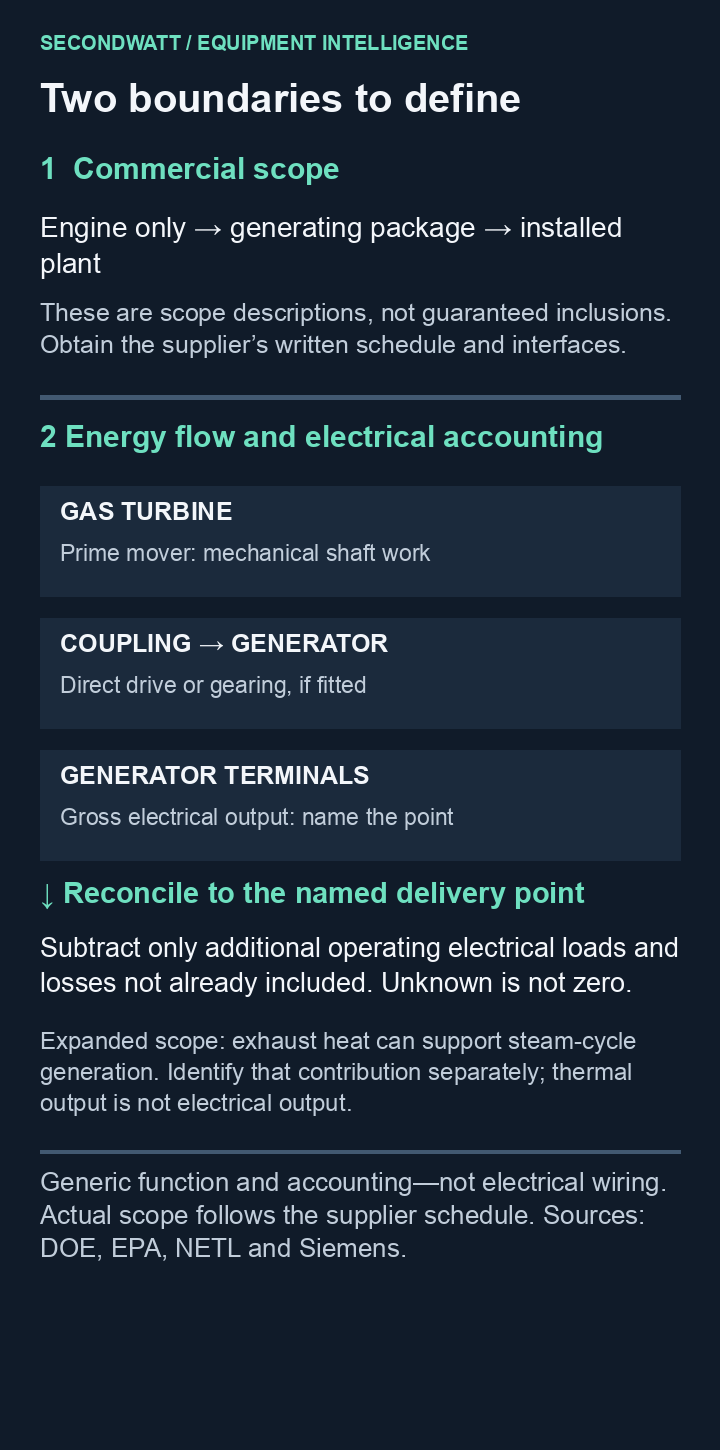
Name the electrical output boundary#
In EPA’s April 2024 technical definition, gross electrical output is measured at generator terminals; unit net output subtracts electricity used to operate the unit. That definition does not locate the final export meter or account for every downstream loss. For an export comparison, name the delivery meter and identify what lies between it and the quoted output point; this use of EPA’s definition makes no claim about current regulatory obligations.
Even a vendor’s “net plant” label needs its footnote. A September 2025 GE Vernova factsheet describes indicative net plant ratings at ISO conditions on natural gas, with inlet/exhaust losses included and balance-of-plant equipment excluded. The label therefore does not establish your complete site delivery boundary.
Ask your electrical engineer to mark the generator terminals and delivery meter on a single-line diagram, a simplified drawing of the electrical connections. Reconcile the operating loads and losses between those points, recording which are already deducted, which remain and which are unknown. Auxiliary loads are electricity used by supporting equipment, such as pumps and fans; an unknown deduction is not zero. NETL’s simple-cycle process documentation includes transformer losses in net-power accounting, but its study numbers and assumptions do not apply to an offered unit.
A gross and net description can lead to the same result#
Illustration only: every input and boundary below is invented. Assume one hypothetical turbine-generator, one unchanged operating case, no other generating units, and a delivery meter beyond the transformer. Assume 50.0 MW at generator terminals, 2.0 MW of total running auxiliary demand and 0.5 MW of transformer loss, with no other deductions before that meter.
- A gross description starts at 50.0 MW: 50.0 − 2.0 − 0.5 = 47.5 MW at the assumed meter.
- A net description of the same case already deducts the 2.0 MW auxiliaries, giving 48.0 MW: 48.0 − 0.5 = 47.5 MW at that meter.
The 50.0 and 48.0 MW labels describe different accounting points, not different equipment performance. These invented values are not typical auxiliary factors or a prediction for any asset. For a real “net” quote, the useful question is: “Which loads and losses have already been deducted, and what remains before our delivery meter?”
Start with a defined electrical output and subtract only additional deductions before the chosen point. Generator losses are already reflected in generator-terminal output; do not subtract them again, or deduct an all-in auxiliary total and its component losses a second time. Keep starting loads separate from running loads. Inlet/exhaust pressure effects belong in the supplier’s performance case, not in a list of electrical consumption.
A shared service can support several units, so its whole-plant load may differ from the portion assigned to the offered unit. Ask which equipment the service serves, what portion is assigned to this offer, and for the supplier or engineer’s documented basis for that allocation. If the basis is unresolved, keep the uncertainty open rather than choosing a percentage; deduct the assigned load only if it is not already included in the quoted output.
Keep the conditions with the rating#
A reference label such as ISO is incomplete without its footnote. A May 2025 Solar Turbines data sheet, for example, specifies 15°C, sea level, 60% relative humidity and a specified natural gas, excluding inlet/exhaust and accessory losses. Those qualifications describe that dated reference, not the offered asset’s site performance.
Higher inlet temperature and site altitude can reduce turbine output; inlet cooling changes air conditions as well as system loads. EPA’s environmental-effects discussion supports requesting a performance case for the intended installation from the supplier or original equipment manufacturer (OEM). A universal derating percentage cannot fill in that case.
Have your engineer and supplier agree the inputs in three groups:
- Air conditions: ambient and compressor-inlet temperature, pressure or elevation, and humidity.
- Fuel and installation: fuel composition and supply conditions, inlet/exhaust pressure losses, cooling arrangement, and combustion, controls and emissions configuration.
- Required service: load, duty, rating duration, frequency and voltage for the actual turbine-generator configuration.
Keep these inputs with the returned site case so a reference rating and a site estimate are not ranked as equivalent figures. A frequency label establishes neither output equivalence nor a rule for converting one rating to another.
Tie performance evidence to the existing asset#
EIA defines generator nameplate capacity by manufacturer-designated conditions. To assess the offered unit, connect its serial/configuration records to its operating and maintenance history, inspections and repairs, available borescope findings, wash history and performance trends. EPA identifies inspections, trend monitoring and testing among turbine maintenance practices; these buyer requests help assess condition but do not prove it.
For a test result, request the test date, measured conditions and output boundary, correction inputs and corrected results, plus instrumentation, calibration and uncertainty documentation. The public descriptions of ASME PTC 22-2023 and PTC 46-2015 (R2025) distinguish turbine and overall-plant performance testing. Those descriptions do not establish compliance with the full codes, and a performance result is not an availability guarantee.
Corrected output is a test result adjusted to stated base reference conditions. It does not mean the equipment has been physically restored. Read the measured result, reference conditions and correction inputs together; they explain the adjustment rather than any repair work.
If the offer promises output after maintenance, relocation or reconfiguration, request the proposed work scope, supporting performance basis and written guarantee terms. Keep that promise separate from what was measured at the previous installation. This lets you distinguish the asset’s documented performance from the work and commitments on which the offer depends.
Decide whether the offer is ready to compare#
Rank offers by MW only when the supplied equipment, operating case, output point and evidence status are defined consistently. If a material field is unknown, make the next request specific—for example, “Please identify whether the quoted net figure includes transformer losses to our named delivery meter, and provide the supporting loss schedule.” Resolve that question before using the figure in the comparison; your engineering team still needs to assess the asset and project requirements.
For category context, use SecondWatt’s gas turbine equipment hub. To source an existing unit, tell SecondWatt what your project needs, including the candidate’s scope and rating sheet, required delivery point, site conditions and unresolved questions. That gives the sourcing enquiry a defined basis without implying confirmed availability or guaranteed output.
SecondWatt facilitates introductions between equipment buyers and sellers and may earn a fee when an introduction proceeds.