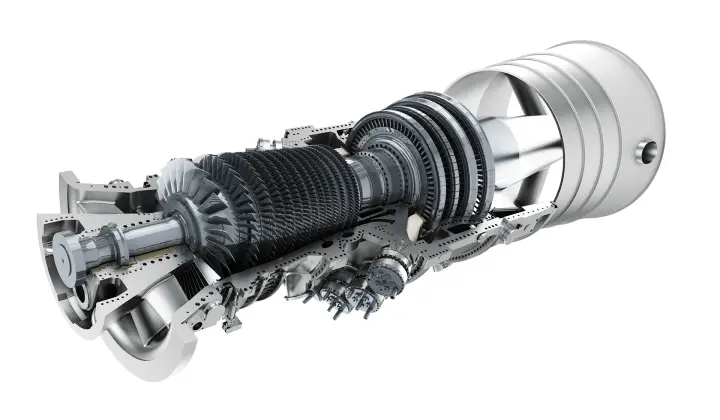
GE Vernova 9HA

448-571 MW 50 Hz H-class frames delivering up to 64% combined-cycle efficiency for baseload plants
GE Vernova 9HA is one of 21 gas turbines tracked in the SecondWatt catalogue, each with specifications, lead times and indicative secondary-market pricing.
GE Vernova 9HA dossier: 448-571 MW 50 Hz H-class specs, 64% combined-cycle efficiency, market availability outlook, and buyer inspection guidance.
The GE 9HA is the 50 Hz H-class heavy-duty frame, offered as the 9HA.01 (448 MW simple cycle) and 9HA.02 (571 MW). Combined-cycle blocks reach 838 MW in 1x1 and 1,680 MW in 2x1 at up to 64.3% net efficiency, and the first 9HA set a 62.22% world efficiency record at EDF Bouchain in 2016. The DLN 2.6e combustor runs 50% hydrogen blends with a pathway to 100%. 9HAs anchor utility-scale combined-cycle plants across Europe, Asia, and the Middle East, competing with the Siemens SGT5-9000HL and Mitsubishi M701JAC. GE reports more than 200 H-class units ordered across 7HA and 9HA with 4 million fleet operating hours, and 925,000 hours on the second-generation HA fleet specifically. There is no observable secondary market: no 9HA unit or reservation slot has appeared on any public resale channel as of August 2026. The nearest 50 Hz frame observations are a never-installed 2011 9FA.03 asking 143.75 million USD, about 288 USD per kW, and legacy Frame 9E units from 30 to 198 USD per kW. SecondWatt covers the 9HA for buyer intelligence and forward availability tracking.
Why it matters
The 9HA is the reference 50 Hz machine for the H-class era, and its unavailability defines the market: reservations stretch into 2031 and repricing runs 10-20 USD/kW-class points every quarter. Buyers who need H-class-scale 50 Hz capacity sooner are paying M&A premiums for operating CCGTs or settling for 9F and 9E units that do trade.
Who buys it
Buyers are 50 Hz utilities, national power companies, and gigawatt-scale IPP and data center campus developers in Europe, Asia, and the Middle East. Purchases run through OEM reservation agreements with non-refundable deposits; the practical trigger for secondary interest is the 2029-2031 delivery queue, which pushes buyers toward operating-plant acquisitions instead.
Role in the data center
Gigawatt-class campus generation outside North America: a single 9HA.02 1x1 block covers roughly 800 MW of IT-plus-cooling load in combined cycle.
Key specifications
| SC net output, 9HA.01 | 448 MW |
|---|---|
| SC net output, 9HA.02 | 571 MW |
| SC net efficiency, 9HA.02 | 44.0 % |
| SC heat rate, 9HA.02 (LHV) | 7740 Btu/kWh |
| CC net output, 9HA.02 1x1 | 838 MW |
| CC net efficiency, 9HA.02 1x1 | 64.1 % |
| CC net output, 9HA.02 2x1 | 1680 MW |
| Ramp rate, 9HA.02 1x1 / 2x1 | 88 / 176 MW/min |
| CC plant startup | 30 minutes (under) |
| Hydrogen blend capability | 50 % by volume |
| Frequency | 50 Hz |
| Turndown with park mode | 7-15 % load |
| Second-generation HA fleet hours | 925000 hours |
| H-class units ordered (7HA + 9HA) | 200 units (more than) |
Technical summary
SC net output, 9HA.01 / 9HA.02: 448 / 571 MW SC net efficiency, 9HA.01 / 9HA.02: 42.9 / 44.0 % SC heat rate, 9HA.02: 7740 Btu/kWh LHV CC net output 1x1, 9HA.01 / 9HA.02: 680 / 838 MW CC net efficiency 1x1, 9HA.02: 64.1 % CC net output 2x1, 9HA.02: 1680 MW Ramp rate, 9HA.02 1x1: 88 MW/min Startup, CC plant: under 30 minutes Hydrogen capability: 50 % by volume, pathway to 100 % Combustor: DLN 2.6e Frequency: 50 Hz Second-generation HA fleet hours: 925000 hours
Configurations and options
Sold only as new combined-cycle power islands: gas turbine, hydrogen-cooled generator, HRSG, steam turbine, and plant controls. Order options include hydrogen-blend combustion provisions, park-mode turndown to 7-15% load, and dual-fuel capability. No used configurations exist to describe.
Compatibility and dependencies
Requires utility-scale infrastructure: 50 Hz grid interconnection at transmission voltage, heavy foundations, high-pressure fuel gas, demineralized water, and HRSG integration. H-class rotor and hot-section life management follows GE factored-hours methodology; long-term service agreements with GE are the norm for this fleet.
Pricing and availability
Comparable secondary-market band: 30–198 $ per kW. Trend: up No 9HA has ever traded publicly. Directionally, GE reservation pricing rose 10-20 USD/kW-class points between Q4 2025 and H1 2026 per earnings coverage, and analyst-cited order pricing reached the 2,500 USD/kW class in January 2026 against BNP Paribas equipment-scope estimates near 950 USD/kW for HA combined cycle. Lead time, new: 48-72 months.
Lifecycle and maintenance
The 9HA fleet is young: 925,000 hours across the second-generation HA fleet per GE, with life management under GE factored-hours methodology and long-term service agreements standard.
Common failure points
- Stage 1 turbine blades — Oxidation distress; forced 2018 shutdowns on early HA units
- Combustion hardware (DLN 2.6e) — Dynamics excursions and premixer wear under load-following duty
- Hydrogen-cooled generator — Seal oil ingress and purity excursions
- HRSG cycling components — Attemperator and drum cracking on cycled plants
- Controls and grid interface — Trips from grid-code and software events in young fleets
Inspection checklist
Fleet fix status — confirm the stage 1 blade oxidation fix from the 2018 HA campaign is incorporated; reject hardware without the update record Hours and starts — audit factored fired hours and starts from COD; second-generation HA fleet averages under 10,000 hours per unit Stage 1 nozzles and blades — borescope for oxidation and coating distress at every combustion inspection window DLN 2.6e premixers — inspect 3D-printed premixer condition and record combustion dynamics across load range Combustion dynamics — require tuning data from the last 12 months; flag any excursion logs above OEM alarm limits Rotor — verify factored-hours accounting under GE methodology; H-class rotors are young but tracking must be complete from COD Compressor — borescope R0 and front stages for erosion or FOD; enforce OEM blend limits Hydrogen-cooled generator — check seal oil system, hydrogen purity logs above 98%, and stator insulation resistance at or above 100 megohms HRSG interface — inspect attemperator and drum records for cycling damage on plants run in load-following duty SCR and catalyst — verify catalyst age against design life and ammonia slip under the 5.0 ppmvd class permit limit Controls — Mark VIe generation with current cybersecurity patching and OEM support status LTSA position — review long-term service agreement transferability, outstanding credits, and next major outage date Performance — ISO-corrected output within 5% of the applicable fact-sheet rating and CC heat rate within 3% Grid compliance — verify 50 Hz grid-code performance records including ramp and frequency-response tests Records — require complete outage reports, TIL compliance log, and borescope history from COD; gaps reprice the asset
Procurement channels
New units only, through GE Vernova reservation agreements with non-refundable deposits credited at delivery. Operating-plant M&A is the only route to in-service H-class-era 50 Hz capacity; legacy 9FA and 9E units trade through brokers such as USP&E and Power Plants Online.
Regional notes
50 Hz only: Europe, Asia, Middle East, Africa, and parts of South America. Not deployed on the 60 Hz North American grid. Secondary interest routes to operating-plant M&A or to legacy 9F/9E units, which do appear on dealer sites.