Mitsubishi Power M501J / M701J
Manufacturer: Mitsubishi Power
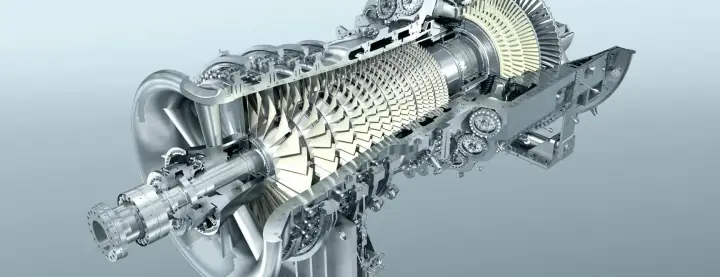
330-574 MW J-class frames with 1,600 C class firing temperatures for utility and campus combined cycle
This model is part of SecondWatt’s gas turbine research catalogue. Specifications and price observations are included where supported by sources. Equipment availability and commercial terms require confirmation.
Mitsubishi Power M501J and M701J J-class gas turbines: 330-574 MW specs, 1650 C JAC technology, market availability outlook, and inspection guidance.
The Mitsubishi Power M501J (60 Hz) and M701J (50 Hz) are J-class heavy-duty frame gas turbines, launched commercially in 2009 with first operation in 2011. The current air-cooled M501JAC delivers 453 MW simple cycle at 44.0% efficiency and 664 MW in 1x1 combined cycle above 64%, running a 1,650 C turbine inlet temperature. MHI reported 92 J-series units ordered by September 2022 and more than 3.2 million commercial operating hours on current product pages.
J-class blocks anchor utility baseload and gigawatt campuses: the 5,300 MW Gulf Energy program in Thailand runs eight M701JAC units, and US deployments span Texas, Virginia, and Utah hydrogen-ready plants. The JAC's 25 ppm NOx combustor with 30% hydrogen co-firing demonstrated at T-Point 2 keeps it permittable worldwide.
No M501 or M701 of any letter class appears on public resale channels as of August 2026; MHI's 35 GW large-frame backlog delivers 2028-2030. Effective secondary pricing is set by operating-plant M&A, which Enverus reports doubled to about 1.0 million USD per MW in 2025. The only mid-size MHI unit observed trading is the H-25, at about 198 USD per kW on USP&E.
Why it matters
J-class machines sit at the top of the efficiency ladder, and their absence from the secondary market is itself market intelligence: MHI's backlog rose from 23 GW to 35 GW in a year while the company doubles production capacity. Every JAC slot taken by a data center campus removes a utility block, feeding the M&A premium on operating combined-cycle plants.
Who buys it
Buyers are utilities, national power companies, and IPP or hyperscale campus developers procuring 600 MW-class combined-cycle blocks. All J-class purchases route through MHI order books delivering 2028-2030, so acquirers needing capacity sooner buy operating F/G/J-era plants at M&A premiums. The purchase trigger is firm load growth against a sold-out OEM queue.
Role in the data center
Gigawatt campus anchor: one M501JAC 1x1 block supplies about 664 MW of combined-cycle capacity behind the meter, with 2x1 blocks at 1,332 MW for the largest compute campuses. At that size the plant is a grid-interconnected generating station serving the campus, not behind-the-meter equipment in the conventional sense.
Key specifications
| SC output, M501JAC | 453 MW |
|---|---|
| SC efficiency, M501JAC | 44.0 % LHV |
| SC heat rate, M501JAC | 8182 kJ/kWh |
| CC output, M501JAC 1x1 | 664 MW |
| CC output, M501JAC 2x1 | 1332 MW |
| SC output, M501J steam-cooled | 330 MW |
| SC output, M701JAC (50 Hz) | 448-574 MW |
| Turbine inlet temperature, JAC | 1650 C |
| Pressure ratio, JAC | 25:1 |
| Exhaust flow, M501JAC | 815 kg/s |
| Exhaust temperature, M501JAC | 649 C |
| NOx / CO at 15% O2 | 25 / 9 ppm |
| Start time / ramp rate | 30 min / 42 MW/min |
| Shaft speed / frequency, M501 | 3600 / 60 rpm / Hz |
| Package size / weight, M501JAC | 15.0 x 5.6 x 5.6 / 347000 m / kg |
| J-series cumulative operating hours | 3200000 hours (more than) |
| ISO gross output, M501JAC (60 Hz) | 453 MW |
| ISO gross output, M501J steam-cooled (60 Hz) | 330 MW |
| ISO gross output, M701JAC (50 Hz) | 574 MW |
Technical summary
SC output, M501JAC: 453 MW at 44.0 %. SC heat rate, M501JAC: 8182 kJ/kWh. CC output, M501JAC 1x1: 664 MW above 64.0 %. CC output, M501JAC 2x1: 1332 MW. SC output, M501J (steam-cooled): 330 MW at 42.1 %. SC output, M701JAC: 448-574 MW. Turbine inlet temperature, JAC: 1650 C. Pressure ratio, JAC: 25:1. Exhaust flow / temperature, M501JAC: 815 kg/s / 649 C. NOx / CO: 25 / 9 ppm at 15% O2. Start time: 30 minutes, ramp 42 MW/min. Hydrogen: 30 % co-firing demonstrated. The M701JAC page also carries a 448 MW 2018 figure under the same name; 574 MW is the current top rating.
Major variations
M501J and M701J (steam-cooled combustor, 1,600 C) versus M501JAC and M701JAC (enhanced air-cooled combustor, 1,650 C, pressure ratio raised from 23:1 to 25:1). The JAC eliminates the steam cooling dependency, simplifying operation and cycling; 60 Hz M501 and 50 Hz M701 differ in scale and speed. G-class predecessors (M501G/GAC) remain the closest trading proxy.
Configurations and options
Sold as combined-cycle power trains: gas turbine, generator, HRSG, steam turbine, and TOMONI plant controls. Order options include hydrogen co-firing readiness, air-cooled versus steam-cooled combustion (JAC standard on new orders), and enhanced load-flexibility cooling-air paths. No used configurations exist.
Compatibility and dependencies
Requires transmission-voltage interconnection, heavy foundations, high-pressure fuel gas, and full water treatment; steam-cooled J units additionally depend on combustor cooling steam from the bottoming cycle. Long-term service agreements with Mitsubishi Power govern parts and outage cadence across the fleet. The M501JAC package alone measures 15.0 x 5.6 x 5.6 m and weighs 347 tonnes, so rigging access and foundation design are fixed at plant layout rather than adjusted later.
Pricing and availability
Trend: rising No J-class unit has traded publicly. Directional evidence: MHI's large-frame backlog grew from 23 GW to 35 GW in the year to August 2026 with 2028-2030 deliveries, while US gas plant M&A multiples doubled from about 0.5 to about 1.0 million USD per MW in 2025 per Enverus, setting the effective price of operating advanced-class capacity. Lead time, new: 30-54 months.
Supply, delivery and overhaul
- Delivery time: 24 months
- Delivery time: 48 months
Lifecycle and maintenance
MHI does not publish J-class inspection intervals; long-term service agreements govern outage cadence in practice. Fleet validation ran roughly 2,800 temporary measurements at T-Point 2 in 2020, and MHI reports 99.5% fleet reliability with more than 3.2 million cumulative J-series operating hours. First-year JAC inspections found no long-term reliability problems per MHI's technical review; hot-parts life at 1,650 C remains the cost driver inside LTSA pricing.
Thermal and emissions profile
The J/JAC dry low-NOx can combustor holds 25 ppm NOx and 9 ppm CO at 15% O2 on natural gas per MHI product documentation. Under 40 CFR 60 Subpart KKKK, US units above 850 MMBtu/h face a 15 ppm line, and the January 2026 KKKKa revision sets 5 ppm for new high-utilization large turbines, so US J-class combined-cycle plants pair the 25 ppm combustor with SCR. Thirty percent hydrogen co-firing was demonstrated at T-Point 2.
Common failure points
- Stage 1 hot parts — Oxidation and coating distress at 1,600-1,650 C firing temperatures
- Steam-cooled combustors (J) — Cooling-steam dependency complicates cycling and restarts
- Combustion dynamics — Excursions under load-following and co-firing operation
- Cooling-air path hardware (JAC) — Changeover valve and clearance-control faults
- Generator auxiliaries — Seal oil and purity excursions on hydrogen-cooled machines
Inspection checklist
Cooling system lineage: identify steam-cooled J versus air-cooled JAC hardware; steam-cooled units carry bottoming-cycle dependencies that reprice diligence. Hours and starts: audit actual operating hours against the fleet baseline; the 50 Hz lead JAC logged 8,000 hours before fleet rollout. Hot parts: borescope stage 1 nozzles and blades for oxidation and coating loss at every combustion inspection window. Combustor cans: inspect all 16 (M501) or 22 (M701) cans for liner distress and record dynamics data across the load range. TIT validation: verify 1,650 C class operation against MHI temporary-measurement validation records where available. Rotor: confirm complete hours-and-starts accounting from COD under MHI life methodology; flag any gap exceeding 100 fired hours. Compressor: borescope stages 1-3 for erosion and FOD; enforce OEM blend limits.
Procurement channels
New units through MHI order books only, with capacity expansion underway. In-service capacity moves through plant M&A brokered by advisors; the H-25 is the only mid-size MHI machine observed on dealer inventories (USP&E), and legacy Westinghouse 501-lineage frames trade occasionally.
Regional notes
M501 (60 Hz) serves the Americas and parts of Asia; M701 (50 Hz) serves Japan, Southeast Asia, Europe, and the Middle East. The anchor JAC fleets run in Japan and Thailand; US JAC plants concentrate in Texas, Virginia, and Utah. No resale market in either frequency.
Content owner: Gary Martin, SecondWatt