
Low-voltage power circuit breaker switchgear is a complete metal-enclosed assembly for switching electrical circuits and protecting them by interrupting fault current. For a buyer comparing an offered lineup, the first question is whether the assembly and its included breakers are documented for the same required duty. Here, a listing means evidence of certification to the applicable equipment standard, not a sales advertisement. A breaker listing or an impressive fault-current figure cannot establish the complete assembly's suitability on its own.
A useful dividing line is short-time withstand: the ability to carry fault current for a stated interval. If your engineer requires that rating on the assembly, a UL 891 switchboard is not an equivalent substitute: UL 891's public scope excludes switchboards with short-time current ratings. That exclusion concerns the assembly; a breaker inside it can have its own short-time rating.
Key takeaways
- Identify the assembly listing separately from the breaker listing before comparing offers.
- Interrupting current describes opening a fault; withstand describes enduring it. A kA value needs its duty, voltage basis and, for withstand, duration.
- “480 V” can describe the system while a breaker table uses 508 V rated maximum. Keep those labels attached to the figures.
- A family name or drawout construction does not establish compatibility. Match the exact breaker to its documented receiving equipment and the engineer's requirements.
Start with the assembly, then its breakers#
For the US standards comparison here, UL 1558 covers metal-enclosed low-voltage power circuit breaker switchgear assemblies and supplements IEEE C37.20.1 and ANSI C37.51. The assembly includes more than the breakers: it can also contain switching, control, metering and protective equipment.
The public scope of IEEE C37.20.1-2026 describes stationary or drawout devices in individual metal compartments. Stationary means mounted in place; drawout identifies a removable mounting arrangement. Both are within scope, so “drawout” alone is not a definition of switchgear or proof that a quoted breaker fits a particular lineup.
Keep two document sets side by side when assessing an offer.
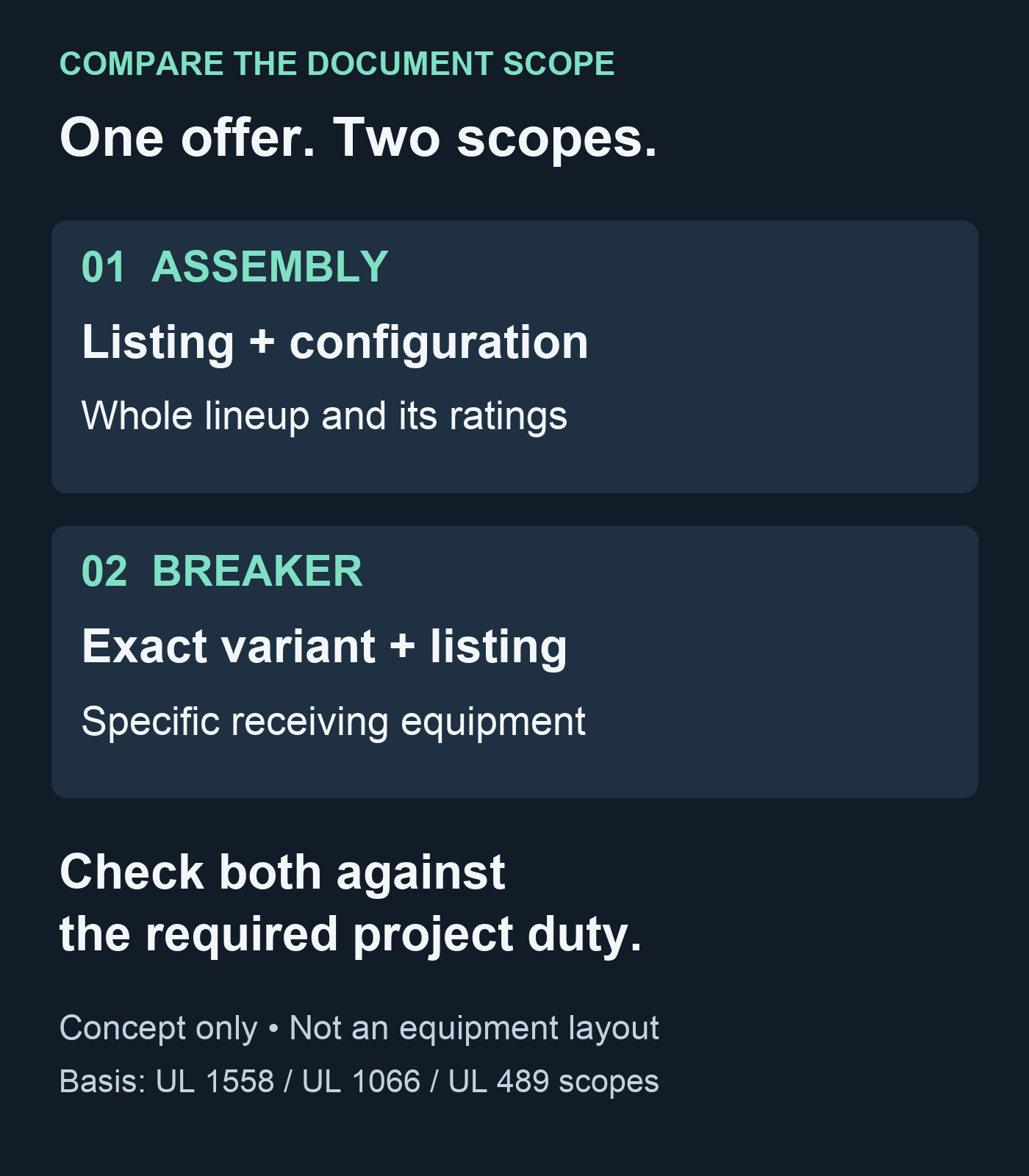
UL 1066 covers power circuit breakers, including stationary and drawout forms. Its scope says drawout devices are intended for specific adapters or receiving equipment, and the complete breaker/enclosure combination determines acceptance. UL 489, covering molded-case devices, likewise addresses acceptance of the complete combination and excludes the low-voltage power circuit breakers identified in its scope.
For an existing-asset offer, this means a breaker data sheet is only part of the answer. Match the assembly nameplate and configuration documents to what is actually included, then match each breaker identification to that assembly. Otherwise, two prices may cover different equipment or an unresolved combination.
Compare the duty behind each kA figure#
A kiloampere, or kA, is 1,000 amperes. In this comparison it describes fault-current duty: current associated with a short circuit, rather than ordinary load current. The number becomes useful only when you know what it rates.
| Quoted rating | What it describes | What makes the comparison usable |
|---|---|---|
| Breaker interrupting current | The fault current the breaker is rated to open at a stated voltage | Exact breaker, voltage column and current basis |
| Breaker short-time withstand | Fault current the closed breaker can endure for a defined interval | Exact breaker, current and duration, with applicable conditions |
| Assembly/bus withstand | Fault-current duty of the assembly's conducting system | Assembly configuration, named withstand rating, voltage/current basis and duration |
ABB's 2020 ratings guide distinguishes interruption from duration-dependent withstand and separates switchgear bus short-circuit withstand from short-time withstand. The bus is the assembly's main conducting system. ABB also cautions against treating “bus bracing” as a defined rating; ask which withstand rating the quoted phrase represents.
Interrupting ratings normally state rms symmetrical current. A peak rating uses a different current basis—the crest of the waveform. A higher peak number does not by itself mean greater interrupting capability: compare ratings on the same current basis, keeping the manufacturer's labels attached.
If one offer supplies breaker interrupting current and another supplies assembly short-time withstand, neither figure establishes which offer meets the project duty. Obtain the missing counterpart instead of ranking the larger number first. ABB's guide uses older standards to explain the distinctions; it does not establish current test durations or permission to apply a tripping delay. Your electrical engineer must assess the actual ratings and protection requirements together.
Why a 480 V offer may have a 508 V column#
Nominal voltage identifies the system voltage; rated maximum voltage identifies the equipment rating basis. The IEEE C37.13-2024 public abstract pairs 508 V rated maximum with 480 V nominal systems for the enclosed low-voltage AC power circuit breakers it covers. It also pairs 635 V with 600 V nominal systems, but specifies 600 V for units incorporating fuses.
Thus, a 508 V table entry should remain labeled 508 V even when the intended system is 480 V. Do not relabel it as a 480 V test result or assume every manufacturer's table uses the same convention. Ask the engineer to align the actual table, standard, frequency and breaker variant before treating two quoted fault-current ratings as comparable.
A family name does not settle the listing#
Siemens' undated 3WA catalogue, pages 5–6 identifies 3WA2 as UL 489 and 3WA3 as UL 1066. It describes 3WA3 applications in both UL 1558 switchgear and UL 891 switchboards, among other assembly classes. This is a manufacturer example of why “3WA breaker” or even “UL 1066 breaker” does not identify the assembly being offered.
Ask for the exact variant and its documented assembly application. The catalogue's application statement is not proof that any particular used breaker and enclosure are interchangeable; options and ratings can differ. Keep fixed/drawout construction in the same comparison, alongside the receiving-equipment identification.
Turn the comparison into a sourcing decision#
Use the documents to put each offer into one of three practical positions:
- Ready for engineering comparison: the assembly and included breaker identities, configuration and rating bases are clear. Have the engineer compare them with the site's required duty before progressing the commercial comparison.
- Incomplete: the offer provides only a breaker sheet, an unexplained “bracing” figure or a kA value without its basis. Request the specific missing information; an unknown is not a demonstrated mismatch.
- Different from the requested scope: the offer identifies a different assembly class or breaker/configuration. Ask the engineer whether an alternative is acceptable before treating the price as equivalent.
For a sourcing enquiry, send the required voltage, current and fault-duty basis established by your engineer, the assembly configuration, location and any existing equipment identifiers. Attach the offered assembly and breaker records together so the comparison starts with a defined scope. This is a purchasing comparison method, not installation approval or protection-setting guidance; standards descriptions above are limited to public scopes and the attributed explanatory sources.
SecondWatt facilitates introductions between equipment buyers and sellers and may earn a fee when an introduction proceeds. To source equipment, send SecondWatt your switchgear requirements. For equipment discovery, use the switchgear hub.