Schneider Electric Premset shielded-solid-insulation MV switchgear
Manufacturer: Schneider Electric
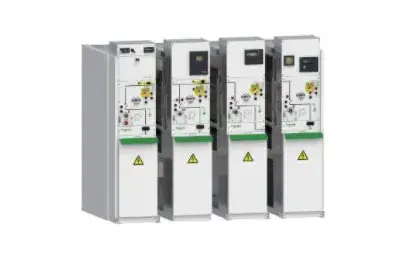
Schneider Premset switchgear, shielded solid insulation to 17.5 kV with no gas at all and a UL/IEEE US version
This model is part of SecondWatt’s switchgear research catalogue. Specifications and price observations are included where supported by sources. Equipment availability and commercial terms require confirmation.
Schneider Premset dossier: shielded-solid-insulation switchgear to 17.5 kV and 25 kA with zero insulation gas, IEC and US versions, inspection checklist.
Premset is Schneider Electric's shielded-solid-insulation MV switchgear: the entire main circuit is solid-insulated in epoxy and EPDM and earthed-shielded, leaving no live parts in free air and no insulation gas of any kind. The IEC version covers 7.2/12/17.5 kV with BIL of 60-95 kV by class, busbars to 1,250 A, short-time and breaking ratings to 25 kA/1 s, and internal arc IAC A-FLR at 21-25 kA/1 s per IEC 62271-200, in 375 mm (630 A) and 750 mm (1,250 A) unit widths.
Two market versions exist and they are not interchangeable. The IEC version is documented in catalogue AMTED310010EN; the US version ships as metal-enclosed switchgear under IEEE C37.20.3 with UL listing and is documented in catalog 6045CT1601. A used unit has to be verified against the catalog for the standard family it was actually built to, because acceptance testing and clearances differ.
Status is COMMERCIALIZED and current.
Why it matters
Solid insulation is the third path through the SF6 transition, no gas to manage at all, and Premset is its volume standard-bearer. The SSIS design also changes inspection: PD testing and resin condition, not gas density, are the health checks.
Who buys it
Utilities, buildings, and data centers wanting gas-free MV switching in tight rooms specify Premset; coastal, humid, and polluted sites value the sealed solid insulation. US buyers get the IEEE C37.20.3/UL version; there is no used channel yet on either side.
Role in the data center
Gas-free medium-voltage distribution in tight electrical rooms and in coastal, humid or polluted sites where air-insulated clearances and contamination are the constraint. The US IEEE C37.20.3 version is what brings shielded solid insulation into ANSI-market campus designs, typically at the 15 kV class feeding unit substations.
Key specifications
| Voltage classes | 7.2 / 12 / 17.5 kV |
|---|---|
| BIL range | 60-95 kV |
| Busbar ceiling | 1,250 A |
| Fault ratings | to 25 kA / 1 s |
| Internal arc | IAC A-FLR 21-25 kA / 1 s |
| Insulation system | shielded solid (SSIS), gas-free |
| Unit widths | 375 / 750 mm (630 / 1,250 A) |
| US version | IEEE C37.20.3 + UL Listed |
| Status | COMMERCIALIZED |
| US catalog | 6045CT1601 |
Technical summary
Voltage classes: 7.2 / 12 / 17.5 kV. BIL: 60-95 kV by class. Busbar: up to 1,250 A. Short-time/breaking: up to 25 kA / 1 s. Internal arc: IAC A-FLR 21-25 kA / 1 s (IEC 62271-200). Insulation: shielded solid (SSIS/2SIS), no gas. Unit widths: 375 mm (630 A) / 750 mm (1,250 A). US version: IEEE C37.20.3 metal-enclosed, UL Listed. Design benefit: no live parts in free air; insulation resists aging. Status: COMMERCIALIZED.
Major variations
The IEC version (7.2-17.5 kV, IEC 62271-200, BIL 60-95 kV, to 25 kA, IAC A-FLR) and the US version (metal-enclosed to IEEE C37.20.3, UL Listed) are the primary split, documented in separate catalogs. Within each, functional units cover ring, feeder, circuit-breaker and metering duties in 375 mm and 750 mm widths, and US bulletins add an outdoor supplement and close-coupled transformer transition builds. Shielded solid insulation is common to all of them, so no variant carries an F-gas obligation.
Configurations and options
Two market versions that are not interchangeable and have to be identified before anything else: the IEC version documented in catalogue AMTED310010EN at 7.2, 12 and 17.5 kV, and the US version built as metal-enclosed switchgear to IEEE C37.20.3 with UL listing, documented in catalog 6045CT1601. Within either, functional units cover ring, feeder, circuit-breaker and metering duties in 375 mm widths at 630 A and 750 mm at 1,250 A, which is what sets lineup length. Ratings to confirm are BIL of 60-95 kV by class, short-time and breaking to 25 kA/1 s, and internal arc IAC A-FLR at 21-25 kA/1 s. US bulletins add an outdoor supplement and close-coupled transformer transition builds.
Compatibility and dependencies
The whole main circuit is solid-insulated in epoxy and EPDM and earth-shielded, so there are no live parts in free air and no insulation gas at all: no density monitoring, no gas handling on relocation, and no F-gas obligation on any variant. What that changes practically is the room, since the design tolerates humid, coastal and polluted environments that force derating on air-insulated gear. Close-coupled transformer transitions are a documented US build, which is the interface to specify when the switchgear feeds a unit substation directly. Acceptance testing differs between the two market versions, so a used unit has to be verified against the catalogue for the standard family it was actually built to.
Pricing and availability
Trend: rising Lead time, new: 52-72 weeks (metal-enclosed class). Lead time, used or refurbished: No used supply exists. Warranty, used: 1-year typical from reconditioning dealers.
Lifecycle and maintenance
Metal-clad MV switchgear routinely serves 40+ years: vacuum interrupters rated for 10,000-30,000 operations far outlast the mechanical duty standby service imposes, so lineup life is governed by insulation condition and relay/controls vintage. Breakers recondition readily and trade as units, while lineups modernize in place with digital relays and retrofit breakers. ANSI/NETA MTS acceptance testing at purchase plus PD surveys in service are the condition gates.
Thermal and emissions profile
Switchgear produces no combustion emissions, and SF6-free designs remove the category's one regulatory exposure: instead of SF6 (GWP 24,300), these units insulate with clean air, dry air, or pure air at GWP below 1 and interrupt in vacuum. That satisfies EU F-gas Regulation 2024/573, which bars new SF6 MV switchgear from the EU market from 2026, and California's CARB phase-out of new SF6 equipment acquisitions from 2025. Buyers avoid gas handling, leak reporting, and end-of-life recovery costs entirely.
Common failure points
- Vacuum interrupters — Loss of vacuum ends interrupting capability with no external sign
- Insulation tracking and PD — Partial discharge across dusty or damp insulation progressing to flashover
- Racking and interlocks — Damaged racking screws and defeated interlocks from forced operation
- Protection relays — Obsolete or drifted relays mis-operate under fault
- Instrument transformers — CT/VT failures disable metering and protection inputs
- Space heater failure — Condensation-driven tracking in unheated outdoor or humid gear
Inspection checklist
Vacuum integrity: hipot test each interrupter per OEM procedure (e.g., 36 kV test on 15 kV class). Insulation resistance: megger bus and breakers at 2,500-5,000 V; compare to ANSI/NETA MTS tables. Contact resistance: micro-ohm each pole; investigate imbalance beyond 50% between phases. Partial discharge: ultrasonic and TEV survey; investigate any reading 6 dB above baseline. Contact erosion: measure vacuum interrupter erosion marks against the OEM wear allowance. Racking mechanism: cycle connect/test/disconnect positions 3 times each; verify interlocks and shutters. Mechanism timing: verify open/close times; closing beyond 5 cycles flags mechanism trouble. Bus insulation: inspect epoxy and boots for tracking or corona; clean and torque joints. Instrument transformers: verify CT/VT ratios, insulation, and fusing.
Procurement channels
New units come through Schneider channels in both the IEC and US versions.
Regional notes
The clearest two-market split in this category: an IEC 62271-200 version for IEC markets and a separate US version built as metal-enclosed switchgear to IEEE C37.20.3 and UL Listed, documented in different catalogues with different acceptance testing and clearances. A unit therefore cannot be moved between the two markets on the strength of the product name. The US version is what brings shielded solid insulation into ANSI-market campus designs, typically at the 15 kV class. Being gas-free, no variant is exposed to EU F-gas or California SF6 rules.