
A prime power rating describes output for a variable load over extended operation, subject to the manufacturer's load limits and maintenance requirements. Standby ratings address backup duty; continuous ratings address constant demand at their own stated output. For a buyer, the useful comparison is the rating that fits the planned hours and load—not the largest kW number in the offer. Caterpillar’s rating guide explains these different applications.
Key takeaways
- Match the duty—the permitted operating pattern—to your purpose, run hours and changing or constant load.
- Unlimited annual hours under a prime definition do not mean unrestricted operation at full prime output; average-load limits and maintenance still matter.
- Compare the same duty across offers. A model’s standby, prime and continuous numbers are not interchangeable.
- Apply the exact manufacturer’s definition and averaging rule. A percentage in another document is neither a conversion nor an allowance for your unit.
- Confirm the offered configuration and site conditions with the supplier and engineer; assess operating permission separately.
Start with the operating pattern#
A duty rating describes how a generator can be used as well as how much power it can supply. kW, or kilowatts, measures electrical power; a load profile records the demand and how long each load lasts. Begin with that profile and the reason for running, then select the applicable rating from the original equipment manufacturer (OEM).
| Your operating pattern | Rating to investigate | What changes the buying decision |
|---|---|---|
| Backup during interruption of the normal supply | Standby or emergency standby power (ESP), using the maker’s exact label | Check permitted hours and load limits; a backup number does not establish routine generating capacity. |
| Sustained service with demand that varies | Prime rated power (PRP) | Check both the prime output and its average-load rule. Annual hours alone cannot establish suitability. |
| Sustained service with constant demand | Continuous operating power (COP) | Compare demand with the continuous rating, rather than carrying over the larger standby or prime number. |
The prime and continuous distinction above follows Cummins’ July 18, 2017 teaching presentation: PRP addresses variable load and COP constant load, both for unlimited annual hours less service time. These are dated OEM descriptions, not a statement of current ISO clauses. They help you choose which rating to investigate; the offered set’s applicable documentation controls the decision.
Even “standby” needs its full name. Caterpillar distinguishes ESP, with maximum expected usage of 200 hours per year, from its separate Standby rating, with maximum expected usage of 500 hours per year; both address varying load during interruption of normal power and use 70% average-load wording. Those are Cat’s duty definitions, not legal operating allowances or rules to apply to another manufacturer’s set.
Why one model can carry different power numbers#
The duty changes the operating commitment behind the output. A larger backup figure and a smaller continuous figure can therefore describe the same named model without being contradictory.
Cummins’ DQLF model page, observed October 8, 2026, lists the following for a 60 Hz, QSK78-G12 diesel, unhoused generator. The page’s publication and revision date are unknown.
| Published duty | Electrical output |
|---|---|
| Standby | 2,750 kW |
| Prime | 2,500 kW |
| Continuous | 2,100 kW |
| Data Center Continuous (DCC) | 2,500 kW |
These are model-level published values, not a guarantee for an offered used unit. The selected alternator, voltage option, cooling arrangement, ambient temperature, elevation and inclusion of fan or other auxiliary loads are not established by this comparison. Obtain the matching rating sheet and a written site case before treating a listed value as usable project capacity.
The table’s practical lesson is to carry the duty label into the commercial comparison. An offer headed “2,750 kW DQLF” has not yet established 2,750 kW for your sustained operating plan. Nor can dividing its prime number by its standby number produce a conversion for other models.
DCC also needs its own definition. Cummins’ 2017 presentation describes Data Center Continuous for constant or varying load in a data-center application where reliable utility power is available. The model page lists DCC separately from continuous: equal prime and DCC numbers do not make those duties interchangeable, and DCC is not generic permission for off-grid continuous service.
Separate the rating from the average-load allowance#
A rating gives the output for a particular duty; an average-load allowance limits the demand over a specified operating period. Average load reflects both the power drawn and the time spent at each level. Staying below the rating at every moment can still leave the average too high.
Here is a separate, dated teaching example—not newly verified conditions for the model page above. In Cummins’ July 18, 2017 DQLF example, the 2,500 kW PRP rating has a maximum average of 1,750 kW over a 24-hour operating period:
2,500 kW × 70% = 1,750 kW maximum average.
Assume, only to illustrate the distinction, a constant demand of 2,000 kW for that entire operating period. Its average is also 2,000 kW: below the 2,500 kW rating but above the example’s 1,750 kW average limit. Thus “our load is below prime kW” does not establish that this prime duty fits; a constant-load requirement calls for evaluation of an applicable continuous or other explicitly suitable duty.
The 70% calculation does not turn a standby rating into a prime rating. For a real varying profile, have the supplier or application engineer apply the controlling document’s averaging window, low-load treatment, exclusions and exceptions. Do not assume that idle or shutdown hours can be inserted to make an average pass.
Keep conflicting percentages with their documents#
The Kohler KD27V12 engine manual dated September 1, 2022, section 5.2.1, describes ISO 8528-1:2005 using 85% for ESP and 75% for PRP over 24 operating hours. Cummins’ 2017 teaching material uses 70% for both. These descriptions differ; their dates alone do not establish why, and the Kohler engine manual is not a generator-set rating sheet for an offered unit.
Ask which OEM document and revision govern the exact set and planned profile. Selecting the most generous percentage, averaging the percentages, or calling one a universal ISO rule would hide the unresolved applicability question.
For standards context, the ISO catalogue listed ISO 8528-1:2018, edition 3, as current on October 8, 2026, confirmed in 2023 with revision underway. Its scope covers reciprocating-engine AC generating sets and associated equipment. The catalogue establishes edition and scope; the OEM examples here do not reproduce or verify the standard’s detailed normative requirements.
Turn your operating plan into a comparable offer#
Write down the operating purpose, expected annual hours, longest planned run and demand over time. Send that plan with the offer’s identity and rating sheet. The aim is a written match between the intended use and the offered duty, so a missing qualification becomes a specific question before capacity or price ranking.
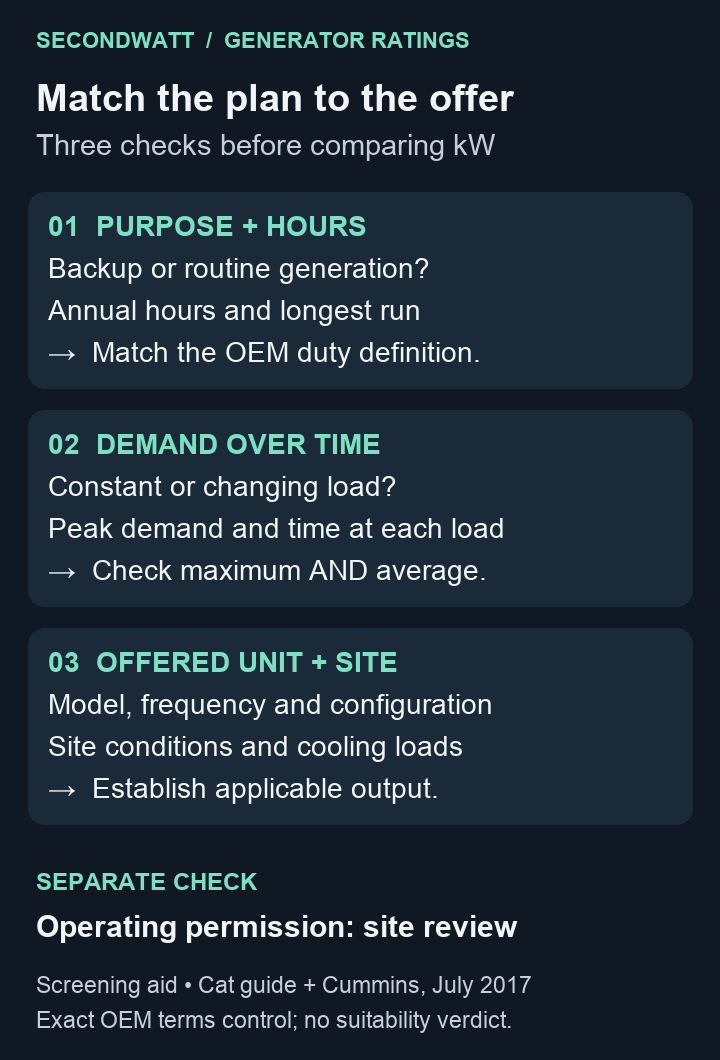
Ask the supplier to return the exact duty, output and document revision for the offered model and frequency, identifying the configuration and site assumptions. Cummins’ 2017 presentation notes that manufacturers’ reference conditions vary, altitude and ambient conditions can affect available load, and published ratings may not include all cooling-system loads. An unresolved cooling or site assumption can change the capacity you are buying even after the duty label is correct.
Keep overload out of routine capacity planning. For example, Cat’s prime definition permits 10% overload for emergency use for at most one hour in twelve and 25 hours per year, and excludes overload for gas generator sets. That conditional example does not establish an allowance for the DQLF or any other offered unit; obtain its explicit OEM terms if overload is proposed.
A useful supplier question is: “For this offered configuration at our site, which duty covers the attached load profile and run hours, what maximum and average output limits apply, and which loads or conditions remain outside the quoted output?” Have the application engineer resolve the answer against the profile before using the figure to rank offers. This is a screening method, not a complete generator-sizing or equipment-acceptance study.
Check operating permission separately#
A manufacturer’s duty rating does not grant permission to operate. EPA’s stationary-engine overview distinguishes requirements by engine and source characteristics; it does not turn an OEM duty label into approval for a specific project. Send the actual engine identity and certification, operating purpose and planned hours to the permitting adviser for a separate site review.
For equipment context, visit SecondWatt’s generator hub. To source a unit, send your generator requirement with the required electrical output, duty and load profile, operating hours, site conditions and any unresolved rating question. That gives the enquiry a defined basis without implying confirmed inventory or guaranteed output.
SecondWatt facilitates introductions between equipment buyers and sellers and may earn a fee when an introduction proceeds.