Cummins QSK60 (incl. G23)
Manufacturer: Cummins
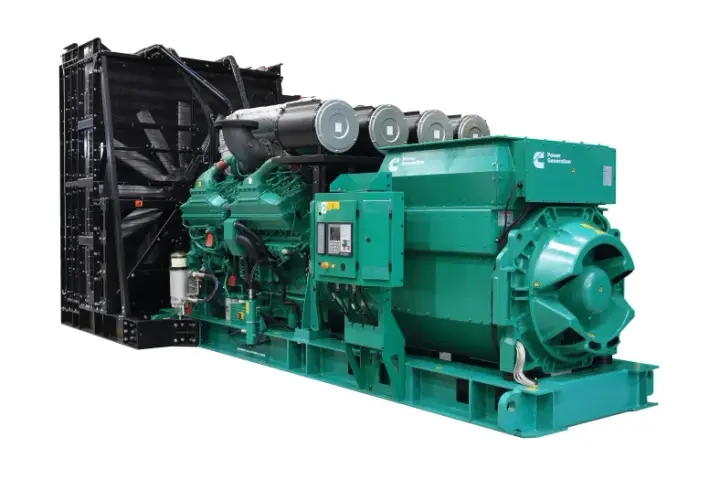
1,750-2,500 kW standby diesel gensets on the 60 L V-16, Cummins' flagship data center machine
This model is part of SecondWatt’s generator research catalogue. Specifications and price observations are included where supported by sources. Equipment availability and commercial terms require confirmation.
Cummins QSK60 genset dossier: 1,750-2,500 kW ratings, published specs, used pricing from 135,000 to 850,000 USD, and a buyer inspection checklist.
The Cummins QSK60 is a 60.2 L V-16 (159 x 190 mm) with modular common-rail injection at 1,600 bar, packaged into gensets from 1,750 to 2,500 kW standby at 60 Hz with Data Center Continuous ratings of 1,600-2,250 kW carrying unlimited-hours Uptime Tier III/IV language. The G23 build is a 50 Hz rating (2,388 kWm gross standby at 1,500 rpm) powering C2500D5P and C2750D5BE packages; US 60 Hz fleets run G6, G9, and G19 builds in DQKAB, DQKC, DQKH, and DQKAN packages.
QSK60 gensets anchor 2 MW standby fleets at data centers and hospitals, with PowerCommand controls and 480 V through 13,800 V alternators.
The used bench is priced and active: a 2002 DQKC with 406 hours asked 249,900 USD live in August 2026, a 133-hour 2007 Tier 2 DQKAB sold at 850,000 USD, and a 2018 unit at 625,000 USD, spanning roughly 67 to 425 USD per kW by hours, tier, and documentation. Cummins Power Systems grew 19% in Q2 2026 on data center standby orders, keeping the new-unit queue at 50-70 weeks.
Why it matters
The QSK60 is the only 2 MW machine that rivals the 3516B's used liquidity, and its price dispersion is the widest in the class: a 24-year-old unit marketed on immediate availability against manufacturing lead times asked 249,900 USD while low-hour Tier 2 units cleared at 850,000 USD. Rebuild economics are published (28,000-45,000 USD parts kits), making total-cost underwriting tractable.
Who buys it
Data center operators and EPCs buy QSK60s in N+1 blocks at the 2 MW node; hospitals, utilities, and industrial plants take singles and pairs. The trigger is queue arbitrage: a tested used unit ships in weeks against 50-70 week new-unit leads, and the used ask spread (67-425 USD per kW) rewards buyers who can verify hours and tier.
Role in the data center
Core standby block at 2,000-2,250 kW behind the paralleling bus in N+1 fleets, with DCC-rated configurations carrying unlimited-hours utility-outage duty. Alternator voltages run from 480 V through 13,800 V on these packages.
Key specifications
| Standby range, 60 Hz | 1750-2500 kW |
|---|---|
| Data Center Continuous rating, 60 Hz | 1600-2250 kW |
| DQKAB standby (QSK60-G6) | 2000 kW |
| DQKH standby (QSK60-G9) | 2250 kW |
| G23 build gross standby (50 Hz) | 2388 kWm at 1500 rpm |
| Engine displacement | 60.2 L (V-16) |
| Bore x stroke | 159 x 190 mm |
| Fuel system | Cummins MCRS common rail, 1600 bar |
| Fuel, DQKAB standby 100% / 75% / 50% | 141.3 / 107.3 / 82 gal/hr |
| Voltages | 480-13800 V |
| Sound, DQKAB unhoused full load | 99.7 dBA at 7 m |
| DQKAB dry weight | 17382 kg |
| Emissions options | Tier 2 emergency; Tier 4F / Tier 4i |
| Controller | PowerCommand PCC 3201 / PC 3.3 with MLD |
| UL 2200 | Available on all 60 Hz low-voltage models |
Technical summary
Standby range, 60 Hz: 1750-2500 kW. Data Center Continuous: 1600-2250 kW (60 Hz). DQKAB: 2000 kW standby, QSK60-G6. DQKH: 2250 kW standby, QSK60-G9. G23 build (50 Hz): 2388 kWm gross standby at 1500 rpm. Engine: 60.2 L V-16, 159 x 190 mm, MCRS 1600 bar. Fuel, DQKAB standby 100%: 141.3 gal/hr (534.9 L/hr). Voltages: 480-13800 V. Sound, DQKAB unhoused: 99.7 dBA at 7 m. DQKAB dry weight: 17382 kg. Emissions: Tier 2 emergency; Tier 4F/4i options. Controller: PowerCommand PCC 3201 / PC 3.3.
Major variations
60 Hz package ladder: DQKAB/DQKAD (2,000 kW, G6), DQKC (2,000 kW legacy), DQKH (2,250 kW, G9), DQKAN (2,500 kW, G19); 50 Hz C-series runs C1760D5e through C2750D5BE with the G23 build in C2500D5P and containerized C2750D5BE. The G23 is a 50 Hz MCRS build, not a data center rating; DCC ratings span the series. Tier 1 through Tier 4F vintages coexist on the used bench.
Configurations and options
Used-market forms: open skid, Level 2 sound-attenuated enclosures, and 40 ft containerized packages. Options: PowerCommand paralleling (PCC 3201/PC 3.3 with masterless load demand), 4,160 V and 13.8 kV alternators, jacket water heaters, and dual starters. Tier and hours split the price curve more than options.
Compatibility and dependencies
Requires 2,500-3,125 kVA-class paralleling or ATS gear, bulk fuel sized to 534.9 L/hr full-load burn per 2 MW unit, and MCRS-clean fuel (1,600 bar injection punishes contamination). PowerCommand integrates natively with Cummins paralleling; third-party switchgear needs protocol mapping. Cummins distributor network covers parts globally.
Pricing and availability
Published price range: $135,000 - $850,000. Trend: rising Dealer guide bands from 2026 put DQKAB units at 280,000-550,000 USD. Observed 2025-2026 transactions and asks span 135,000 USD (high-hour, undocumented tier) through 249,900 USD (2002 DQKC, 406 hours, live August 2026) to 850,000 USD (2007 DQKAB, 133 hours, Tier 2, containerized, sold), with sector reporting of genset prices up roughly 20% since 2024 and order books full through 2027-2028. Lead time, new: 50-70 weeks. Lead time, used or refurbished: 2-8 weeks. Warranty, used: 30-day dealer typical; as-is on undocumented units.
Supply, delivery and overhaul
1 units listed without public prices.
- Manufacturer-wide delivery estimate: 24 months
Lifecycle and maintenance
Overhaul intervals run 20,000-30,000 hours by application, with some sources citing 40,000-hour majors; oil and fuel filters at 500 hours or 12 months, air filters at 1,000 hours, coolant at 6,000 hours or 5 years. Rebuild economics are published: OEM rebuild kits near 45,000 USD and aftermarket near 28,000 USD, parts only. Standby duty keeps fleet hours low, so calendar service and fuel quality dominate condition.
Thermal and emissions profile
QSK60 gensets ship EPA Tier 2 certified for stationary emergency use per the DQKAB sheet's NSPS 40 CFR 60 Subpart IIII language, with Tier 4 Final and Tier 4i options for non-emergency duty; Tier 1 legacy units circulate on the used market with restricted siting. Non-emergency engines above 560 kW require the Tier 4 pathway under Subpart IIII. California ATCM and district permitting govern in-state siting, with pre-Tier 2 units effectively excluded from new permits.
Common failure points
- MCRS injectors — Performance loss and imbalance past 15,000 hours
- Turbochargers — Degradation past 18,000 hours
- Head gaskets — Combustion leak and coolant intrusion
- Seals and O-rings — Brittleness leading to coolant-oil intermix and seizure risk
- Stored-fuel fouling — Injector fouling past 4,380 hours on standby fuel
- Starting system — Failures past 8,760 hours of calendar age
Inspection checklist
Build identification: record package (DQKAB/DQKC/DQKH/DQKAN) and G-build; Tier 1 legacy units price well below Tier 2. Hours: verify meter; observed bench spans 133 to 3,600+ hours with price tracking hours tightly. Overhaul position: check against the 20,000-30,000-hour overhaul window (application-dependent). MCRS injectors: performance loss documented past 15,000 hours; verify service or budget 28,000-45,000 USD kit economics. Fuel quality: stored-fuel degradation drives injector fouling past 4,380 hours; polish and filter at purchase. Turbochargers: degradation documented past 18,000 hours; inspect all units for shaft play. Head gaskets: pressure-test for combustion leak and coolant intrusion, a documented rebuild trigger. Piston and liner: blow-by test on high-hour units; thermal cracking documented at rebuild.
Procurement channels
Priced dealer channel: CSDG (live asks with dated posts), Depco, Surplus Record sellers (Lenmark, Texas Oil Electric), IMP call-for-price stock, and Global Power new-unit references. MachineryTrader publishes auction results to registered users only. Containerized units trade through rental and project disposals.
Regional notes
US dealer inventory observed is entirely 60 Hz (G6/G9/G19 builds); G23-powered 50 Hz C-series packages market ex-US through Middle East and Asia channels. Containerized C2750D5BE units serve 50 Hz export projects. Tier vintage governs domestic siting.