Cummins QST30-G5
Manufacturer: Cummins
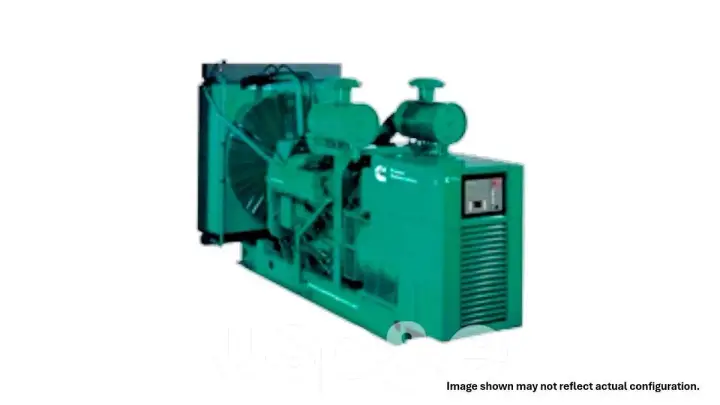
1,000 kW standby and 900 kW prime on the 30.5 L V-12, the Cummins standard at the 1 MW node
This model is part of SecondWatt’s generator research catalogue. Specifications and price observations are included where supported by sources. Equipment availability and commercial terms require confirmation.
Cummins QST30-G5 (DQFAD) genset dossier: 1,000 kW rating, specs, used pricing from 175,000 USD versus 349,900 USD new, inspection checklist.
The Cummins QST30-G5 is a 60 Hz G-Drive build of the 30.5 L V-12 QST30 (140 x 165 mm, twin-turbo, Quantum full-authority electronic injection at 1,100 bar), powering the DQFAD genset at 1,000 kW standby and 900 kW prime. Gross engine output runs 1,112 kWm standby at 1,800 rpm, burning 272.3 L/hr at full standby load, with PowerCommand controls, UL 2200 listed packages, and EPA Tier 2 emergency certification; the Tier 4 Final node is the DQFAH package.
DQFADs carry 1 MW standby duty at data rooms, hospitals, and industrial plants, competing head-on with the CAT C32. Fleet standardization on PowerCommand electronics and the nationwide Cummins distributor network keep the model on repeat-buyer shortlists.
The used market is priced but compressed: a 10,921-hour 2007 unit asked 307,900 USD against 349,900-350,000 USD for new units, meaning used asks ran 85-90% of new money in the 2026 supply crunch. Low-hour units at 175,000 USD (2015, 263 hours; 2021, 6 hours) show the bid-ask dispersion buyers can still exploit.
Why it matters
The QST30 shows the 2026 market's compression at its starkest: used asks at 85-90% of new pricing, the clearest arbitrage signal in the category for sellers, and a warning marker for buyers. A published new-unit anchor near 350 USD per kW makes this one of the few nodes where new, surplus, and used pricing can be laddered precisely.
Who buys it
Data rooms, hospitals, municipalities, and industrial plants buy DQFADs at the 1 MW node; fleet standardization on Cummins electronics drives repeat buyers. The trigger is the 52-70 week new-unit queue: with new units at 349,900 USD, tested used units at 175,000 USD clear fast, and even high-hour units command near-new money.
Role in the data center
Standby engine-generator at 1,000 kW behind the ATS for mid-size data rooms, or distributed N+1 rows where 1 MW blocks simplify sparing. The DQFAD burns 272.3 L/hr at full standby load and carries UL 2200 listed packaging.
Key specifications
| DQFAD standby / prime | 1000 / 900 kW |
|---|---|
| Engine displacement | 30.5 L (V-12) |
| Bore x stroke | 140 x 165 mm |
| Gross standby output | 1112 kWm at 1800 rpm |
| Fuel system | Quantum full-authority electronic, 1100 bar |
| Fuel, standby 100% (genset) | 272.3 L/hr |
| Fuel, prime 100% / 75% / 50% (engine) | 248 / 185 / 126 L/hr |
| Compression ratio | 14.7:1 |
| Engine dry weight | 3565 kg |
| Package weight, enclosed with 2,000 gal tank | 15967 kg |
| Emissions | EPA NSPS Tier 2, stationary emergency |
| Controller | PowerCommand 3.3 (current builds) |
| UL 2200 | Listed package |
| Speed / frequency | 1800 / 60 rpm / Hz |
Technical summary
DQFAD standby / prime: 1000 / 900 kW. Engine: QST30, 30.5 L V-12, twin turbo. Bore x stroke: 140 x 165 mm, CR 14.7:1. Gross standby: 1112 kWm at 1800 rpm. Fuel system: Quantum electronic, 1100 bar. Fuel, standby 100%: 272.3 L/hr. Fuel, prime 100% / 75% / 50%: 248 / 185 / 126 L/hr. Voltage: 277/480 V typical, PMG excitation. Engine dry weight: 3565 kg. Emissions: EPA NSPS Tier 2, stationary emergency. Controller: PowerCommand 3.3 (current), PCC 3201 earlier. Certifications: UL 2200 listed package.
Major variations
Package ladder: DFHA (750 kW) and DFHD (1,000 kW, G5 NR1) legacy, DQFAD (1,000 kW, G5 NR2, Tier 2, current), and DQFAH (Tier 4 Final with aftertreatment). G-Drive builds run G3 and G4 (50 Hz nodes) and G5 (60 Hz). The QST30 is full-authority electronic, not a PT-pump engine, which simplifies diagnostics against the KTA generation.
Configurations and options
Used units appear open, in Level 2 sound-attenuated enclosures, and enclosed with 2,000 gal class UL 142 tanks (a documented 2019 build weighed 35,202 lbs in that form). Options: PowerCommand 3.3 paralleling, PMG alternators at 277/480 V, jacket water heaters, and battery chargers. PowerCommand 3.3 is the current controller, with PCC 3201 on earlier builds.
Compatibility and dependencies
Pairs with 1,250 kVA-class ATS gear, day tanks, and 480 V switchboards. Quantum electronics diagnose through Cummins InPower tooling; Tier posture (DQFAD Tier 2 versus DQFAH Tier 4F) governs siting in strict districts. Cummins distributor coverage is nationwide. Engine dry weight is 3,565 kg, with 277/480 V and PMG excitation typical.
Pricing and availability
Market price (seller asking and transaction prices from the last 24 months, one value per seller; not a quote). used, genset package: $144–$179 per kW ($144K–$179K per unit, at 1 MW), 2 sellers, latest Sep 2026, includes undated listings. Lead time, new: 52-70 weeks. Lead time, used or refurbished: 2-8 weeks.
Supply, delivery and overhaul
1 units listed without public prices.
- Manufacturer-wide delivery estimate: 24 months
Lifecycle and maintenance
Published service economics: annual service 2,500-5,000 USD, load-bank testing 1,500-3,000 USD per year, with top-end and in-frame overhauls described as five-figure events spaced years apart under standby duty. Aftercooler and cooling-system care are flagged longevity drivers. Cummins does not publish QST30 overhaul-hour intervals; dealer assessment governs, and documented service history materially moves resale value.
Thermal and emissions profile
The DQFAD certifies EPA NSPS stationary emergency Tier 2 per the Cummins data sheet, with the DQFAH package carrying Tier 4 Final aftertreatment for non-emergency and strict-district duty. Under 40 CFR 60 Subpart IIII, non-emergency engines above 560 kW require the Tier 4 pathway. California ATCM rules and district permits govern in-state siting; legacy DFHA/DFHD packages predate current tiers and face the same grandfathering limits as other pre-tier stock.
Common failure points
- Fuel injectors — Fouling and rough running on degraded standby fuel
- Twin turbochargers — Shaft play and oil leaks on high-hour units
- Aftercooler and cooling — Thermal stress on neglected cooling systems
- Quantum ECM and sensors — Fault codes and derates from aging sensors
- Generator-end insulation — Low megger readings after storage
Inspection checklist
Package identification: DFHA/DFHD legacy versus DQFAD Tier 2 versus DQFAH Tier 4F; bands differ by 100,000+ USD. Hours: verify meter; observed bench spans 6 to 10,921 hours with price tracking hours loosely in 2026. Overhaul documentation: top-end and in-frame overhauls are five-figure events; require records. Injectors: verify service; fuel-quality fouling is the family's documented standby failure driver. Twin turbos: inspect both for shaft play and oil leaks. Quantum electronics: read fault history through InPower; verify ECM firmware support. Oil analysis: trend 2 samples; copper flags bearings, silicon flags filtration. Coolant: verify service history; aftercooler and cooling care are flagged longevity drivers. Generator end: megger stator; below 5 megohms warrants rewind pricing. Controls: PCC 3201 versus PC 3.3; paralleling config verified against destination switchgear.
Procurement channels
Priced channel: CSDG (new and used DQFADs), Alia Power, MachineryTrader dealers (Industrial Engines, Generator Source), McKain (quantity-5 new lots), and Depco. The 18-unit PGE QST30 category runs nearly all sold, a liquidity signal.
Regional notes
60 Hz US supply dominates (the G5 is a 60 Hz build); 50 Hz nodes are served by QST30-G3/G4 builds in export markets. No 50 Hz QST30 stock observed in US channels. Tier posture splits California-bound value.