Caterpillar C27 ACERT
Manufacturer: Caterpillar
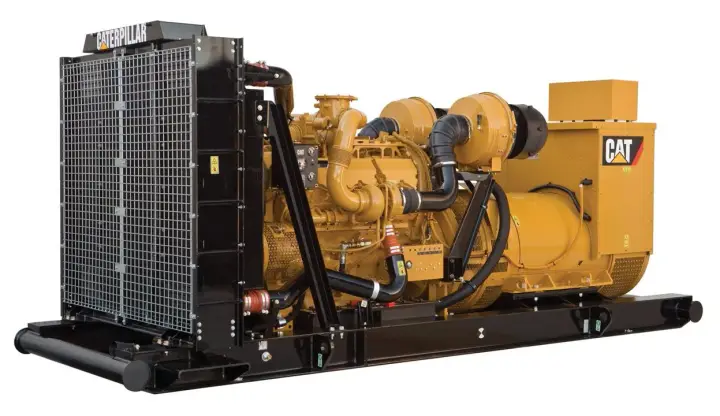
750-800 ekW standby diesel genset on the 27.03 L ACERT V-12, with prime ratings of 680 and 725 ekW
This model is part of SecondWatt’s generator research catalogue. Specifications and price observations are included where supported by sources. Equipment availability and commercial terms require confirmation.
Caterpillar C27 ACERT genset dossier: 680-800 ekW ratings, verified specs, live used pricing from 137,500 USD, and a buyer inspection checklist.
The Caterpillar C27 ACERT genset packages a 27.03 L V-12 evolved from the 3412 (produced 1983-2004) into a machine rated 750 or 800 ekW standby and 680 or 725 ekW prime at 1,800 rpm and 208-600 V. It burns 200.3 L/hr at a full 750 ekW load, with EMCP 4 controls and EPA Tier 2 emergency certification; a Tier 4 Interim variant serves non-emergency oil and gas duty.
C27s carry standby loads at mid-size data rooms, hospitals, municipal utilities, and industrial plants, and the compact 4,674 mm package at 6,622 kg dry keeps rigging simple. UL 2200 listed packages and CSA certification cover North American code paths.
The used market is liquid with published prices: August 2026 observations run from 137,500 USD (2012, 190 hours, sold) to 299,000 USD (2008, 362 hours) across dealer and CAT-dealer channels, with Machinio resale bands of 88,900-180,000 USD by vintage. Dealer guide ranges of 60,000-150,000 USD sit below live asks, the same demand-driven spread seen across the CAT line.
Why it matters
The 750 kW node is the volume tier of the standby market, and the C27 is one of its two most-traded models. Live asks at 172-399 USD per kW have decoupled from the 60,000-150,000 USD dealer guide band, and CARB-expired units trade at discounts, giving buyers real arbitrage if they can verify condition and tier.
Who buys it
Mid-size data rooms, hospitals meeting NFPA 110, municipalities, water plants, and industrial facilities buy C27s; rental fleets take enclosed units with tanks. The trigger is the same supply squeeze as the large frames: 28-130 week new-unit queues against 2-8 week used delivery, with a deep bench of sub-400-hour units from emergency service.
Role in the data center
Standby unit for mid-size data rooms and edge sites at 750-800 ekW, or distributed N+1 blocks in smaller campuses behind low-voltage ATS gear. UL 2200 listed packages and CSA certification cover the North American code paths.
Key specifications
| Standby ratings | 750 / 800 ekW |
|---|---|
| Prime ratings | 680 / 725 ekW |
| Engine displacement | 27.03 L (V-12) |
| Bore x stroke | 137.2 x 152.4 mm |
| Compression ratio | 16.5:1 |
| Speed / frequency | 1800 / 60 rpm / Hz |
| Voltage options | 208-600 V |
| Fuel at 100% load, 750 ekW | 200.3 L/hr |
| Fuel at 75% / 50% load | 154.4 / 111.2 L/hr |
| Dimensions | 4674 x 1723 x 2162 mm |
| Dry weight | 6622 kg |
| Emissions certification | EPA Tier 2, emergency stationary |
| Controller | EMCP 4 (4.2B / 4.3 / 4.4) |
| Alternator | Frame 1266, PM excitation, 2117 skVA at 30% dip |
| Standby rating, 60 Hz | 800 ekW |
| Prime rating, 60 Hz | 725 ekW |
Technical summary
Standby ratings: 750 / 800 ekW (937 / 1000 kVA). Prime ratings: 680 / 725 ekW. Engine: C27 ATAAC V-12, 27.03 L. Bore x stroke: 137.2 x 152.4 mm, CR 16.5:1. Speed / frequency: 1800 rpm / 60 Hz. Voltage: 208-600 V. Fuel at 100% / 75% / 50% (750 ekW): 200.3 / 154.4 / 111.2 L/hr. Dimensions: 4674 x 1723 x 2162 mm. Dry weight: 6622 kg. Emissions: EPA Tier 2, emergency stationary. Controller: EMCP 4 (4.2B / 4.3 / 4.4). Certifications: UL 2200 packages, CSA.
Major variations
Standby steps at 750 and 800 ekW with prime at 680 and 725 ekW; a Tier 4 Interim land-production variant serves non-emergency oil and gas service. The C27 descends from the mechanical 3412; electronic ACERT branding arrived after 2007, and vintage determines both controls generation and emissions paperwork.
Configurations and options
Used units appear open-skid, in weatherproof enclosures, and with large sub-base tanks (2,000-4,250 gal documented). Options: EMCP 4.2B through 4.4 controls, 600 V configurations for Canada, jacket water heaters, and battery chargers. Enclosed-with-tank units command the top of the price band. Voltage options run 208 to 600 V.
Compatibility and dependencies
Pairs with 1,000 kVA-class transfer switches, day tanks, and standard low-voltage switchboards. CARB status matters in California: units with expired CARB certification trade at documented discounts and face registration hurdles. EMCP 4 controls integrate directly with modern monitoring. Package dimensions are 4,674 x 1,723 x 2,162 mm at 6,622 kg dry.
Pricing and availability
Market price (seller asking and transaction prices from the last 24 months, one value per seller; not a quote). refurbished, genset package: $306–$481 per kW ($245K–$385K per unit, at 800 kW), 3 sellers, latest Sep 2026, includes undated listings. used, genset package: $399–$469 per kW ($309K–$363K per unit, at 775 kW), 2 sellers, latest Sep 2026, includes undated listings. Lead time, new: 28-78 weeks. Lead time, used or refurbished: 2-8 weeks.
Supply, delivery and overhaul
11 units listed without public prices.
Lifecycle and maintenance
Service cadence: oil and filters at 500 hours or 12 months, fuel filters at 500 hours, air filters at 1,000 hours, coolant at 6,000 hours, and a major overhaul near 20,000 hours per the family service guide and the C27/C32 O&M manual (SEBU8088). Turbo cartridges are stocked aftermarket wear items. Bare C27/C32 engines trade at 25,000-90,000 USD, which anchors repower economics against rebuild quotes.
Thermal and emissions profile
Current C27 gensets certify EPA Tier 2 for emergency stationary use per the Caterpillar spec sheet, with a Tier 4 Interim variant for non-emergency land production. Under 40 CFR 60 Subpart IIII, non-emergency units of 560 kW and above installed after 2016 require Tier 4 compliance. CARB status is a live market variable: used C27s with expired CARB certification are documented trading at discounts, and district permits above 50 bhp apply statewide in California.
Common failure points
- Fuel injectors (HEUI-era) — Fouling and hard starts past 4,380 hours on stale fuel
- Turbocharger — Reduced power and oil in intake past 15,000 hours
- Battery bank — Failed starts near 8,760 hours of calendar age
- Wet stacking — Carbon buildup from chronic low-load running
- Generator-end insulation — Low megger readings after storage
Inspection checklist
Hours and vintage: verify meter and build year; the used bench spans 2007-2022 with most units under 400 hours. Overhaul position: check against the roughly 20,000-hour major interval for the family. Injectors: fouling and hard starts emerge past 4,380 hours on degraded fuel; verify service records. Turbocharger: inspect for shaft play and oil in the intake; wear emerges past 15,000 hours on this family. Oil analysis: pull a sample; copper flags bearings, silicon flags filtration or coolant intrusion. Coolant service: verify within 6,000 hours; inspect pumps and cores. Batteries: 24 V bank replacement due near 8,760 hours or 4-5 years. Generator end: megger stator; below 5 megohms warrants rewind pricing. Controls: confirm EMCP 4 generation and firmware support. Emissions nameplate: verify Tier 2 emergency certification; check CARB status on any California-bound unit.
Procurement channels
Wide dealer channel with published prices: Depco, CSDG, Woodstock Power, React Power, and CAT dealer used desks (MacAllister, Ohio Cat, Empire, Toromont). Enclosed-with-tank units clear fastest.
Regional notes
60 Hz North American supply dominates with 600 V Canadian units in the mix (one CAD-priced Toromont listing noted). CARB status splits California-bound value. Export 50 Hz demand is served by other CAT models; the C27 genset line is 60 Hz.