Caterpillar 3516E
Manufacturer: Caterpillar
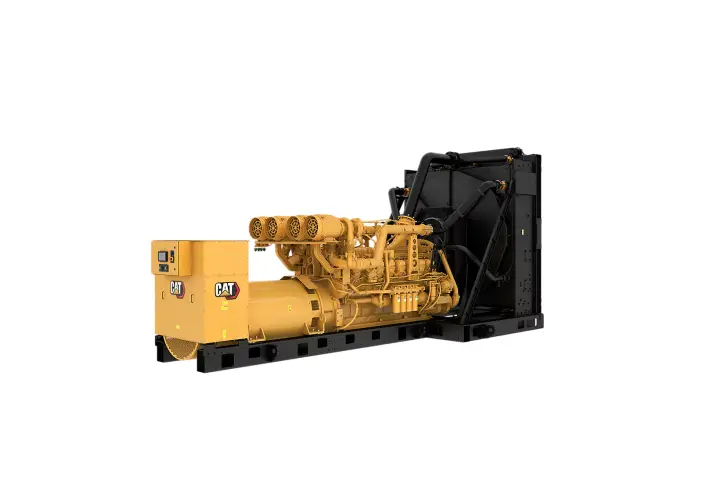
2,500-3,000 ekW standby diesel genset, the newest 3500-series generation built for hyperscale halls
This model is part of SecondWatt’s generator research catalogue. Specifications and price observations are included where supported by sources. Equipment availability and commercial terms require confirmation.
Caterpillar 3516E diesel genset dossier: 2,500-3,000 ekW ratings, verified specs, market scarcity analysis, and surplus-unit inspection checklist.
The Caterpillar 3516E is the latest generation of the 3500 family, a 78.1 L V-16 with 170 mm bore and 215 mm stroke delivering 2,500 to 3,000 ekW standby at 60 Hz and up to 3,500 kVA at 50 Hz. The published 2,750 ekW rating burns 645.8 L/hr at full load, ships EPA-certified Tier 2 for emergency stationary use, and carries Uptime Tier III/IV and TIA-942 compliance language directly on the spec sheet.
The 3516E is aimed squarely at hyperscale and large colocation standby fleets, with a Mission Critical rating equal to the standby rating and ECS or EMCP 4.4 controls. Voltages run 416 V through 13,800 V for medium-voltage plants.
The secondary market has essentially no price discovery: two known surplus units (2017 builds at 10 and 733 hours) both sold on request with no published ask, and an 83-listing 3516-family index contained no 3516E. The nearest priced proxy is a 2007 3516C HD at 799,500 USD. Buyers should treat any available 3516E as a negotiated asset priced off the 3516C HD band and the 50-110 week new-unit queue.
Why it matters
The 2.5-3 MW node is where new data center standby design is consolidating, and the 3516E is its CAT flagship. Zero public price discovery is itself the intelligence: surplus units clear instantly on request while the nearest proxy, a 3516C HD, asked 799,500 USD. The absence of a public reference price is itself the negotiating condition on any surplus unit.
Who buys it
Hyperscalers, large colocation operators, and their EPCs buy 3516Es in multi-unit standby fleets; utilities and campuses take the 3 MW node where fewer units mean simpler paralleling. The trigger is scarcity: new units queue 50-110 weeks, the used channel is empty, and the two documented surplus units both sold without ever publishing a price.
Role in the data center
Hyperscale standby block at 2,750-3,000 ekW per unit behind the paralleling bus, cutting unit count by roughly a quarter versus 2,250 kW machines in the same fleet. Its Mission Critical rating equals the standby rating.
Key specifications
| Standby / Mission Critical rating | 2750 ekW |
|---|---|
| Top 60 Hz standby step | 3000 ekW |
| Prime rating | 2500 ekW |
| 50 Hz range | 3000-3500 kVA |
| Engine displacement | 78.1 L (V-16) |
| Bore x stroke | 170 x 215 mm |
| Compression ratio | 14.7:1 |
| Fuel at 100% load, 2750 ekW standby | 645.8 L/hr |
| Fuel at 75% / 50% load | 505.8 / 370.6 L/hr |
| Voltage options | 416-13800 V |
| Dimensions | 7922 x 2640 x 3342 mm |
| Dry weight | 18480 kg |
| Emissions certification | EPA Tier 2, emergency stationary |
| Data center compliance | Uptime Tier III/IV; TIA-942 Rated 1-4 |
| Controls | Cat ECS 100/200; EMCP 4.4 |
Technical summary
Standby / Mission Critical: 2750 ekW (3438 kVA). Top 60 Hz step: 3000 ekW standby. Prime: 2500 ekW (3125 kVA). Hz: 3000-3500 kVA; 2200 ekW prime at 1500 rpm. Engine: 78.1 L V-16, 170 x 215 mm, CR 14.7:1. Fuel at 100% / 75% / 50% (2750 ekW standby): 645.8 / 505.8 / 370.6 L/hr. Voltages: 416-13800 V. Dimensions: 7922 x 2640 x 3342 mm. Dry weight: 18480 kg. Emissions: EPA Tier 2, emergency stationary. Controls: Cat ECS 100/200, EMCP 4.4 options. Compliance: UL 2200, Uptime Tier III/IV, TIA-942.
Major variations
60 Hz variants: low-voltage 2,500-3,000 ekW, a 2,750 ekW Tier 2 Low NOx build, and a high-voltage line; 50 Hz runs 2,750-3,500 kVA at 1,500 or 1,800 rpm. The widely-quoted '3,500 kW' figure verifies only as 3,500 kVA at 50 Hz; maximum verified 60 Hz standby is 3,000 ekW. Muffler grades run industrial (15 dB) to hospital (35 dB).
Configurations and options
Sold new as open units or in packager enclosures with sub-base tanks; the two documented surplus units were 13,200 V high-voltage builds with EMCP 4.2 panels. Options: ECS 100/200 controls, SR5 medium-voltage alternators, dual starters, and Low NOx configuration for permit-sensitive sites. Voltages span 416 V to 13,800 V.
Compatibility and dependencies
Requires 3,438 kVA-class paralleling switchgear, bulk fuel sized to 645.8 L/hr full-load burn, and medium-voltage integration on HV builds. Emissions posture is Tier 2 emergency only; non-emergency duty needs packager aftertreatment. ECS/EMCP 4.4 controls integrate with modern BMS platforms directly.
Pricing and availability
Comparable secondary-market band: 400000–850000 $ per unit. Trend: rising Proxies stepped up through 2026: a 2007 3516C HD at 799,500 USD, used 2,500-3,000 kW Tier 2 platforms guided at 400,000-850,000 USD, and new 2,000 kW Tier 4 packages at 1.39-1.73 million USD. Lead time, new: 50-110 weeks. Lead time, used or refurbished: on request. Warranty, used: Negotiated; CAT warranty transfer where remaining.
Supply, delivery and overhaul
2 units listed without public prices.
Lifecycle and maintenance
The 3500E platform follows family service cadence: oil and filters at 500 hours or 12 months, coolant at 6,000 hours, annual load-bank testing, and majors routinely past 20,000 hours under standby duty. The fleet is young, so calendar-based service and storage quality dominate condition.
Thermal and emissions profile
The 3516E is US EPA certified Tier 2 for emergency stationary applications per the Caterpillar spec sheet, with a Tier 2 Low NOx 60 Hz variant offered. Under 40 CFR 60 Subpart IIII, non-emergency units of 560 kW and above installed after 2016 must meet Tier 4 requirements, so prime-duty use requires packager aftertreatment. In Virginia, over 70% of permitted data center generator capacity is Tier 2 while over half of newly permitted capacity is Tier 4, mapping the regulatory direction for this class.
Common failure points
- Stored-fuel degradation — Injector fouling and hard starts on low-hour surplus units
- Generator-end insulation — Low megger readings after unpowered storage
- Turbochargers — Family wear pattern past 18,000 hours
- Cooling system — Core corrosion on stored or coastal units
- Controls software — Outdated ECS/EMCP firmware on early builds
Inspection checklist
Provenance: confirm build year and rating letter on the nameplate; the fleet is young and 2017-era surplus units dominate. Hours: most surplus 3516Es show under 1,000 hours; verify meter against commissioning and test logs. Storage condition: for surplus units, verify heater power, rotation logs, and desiccant service during storage. Injectors: verify service records; 3500-family fouling emerges past 4,380 hours on degraded fuel. Turbochargers: inspect for shaft play and oil in the intake; family wear point past 18,000 hours. Aftercooler and cooling cores: inspect for corrosion; verify coolant service within 6,000 hours. Generator end (SR5): megger stator; below 5 megohms indicates insulation risk on stored units. Controls: confirm ECS 100/200 or EMCP 4.2/4.4 generation and software support status.
Procurement channels
Surplus 3516Es surface through specialist brokers (React Power, Turnkey Industries) from cancelled projects and clear on request without published pricing. New units route through CAT dealer allocations, so direct dealer relationships rather than public listings govern availability at this node.
Regional notes
60 Hz North American allocations dominate; 50 Hz builds (3,000-3,500 kVA) serve export markets. High-voltage 13,200 V surplus units are documented in the US. Emissions siting follows the Tier 2 emergency framework with district-level Tier 4 mandates emerging.