Caterpillar C32 ACERT
Manufacturer: Caterpillar
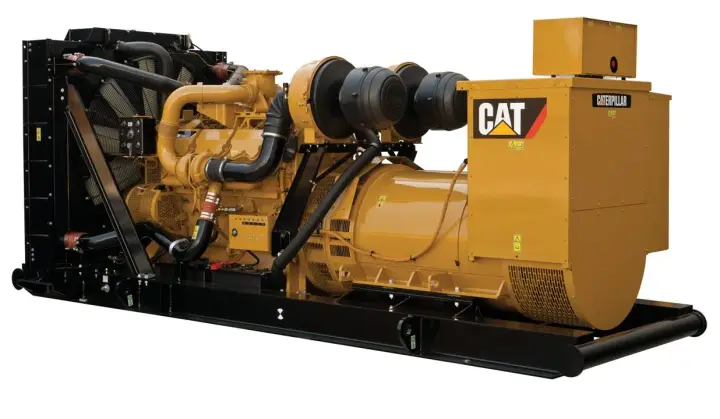
830-1,250 ekW standby diesel genset on the 32.1 L V-12, the volume machine of the 1 MW node
This model is part of SecondWatt’s generator research catalogue. Specifications and price observations are included where supported by sources. Equipment availability and commercial terms require confirmation.
Caterpillar C32 genset dossier: 830-1,250 ekW ratings, verified specs, live used pricing from 250,000 USD, Tier 4 options, and inspection checklist.
The Caterpillar C32 genset packages the 32.1 L V-12 (145 mm bore, 162 mm stroke) into 1,000 to 1,250 ekW standby ratings at 60 Hz, with Mission Critical ratings and 50 Hz builds to 1,250 kVA. The 1,250 ekW configuration burns 326.4 L/hr at full load, carries EMCP 4.2B through 4.4 controls, and certifies EPA Tier 2 for emergency stationary use; packagers add SCR/DPF for documented Tier 4 Final builds. The current cat.com packaging is the C32B at 830-1,250 ekW.
C32s anchor the 1 MW node across data rooms, hospitals, and industrial plants, compact enough (4,385 mm, 7,600 kg dry) for rooftop and tight-mechanical-yard installs.
Used supply is deep and priced: live August 2026 observations run from 250,000 USD (2016, 43 hours) through 450,000 USD (2021, 5 hours), with new-surplus 910 kW marine-spec units at 255,900 USD and a 2023 enclosed-with-tank unit sold at 412,900 USD. Machinio vintage bands run 79,000-250,000 USD, and several dealer asks above 490,000 USD look like outliers against the cluster.
Why it matters
The 1 MW standby node clears more transactions than any other in the category, and the C32 is its CAT standard-bearer. Live asks at 250-450 USD per kW have pulled far above the 80,000-200,000 USD dealer guide band, while new Tier 4 Final 1,000 kW packages at 710,000-905,000 USD set the ceiling that keeps used demand hot.
Who buys it
Data center operators at the 1 MW node, hospitals, universities, water utilities, and industrial plants buy C32s; rental fleets absorb enclosed units. The trigger is availability against 28-130 week new queues, plus emissions arbitrage: Tier 4 packaged units command 35,000-80,000 USD premiums where districts demand them.
Role in the data center
Standby engine-generator at 1,000-1,250 ekW behind the ATS for mid-size halls, or distributed N+1 rows in larger campuses where the 1 MW node simplifies maintenance sparing. The compact 4,385 mm package at 7,600 kg dry suits rooftop and tight mechanical yards.
Key specifications
| Standby ratings | 1000 / 1100 / 1250 ekW |
|---|---|
| Prime ratings | 910-1136 ekW |
| 50 Hz prime | 880 ekW at 1500 rpm |
| Engine displacement | 32.1 L (V-12) |
| Bore x stroke | 145 x 162 mm |
| Fuel at 100% load, 1250 ekW standby | 326.4 L/hr |
| Fuel at 75% / 50% load | 238.8 / 164.0 L/hr |
| Voltage options | 220-4160 V |
| Dimensions | 4385 x 2228 x 2194 mm |
| Dry weight | 7600 kg |
| Emissions certification | EPA Tier 2 emergency; Tier 4F via packager SCR/DPF |
| Controller | EMCP 4.2B / 4.3 / 4.4 |
| Certifications | UL 2200, CSA, IBC seismic |
| Speed / frequency | 1800 / 60 (1500 / 50) rpm / Hz |
| Standby rating, 60 Hz | 1250 ekW |
| Prime rating, 60 Hz | 1136 ekW |
Technical summary
Standby ratings: 1000 / 1100 / 1250 ekW. Prime ratings: 910-1136 ekW. Hz: 880 ekW prime / 1100 kVA at 1500 rpm. Engine: C32 TA V-12, 32.1 L. Bore x stroke: 145 x 162 mm. Fuel at 100% / 75% / 50% (1250 ekW): 326.4 / 238.8 / 164.0 L/hr. Voltage: 220-4160 V. Dimensions: 4385 x 2228 x 2194 mm. Dry weight: 7600 kg. Emissions: EPA Tier 2 emergency; Tier 4 Final via packager SCR/DPF. Controller: EMCP 4.2B / 4.3 / 4.4. Certifications: UL 2200, CSA, IBC seismic.
Major variations
Rating steps at 1,000, 1,100, and 1,250 ekW standby; the current EP packaging is the C32B (830-1,250 ekW), while C32 ACERT units fill the used market. Marine-spec 910 kW gensets cross into land service as new surplus. Compression ratio differs by build (14.0:1 60 Hz EP, 15.0:1 international), and Tier 4 Final exists via packager SCR/DPF.
Configurations and options
Used-market forms: open skid, weatherproof and sound-attenuated enclosures, and enclosed units with 3,600 gal class UL 142 tanks. Options: EMCP 4.x or GCCP controls on GC packaging, 4,160 V alternators, jacket water heaters, and packager Tier 4 aftertreatment (Safety Power SCR/DPF documented). Voltage options run 220 to 4,160 V.
Compatibility and dependencies
Pairs with 1,563 kVA-class ATS or switchboards, day tanks, and standard 480 V distribution; 4,160 V builds need MV gear. Tier posture governs siting: Tier 2 emergency federally, packager Tier 4 where districts mandate it, and CARB-certified units documented for California. EMCP generation sets monitoring integration effort.
Pricing and availability
Market price (seller asking and transaction prices from the last 24 months, one value per seller; not a quote). refurbished, genset package: $258–$366 per kW ($258K–$366K per unit, at 1 MW), 2 sellers, latest Sep 2026, includes undated listings. Lead time, new: 28-78 weeks. Lead time, used or refurbished: 2-8 weeks.
Supply, delivery and overhaul
17 units listed without public prices.
Lifecycle and maintenance
Family cadence per the SEBU8088 O&M manual and service guides: oil and filters at 500 hours or 12 months, coolant at 6,000 hours, majors near 20,000 hours under standby duty. Marine fleet data cites MTBF above 1,200 hours at a 95% reliability rating in that harsher environment. Turbo cartridges are stocked wear items, and bare C27/C32 engines trade at 25,000-90,000 USD, anchoring repower against rebuild economics.
Thermal and emissions profile
C32 gensets certify EPA Tier 2 for stationary emergency use per Caterpillar documentation, with Tier 4 Final achieved through packager SCR/DPF systems (a Safety Power-equipped new-surplus unit is documented) and CARB-certified units present in the used market. Under 40 CFR 60 Subpart IIII, non-emergency units of 560 kW and above installed after 2016 require Tier 4. The 2026 pricing guide documents a 35,000-80,000 USD Tier 4-versus-Tier 2 premium in this class.
Common failure points
- Turbocharger — Shaft play and oil leaks on hard-run units
- Fuel injectors — Fouling and rough running past 4,380 hours
- Aftercooler (early ACERT) — Early-production issues, since resolved; core clogging on neglected units
- Oil consumption — Elevated burn under heavy load on high-hour units
- Carbon buildup — Wet stacking from chronic low-load standby duty
- Generator-end insulation — Low megger after unpowered storage
Inspection checklist
Hours and vintage: verify meter and build year; live bench spans 2006-2023 with many sub-100-hour units. Overhaul position: check against the roughly 20,000-hour family major interval. Injectors: verify service; fouling emerges past 4,380 hours on degraded fuel. Turbochargers: check shaft play and oil in intake; early-production C32 ACERT aftercooler issues were resolved, but inspect cores. Aftercooler: inspect for clogging and corrosion; family thermal-management dependency. Oil analysis: copper flags bearings, silicon flags filtration or coolant leak; trend 2 samples. Oil consumption: document consumption under load; a noted C32 wear signal on hard-run units. Generator end: megger stator; below 5 megohms warrants rewind pricing. Controls: identify EMCP 4.x or GCCP generation and firmware support.
Procurement channels
Deep priced channel: Depco (new-surplus and enclosed units), MachineryTrader dealer asks (ARC, MacAllister, Powersafe), IMP and CSDG call-for-price stock, and Machinio vintage bands. Two dealer asks above 490,000 USD sit well outside the 250,000-450,000 USD cluster and are not representative.
Regional notes
60 Hz North American units dominate; 50 Hz international builds (880 ekW prime at 1,500 rpm) serve export markets. Marine-spec 910 kW new-surplus units cross into land duty. CARB and SCAQMD posture split California-bound value.