Cummins QSK50 / KTA50-G9
Manufacturer: Cummins
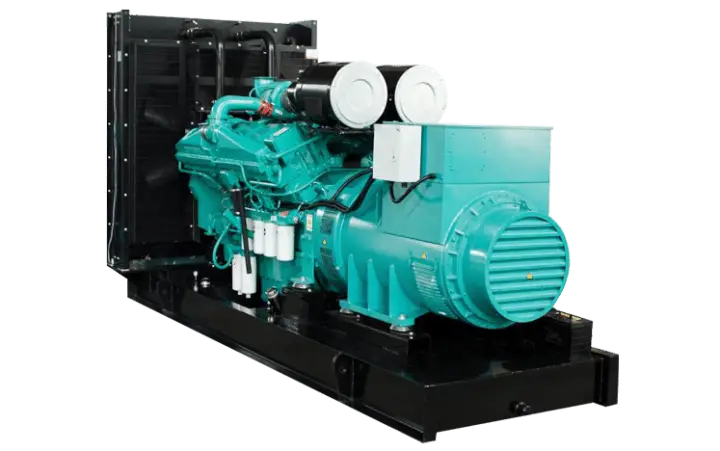
1,250-1,500 kW standby diesel gensets on the Cummins 50 L V-16, from KTA50 workhorse to QSK50 Tier 4
This model is part of SecondWatt’s generator research catalogue. Specifications and price observations are included where supported by sources. Equipment availability and commercial terms require confirmation.
Cummins QSK50 and KTA50-G9 genset dossier: 1,250-1,500 kW ratings, published specs, used pricing from 129,500 USD, and buyer inspection checklist.
The Cummins 50.3 L V-16 genset node spans two generations: the mechanical PT-injected KTA50-G9, which powers the DFLE genset at 1,500 kW standby and 1,250 kW prime, and the electronic QSK50 family (DQGAA at 1,250 kW, DQGAB at 1,500 kW standby) offered in EPA Tier 2 and Tier 4 Final. The KTA50-G9 engine delivers 1,655 kWm gross standby at 1,800 rpm and burns 392 L/hr at full standby load; the DQGAB package runs PowerCommand PCC 3201 controls with UL 2200 availability across 60 Hz low-voltage models.
These gensets carry standby duty at data rooms, hospitals, and industrial plants, with the KTA50's mechanical simplicity favored by rental and export buyers.
The used bench is real but bifurcated: low-hour DFLE units (39-229 hours, 1999-2001 builds) asked 129,500-159,900 USD in 2025-2026 dealer channels, about 86-107 USD per kW, while dealer guides band electronic QSK50 packages at 140,000-320,000 USD. One naming point matters when reading listings: Cummins' published G-Drive lineup carries no 'QSK50-G9' designation, and the 50 L '-G9' build is the KTA50-G9.
Why it matters
The KTA50/QSK50 node is the value play of the 1.5 MW class: observed low-hour asks run roughly 60% below comparable CAT 3512C money. Hours since documented overhaul is the primary value driver per dealer guides, and Cummins Power Systems' record 2025-2026 results confirm the demand backdrop that keeps absorbing this supply.
Who buys it
Hospitals, mid-size data rooms, industrial plants, and export or rental buyers take the 1.5 MW Cummins node; KTA50s go to cost-focused and international buyers while Tier 2/Tier 4 QSK50s serve permit-sensitive US sites. The trigger is price and speed: sub-250-hour DFLE units at under 110 USD per kW ship in weeks against 52-70 week new-unit queues.
Role in the data center
Standby block at 1,250-1,500 kW behind the ATS for mid-size halls; KTA50 units also serve as low-cost bridge or temp power where permits allow. Fuel planning sizes to 392 L/hr at full standby load on the KTA50-G9.
Key specifications
| DFLE standby / prime (KTA50-G9) | 1500 / 1250 kW |
|---|---|
| DQGAB standby (QSK50) | 1500 kW |
| Engine displacement | 50.3 L (V-16) |
| KTA50-G9 gross standby | 1655 kWm at 1800 rpm |
| Fuel, KTA50-G9 standby 100% | 392 L/hr |
| Fuel, prime 100% / 75% / 50% | 330 / 257 / 180 L/hr |
| Fuel system, KTA50 | Cummins PT direct injection |
| QSK50-G4 gross standby | 1529 kW at 1800 rpm |
| DQGAB voltages, 60 Hz | 208/240/480 to 2400/4160 V |
| DQGAB dimensions | 5969 x 2007 x 2840 mm |
| DQGAB dry weight | 10989 kg |
| DQGAB emissions | NSPS Subpart IIII Tier 2, stationary emergency |
| QSK50 tier options (current) | Tier 2 and Tier 4 Final |
| Controller (DQGAB) | PowerCommand PCC 3201, brushless PMG alternator |
Technical summary
DFLE genset (KTA50-G9): 1500 kW standby / 1250 kW prime. DQGAB genset (QSK50): 1500 kW / 1875 kVA standby. DQGAA genset (QSK50): 1250 kW standby. Engine: 50.3 L V-16, 159 mm bore and stroke. KTA50-G9 gross standby: 1655 kWm at 1800 rpm. Fuel, KTA50-G9 standby 100%: 392 L/hr. Fuel, prime 100/75/50/25%: 330 / 257 / 180 / 111 L/hr. Voltages (DQGAB): 208-4160 V options. DQGAB dimensions: 5969 x 2007 x 2840 mm. DQGAB dry weight: 10989 kg. Emissions: KTA50-G9 pre-tier; QSK50 Tier 2 and Tier 4F. Controller: PowerCommand PCC 3201 (DQGAB).
Major variations
KTA50-G9 (mechanical PT injection, pre-tier, DFLE package) versus QSK50 (Quantum full-authority electronic, DQGAA/DQGAB packages, Tier 2 and Tier 4F). Official QSK50 G-Drive builds are G2 through G6 (60 Hz) and G2/G3/G4/G7 (50 Hz); no 'QSK50-G9' exists.
Configurations and options
Used units appear open-skid, weatherproof, and sound-attenuated, mostly 277/480 V with PMG excitation. Options: PCC 3201 or later controls, 4,160 V alternators, jacket water heaters, and enclosures with sub-base tanks. Load-test documentation from dealer refurb programs adds resale value. Voltage options on the DQGAB run 208 to 4,160 V.
Compatibility and dependencies
Pairs with 1,875 kVA-class transfer gear and day tanks. KTA50 PT fuel systems need calibration at 6,000-hour service events and pre-tier status restricts new permits; QSK50 electronics integrate with PowerCommand paralleling. Parts flow through the worldwide Cummins distributor network. The DQGAB package measures 5,969 x 2,007 x 2,840 mm at 10,989 kg dry.
Pricing and availability
Market price (seller asking and transaction prices from the last 24 months, one value per seller; not a quote). KTA50-G3, used, genset package: $103–$132 per kW ($129K–$165K per unit, at 1.25 MW), 2 sellers, latest Sep 2026, includes undated listings. Lead time, new: 52-70 weeks. Lead time, used or refurbished: 2-8 weeks.
Supply, delivery and overhaul
- Manufacturer-wide delivery estimate: 24 months
Lifecycle and maintenance
KTA50 service cadence: oil, filters, and cooling inspection at 250 hours or 6 months; fuel filters, coolant flush, injector cleaning, and valve adjustment at 1,500 hours or annually; turbo inspection, ring work, PT pump calibration, and bearing checks at 6,000 hours or 2 years. A full major on a KTA50 is a planned event, and hours-since-major govern valuation per dealer guides. QSK50 electronics follow PowerCommand service tooling through Cummins distributors.
Thermal and emissions profile
The KTA50-G9 predates EPA tiers and sells with no tier rating; pre-2007 units are grandfathered for existing emergency service under 40 CFR 60 Subpart IIII applicability dates, but new installations require certified engines. Current QSK50 gensets ship EPA Tier 2 for stationary emergency use (the DQGAB sheet certifies NSPS Subpart IIII Tier 2) with Tier 4 Final options for non-emergency duty. California ATCM rules and district permits govern siting statewide.
Common failure points
- Fuel filters and injectors — Power loss and rough running from clogged filters and deposits
- Water pump and heat exchanger — Corrosion-driven cooling loss
- Turbocharger — Shaft play and oil leaks by 6,000-hour service events
- Main and rod bearings — Wear signaled by oil analysis on high-hour units
- PT pump calibration (KTA50) — Cylinder power imbalance from calibration drift
- Ring and liner wear — Blow-by and oil consumption past major-interval hours
Inspection checklist
Generation check: confirm KTA50 (mechanical PT) versus QSK50 (electronic) on the dataplate; they price on different curves. Hours: verify meter; observed DFLE bench runs 39-575 hours on 1999-2001 builds. Overhaul documentation: hours since documented overhaul is the primary value driver; require records. PT fuel pump (KTA50): verify calibration at the 6,000-hour service event; drift causes power imbalance. Injectors: clean and flow-test at 1,500-hour intervals per family schedule; verify compliance. Turbochargers: inspect for shaft play and oil leaks; rebuild consideration at 6,000 hours. Water pump and heat exchanger: inspect for corrosion, a documented KTA-family wear area. Bearings: oil analysis for main and rod bearing wear; trend at least 2 samples. Rings and liners: compression or blow-by test on units past 10,000 hours.
Procurement channels
Dealer channel with published prices: Depco, CSDG (load-tested units with dated certificates), MachineryTrader, and export traders for high-hour stock. Tier 4F QSK50 surplus appears through specialist brokers.
Regional notes
US dealer stock observed is entirely 60 Hz; 50 Hz KTA50/QSK50 units circulate in export markets. Pre-tier KTA50s flow toward international and grandfathered domestic sites, while Tier 2/4 QSK50s serve permit-constrained US installs.