Caterpillar 3512C
Manufacturer: Caterpillar
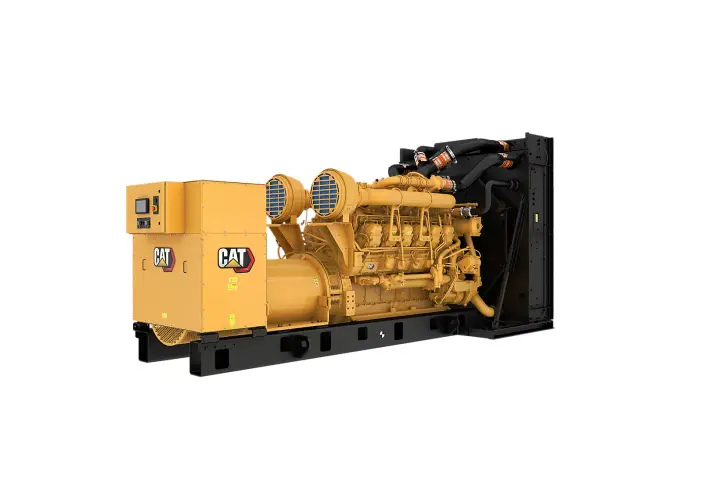
1,230-1,750 kW standby diesel genset on the 3500-series V-12 platform trusted for data center backup
This model is part of SecondWatt’s generator research catalogue. Specifications and price observations are included where supported by sources. Equipment availability and commercial terms require confirmation.
Caterpillar 3512C diesel genset dossier: 1,230-1,750 kW ratings, verified specs, live used pricing from 349,900 USD, inspection checklist, failure points.
The Caterpillar 3512C is the current electronic generation of the 3512 diesel genset, a 51.8 L V-12 on the 3500-series platform in production since 1980. Standard 60 Hz ratings run 1,230 to 1,500 ekW with a long-stroke HD variant at 1,750 ekW standby, at 1,800 rpm and voltages from 220 to 13,800 V. It burns 396.9 L/hr at full 1,500 ekW load and ships EPA-certified Tier 2 for stationary emergency use.
The 3512C carries standby duty at data centers, hospitals, and industrial plants, where emergency classification keeps fleet hours low. The generation ladder matters to buyers: mechanical 3512s from the 1990s, electronic 3512Bs, and current 3512Cs with ADEM A4 controls trade at distinctly different levels.
Used supply is liquid and repricing fast. Four low-hour 1,500 kW units (104-194 hours) asked 349,900 to 369,900 USD at Depco in August 2026 with a CAT-dealer 2008 unit at 370,000 USD, while a 32,501-hour 3512B cleared the market at 99,900 USD. Dealer guide bands published in 2026 sit well below these live asks, a spread that tracks 50-110 week new-unit lead times.
Why it matters
The 1,500 kW class is the workhorse node of backup power, and the 3512C is its most-searched model. Caterpillar's 72.1 billion USD backlog and 72% jump in power generation retail sales have pushed low-hour used asks to roughly 233-247 USD per kW, nearly double the dealer guide bands published only months earlier. Parts and dealer support are effectively universal.
Who buys it
Data center operators and EPCs buy 3512Cs for standby blocks at 1.2-1.75 MW, alongside hospitals meeting NFPA 110, water utilities, and industrial plants. Rental fleets absorb enclosed units with tanks. The trigger is delivery: a tested low-hour unit ships in weeks while new 3500-series orders queue 50 to 110 weeks behind data center demand.
Role in the data center
Standby engine-generator behind the ATS or paralleling bus at 1.2-1.75 MW per unit, feeding the critical bus in N+1 blocks for mid-size halls and edge campuses. Fuel planning sizes to 396.9 L/hr at full 1,500 ekW load.
Key specifications
| Standby rating | 1500 ekW |
|---|---|
| Rating range, 60 Hz | 1230-1500 ekW |
| HD variant standby / prime | 1750 / 1600 ekW |
| Engine displacement | 51.8 L (V-12) |
| Bore x stroke | 170 x 190 mm |
| Speed / frequency | 1800 / 60 rpm / Hz |
| Voltage options | 220-13800 V |
| Fuel at 100% load (1500 ekW) | 396.9 L/hr |
| Fuel at 75% / 50% load | 310.9 / 219.8 L/hr |
| Dimensions, open with radiator | 5895 x 2325 x 2726 mm |
| Dry weight, open | 14121 kg |
| Emissions certification | EPA Tier 2, stationary emergency |
| Compression ratio | 14.7:1 |
| UL 2200 / NFPA 110 | UL 2200 listed config available; meets NFPA 110 |
Technical summary
Standby rating: 1500 ekW / 1875 kVA at 0.8 PF. Rating range, 60 Hz: 1230-1500 ekW (HD variant 1750 ekW). Prime rating: 1360 ekW. Engine: 3512C ATAAC V-12, 51.8 L. Bore x stroke: 170 x 190 mm. Speed / frequency: 1800 rpm / 60 Hz. Voltage options: 220-13800 V. Fuel at 100% / 75% / 50% load: 396.9 / 310.9 / 219.8 L/hr. Dimensions (open): 5895 x 2325 x 2726 mm. Dry weight (open): 14121 kg. Emissions: EPA Tier 2, stationary emergency only. Controller: EMCP 3.1/3.3 (earlier), EMCP 4 current.
Major variations
Generation ladder: mechanical 3512 (1990s), 3512B (electronic unit injection, ADEM), 3512C (MEUI-A injectors, ADEM A4, current), and 3512C HD (58.6 L long-stroke block, 1,750 ekW standby). Emissions vintage splits the used market: pre-tier, Tier 2 emergency, and Tier 4 packaged units price on different curves.
Configurations and options
Used units appear open-skid, in weatherproof or sound-attenuated enclosures, and as containerized modules with UL 142 sub-base tanks. Common options: paralleling switchgear, EMCP 3.x or 4.x controls, jacket water heaters, dual starters, and 4,160 V or 13.8 kV alternators for medium-voltage plants. EMCP 4 is the current control generation.
Compatibility and dependencies
Pairs with automatic transfer switches or paralleling switchgear sized for 1,875 kVA, day tank and bulk fuel storage, and exhaust after-treatment where permits demand it. EMCP generation determines monitoring integration; SR4B alternator rewinds run 8,000-15,000 USD and replacements 15,000-25,000 USD when the generator end needs work.
Pricing and availability
Published price range: $349,900 - $370,000. Trend: rising Dealer guide bands published July 2026 put 3512Cs at 95,000-185,000 USD and the HD at 120,000-250,000 USD, reflecting pre-surge levels. Live August 2026 asks for low-hour 1,500 kW units run 349,900-370,000 USD, roughly double the guide top, while a 32,501-hour 3512B cleared at 99,900 USD, showing how hours and demand now split the market. Lead time, new: 50-110 weeks. Lead time, used or refurbished: 2-8 weeks. Warranty, used: 30-day dealer typical; 6-month on rebuilt units.
Supply, delivery and overhaul
13 units listed without public prices.
Lifecycle and maintenance
Top-end overhauls fall at 12,000-15,000 hours and majors at 24,000-30,000 hours on the 3512 platform, with oil and filters at 500 hours or 12 months and coolant at 6,000 hours. Standby units accumulate hours slowly, so calendar-based service and fuel quality dominate condition. Alternator-end economics are published: SR4B rewinds 8,000-15,000 USD, replacements 15,000-25,000 USD.
Thermal and emissions profile
Current 3512C gensets are US EPA certified Tier 2 for stationary emergency use only, per the Caterpillar spec sheet, which under 40 CFR 60 Subpart IIII limits operation to emergency service plus roughly 100 hours per year of maintenance and testing. Non-emergency or prime service in this class requires Tier 4 pathways. California ATCM rules and districts such as South Coast AQMD, which now requires Tier 4 Final for new stationary emergency engines of 1,000 BHP and above, constrain siting of used Tier 2 units.
Common failure points
- Fuel injectors (MEUI-A) — Rough running and hard starts past 4,380 hours on degraded fuel
- Turbochargers (x4) — Reduced power, oil in intake, noise past 18,000 hours
- Wet stacking — Carbon buildup and glazed liners from low-load standby running
- Main and rod bearings — Elevated copper in oil analysis preceding failure
- Generator-end insulation — Megger readings below 5 megohms after storage without heaters
- Coolant system — Thermostat, pump, and blocked-core overheating on neglected units
Inspection checklist
Hours and duty history: verify hour meter against logs; standby units should show under 500 hours per service year. Overhaul position: check hours against the 12,000-15,000-hour top-end and 24,000-30,000-hour major intervals. Oil analysis: pull sample; elevated copper flags bearing wear and high silicon flags filtration failure or coolant leak. Wet stacking: inspect exhaust for unburned fuel evidence from low-load running; require a load-bank run before purchase. Injectors: MEUI-A injector fouling typically emerges past 4,380 hours; verify service records or budget a set. Turbochargers: check all four turbos for shaft play and oil in the intake; wear emerges past 18,000 hours. Aftercooler cores: inspect for clogging and corrosion; core condition is critical to 3500-series thermal management. Generator end: megger the SR4B stator; below 5 megohms indicates insulation breakdown risk.
Procurement channels
Deep dealer channel: Depco, Woodstock Power, Generator Source, CSDG, and CAT dealer used desks (MacAllister, HOLT, Empire) list units with published prices; MachineryTrader indexes 80 3512 listings. Auction supply moves through IronPlanet and Ritchie Bros with sold prices login-gated.
Regional notes
60 Hz units dominate North American supply; 50 Hz needs are served by the 3512 export line (1,000-1,400 kVA). Emissions vintage governs siting state by state, with California districts the most restrictive for used Tier 2 units.