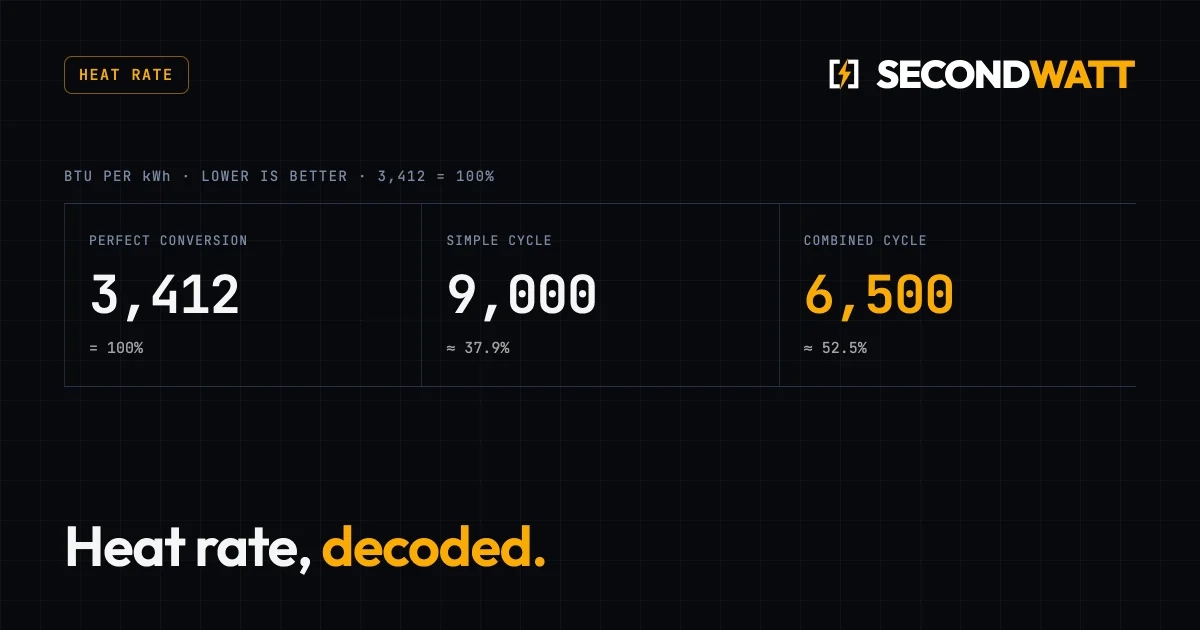
Gas turbine efficiency is the share of fuel energy that comes out as electricity. Heat rate states the same fact the other way round: the fuel energy burned for each kilowatt-hour, in Btu or kilojoules. A higher efficiency means a lower heat rate, and one converts to the other with a single division.
Comparing two gas turbines takes more care than reading two numbers. OEMs publish ratings on different bases: lower or higher heating value, gross or net output, ISO or site conditions, with or without inlet and exhaust losses. Two figures compare only when every one of those matches, so a buyer reads the basis before the number.
Key Takeaways
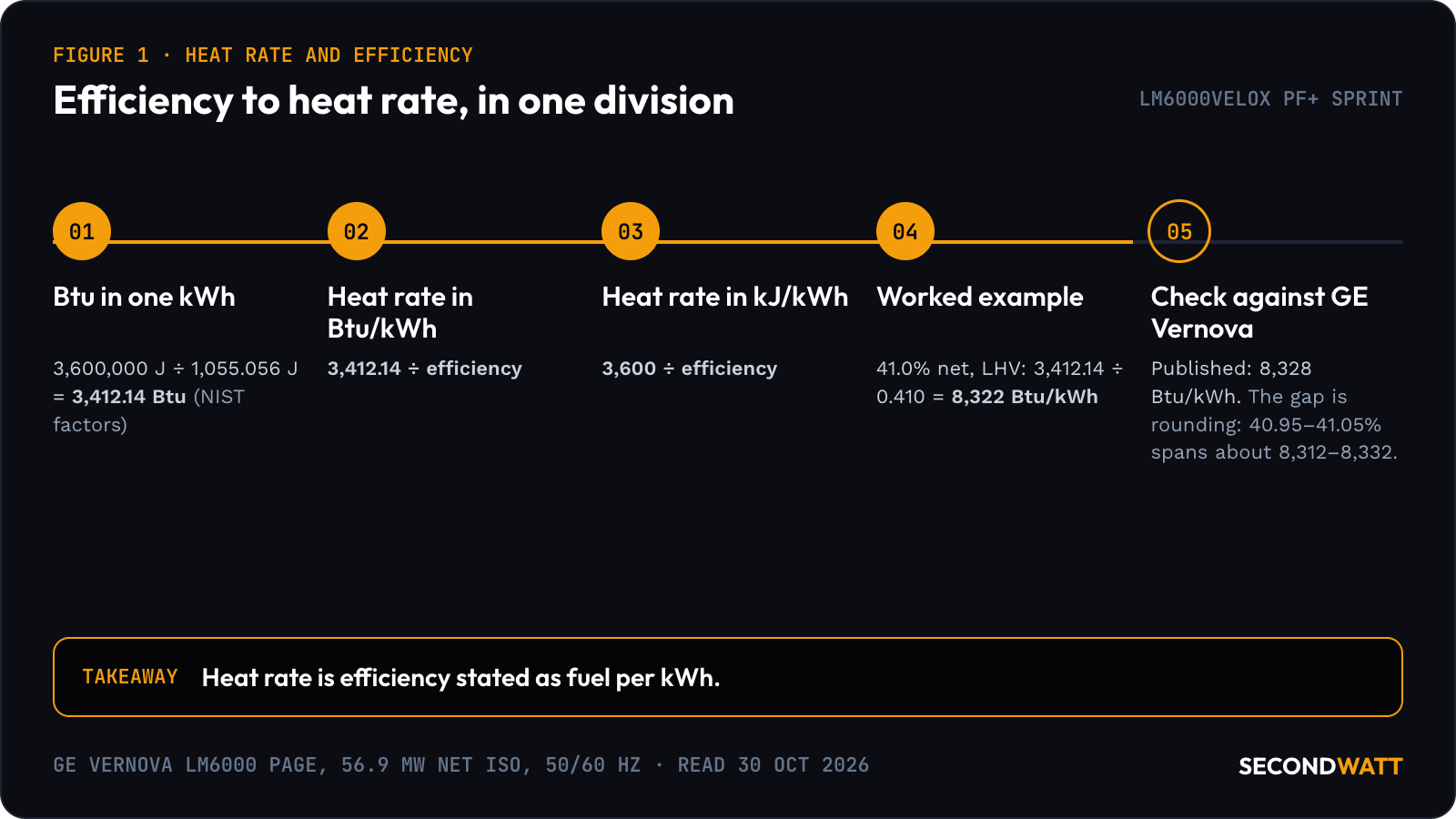
- Heat rate is efficiency stated as fuel per kWh. Divide 3,412.14 by efficiency to get Btu/kWh: GE Vernova's 41.0% LM6000VELOX PF+ Sprint rating works out to 8,322 against 8,328 published.
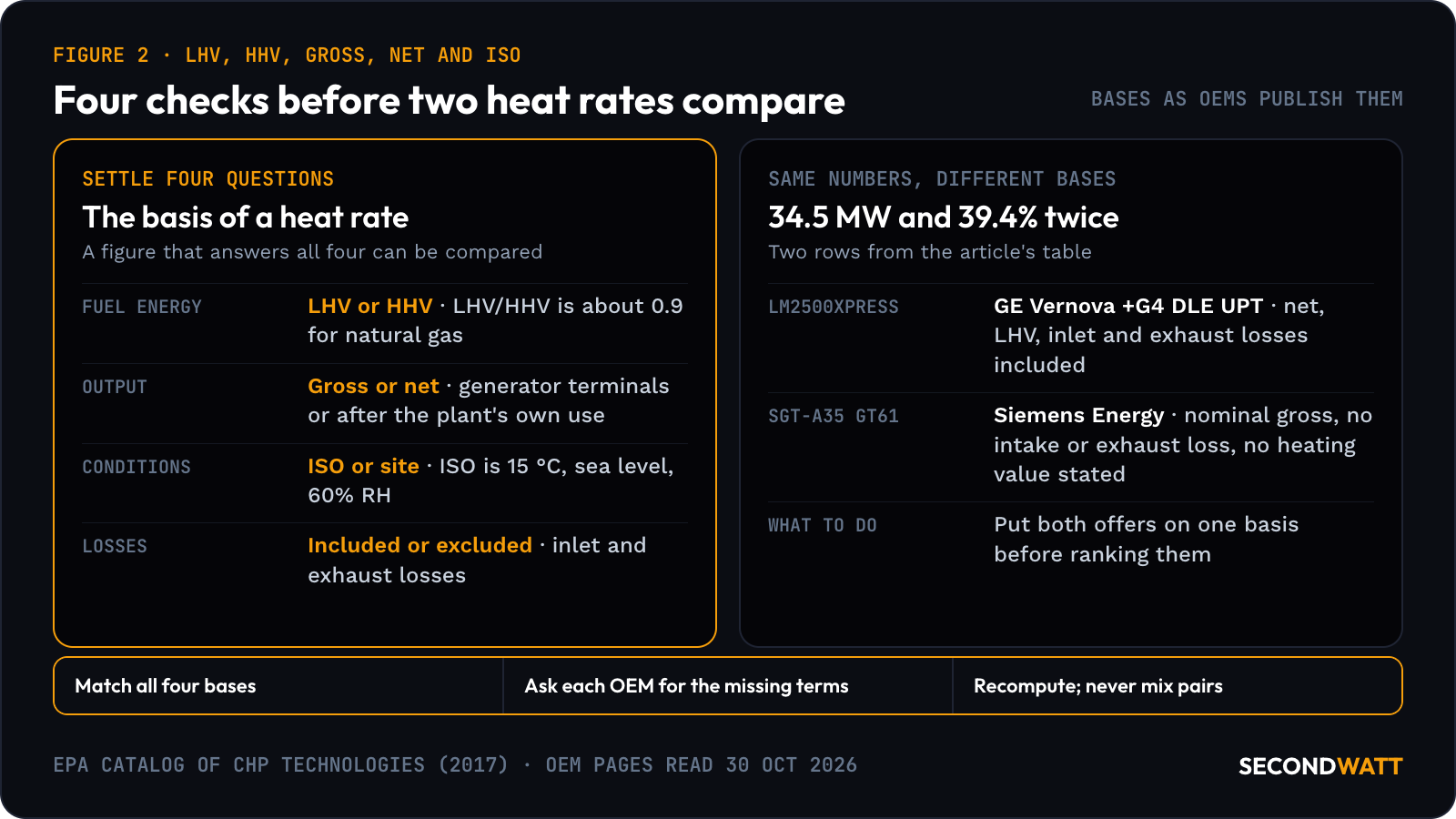
- Two heat rates compare only on one basis. Match LHV or HHV, gross or net output, ISO or site conditions, and inlet and exhaust losses included or excluded.
- OEM simple-cycle efficiency spans 27.7% to 44.0% across the 25 models compared. Each figure sits on its OEM's stated basis, and several OEMs leave part of that basis unstated.
- Hot inlet air, part load and fouling raise heat rate above the ISO figure. Altitude cuts output but has only a very slight effect on efficiency, by EPA's account.
- A steam bottoming cycle lifts frame efficiency past 50%. GE Vernova rates the 7E.03 at 33.8% in simple cycle and 52.4% in a 1x1 combined cycle, both net LHV.
What gas turbine efficiency means#
Heat rate is the amount of energy a generator or power plant uses to generate one kilowatt-hour of electricity. In its FAQ on power plant efficiency, EIA expresses it in Btu per net kWh. Net generation is what the plant sends to the transmission line after its own consumption.
Efficiency is the electrical output divided by the fuel energy in, as a percentage. A turbine at 40% turns 40 units of fuel energy into electricity, and the other 60 leave as heat. Combined cycle and CHP plants put part of that heat to work.
The fuel side of the ratio carries a choice of heating value, and the electrical side a choice of gross or net output. Those two choices, plus the ambient conditions behind the rating, decide whether two published figures can be set side by side.
Heat rate and efficiency: the conversion#
Appendix B.8 of the NIST Guide to the SI gives one kilowatt-hour as 3.6 million joules and one international-table Btu as 1,055.056 joules. So one kilowatt-hour holds 3,600,000 ÷ 1,055.056 = 3,412.14 Btu. EIA rounds the same figure to 3,412 Btu in its FAQ.
The heat rate calculation follows directly:
- Heat rate (Btu/kWh) = 3,412.14 ÷ efficiency
- Heat rate (kJ/kWh) = 3,600 ÷ efficiency
- Efficiency = 3,412.14 ÷ heat rate in Btu/kWh, or 3,600 ÷ heat rate in kJ/kWh
As a worked example, take the LM6000VELOX PF+ Sprint, a version of the LM6000. GE Vernova's LM6000 page lists it at 56.9 MW net ISO output, 41.0% net efficiency and 8,328 Btu/kWh net heat rate, LHV, for 50 Hz and 60 Hz. The conversion gives 3,412.14 ÷ 0.410 = 8,322 Btu/kWh. The 6 Btu gap is rounding: any efficiency from 40.95% to 41.05% rounds to 41.0%, and that band spans about 8,312 to 8,332 Btu/kWh.
Published pairs do not always agree to the last digit. The same GE Vernova table gives 8,800 kJ/kWh, while 8,328 Btu/kWh × 1.055056 = 8,787 kJ/kWh. Pick one unit for every row of a comparison, and recompute the other from it rather than mixing published pairs.
LHV, HHV, gross, net and ISO#
The higher heating value (HHV) of a fuel includes the heat of condensation of the water vapor in the combustion products; the lower heating value (LHV) leaves it out. For natural gas, the ratio of LHV to HHV is approximately 0.9. The September 2017 EPA Catalog of CHP Technologies notes that turbine and engine manufacturers quote heat rates on LHV. It adds that utilities measure plant heat rates on HHV and that fuel prices are given on HHV.
In its Form EIA-923 instructions, EIA asks plants to report fuel heat content "as the gross or 'higher heating value' (rather than the net or lower heating value)". The instructions carry OMB approval through July 31, 2029. The EIA glossary adds that EIA typically uses gross heat content values and that heat rates are typically expressed as net heat rates. Read EIA's heat rates, operating and tested, as net figures on that usual HHV basis.
Gross output is measured at the generator terminals; net output subtracts the power the plant uses itself. GE Vernova's aeroderivative ratings are net, with inlet and exhaust losses included and balance-of-plant equipment excluded. Baker Hughes rates its units with no inlet or exhaust losses, as Siemens Energy does on its SGT-800 and SGT-A35 pages.
ISO conditions are 15 °C (59 °F) and 60% relative humidity at sea level, as Baker Hughes states them; Mitsubishi Power gives the pressure as 1,013 hPa. Every rating in the model table below is at ISO, except where the basis cell says the OEM does not state it.
Before setting two figures side by side, settle four questions: LHV or HHV fuel energy, gross or net output, ISO or site conditions, and inlet and exhaust losses included or excluded. A figure that answers all four can be compared; one that leaves any open needs the answer from the OEM first.
Heat rate bases and where each appears (EPA, EIA and OEM rating pages)#
| Basis | What it includes | Where it appears |
|---|---|---|
| LHV | Fuel energy without the condensing heat of water vapor | OEM turbine and engine ratings |
| HHV | Fuel energy including the condensing heat; about 1/0.9 of LHV for natural gas | EIA statistics, utility heat rates, fuel purchases |
| Gross | Output at the generator terminals | Siemens Energy ratings; Mitsubishi's H-25 cogeneration figures |
| Net | Output after the plant's own consumption | GE Vernova ratings; EIA heat rates |
| ISO, losses included | ISO ambient, with inlet and exhaust losses included | GE Vernova aeroderivative ratings |
| ISO, no losses | The same ambient, with no inlet or exhaust losses | Baker Hughes ratings; Siemens Energy SGT-800 and SGT-A35 ratings |
| Site | Actual ambient, altitude, losses and load | Project guarantees and operating data |
EIA's fleet averages show what figures on the HHV basis look like. Table 8.2 of the EIA Electric Power Annual, released 21 October 2026, reports the tested averages. In 2025, US natural gas combustion turbines averaged a tested full-load heat rate of 10,975 Btu/kWh, and natural gas combined cycle units 7,535. Those averages cover electric utilities and independent power producers, weighted by net summer capacity.
The same report's Table 8.1 puts the 2025 average operating heat rate for natural gas plants in the utility and independent power producer sectors at 7,781 Btu/kWh. It excludes CHP plants and all commercial and industrial plants.
10,975 Btu/kWh — EIA's 2025 capacity-weighted average tested full-load heat rate for US natural gas combustion turbines, per net kWh on EIA's usual HHV basis.
To set an OEM LHV rating beside an EIA figure, divide it by about 0.9. On that approximation, the LM6000VELOX PF+ Sprint's 8,328 Btu/kWh LHV becomes about 8,328 ÷ 0.9 = 9,253 Btu/kWh HHV, still at ISO conditions and on GE Vernova's net basis.
Heat rates by model#
The table lists 25 turbines from OEM rating pages, sorted by heat rate from lowest to highest. Each output and efficiency is the OEM's own, on the basis it publishes. Where an OEM gives only efficiency, the heat rate is calculated as 3,412.14 ÷ efficiency; where it gives only heat rate, efficiency is 3,412.14 ÷ heat rate. Those cells are marked "calc."
Simple-cycle ratings for 25 gas turbines, sorted by heat rate (OEM product pages; basis as each OEM publishes it, not adjusted)#
| Model (OEM) | Class | ISO output, frequency | Efficiency | Heat rate, Btu/kWh | Basis as published |
|---|---|---|---|---|---|
| 9HA.02 (GE Vernova) | Heavy-duty | 571 MW net, 50 Hz | 44.0% | 7,740 | Net, LHV, ISO, natural gas |
| M501JAC (Mitsubishi Power) | Heavy-duty | 453 MW, 60 Hz | 44.0% | 7,755 | ISO base rating, LHV; gross or net not stated |
| 7HA.03 (GE Vernova) | Heavy-duty | 430 MW net, 60 Hz | 43.3% | 7,884 | Net, LHV, ISO, natural gas |
| LM9000 (Baker Hughes) | Aeroderivative | 71.4 MWe, 60 Hz | 43.1% | 7,917 calc. | ISO, no inlet or exhaust losses; LHV and gross or net not stated |
| LMS100 PA+ (GE Vernova) | Aeroderivative | 112.9 MW net, 50 Hz | 43% | 7,935 | Net, LHV, ISO, inlet and exhaust losses included |
| SGT-800, 62 MW rating (Siemens Energy) | Industrial | 62.5 MW gross, 50/60 Hz | 41.1% | 8,302 | Gross, ISO, no intake or exhaust loss; LHV not stated |
| LM6000VELOX PF+ Sprint (GE Vernova) | Aeroderivative | 56.9 MW net, 50/60 Hz | 41.0% | 8,328 | Net, LHV, ISO, inlet and exhaust losses included |
| SGT6-5000F (Siemens Energy) | Heavy-duty | 260 MW gross, 60 Hz | 40.6% | 8,400 | Gross; ISO and LHV not stated in the table |
| SGT-A35 GT61 34 MW (Siemens Energy) | Aeroderivative | 34.5 MW gross, 50/60 Hz | 39.4% | 8,660 | Nominal gross, ISO, no intake or exhaust loss; LHV not stated; non-DLE variant |
| LM2500XPRESS+G4 DLE UPT (GE Vernova) | Aeroderivative | 34.5 MW net, 50 or 60 Hz | 39.4% | 8,669 | Net, LHV, ISO, inlet and exhaust losses included |
| Titan 250 (Solar Turbines) | Industrial | 23,100 kWe | 38.9% calc. | 8,775 | ISO; LHV, gross or net and frequency not stated |
| 7F.05 (GE Vernova) | Heavy-duty | 239 MW net, 60 Hz | 38.5% | 8,871 | Net, LHV, ISO, natural gas |
| H-100 (Mitsubishi Power) | Heavy-duty | 105.7 MW, 60 Hz | 38.2% | 8,930 | ISO base rating, LHV; gross or net not stated |
| 9E.04 (GE Vernova) | Heavy-duty | 147 MW net, 50 Hz | 37.0% | 9,233 | Net, LHV, ISO, natural gas |
| FT8 MOBILEPAC (Mitsubishi Power) | Aeroderivative | 30,941 kW, 60 Hz | 36.7% | 9,312 | ISO base rating, LHV; gross or net not stated |
| NovaLT16 (Baker Hughes) | Industrial | 16.9 MW, 50/60 Hz | 36.4% | 9,374 calc. | ISO, no inlet or exhaust losses; LHV and gross or net not stated |
| H-25 (Mitsubishi Power) | Heavy-duty | 41.0 MW, 50/60 Hz | 36.2% | 9,432 | ISO base rating, LHV; gross or net not stated |
| Frame 5/2E (Baker Hughes) | Heavy-duty | 32.8 MW, 50/60 Hz | 35.8% | 9,531 calc. | ISO, no inlet or exhaust losses; LHV and gross or net not stated |
| Titan 130 (Solar Turbines) | Industrial | 16,530 kWe | 35.4% calc. | 9,630 | ISO; LHV, gross or net and frequency not stated |
| Taurus 70 (Solar Turbines) | Industrial | 8,180 kWe | 34.3% calc. | 9,955 | ISO; LHV, gross or net and frequency not stated |
| 7E.03 (GE Vernova) | Heavy-duty | 90 MW net, 60 Hz | 33.8% | 10,107 | Net, LHV, ISO, natural gas |
| 6B (GE Vernova) | Heavy-duty | 45 MW net, 50/60 Hz | 33.4% | 10,216 | Net, LHV, ISO, natural gas |
| Taurus 60 (Solar Turbines) | Industrial | 5,670 kWe | 31.5% calc. | 10,830 | ISO; LHV, gross or net and frequency not stated |
| Centaur 40 (Solar Turbines) | Industrial | 3,515 kWe | 27.9% calc. | 12,240 | ISO; LHV, gross or net and frequency not stated |
| Frame 5/1PA (Baker Hughes) | Heavy-duty | 26.6 MW, 50/60 Hz, geared | 27.7% | 12,318 calc. | ISO, no inlet or exhaust losses, average gearbox and generator efficiency assumed; LHV and gross or net not stated; LHE version |
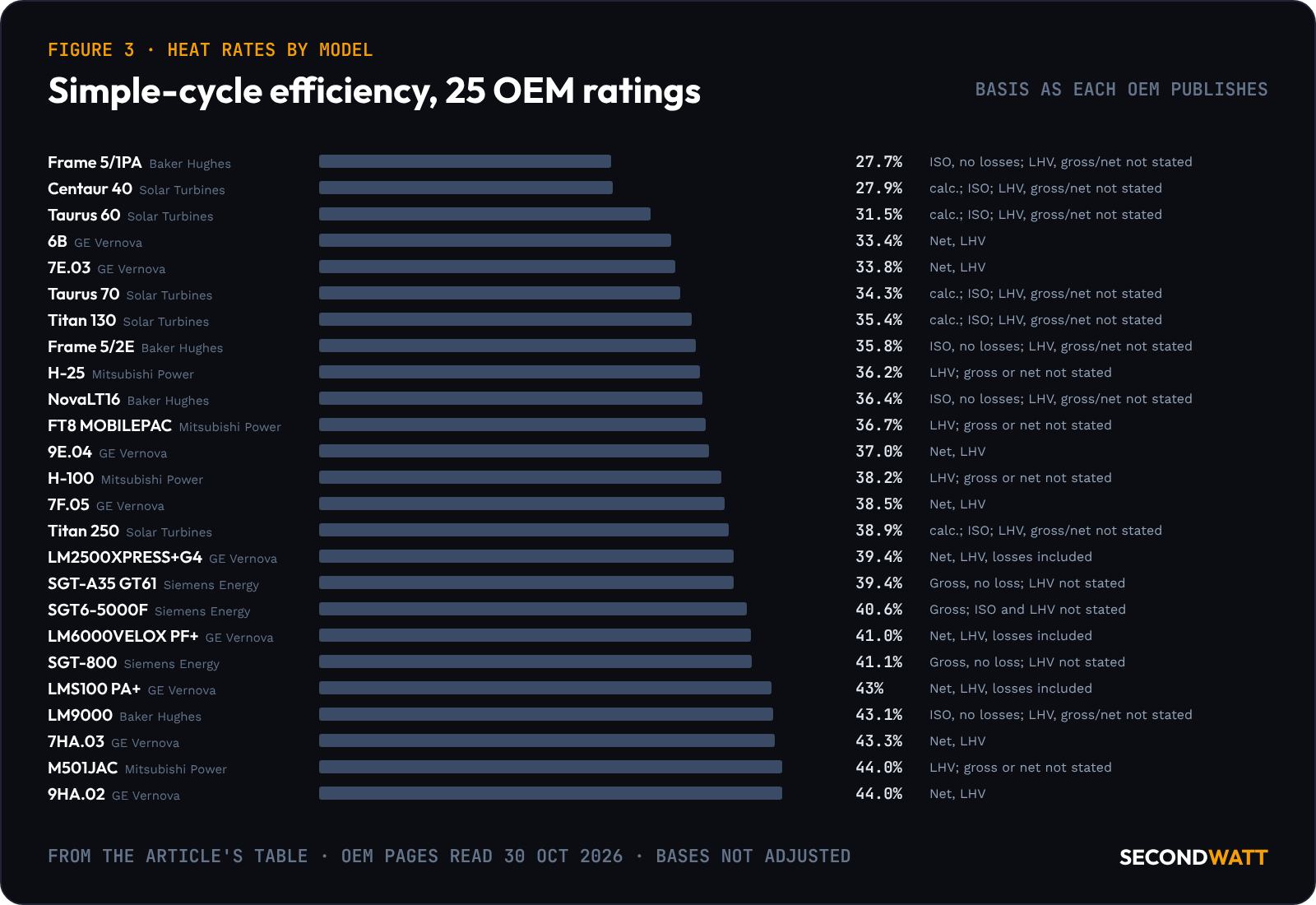
27.7% to 44.0% — the span of OEM simple-cycle efficiency across the 25 models in the table, from Baker Hughes' Frame 5/1PA to GE Vernova's 9HA.02 and Mitsubishi Power's M501JAC.
Read the table in bands. The H- and J-class frames, such as the 9HA and M501J, rate 43–44% alongside the LM9000 and LMS100 aeroderivatives, or 7,740–7,935 Btu/kWh. The industrial units rated 25 MW and under, from the Titan 250 to the Taurus 60 and Centaur 40, run from 27.9% to 38.9%. The bases differ even inside a band, so a 0.5-point gap between two rows can be a basis difference, not a performance difference.
Two rows show why the basis column matters. GE Vernova's LM2500XPRESS+G4 DLE UPT and Siemens Energy's SGT-A35 GT61 both list 34.5 MW ISO output and 39.4%. GE's figures are net, LHV, with inlet and exhaust losses included. Siemens' are nominal gross for the non-DLE variant, with no intake or exhaust loss and no heating value stated; its DLE version lists 33.7 MW gross and 39.1%.
Matching numbers on unmatched bases do not show matching performance. Put both offers on one basis before ranking them, and ask each OEM for the missing terms rather than adjusting a figure yourself.
Most rows with both figures published recompute within rounding. Two do not quite: GE Vernova's 9HA.02 lists 44.0% beside 7,740 Btu/kWh, and 3,412.14 ÷ 7,740 = 44.1%. Mitsubishi Power's FT8 MOBILEPAC lists 36.7% beside 9,825 kJ/kWh, and 3,600 ÷ 9,825 = 36.6%. Baker Hughes publishes efficiency only, so its rows, including the Frame 5 family's 5/1PA and 5/2E, carry calculated heat rates.
Solar's Titan 250 page cites "40 percent shaft efficiency", while its 8,775 Btu/kWh generator-set heat rate works out to 38.9%. The two figures measure different outputs: power at the turbine shaft and electricity from the generator set.
What changes heat rate on site#
Ambient temperature moves both output and efficiency: on Solar's Taurus 70, EPA reports output falling to 80% of the ISO rating at 100 °F and rising to 107% at 40 °F. Efficiency falls 8% at 100 °F, because the compressor needs more power to compress warmer air, and rises 2% at 40 °F. Hot inlet air therefore raises heat rate, and cold air can lower it. The derating guide works through site corrections.
Altitude thins the air and cuts output by the same percentage for every turbine. Unlike high ambient temperature, altitude changes have only a very slight impact on efficiency, by EPA's account.
Inlet and exhaust losses are part of the basis, included in some ratings and left out of others, as the model table shows. Ask each bidder to state the inlet and exhaust pressure losses behind its figure, so all offers carry the same allowance.
Part load raises heat rate. EPA notes that a gas turbine reduces output by lowering turbine inlet temperature, which also reduces efficiency. Emissions generally rise at part load, especially at half load and below. The part-load guide covers phased data center demand.
Fouling and wear add the rest. GE Vernova's 2021 GER-3620-P guide covers fouling on its heavy-duty frames. Compressor fouling that reduces airflow by 5% can cut output by up to 8% and raise heat rate by up to 3%.
Simple cycle and combined cycle efficiency#
A heat recovery steam generator turns exhaust heat into steam for a steam turbine, which adds output from heat the simple cycle rejects. Each pair below comes from one OEM document, on the basis that document states.
Simple-cycle and 1x1 combined-cycle efficiency, OEM pairs with each document's stated basis (GE Vernova fact sheets, Mitsubishi Power and Siemens Energy product pages)#
| Model (OEM) | Simple cycle | 1x1 combined cycle | Gain | Basis |
|---|---|---|---|---|
| 7E.03 (GE Vernova) | 33.8%, 90 MW | 52.4%, 140 MW | 18.6 points | Net, LHV, ISO, 60 Hz |
| 6B (GE Vernova) | 33.4%, 45 MW | 51.9%, 70 MW | 18.5 points | Net, LHV, ISO, 50/60 Hz |
| H-25 (Mitsubishi Power) | 36.2%, 41.0 MW | 54.0%, 60.1 MW | 17.8 points | LHV, 50/60 Hz; ISO stated for simple cycle; gross or net not stated |
| LM6000VELOX PF+ Sprint (GE Vernova) | 41.0%, 56.9 MW | 54.9%, 75.8 MW | 13.9 points | Net, LHV, ISO, 50/60 Hz |
| LMS100 PA+ (GE Vernova) | 43%, 112.9 MW | 51.4%, 134.6 MW | 8.4 points | Net, LHV, ISO, 50 Hz |
| SGT6-5000F (Siemens Energy) | 40.6%, 260 MW | 60.5%, 398 MW | 19.9 points | Gross, 60 Hz; ISO and LHV not stated |
| 9HA.02 (GE Vernova) | 44.0%, 571 MW | 64.1%, 838 MW | 20.1 points | Net, LHV, ISO, 50 Hz |
| M501JAC (Mitsubishi Power) | 44.0%, 453 MW | over 64.0%, 664 MW | over 20 points | LHV, 60 Hz; ISO stated for simple cycle; gross or net not stated |
The SGT6-5000F row uses the page's gross performance tables. The same page's summary text gives the 1x1 plant 387 MW and 59.6%, and its introduction gives 40.0% simple-cycle efficiency, with no basis stated for either.
Each frame pair gains at least 17.8 points; the LMS100 gains the least, 8.4 points. The heat rate falls with it. On GE Vernova's May 2025 7E fact sheet, the 7E.03 drops from 10,107 to 6,514 Btu/kWh, 35.5% less fuel per kWh. The trade-offs of adding the steam cycle sit in simple cycle vs combined cycle.
From heat rate to fuel use#
Fuel per hour is output times heat rate. For the LM6000VELOX PF+ Sprint at its ISO rating:
56,900 kWh per hour × 8,328 Btu/kWh = 473.9 MMBtu per hour, LHV
Gas is priced on HHV, so divide by about 0.9 for the purchase basis: 473.9 ÷ 0.9 = about 527 MMBtu per hour. Both figures assume ISO conditions and full load. On site, hot inlet air, losses, part load and fouling raise the fuel burned per kWh, as the site section shows.
Turning that fuel into cost per MWh needs a gas price and a dollar-year, which the operating cost guide supplies.
FAQ: gas turbine efficiency#
Is a lower heat rate always better?#
It depends on how many hours the unit runs. Fuel savings scale with hours, so a baseload plant rewards the lowest heat rate. A peaking or backup unit may value start time more: GE Vernova lists a 5-minute start for the LM6000, against a 21-minute rapid-response hot start for the 7HA.03. The aeroderivative vs industrial guide sets out that trade.
Why do EIA heat rates look worse than OEM ratings?#
Partly basis, partly source. EIA typically works on HHV, which EPA puts at about 10% above LHV for natural gas, and it counts net output after plant consumption.
EIA's figures also come from working plants. Table 8.2 holds full-load test results, and Table 8.1 is an operating average built from plant fuel and generation reports.
Can lost heat rate be recovered?#
Part of the loss is recoverable. On GE Vernova's heavy-duty frames, compressor fouling typically accounts for 70–85% of performance losses, and on-line and off-line washing address it. Erosion, blade tip rubs and larger clearances are non-recoverable, GER-3620-P notes, so some degradation remains even on a well-maintained unit. On a used unit, that makes the latest performance test, on a stated basis, a better guide than the catalog rating.
What is a good heat rate for a gas turbine?#
It depends on size and class. In the table, H- and J-class frames rate 7,740–7,884 Btu/kWh, and aeroderivatives rated above 50 MW rate 7,917–8,328, each on its OEM basis. Industrial units rated 25 MW and under rate 8,775–12,240. Judge a unit against its own class and basis.
How do reciprocating engines compare on heat rate?#
The largest lean-burn engines are more efficient than any simple-cycle turbine in the table, on EPA's general LHV figure. The EPA catalog gives natural gas engine efficiencies from about 28% LHV for engines rated under 50 kW to 46% LHV for the largest lean-burn engines. On EIA's 2025 tested figures, natural gas internal combustion units averaged 8,853 Btu/kWh against 10,975 for combustion turbines. The turbines vs engines guide weighs the rest.
Comparing turbine offers#
SecondWatt publishes equipment research and helps buyers source power equipment; it earns a fee when a sale it arranges closes. If you are buying, send a request that names your site conditions and asks each offer for heat rate on one stated basis: LHV or HHV, gross or net, and the inlet and exhaust losses assumed. If you own a turbine with its performance test records, the gas turbine seller page sets out how SecondWatt works with owners.