GE Vernova LMS100 Gas Turbines for Sale
Manufacturer: GE Vernova
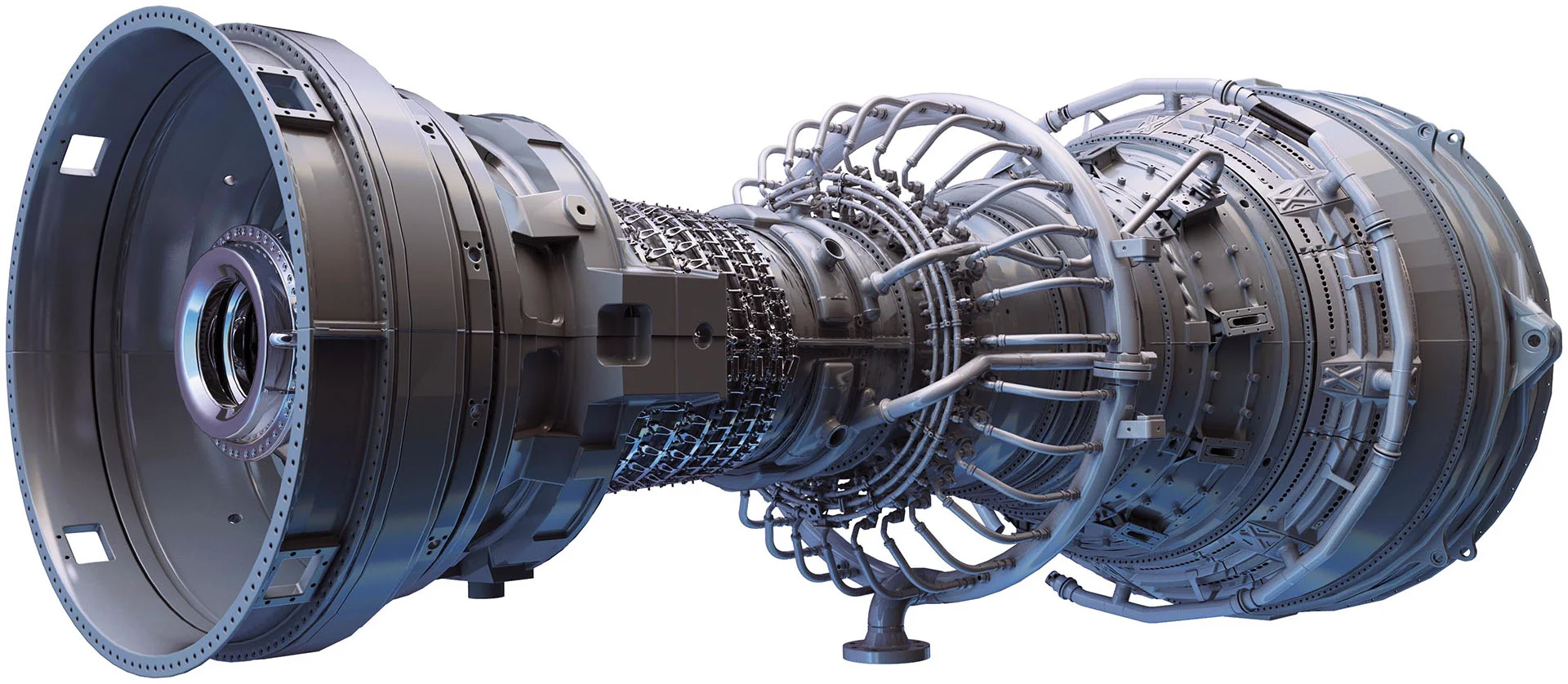
Intercooled aeroderivative gas turbine near 110 MW at 43% simple-cycle efficiency, with an 8-minute start and 50 MW/min ramp per GE Vernova.
This model is part of SecondWatt’s gas turbine research catalogue. Specifications and price observations are included where supported by sources. Equipment availability and commercial terms require confirmation.
GE Vernova LMS100 and Baker Hughes LMS100PB+ gas turbine: about 108-113 MW at 43%, intercooled design, 8-minute start, ratings and inspection intervals.
The LMS100 is the intercooled aeroderivative gas turbine sold by GE Vernova for power generation and packaged by Baker Hughes as the LMS100PB+ for LNG and industrial power. Air is cooled between the low-pressure booster and the high-pressure compressor, which Baker Hughes says cuts compressor work by 30% and allows a 42-44:1 pressure ratio. Baker Hughes describes the core as derived from the LM6000 and the booster from the first six stages of the 6FA compressor.
GE Vernova rates the LMS100 PA+ at 112.9 MW net and 43% LHV (7,935 Btu/kWh) at 50 Hz, ISO conditions with inlet and exhaust losses included, and cites an 8-minute start, a 50 MW per minute ramp rate and supercore exchange in less than four days. Baker Hughes rates its LMS100PB+ package at 108 MWe and 43% at the generator terminals and 110 MW (147,500 hp) at 44% for mechanical drive, with a free power turbine running 2,880-3,600 rpm so 50 and 60 Hz need no gearbox, and a DLE 2.1 combustor at 25 ppm NOx.
PA+ and PB+ denote different combustion arrangements and packages, and the two companies use different rating boundaries (GE Vernova net with losses; Baker Hughes at the generator terminals with no losses). Baker Hughes reports more than 70 LMS100 units in power generation with more than 800,000 combined operating hours.
Why it matters
The LMS100 combines about 43% simple-cycle efficiency with an 8-minute start and a 50 MW per minute ramp rate per GE Vernova, in a single unit near 110 MW. Assessment: that pairing of efficiency and flexibility is why it is used for peaking and firming; the trade-offs are the intercooler's cooling requirement and a larger installation than a simple aeroderivative.
Who buys it
Utilities and independent power producers buying peaking and grid-support capacity that needs fast starts and high simple-cycle efficiency, LNG developers using the LMS100PB+ as a compressor driver, industrial and combined heat and power plants, and large behind-the-meter projects sized in 100 MW blocks.
Role in the data center
Assessment: a 100-plus MW block for large campuses or for grid-firming capacity alongside other generation, one or two units per 150-300 MW phase, valued for its 8-minute start and 50 MW/min ramp per GE Vernova. Its size limits N+1 granularity, and the intercooler adds cooling-water or air-cooler scope at the site.
Key specifications
| Net output, LMS100 PA+, 50 Hz, ISO with inlet and exhaust losses (GE Vernova) | 112.9 MW |
|---|---|
| Net heat rate, LMS100 PA+, 50 Hz, LHV (GE Vernova) | 7935 Btu/kWh |
| Net heat rate, LMS100 PA+, 50 Hz, LHV (GE Vernova) | 8372 kJ/kWh |
| Net efficiency, LMS100 PA+, 50 Hz, LHV (GE Vernova) | 43 % |
| Start time (GE Vernova) | 8 minutes |
| Ramp rate (GE Vernova) | 50 MW/min |
| Supercore exchange (GE Vernova) | less than 4 days |
| Reliability / availability (GE Vernova) | 99.6 / 96.7 % |
| Power-generation output, LMS100PB+, ISO at generator terminals, no losses (Baker Hughes) | 108 MWe |
| Power-generation efficiency, LMS100PB+ (Baker Hughes) | 43 % |
| Mechanical-drive output, LMS100PB+ (Baker Hughes) | 110 (147,500) MW (hp) |
| Mechanical-drive efficiency, LMS100PB+ (Baker Hughes) | 44 % |
| NOx, DLE 2.1, 75-100% load (Baker Hughes) | <25 ppm at 15% O2 |
| Exhaust temperature, power generation / mechanical drive (Baker Hughes) | 413 / 410 C |
| Free power turbine speed range (Baker Hughes) | 2,880-3,600 rpm |
| Overall pressure ratio (Baker Hughes product page, features section) | 44:1 ratio |
| Overall pressure ratio (Baker Hughes product page, intercooling section) | 42:1 ratio |
| Compressor work reduction from intercooling (Baker Hughes) | 30 % |
| Hot-gas-path / major inspection (Baker Hughes) | 25,000 / 50,000 hours |
| Package, L x W x H / weight (Baker Hughes LMS100PB+) | 19 x 7.3 x 7 m / 232 t m / t |
| Modular solution, L x W x H (Baker Hughes) | 52 x 21 x 25 m |
| Modular solution weight (product page / 2025 overview) | just over 1,000 / 3,000 metric tons |
| Supercore exchange (Baker Hughes product page / 2025 overview) | under 2 / 3 days |
| Power-generation fleet (Baker Hughes) | 70+ units, 800,000+ operating hours units / hours |
Technical summary
GE Vernova rates the LMS100 PA+ at 112.9 MW net, 7,935 Btu/kWh (8,372 kJ/kWh) and 43% LHV at 50 Hz, ISO with inlet and exhaust losses included, and cites an 8-minute start, 50 MW/min ramp and supercore exchange in under four days. Baker Hughes rates the LMS100PB+ at 108 MWe and 43% at the generator terminals and 110 MW (147,500 hp) at 44% for mechanical drive, at ISO with no inlet or exhaust losses, with 25 ppm NOx, 413 C exhaust and a free power turbine running 2,880-3,600 rpm. Baker Hughes gives hot-gas-path and major inspections at 25,000 and 50,000 hours and a package of 19 x 7.3 x 7 m and 232 tons.
Major variations
GE Vernova lists the LMS100 PA+ (rated 112.9 MW net at 50 Hz on its product page) and the PB+; Baker Hughes packages the LMS100PB+ at 108 MWe for power generation and 110 MW for mechanical drive. Baker Hughes also offers a single-lift modular solution of 52 x 21 m at 25 m height containing the turbine, package, auxiliaries, intercooler, driven compressors and control room, with an optional full-power string test before shipment. Both 50 and 60 Hz are served by the free power turbine without a gearbox.
Configurations and options
Options that change price or lead time are the PA+ or PB+ combustion arrangement, the intercooler cooling method and its water or air-cooling scope, simple-cycle or combined-cycle configuration, mechanical-drive versus power-generation package, Baker Hughes' modular single-lift solution with an optional full-power string test, and the service agreement covering supercore exchange.
Compatibility and dependencies
The intercooler rejects heat that must go to a cooling system, so site water or air-cooling capacity is a design input. Fuel-gas supply pressure for a 42-44:1 pressure-ratio machine is high; confirm the requirement and any compression. The free power turbine covers 50 and 60 Hz without a gearbox. Baker Hughes' package is 19 x 7.3 x 7 m and 232 tons, and its modular solution 52 x 21 x 25 m.
Planning price band
Modelled planning estimate: $0.75M–$1.98M/MW · $750–$1,980/kW · $84.67M–$223.54M per unit (LMS100 PA+ (50 Hz, with losses), 112.9 MW; Used or refurbished, serviceable; very low confidence; gt-planning-v3, as of 2026-11-03). Not a quote or an observed sale price. Gas turbine generator-set package. Included auxiliaries, controls, emissions equipment (SCR), warranty and delivery terms vary by unit and are subject to confirmation. Not a project budget: BOP, installation and financing sit outside this band.
Intercooled aero at about twice the LM6000 rating; scale lowers per-kW package cost.
What drives the price
Configuration (PA+ or PB+) and packager; intercooler cooling scope; simple-cycle or combined-cycle plant; Baker Hughes modular solution and string test; service agreement terms including spare supercore access; the delivery slot; and, for used units, hours, starts and supercore inspection status.
Lifecycle and maintenance
Baker Hughes rates the LMS100PB+ at 25,000 hours to hot-gas-path inspection and 50,000 hours to major inspection. The supercore (core plus intermediate-pressure turbine, under six tons) can be exchanged in under two days per Baker Hughes' product page or three days per its 2025 overview, and in less than four days per GE Vernova. GE Vernova cites 99.6% reliability and 96.7% availability for the LMS100.
Thermal and emissions profile
Baker Hughes rates its LMS100PB+ DLE 2.1 combustor below 25 ppm NOx at 15% O2 from 75% to 100% load. GE Vernova's LMS100 product page does not list a NOx value as of October 2026. Baker Hughes states its LMS100PB+ emits 55,000 tons less CO2 per year than its main competitor at equal output.
Common failure points
- Supercore hot section — Coating loss, oxidation or cracking at the hot-gas-path inspection
- DLE combustor — Combustion dynamics or emissions drift, especially on cycling duty
- Intercooler and cooling circuit — Fouling, leaks or reduced heat rejection
- Free power turbine and bearings — Blade distress, bearing wear or rising vibration
- Generator — Insulation ageing from frequent starts
PA+, PB+ and the two rating conventions
- GE Vernova rates the LMS100 PA+ at 112.9 MW net and 43% LHV at 50 Hz with inlet and exhaust losses included. Baker Hughes rates its LMS100PB+ package at 108 MWe and 43% at the generator terminals with no losses. Keep the configuration, packager and rating basis attached to any figure.
- Request site-corrected output for the offered package, including intercooler cooling conditions.
Intercooler and site requirements
- The intercooler cuts compressor work by about 30% per Baker Hughes but rejects heat that the site must remove. Confirm whether the package uses wet or dry cooling and the water or air-cooler scope included.
Starts, maintenance and supercore exchange
- GE Vernova cites an 8-minute start and 50 MW/min ramp rate. Baker Hughes rates hot-gas-path and major inspections at 25,000 and 50,000 hours. Supercore exchange takes under two to four days depending on the source; confirm spare-core access in the service agreement.
Compare offers on
- Equipment identity — Model and build standard, serial numbers, generator and gearbox identity, controls platform and packager.
- Rating basis — ISO rating at generator terminals versus site-corrected output at the project's ambient, elevation and inlet and exhaust losses.
- Combustion and fuel — DLE NOx level, gas-only or dual fuel, fuel composition limits and the hydrogen case the combustor is guaranteed for.
- Included scope — Turbine and auxiliary skid, generator and gearbox, filter house and ventilation, controls, fuel system, enclosure and spares.
- Service and delivery — Service agreement, warranty holder, factory slot, test scope and delivery terms.
- Costs outside the offer — Step-up transformer, switchgear, interconnection, gas compression, heat recovery, civil works, permits and commissioning.
Seller checklist
- Nameplate photographs for turbine, gearbox and generator with model, build standard and serial numbers
- Operating hours, fired starts and trip history
- Hot-gas-path and major inspection reports with dates and findings
- Borescope reports and images
- Combustor configuration, fuel-system scope and any emissions test data
- Controls platform, software licences and drawings
- Generator test results and gearbox inspection records
- Service agreement status and transferability
- Preservation and storage records for stored units
- Included and excluded scope list with spares inventory
What sets the value
Value rests on records: configuration and packager, engine serial numbers, operating hours and starts, hot-gas-path and supercore inspection reports, intercooler maintenance, combustor tuning and emissions tests, generator test records, and service agreement status.
Why do GE Vernova and Baker Hughes publish different LMS100 outputs?
They rate different configurations on different boundaries. GE Vernova gives the LMS100 PA+ 112.9 MW net at 50 Hz with inlet and exhaust losses included; Baker Hughes gives its LMS100PB+ package 108 MWe at the generator terminals with no losses. Neither is a site rating.
How fast does an LMS100 start?
GE Vernova states the LMS100 can start in 8 minutes and ramp at 50 MW per minute.
Does the LMS100 need a gearbox for 50 or 60 Hz?
No. Baker Hughes describes a free power turbine with a 2,880-3,600 rpm speed range that serves both 50 and 60 Hz without a gearbox.
What are the LMS100 maintenance intervals?
Baker Hughes rates hot-gas-path inspection at 25,000 hours and major inspection at 50,000 hours for the LMS100PB+, with supercore exchange in under two to three days; GE Vernova cites supercore exchange in less than four days.
Inspection checklist
Confirm the configuration (PA+ or PB+), engine serial numbers and packager from the nameplates. Obtain operating hours, starts and trip history; peaking units accumulate starts quickly. Review hot-gas-path and supercore inspection records. Inspect the intercooler and cooling system records. Confirm NOx rating and combustor tuning. Check generator tests, vibration trends, controls licences and the service agreement, including spare supercore access.
Procurement channels
New power-generation units come from GE Vernova; Baker Hughes supplies the LMS100PB+ for LNG, industrial and combined heat and power projects, including modular single-lift solutions. For a used unit, confirm the packager, configuration and service history.
Regional notes
The free power turbine runs at 50 or 60 Hz without a gearbox. In the United States a new LMS100 falls in the large band (above 850 MMBtu/h) of NSPS Subpart KKKKa on published ratings (about 896 MMBtu/h LHV for the 112.9 MW PA+ at 7,935 Btu/kWh, calculated), where its design efficiency of about 38.8% HHV (calculated from 43% LHV) places it in the higher-efficiency low-utilization subcategory.
Content owner: Gary Martin, SecondWatt