Ansaldo Energia GT36 H-Class Gas Turbines
Manufacturer: Ansaldo Energia
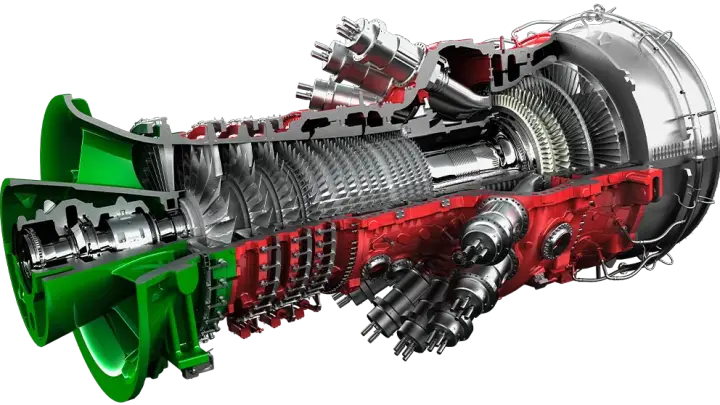
563 MW, 50 Hz H-class frame with sequential combustion, 70% hydrogen capability and 62.6-62.8% combined-cycle efficiency.
This model is part of SecondWatt’s gas turbine research catalogue. Specifications and price observations are included where supported by sources. Equipment availability and commercial terms require confirmation.
Ansaldo Energia GT36 H-class gas turbine: 563 MW at 43%, 800 MW combined cycle at 62.6%, sequential combustion, 70% hydrogen and fleet status.
The GT36 is Ansaldo Energia's H-class heavy-duty gas turbine for 50 Hz grids. Ansaldo rates the GT36-S5 at 563 MW and 43.0% at ISO conditions on natural gas, figures that include the contribution of its once-through cooler. It has a 15-stage compressor with four variable guide vane rows, a cannular sequential combustor, a 4-stage air-cooled turbine and a solid welded rotor. Like the GT26, it burns fuel in two stages in series, which Ansaldo says widens the emission-compliant load range and allows 70% hydrogen in natural gas blends, a level TUV SUD certified in September 2026. A 1+1 combined cycle gives 800 MW at 62.6%.
The design began at Alstom; Gas Turbine World reports that Alstom first conceived it as a 60 Hz machine. GE divested the GT36 programme to Ansaldo in February 2016, and Ansaldo switched the focus to 50 Hz and finished development by 2020. The first Italian-built unit, rated 538 MW at the time, was presented in Genoa in November 2020.
The frontrunner GT36 first fired in November 2022. Public reports describe units in three Italian combined-cycle plants and one in Shanghai. In July 2026 Ansaldo reported more than 80,000 EOH across the fleet and the first B1 inspection on the fleet leader.
Why it matters
It pairs H-class size with deep turndown: Ansaldo states plant minimum loads of 20% (1+1) and 10% (2+1), parking at 10% and 5%, ramp rates up to 100 MW per minute and 70% hydrogen. Gas Turbine World quotes Ansaldo saying that at base load the GT36 is not the best choice for power and efficiency; its case is cycling, ramping and part load. Assessment: the fleet is young and serviced only by Ansaldo, so availability of spares and service capacity matters as much as the rating.
Who buys it
Utilities and large independent producers in 50 Hz markets replacing coal or older gas units with high-efficiency, flexible combined cycle: three Italian plants of 770-800 MW commissioned from 2023 to 2025, a Shanghai unit in commercial operation by January 2024, and hydrogen-ready plants planned in Germany. Gas Turbine World reports reservation agreements for four units in Europe and three in advanced development in the Middle East, and strong data-center interest in Europe, the Middle East and Italy.
Role in the data center
No public GT36 data-center project exists as of November 2026. In October 2026 Ansaldo cited the GT36's 100 MW per minute ramp while discussing data-center demand, without naming a frequency or a US offer. Assessment: in 50 Hz markets an 800 MW 1+1 block could anchor grid-parallel supply to a very large campus, using its ramp and turndown to follow load.
Key specifications
| Gas turbine power output, GT36-S5, ISO, incl. once-through cooler contribution | 563 MW |
|---|---|
| Gas turbine efficiency, ISO, LHV, incl. once-through cooler contribution | 43.0 % |
| Frequency | 50 Hz |
| Exhaust mass flow / temperature (brochure) | 1,065 / 630 kg/s / C |
| Exhaust mass flow / temperature (product page) | 1,058 / 621 kg/s / C |
| Combined cycle 1+1 net output / efficiency | 800 / 62.6 MW / % |
| Combined cycle 2+1 net output / efficiency | 1,605 / 62.8 MW / % |
| Combined cycle net heat rate, 1+1 / 2+1 | 5,751 / 5,732 kJ/kWh |
| Plant minimum load, 1+1 / 2+1 | 20 / 10 % |
| Low-load operation, 1+1 / 2+1 | 10 / 5 % |
| NOx, dry gas mode (option) | 25 (15) ppm |
| CO | 10 ppm |
| Hydrogen in natural gas blends, released for operation | 70 % by volume |
| Compressor | 15 stages with 4 variable guide vanes |
| Combustion system | cannular sequential combustor |
| Turbine | 4-stage, air-cooled |
| Rotor | solid welded, cold-end generator drive |
| Hot-gas-path inspection interval | 33,000 hours |
| Ramp rate, up to | 100 MW/min |
| Reference units (brochure, March 2024) | 5 units |
| First firing of the frontrunner unit | November 2022 date |
| Fleet operating experience (July 2026) | more than 80,000 EOH |
| Rating of the first Italian-built unit (2020) | 538 MW |
Technical summary
Ansaldo Energia rates the GT36-S5 at 563 MW and 43.0% at ISO on 100% methane (LHV), including the once-through cooler contribution. Its brochure gives 1,065 kg/s exhaust at 630 C; the product page gives 1,058 kg/s at 621 C. Combined cycle: 800 MW net at 62.6% and 5,751 kJ/kWh (1+1), 1,605 MW at 62.8% and 5,732 kJ/kWh (2+1), with plant minimum loads of 20% and 10%. NOx is 25 ppm in dry gas mode with an option to 15 ppm; Gas Turbine World gives 10 ppm CO, a 100 MW per minute ramp and a 33,000-hour hot-gas-path interval.
Major variations
The current commercial rating is the GT36-S5 for 50 Hz at 563 MW including cooler contribution. Earlier ratings were 538 MW (2018-2020) and about 500 MW (2017). A 60 Hz GT36-S6 ran as the validation engine at Birr, Switzerland, from 2016, but Ansaldo's current documents list only the 50 Hz GT36-S5. Operating modes rather than hardware variants change output and service intervals: a Performance Optimized mode and an extended-lifetime mode.
Configurations and options
The GT36 is offered for 1+1 and 2+1 combined cycle and as part of power islands or EPC plants, with Ansaldo multi-year service contracts. Options include the 15 ppm NOx combustion setting, hydrogen blends up to 70%, inlet fogging, and SCR in the heat recovery steam generator, which one Italian GT36 plant uses. Ansaldo supplies the gas turbine, generator and, in some plants, the steam turbine.
Compatibility and dependencies
The GT36 is built for 50 Hz only; Assessment: it is not a candidate for a 60 Hz grid as of November 2026. Its rating includes the once-through cooler contribution. Ratings are ISO on methane, so site output falls with heat, altitude and duct losses. A single unit weighs more than 520 tonnes as shipped, so heavy-haul and port access shape site choice.
Price evidence
Price on request. Configuration, scope and dated evidence are confirmed separately for each request.
What drives the price
Assessment: scope (gas turbine only, power island or EPC plant), delivery slot, service agreement terms, hydrogen and emissions options, and site conditions drive price. Public reference values: about EUR 60 million for the first GT36 supplied to China (2018), and total plant investments of about EUR 400 million and more than EUR 450 million for two 770-800 MW Italian plants.
Lifecycle and maintenance
Gas Turbine World reports a 33,000-hour hot-gas-path inspection interval. Ansaldo calls the B1 inspection the first scheduled maintenance milestone and completed it on the fleet leader in 2026, without publishing the findings or the hours at which it falls. Ansaldo offers services from transactional work to operation and maintenance contracts. Ansaldo publishes no MTBF or starts-based interval as of November 2026.
Thermal and emissions profile
Ansaldo states NOx of 25 ppm in dry gas mode with an option down to 15 ppm; Gas Turbine World adds 10 ppm CO. 25 ppm is about 51 mg/Nm3 and 15 ppm about 31 mg/Nm3 as NO2 at 15% O2 (calculated). Hydrogen is released up to 70% by volume in natural gas blends, and a GT36 combustor ran on 100% hydrogen in a 2024 test-facility trial. Assessment: the 25 ppm setting sits just above the EU 50 mg/Nm3 limit, so an EU plant needs the 15 ppm option or SCR; one Italian GT36 plant has SCR.
Common failure points
- Combustion system — Assessment: a young, single-source sequential can combustor; no public failure record as of November 2026
- Hot-section blades and vanes — Assessment: coating and cooling condition determine the 33,000-hour hot-gas-path interval
- Once-through cooler and cooling air — Assessment: the rating depends on the cooler; its condition affects output and hot-part cooling
- Spare parts supply — Assessment: one OEM and rotor production bottlenecks reported in 2026 can lengthen outages
- Project schedule — All three Italian GT36 plants entered service later than first planned
What the GT36 rating includes
- Ansaldo's 563 MW and 43.0% include the contribution of the once-through cooler, and earlier ratings were 538 MW. Compare offers on the same basis and ask for a site rating at the project's ambient, altitude and duct losses.
Frequency and markets
- Ansaldo lists the GT36-S5 for 50 Hz only. A 60 Hz GT36-S6 ran as the validation engine, but no 60 Hz GT36 is offered as of November 2026, so the GT36 suits 50 Hz projects in Europe, the Middle East and Asia.
Delivery and support
- Ansaldo is the only supplier and service provider for the GT36. Ask for the delivery slot, the service agreement and spare-parts commitments, and note that the first B1 inspection was completed only in 2026.
Compare offers on
- Scope — Gas turbine and generator only, power island, or full EPC plant.
- Delivery slot — Factory slot, shipping date and commissioning schedule with penalties.
- Rating basis — ISO including once-through cooler, versus guaranteed site output.
- Emissions and fuel — 25 ppm or 15 ppm setting, SCR scope and hydrogen blend guarantee.
- Service agreement — Inspection intervals, parts commitments and outage durations.
Seller checklist
- Commissioning records and performance test report
- EOH and starts since commissioning
- B-inspection and other inspection reports
- Combustor and hot-section borescope images
- Once-through cooler and cooling-air records
- Emissions test results and SCR records
- Hydrogen-blend operating history
- Ansaldo service agreement and spare-parts commitments
What sets the value
Value rests on documents that prove the unit's condition and support path: commissioning records, EOH and starts, B-inspection reports, borescope images, emissions tests, the operating mode history, hydrogen-blend records and the Ansaldo service agreement, including spare-parts commitments.
How much power does a GT36 produce?
Ansaldo Energia rates the GT36-S5 at 563 MW and 43.0% at ISO conditions, including the once-through cooler contribution. A 1+1 combined cycle gives 800 MW net at 62.6% and a 2+1 gives 1,605 MW at 62.8%.
Is there a 60 Hz GT36?
Not as a current product. A 60 Hz GT36-S6 served as the validation engine from 2016, but Ansaldo's current brochure and portfolio list only the 50 Hz GT36-S5.
How much hydrogen can the GT36 burn?
Ansaldo states the GT36 is offered with up to 70% hydrogen by volume in natural gas blends, a capability TUV SUD certified in September 2026. A GT36 combustor ran on 100% hydrogen in a 2024 test-facility trial.
How long has the GT36 been in service?
The frontrunner GT36 first fired in November 2022. By July 2026 Ansaldo reported more than 80,000 equivalent operating hours across the fleet and the first B1 inspection on the fleet leader.
Can I buy a used GT36?
No used GT36 has been offered publicly as of November 2026. New units come only from Ansaldo Energia, with delivery set by its Genoa production slots.
Inspection checklist
Record the rating (GT36-S5), operating mode history and serial numbers. Obtain EOH and starts since commissioning and the date and report of the last B inspection. Request combustor and hot-section borescope images, once-through cooler and cooling-air records, hydrogen-blend operating history, emissions tests with and without SCR, and the service agreement with Ansaldo.
Procurement channels
New GT36 units come only from Ansaldo Energia, as equipment, power islands or EPC plants; GE may not sell new GT36 units under the 2015 EU merger remedies. Delivery depends on Ansaldo's Genoa production, where Gas Turbine World reports added rotor machining capacity. No GT36 has been offered on the secondary market, and Ansaldo publishes no list price as of November 2026.
Regional notes
The GT36 is offered for 50 Hz only. Operating units are in Italy and China, with hydrogen-ready plants planned in Germany. In the EU its thermal input of about 1,310 MW (calculated) falls under the Industrial Emissions Directive and the large combustion plant BAT conclusions. Projects financed under World Bank Group standards apply 51 mg/Nm3 (25 ppm) NOx on gas.
Content owner: Gary Martin, SecondWatt