Ansaldo Energia GT26 (Alstom GT26) Gas Turbines for Sale
Manufacturer: Ansaldo Energia
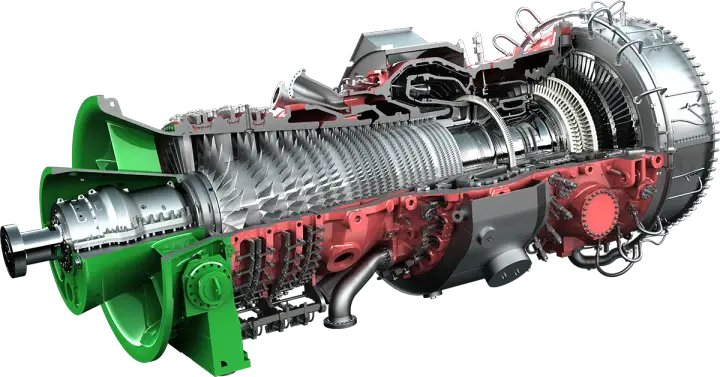
370 MW, 50 Hz F-class frame with two combustors in series (sequential combustion), the former ABB and Alstom GT26, now sold by Ansaldo.
This model is part of SecondWatt’s gas turbine research catalogue. Specifications and price observations are included where supported by sources. Equipment availability and commercial terms require confirmation.
Ansaldo Energia GT26 (Alstom GT26) gas turbine: 370 MW at 41%, sequential combustion, 61% combined cycle, 15% turndown, upgrades and known issues.
The GT26 is a 50 Hz heavy-duty F-class gas turbine with sequential combustion: an EnVironmental (EV) annular combustor feeds a 1-stage high-pressure turbine, and a second Sequential EV (SEV) annular combustor reheats the gas ahead of a 4-stage low-pressure turbine. Ansaldo Energia rates it at 370 MW gross and 41% at ISO conditions, a figure that includes the contribution of its once-through cooler, with a 22-stage compressor and a solid welded rotor. In combined cycle it gives 540 MW net at 61% (1+1) and 1,083 MW at 61.2% (2+1), and Ansaldo states a minimum plant load of 15% (1+1) because the second combustor can be turned down or off.
ABB introduced the GT26 and its 60 Hz sibling, the GT24, in the mid-1990s; ABB Review described the GT26 as a 265 MW-class machine in 1998. The design passed to Alstom through the ABB Alstom Power venture, later wholly owned by Alstom. In 2015 GE bought Alstom's power business, and on 26 February 2016 it divested the GT26 product line for new units, the GT36 programme, service contracts for 34 GT26 units and Power Systems Manufacturing to Ansaldo for EUR 120 million, while about 720 units of the Alstom installed base stayed with GE. GE Vernova still services and upgrades GT26 units and sells upgrades for the GT24.
Ansaldo states 110 GT26 units installed, 78 of them featuring Ansaldo Energia technology, with more than 9 million EOH (estimated).
Why it matters
Sequential combustion is what sets the GT26 apart: the second combustor carries load when the first is derated, so Ansaldo states 61% combined-cycle efficiency, low-load parking down to 15% of plant load and 45% hydrogen in gas blends. Two OEM channels support the fleet: Ansaldo (new units and its MXL2 and MXL3 upgrades) and GE Vernova (most of the former Alstom fleet and the GT26 HE upgrade). Turbomachinery Magazine wrote in 2016 that GT26 peak efficiency trails rivals by about a point, offset by part-load efficiency.
Who buys it
Utilities and independent producers in 50 Hz markets building large combined-cycle plants that need high efficiency and deep turndown, such as two Omani plants that took eight GT26 units in 2016; owners of existing GT26 plants in Europe, the Middle East and Japan buying upgrades and spares; and industrial users such as a Japanese steel mill whose GT26 GE Vernova upgraded. Large data center campuses in 50 Hz markets are a possible use (Assessment).
Role in the data center
No public GT26 data-center project is on record as of November 2026; Ansaldo's US data-center order uses the AE64.3A. Its October 2026 Hitachi Energy partnership targets 50 and 60 Hz markets, including data centers, without naming a model. Assessment: in 50 Hz markets a 540 MW 1+1 or 1,083 MW 2+1 GT26 block suits grid-parallel supply to a hyperscale campus, with deep turndown for low-demand periods.
Key specifications
| Gross gas turbine power output, ISO, including once-through cooler contribution | 370 MW |
|---|---|
| Gross gas turbine efficiency, ISO, LHV | 41 % |
| Gas turbine exhaust mass flow | 741 kg/s |
| Gas turbine exhaust temperature | 635 C |
| Combined cycle 1+1 net output / efficiency | 540 / 61 MW / % |
| Combined cycle 2+1 net output / efficiency | 1,083 / 61.2 MW / % |
| Combined cycle net heat rate, 1+1 / 2+1 | 5,900 / 5,882 kJ/kWh |
| Combined cycle plant minimum load, 1+1 / 2+1 | 15 / 8 % |
| Frequency | 50 Hz |
| Compressor | 22-stage axial with 4 variable guide vanes |
| Combustion system | EV annular combustor and SEV annular combustor, 24 burners each |
| Turbine | 1-stage HP and 4-stage LP, air-cooled |
| Rotor | solid welded rotor, cold-end generator drive |
| NOx, dry gas mode, down to | 15 ppm |
| Hydrogen in natural gas blends, released for operation | 45 % |
| Hot-gas-path inspection interval | 32,000 hours |
| Maintenance Cost Optimized mode, extra time between inspections, up to | 30 % |
| Installed units / with Ansaldo Energia technology (Ansaldo) | 110 / 78 units |
| Fleet operating experience (estimated) | more than 9 million EOH |
| Rating when Ansaldo took over the GT26 (2016), output / efficiency | 345 / 41 MW / % |
| Rating after Alstom's 2006 compressor upgrade | 288 MW |
| Rating reported in 2003 | 262 MW |
| MXL3 upgrade result at one plant (2023) | +37 MW, nearly 3% efficiency gain |
| Maintenance interval after MXL3 upgrade | about 40,000 EOH |
| GT26 HE upgrade (GE Vernova), up to | 25 MW, 2%+ CC efficiency gain |
Technical summary
Ansaldo Energia rates the GT26 at 370 MW gross and 41% gross efficiency at ISO conditions on 100% methane (LHV), including the once-through cooler contribution, with 741 kg/s exhaust flow at 635 C. Combined cycle: 540 MW net at 61% and 5,900 kJ/kWh (1+1), 1,083 MW at 61.2% and 5,882 kJ/kWh (2+1), with minimum plant loads of 15% and 8%. It has a 22-stage compressor with 4 variable guide vanes, EV and SEV annular combustors with 24 burners each, a 1-stage HP and 4-stage LP air-cooled turbine and a welded rotor. NOx is stated down to 15 ppm on dry gas, hydrogen up to 45%, and the hot-gas-path interval is 32,000 hours.
Major variations
Ratings have climbed by generation: 262 MW (Power Engineering, 2003), 288 MW after Alstom's 2006 compressor upgrade, 345 MW at 41% when Ansaldo took over (2016) and 370 MW including cooler contribution today. Buyers meet 'GT26 A/B' early units, 'Rating 2006' units and the 'GT26 2011' rating. Ansaldo's MXL3 upgrade, compatible with the whole GT26 fleet, added 37 MW and nearly 3% efficiency at one plant in 2023; GE Vernova's GT26 HE offers up to 25 MW and 2%+ combined-cycle efficiency. The 60 Hz GT24 is a separate machine supported by GE Vernova.
Configurations and options
The GT26 is sold for combined cycle in 1+1 single-shaft or 2+1 blocks, and as power islands with heat recovery steam generators and steam turbines. Operators can switch online between a Performance Optimized mode and a Maintenance Cost Optimized mode that gives up to 30% more operating time between inspections. Upgrade choices for installed units are Ansaldo's MXL2 and MXL3 (M mode for output, XL mode for longer intervals) or GE Vernova's GT26 HE and low part load packages.
Compatibility and dependencies
The GT26 is built for 50 Hz only; Assessment: it is not a candidate for a 60 Hz grid, where the GT24 is the family member. The rating assumes ISO conditions on methane and includes the once-through cooler contribution, so site output falls with heat, altitude and duct losses. Hydrogen blends up to 45% need no hardware change per Ansaldo. A combined-cycle block needs a large heat recovery steam generator, steam turbine and cooling system.
Price evidence
Price on request. Configuration, scope and dated evidence are confirmed separately for each request.
What drives the price
Assessment: rating generation and upgrades installed (A/B, Rating 2006, MXL2, MXL3 or HE), hours and starts against the inspection interval, rotor remaining life, combustor and compressor condition, which OEM supports the unit, and whether the offer is a turbine-generator or a full power island. For reference, Ansaldo's 2016 Omani contracts for two power islands with eight GT26 units were worth about EUR 600 million.
Lifecycle and maintenance
Ansaldo states a 32,000-hour hot-gas-path interval, and its Maintenance Cost Optimized mode allows up to 30% more operating time between inspections; with MXL3, maintenance follows after about 40,000 EOH. GE Vernova's GT26 HE runs 32,000 weighted operating hours, up to 44,000 EOH at the corner of its box, and GE offers rotor exchanges sized by hours and starts. In 2022 an OEM quoted a 46-week lead time for EV combustor structural parts. Ansaldo publishes no MTBF or starts-based interval as of November 2026.
Thermal and emissions profile
Ansaldo states NOx down to 15 ppm in dry gas mode for the GT26 and hydrogen blends up to 45% released for operation; sequential combustion keeps emissions compliant over a wide load range, with a minimum environmental load near 15% of plant load in 1+1. 15 ppm is about 31 mg/Nm3 as NO2 at 15% O2 (calculated). Ansaldo publishes no CO guarantee for the GT26 as of November 2026.
Common failure points
- Compressor row 16 locking piece — A loose locking piece found after startup on an early unit; an insurer's 2024 study recorded a liberated row 16 locking piece damaging rows 17-22
- Compressor blading — High-pressure compressor blade rubbing at a 1997 GT26 startup, fixed with clearance changes and abrasive heat shields
- EV combustor — Outer liner cracking within a few hundred hours on an early GT26; in 2022 an early GT26 A/B unit needed a complete EV combustor rebuild
- Low-pressure turbine blades — Row 2 shroud deformation from lack of impingement cooling on early GT24 units; a partial LPT4 blade liberation appears in a 2024 insurer study of Alstom units
- Rotor life — Welded rotor life is governed by hours and starts; GE Vernova offers rotor exchanges by those limits
- Spare parts for early units — Few GT26 A/B units remain; one owner used second-hand parts after a 2022 failure, against a 46-week OEM lead time
- Cycling duty — An insurer presenter in 2024 linked two-shifting of Alstom units to more forced outages
Identify the rating generation and upgrades
- GT26 units span several hardware generations: early A/B units, units on the 2006 rating, the 2011 rating and today's 370 MW rating. Installed units may carry Ansaldo's MXL2 or MXL3 upgrade or GE Vernova's GT26 HE. Each changes output, efficiency, inspection interval and parts. Ask for the upgrade certificates, not only the nameplate.
Ansaldo or GE Vernova: who supports the unit
- Ansaldo bought the GT26 new-unit line and 34 GT26 service contracts from GE in 2016, while about 720 units of the former Alstom installed base stayed with GE. Under the 2016 EU merger remedies GE kept the right to use the GT26 name for servicing. Find out which OEM holds the unit's records and service agreement before pricing it.
Inspection position
- Ansaldo states a 32,000-hour hot-gas-path interval, up to 30% longer in its Maintenance Cost Optimized mode and about 40,000 EOH after MXL3. GE Vernova counts 32,000 weighted operating hours for GT26 HE. Compare the unit's counter against the interval of its actual upgrade package.
Known early-fleet issues
- Alstom announced in 2000 that the GT24/GT26 missed contractual performance and lifetime terms, then fixed compressor locking pieces, EV liners and LP turbine blading. Confirm the modifications on any early unit, and check combustor parts lead times: an OEM quoted 46 weeks for EV structural parts in 2022.
Compare offers on
- Rating generation and upgrades — A/B, Rating 2006, 2011 or current, plus MXL2, MXL3 or GT26 HE.
- Inspection position — EOH, weighted hours and starts against the interval of the installed upgrade package.
- Rotor life — Fired starts and hours against rotor limits, and any rotor life assessment.
- OEM support — Whether Ansaldo or GE Vernova holds the records and service agreement.
- Included scope — Gas turbine-generator only or power island with HRSG, steam turbine and once-through cooler.
- Costs outside the offer — Dismantling, heavy transport, foundations, grid connection, emissions controls and recommissioning.
Seller checklist
- Nameplate and rating documents with the hardware generation
- Upgrade certificates (MXL2, MXL3 or GT26 HE) with dates
- EOH, weighted operating hours and starts since new and since the last inspections
- Hot-gas-path and major inspection reports
- Compressor, EV and SEV combustor and LP turbine borescope images
- Rotor life assessment and fired-start count
- Once-through cooler and cooling-air valve records
- Emissions test results
- Service agreement history with Ansaldo or GE Vernova
- Included and excluded scope list with spares inventory
What sets the value
Value rests on records that pin down the hardware generation and remaining life: nameplate and rating documents, upgrade certificates (MXL2, MXL3 or HE), EOH, weighted hours and starts, hot-gas-path and major inspection reports, compressor and combustor borescope images, rotor life assessment, emissions tests and the service agreement history with Ansaldo or GE Vernova.
Is the Ansaldo GT26 the same as the Alstom GT26?
Yes. ABB designed the GT26, Alstom built it from 2000, and GE divested the GT26 new-unit product line to Ansaldo Energia in February 2016 after buying Alstom's power business. GE Vernova kept most of the former Alstom installed base and still services and upgrades GT26 units.
How much power does a GT26 produce?
Ansaldo Energia rates the current GT26 at 370 MW gross and 41% at ISO conditions, including the once-through cooler contribution. A 1+1 combined cycle gives 540 MW net at 61% and a 2+1 gives 1,083 MW at 61.2%. Older units carry lower ratings, such as 288 MW after Alstom's 2006 upgrade.
Can a GT26 run at 60 Hz?
No. Ansaldo lists the GT26 for 50 Hz only. Its 60 Hz sibling, the GT24, is supported by GE Vernova, and Ansaldo's 60 Hz-capable model is the AE64.3A.
What is sequential combustion?
The GT26 burns fuel in two stages: an EV combustor ahead of a 1-stage high-pressure turbine, then an SEV combustor ahead of a 4-stage low-pressure turbine. Ansaldo states this lets the unit shift fuel between stages to hold low NOx over a wide load range, reach 15% minimum plant load and burn up to 45% hydrogen without derating.
Did the GT26 have early reliability problems?
Yes. In July 2000 Alstom announced that the GT24/GT26 could not meet contractual performance and lifetime obligations, and by March 2003 it had reached settlements on 61 of 80 units sold. Reported fixes covered compressor locking pieces, EV combustor liners and LP turbine blading.
Inspection checklist
Record the rating generation (A/B, Rating 2006, 2011, HE, MXL2 or MXL3) and which OEM holds the service records, Ansaldo or GE Vernova. Obtain EOH, weighted hours and starts since the last hot-gas-path and major inspections. Request compressor borescope images for rows 16-22 and locking-piece status, EV and SEV combustor inspection reports, LP turbine blade records, once-through cooler and valve condition, rotor life assessment and emissions tests.
Procurement channels
New GT26 units and power islands come from Ansaldo Energia, whose first post-2016 order was eight units for two Omani plants. Service and upgrades for installed units come from Ansaldo or from GE Vernova, which kept most of the former Alstom fleet and the right to use the GT26 name for servicing under the 2016 EU merger remedies. Ansaldo publishes no list price, and no used GT26 carried a public asking price on major marketplaces in November 2026.
Regional notes
The GT26 is offered for 50 Hz only; the 60 Hz GT24 is supported by GE Vernova. Public reports place GT26 plants in Europe, the Middle East and Japan. In the EU its thermal input of about 900 MW (calculated) falls under the Industrial Emissions Directive and the large combustion plant BAT conclusions. Projects financed under World Bank Group standards apply 51 mg/Nm3 (25 ppm) NOx on gas.
Content owner: Gary Martin, SecondWatt