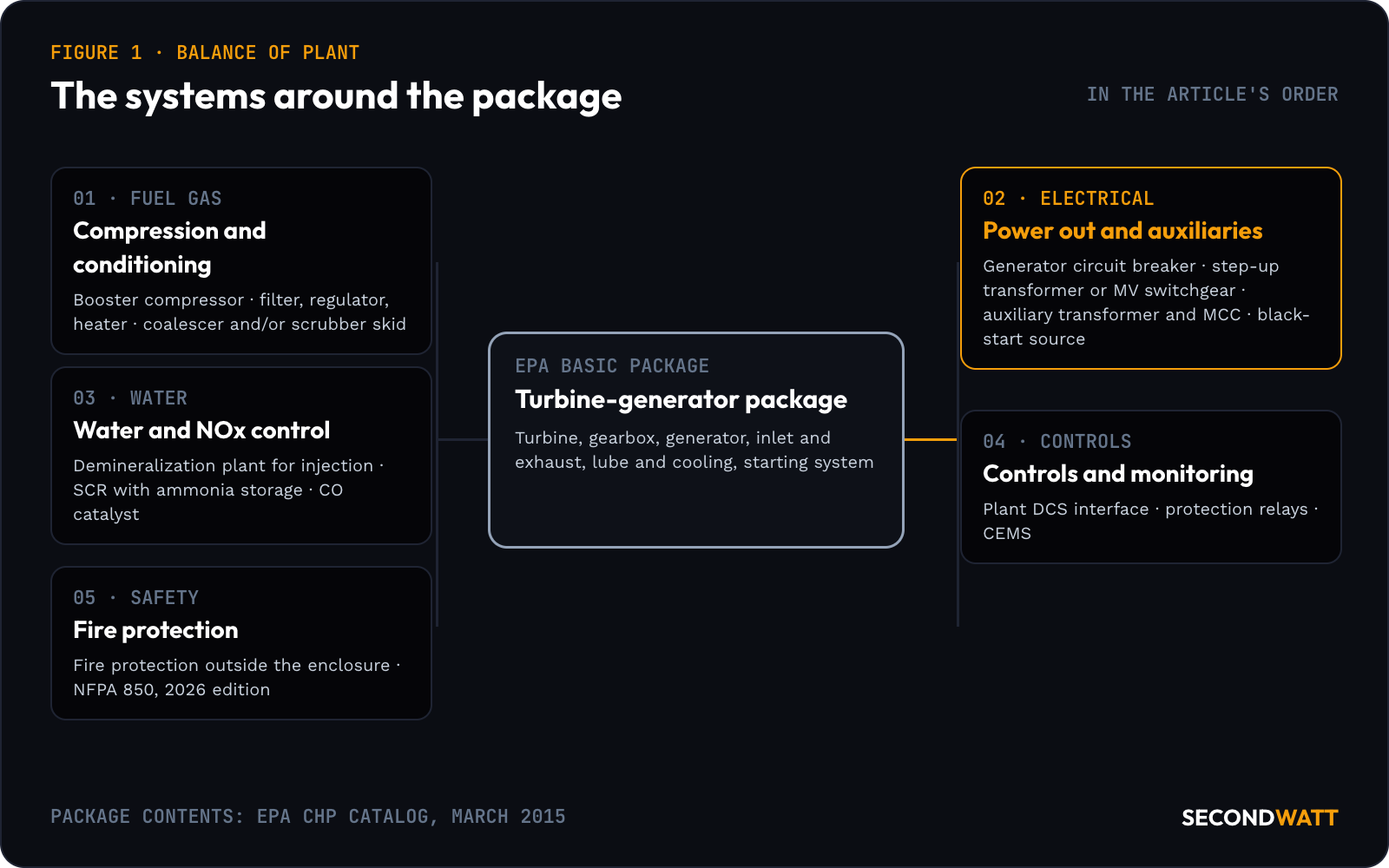
Balance of plant is everything a gas turbine generator package needs around it to deliver power. For a gas turbine that means the fuel gas supply and its conditioning, the electrical path to the load or grid, water treatment for NOx control, plant controls and monitoring, and fire protection. Where the package ends and the balance of plant begins differs by OEM, by model and by offer.
Two offers for the same class of gas turbine can differ by a compressor, a transformer and a water plant. Naming each system in the offer, with who supplies, installs and commissions it, keeps those gaps visible before prices are compared.
Key Takeaways
- Balance of plant is what sits outside the basic package. EPA's basic package cost excludes the fuel-gas compressor, heat recovery, water treatment, SCR and CEMS; not every site needs each.
- Supply pressure decides whether a compressor is needed. Siemens Energy's lowest SGT-800 figure, 27 bar(a), is about 377 psig at sea level, 227 psi above a 150 psig supply.
- Compression can take a measurable share of output. EPA's LM6000-based case needs 1,370 kW of booster power on a 55 psig supply, 3.1% of its 44,488 kW net baseload capacity.
- Electrical scope can arrive as options. Solar's Titan 130 data sheet lists switchgear and generator protective relay, and a motor control center with transfer switch, as options.
- Water injection brings a water plant. EPA says injection water must be thoroughly demineralized, and Siemens lists a demineralization plant as optional balance of plant for the SGT-A45.
What balance of plant means for a gas turbine#
Section 3 of the EPA Catalog of CHP Technologies, dated March 2015, describes the basic gas turbine package. It consists of the turbine, gearbox, generator, inlet and exhaust ducting, inlet air filtration, lubrication and cooling systems, standard starting system and exhaust silencing. Its cost excludes extra systems such as the fuel-gas compressor, heat-recovery system, water-treatment system, SCR and continuous emission monitoring systems. Not all of these systems are required at every site.
The same EPA document lists the electrical scope of its cost cases as switchgear, interconnection, control and transformer. Its fuel system scope is a fuel gas compressor, fuel gas filter, regulator and heater. Gas turbine balance of plant, in this article, means those systems plus controls, monitoring and fire protection around the package.
How much of it a site needs depends partly on the machine class. Many aeroderivatives for stationary use run compression ratios near 30:1 and need a high-pressure external fuel gas compressor, by EPA's account. Industrial turbines, with ratios up to 16:1, often do not.
Where the package ends#
Each OEM draws the line in its own scope document. Solar Turbines' 2025 Titan 130 generator set data sheet puts the fuel system, lube oil system, inlet and exhaust systems, enclosure and on-skid controls in the package. Its electrical system items are options.
Siemens ships the SGT-A45 TR mobile unit on three trailers: the generator; the gas turbine with its fuel and lube oil systems; and the unit control system, motor control center and switchgear. Siemens AG's 2017 SGT-A45 TR datasheet adds a separate list of optional balance of plant scope.
Package scope on two OEM documents: Solar Titan 130 data sheet DS130PG/0525/EO (2025) and Siemens SGT-A45 TR datasheet PGDG-T10034-01-7600 (2017)#
| System | Solar Titan 130 generator set | Siemens SGT-A45 TR mobile unit |
|---|---|---|
| Fuel system | In package: natural gas; diesel, dual fuel and low-Btu gas as options | Gas turbine ancillary systems (fuel, lube oil) on trailer 2 |
| Fuel gas compression | Not listed | Optional balance of plant: natural gas compressors and filters |
| Switchgear and generator protection | Option: switchgear and generator protective relay | Switchgear on trailer 3 |
| Motor control center | Option, with automatic transfer switch | On trailer 3 |
| Step-up transformer | Not listed | Optional balance of plant |
| Water treatment | Not listed | Optional balance of plant: water demineralization plant |
| Fire protection | Enclosure with fire detection and CO2 suppression | Not listed |
| Controls | Turbotronic on-skid turbine and generator control | Unit control system on trailer 3 |
"Not listed" means the document does not name the item, so the offer has to.
Modular packages narrow the interface without removing it. GE Vernova's LM2500XPRESS has 27 electrical interconnects against 130+ for a traditional plant, according to its September 2025 fact sheet. The sheet's net plant ratings exclude balance of plant equipment. How that boundary moves a rating is covered in gas turbine package ratings.
Fuel gas: pressure, conditioning and compression#
Fuel gas is mixed with combustion air after the air is compressed, so the gas must arrive at a pressure somewhat higher than the air. The turbine pressure ratio sets that pressure, as Section 3.4.1 of the EPA catalog explains.
OEM figures are model-specific. Siemens Energy lists a gas supply pressure requirement of 27–31 bar(a), or 390–450 psi(a), for the SGT-800. Siemens Energy's SGT-800 page says this low requirement reduces the need for an on-site gas compressor. For the SGT-500, Siemens Energy's product page lists a fuel-supply pressure requirement of 18.0 bar(a) ± 0.5 bar.
EPA's catalog states supply pressures in psig, while Siemens Energy quotes absolute pressure, so convert before comparing. As a worked example at sea level (14.7 psia), 27 bar(a) × 14.504 = 391.6 psia, and 391.6 − 14.7 = 376.9 psig. The 31 bar(a) upper figure gives 434.9 psig, and the SGT-500's 17.5 bar(a) lower edge gives 239.1 psig.
27–31 bar(a) — the gas supply pressure Siemens Energy lists for the SGT-800, about 377–435 psig at sea level.
EPA's catalog calculates compression from supply pressures of 55, 150 and 250 psig, which it calls typical of commercial and industrial service. Against a 150 psig supply, the SGT-800's lower figure is 376.9 − 150 = 226.9 psi higher. A gap like that puts a booster compressor into the scope.
The catalog also sizes that booster. Its case with 44,488 kW net electricity capacity in baseload duty, based on a GE LM6000 with a 31.9 pressure ratio, needs 538 psig. The compression power requirement is 1,370 kW from a 55 psig supply, 510 kW from 150 psig and 310 kW from 250 psig. The catalog's note says the pressures assume gas delivered at an absolute pressure 35% above compressor discharge, and the power assumes a 95% efficient motor driving the booster.
538 psig — the fuel gas pressure the EPA catalog calculates for its 44,488 kW baseload case based on a GE LM6000 at a 31.9 pressure ratio.
From a 55 psig supply, that booster load is 1,370 ÷ 44,488 = 3.1% of the case's net electricity capacity.
Conditioning sits around the compressor. For GE Vernova's LM2500 dual-fuel upgrade, the gas fuel compressor is off-package "if required to boost gas pressure", and so is a coalescer/dehumidifier and/or filter/scrubber skid. GE Vernova's LM2500 liquid to dual fuel page puts the fuel-metering and shutoff valves on-package. Gas quality, heating and the supplier's delivery point are covered in gas turbine fuel requirements.
The electrical balance of plant#
The electrical scope starts at the generator terminals, so settle the generator circuit breaker first. Hitachi Energy, which builds generator circuit breakers, says on its product page that they increase protection of generators and power transformers and simplify operational procedures. Ask whether the offer includes one, and at what rating.
Generator voltage sets what follows the breaker. The Titan 130 generator's continuous duty rating voltages run from 4,160 to 13,800 V at 60 Hz, and Solar lists switchgear and generator protective relay as options. Connection above that voltage needs a step-up transformer, specified as in the GSU transformer guide. A site at distribution voltage may connect through medium-voltage switchgear instead.
Auxiliary loads need their own supply. The Titan 130 starts on a direct-drive AC motor with VFD control. It carries an AC motor-driven pre/post lube pump, a DC motor-driven backup lube pump and a 120 VDC battery/charger system. Siemens Energy lists low starting power, below 160 kW, for the SGT-500.
Ask how those loads, plus any fuel compressor, are fed: auxiliary transformer, motor control center and transfer switch. The source that starts them without the grid is covered in black start and auxiliary power.
Water and NOx control#
Depending on uncontrolled NOx levels, water or steam injection reduces NOx by 60% or more and lets gas turbines run as low as 25 ppm at 15% O2 on natural gas. Section 3.5.2.1 of the EPA catalog says the water must be demineralized thoroughly to avoid deposits and corrosion in the turbine expansion section. That adds cost and complexity. Siemens offers water injection on the SGT-A45 for low NOx and power boost, and lists a water demineralization plant under optional balance of plant.
How much water that takes is set out in gas turbine water consumption, and LM6000 power augmentation in LM6000 SPRINT water requirements.
Post-combustion control adds equipment of its own. In an SCR, ammonia is injected into the exhaust and reacts with NOx over a catalyst, typically within the HRSG; conventional SCR systems operate at 400 to 800°F. It removes 80 to 90% of the NOx, depending on how uniform the chemical conditions in the exhaust are.
Sections 3.5.2.3 and 3.5.2.4 of the EPA catalog note that SCR requires on-site storage of ammonia, a hazardous chemical. CO oxidation catalysts need no reactant and cut CO by approximately 90%.
In the US, the federal new source performance standards in 40 CFR part 60, Subparts KKKK and KKKKa, regulate NOx and SO2 from stationary combustion turbines. Subpart KKKK covers turbines with a peak-load heat input of at least 10 MMBtu/h (HHV) that commenced construction, modification or reconstruction after February 18, 2005. Under 40 CFR 60.4305, a turbine subject to KKKKa is not subject to KKKK.
Subpart KKKKa took effect as a final rule on 15 January 2026. Correcting amendments followed on 16 July 2026, effective 17 August 2026, according to a Federal Register notice at 91 FR 43561. Under 40 CFR 60.4305a, KKKKa covers turbines with a base load rating of at least 10 MMBtu/h that commenced construction, modification or reconstruction after December 13, 2024, except as § 60.4310a provides. The limits, and which subpart reaches a given unit, are set out in gas turbine emissions permitting.
Controls, protection and monitoring#
On the Titan 130 and SGT-A45 TR documents, the turbine control system is in the supplier's scope. Solar's Turbotronic on-skid system includes load share, automatic synchronization and voltage control, with ControlNet, Ethernet or Modbus supervisory interfaces as options. GE Vernova offers Mark VI or Mark VIe, Woodward or RX3i controls in its LM2500 dual-fuel upgrade, and Siemens Energy lists a Simatic control system for the SGT-500.
The plant distributed control system (DCS) sits above those controls, and none of these sheets includes one. Ask which signals the turbine panel passes to it, over which of those protocols, and who writes the interface. Protection relays need the same answer, since Solar lists the generator protective relay as an option.
Under Subpart KKKK, a turbine using water or steam injection to control NOx needs a continuous monitoring system. It monitors and records fuel consumption and the water- or steam-to-fuel ratio when burning a fuel that requires injection for compliance. Under 40 CFR 60.4335, a continuous emission monitoring system (CEMS) is the alternative.
Without injection, 40 CFR 60.4340 requires annual performance tests, with conditions for less frequent testing, or a CEMS or continuous parameter monitoring instead. Under parameter monitoring, a turbine with SCR must continuously monitor appropriate parameters to confirm the emission controls operate properly.
Under Subpart KKKKa, 40 CFR 60.4333a requires a turbine subject to a NOx standard in § 60.4320a to demonstrate continuous compliance with a NOx CEMS, with two exceptions. A turbine using water or steam injection, but no post-combustion controls, to meet the standard may elect an input-based standard under § 60.4335a. So may one using no water injection, steam injection or post-combustion controls, under § 60.4340a.
Neither exception covers a turbine with post-combustion controls, such as an SCR. A turbine that elects the mass-based standard may use a CEMS or the appendix E to part 75 method.
Fire protection, enclosures and buildings#
NFPA 850's current edition, 2026, is the Standard for Fire Protection for Electric Generating Plants and High Voltage Direct Current (HVDC) Converter Stations. It outlines fire safety requirements for gas, oil, coal and alternative fuel electric generating plants, including combustion turbine units used for electric generation. The 2020 edition was titled a Recommended Practice. According to the NFPA 850 document page, the 2026 edition was issued on 19 November 2025 and took effect on 9 December 2025.
Package enclosures carry their own systems. Solar's Titan 130 enclosure comes with fire detection and CO2 suppression, and its package electrical certification is NEC, CSA Class 1, Group D, Div. 2. The data sheet also draws minimum clearances for enclosure access doors and for engine removal, which set the space a building or pad must allow.
Fire protection outside the enclosure has no line on these package sheets. Give it a line in the offer, with the edition of NFPA 850 the design follows.
Who supplies what: the scope table#
The table sets out each system with the question to put in an offer. The second column states where a cited OEM document puts the item, or says no cited sheet names it. The last column names a commissioning step to assign to the supplier, the EPC contractor or the owner, since none of the sheets assigns one.
Balance-of-plant scope for a gas turbine offer: package position from the Titan 130 (DS130PG/0525/EO), SGT-A45 TR (PGDG-T10034-01-7600) and LM2500 dual-fuel documents; questions and commissioning steps are SecondWatt guidance#
| System | Where the cited OEM documents put it | Question for the offer | Commissioning step to assign |
|---|---|---|---|
| Fuel gas compressor | Off-package on the LM2500 upgrade; optional on the SGT-A45 | Supply pressure assumed, compressor power and who supplies it | Start and load test |
| Gas filtration and conditioning | Off-package skid on the LM2500 upgrade | Filter, coalescer, heater and metering scope | Filter and heater checkout |
| Generator circuit breaker | Not named on these sheets | Included, and at what rating | Breaker timing tests |
| Switchgear and protective relays | Option on Titan 130; trailer 3 on SGT-A45 | Which relays, and who sets them | Relay settings and trip tests |
| Step-up transformer | Optional on SGT-A45 | Rating, voltages and who supplies it | Energization tests |
| Auxiliary power and MCC | Option on Titan 130; trailer 3 on SGT-A45 | Auxiliary load list and supply | Auxiliary transfer test |
| Black-start source | Not named on these sheets | Source, rating and start sequence | Dead-bus start test |
| Water treatment | Optional demineralization plant on SGT-A45 | Water quality and plant capacity | Water quality test |
| SCR and CO catalyst | Not named on these sheets | Guaranteed outlet NOx and CO, and ammonia storage | Emissions tuning |
| CEMS | Not named on these sheets | Monitoring method under the applicable subpart | Certification tests |
| Turbine controls and plant DCS | Turbine controls in package on both | Interface protocol and signal list | Signal checkout |
| Fire detection and suppression | In Titan 130 enclosure | Plant-level fire protection and NFPA 850 edition | Detection and release test |
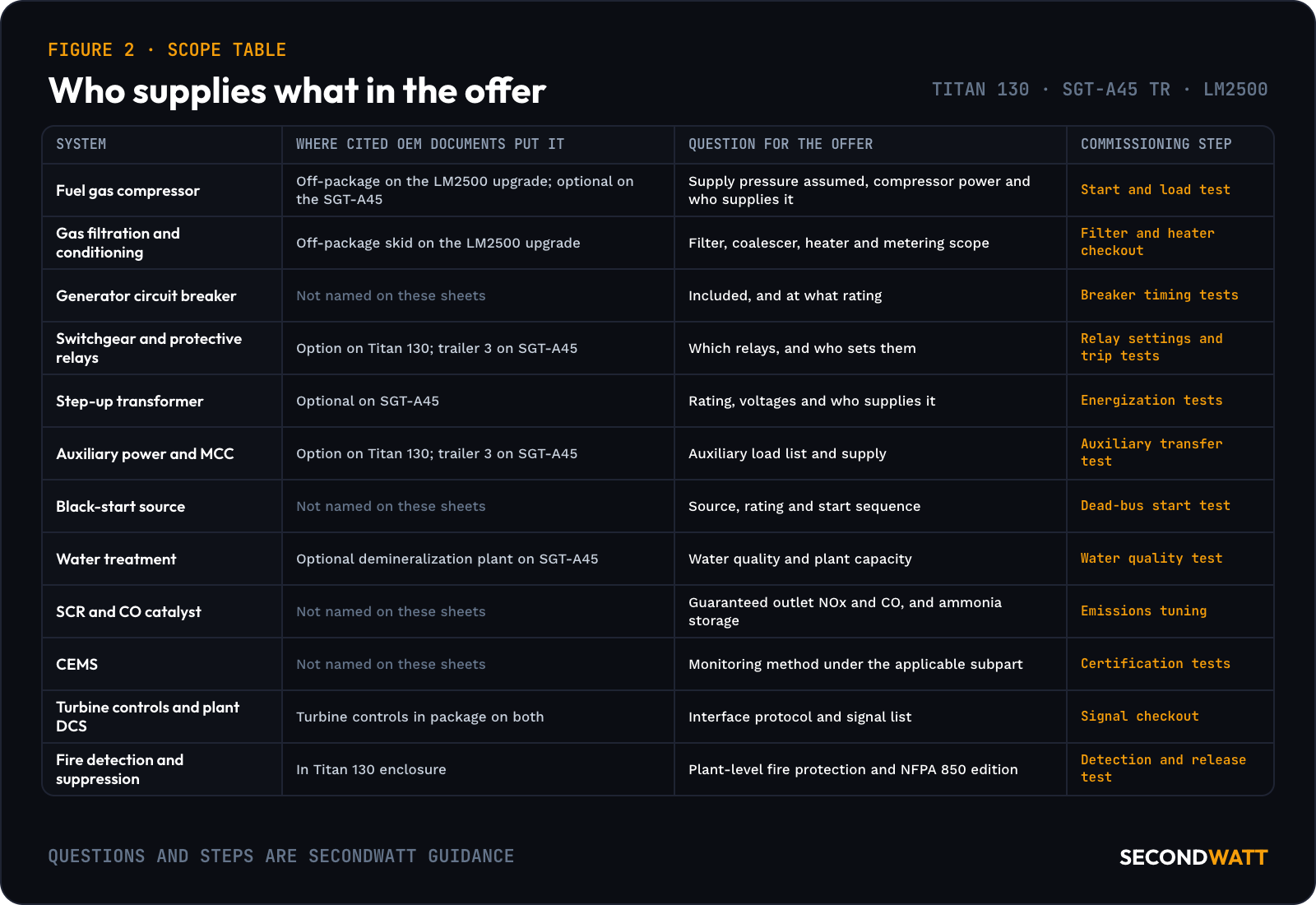
Read it as a checklist. Every row becomes a named line in the offer, and every "Not named" row needs an owner before signing. The RFQ procurement checklist covers the rest of the request.
FAQ: gas turbine balance of plant#
Does a used turbine package include its balance of plant?#
It depends on what left the original site with it. Ask the seller for the scope list item by item, and check which systems stayed behind. The used gas turbine cost guide prices the installed scope, and the relocation guide covers the receiving-site interfaces.
Does a smaller turbine need less gas pressure?#
Usually, since required supply pressures generally increase with gas turbine size, as the EPA catalog notes. The catalog's lowest calculated case is 167 psig for a 3,304 kW baseload Solar Centaur 40 at a 10.1 pressure ratio. A 20,336 kW baseload Solar Titan 250 at a 24 pressure ratio needs 405 psig. Those are calculated figures, so request the OEM's fuel gas specification for the exact unit offered.
Is the heat recovery steam generator part of the balance of plant?#
It is when the plant recovers exhaust heat: EPA's basic package cost leaves out the heat-recovery system. The catalog's installed-cost cases in Table 3-2 assume an unfired heat recovery steam generator, gas compression, a building and SCR, CO and CEMS exhaust treatment. An SCR typically sits within the HRSG, so assign the two together in the offer. On the Titan 130, a heat recovery interface is a Turbotronic control option.
Who supplies the GSU transformer?#
The offer decides. Siemens lists generator step-up transformers as optional balance of plant for the SGT-A45 TR, and the Titan 130 data sheet does not list one. Name the supplier, the voltages and the delivery point in the contract.
What is the difference between balance of plant and EPC?#
Balance of plant is equipment scope; EPC is a way of contracting for it. EPA's cost cases list project management as "Engineer, procure, construct, manage", a separate line from the electrical and fuel system equipment. Turbine suppliers can take part of it: for the SGT-A45 TR, Siemens says it can supply the required balance of plant scope, integration services or a complete power solution.
Writing the scope into the offer#
SecondWatt publishes equipment research and helps buyers source power equipment; it earns a fee when a sale it arranges closes. If you are buying a turbine, send a request that lists the gas supply pressure at the site boundary, the grid voltage and the NOx control you expect, so offers can be compared on the same scope. If you own a turbine package, the gas turbine seller page explains how SecondWatt works with owners.