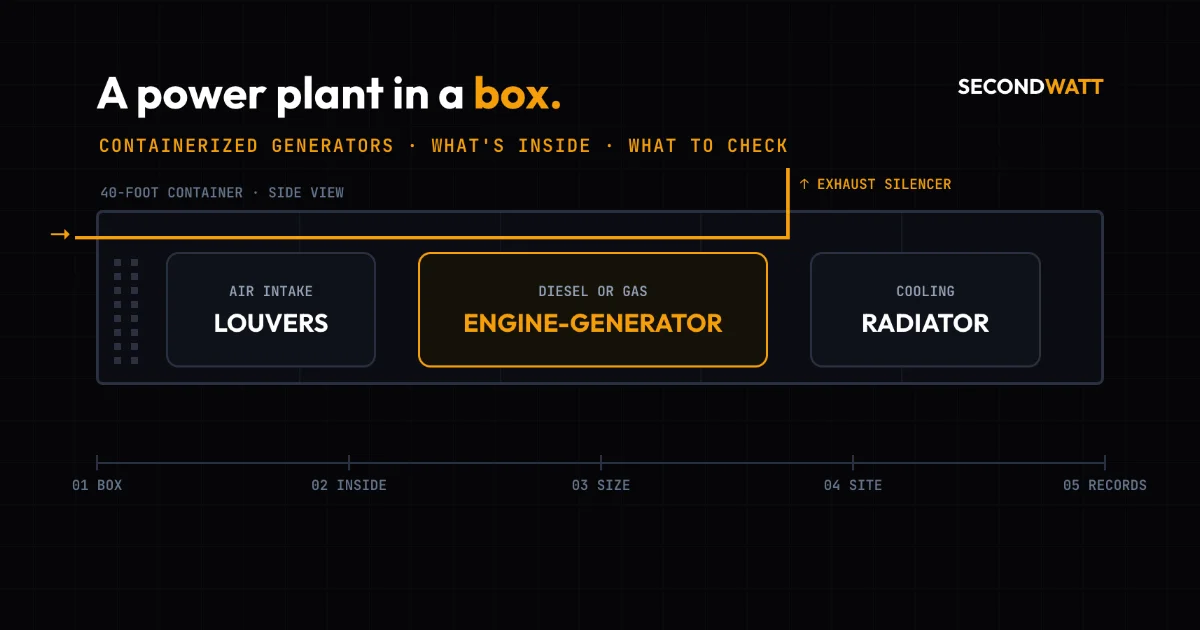
A containerized generator is an engine-generator built into a shipping-container-style enclosure, delivered with its cooling, ventilation, controls and often its fuel tank already installed. The package arrives pre-installed, so less installation work is left to coordinate on site. Diesel and gas sets are both built this way.
For a buyer, the box matters as much as the engine. Its length, width and weight set how it travels, its ventilation and sound package set where it can stand, and its records decide what a used one is worth. The gas engines category holds the dossiers for the gas engines named here.
Key Takeaways
- The container ships its auxiliaries with it. Cummins, Jenbacher and mtu package the engine-generator with its auxiliary systems; Cummins lists cooling, a fuel tank and fire suppression.
- Jenbacher's Type 6 containers outgrow the 40-foot box. Types 2–4 keep the 12,192 mm ISO length; single-bank Type 6 runs 13,500–20,500 mm and multi-bank 6,000 mm wide.
- Width can trigger a road permit before length does. An 8-foot ISO box fits within the 102-inch federal width; a 3,000 mm-wide genset container exceeds it by about 409 mm.
- Sound figures compare only at one distance. Jenbacher quotes 65 dB(A) at 10 m for Type 2–4 containers; Cat, 74–79 dBA at 7 m for 3516C enclosures.
- A used container needs inspecting as closely as its engine. Corrosion, door seals, louvers, fire-system records and the emissions label all bear on what the set can still do.
What a containerized generator is#
On its containerized solutions page, Jenbacher defines a containerized genset as a power generation system installed in a transportable container with key auxiliary systems pre-integrated. The aim, in Jenbacher's words, is less installation work on site and faster project execution.
A sound-attenuated enclosure is a different build. Caterpillar's 3516C 60 Hz enclosures sit over the genset on an integral fuel tank base, with personnel doors and an enclosed muffler; a skid base and motorized louvers are options. They come in two sound levels, and Caterpillar's May 2024 enclosure sheet lists UL 2200 and UL 142 listings.
Cummins builds its Centum Force sets into a 40-foot ISO high-cube container. Its Centum Force page and September 2024 bulletin say the box fits on standard truck trailers. For open and enclosed diesel sets, see the generators category.
What is inside the container#
Each row below ends with the question to put to a seller.
Systems inside a containerized generator, from Cummins, mtu and Jenbacher container descriptions, with a Cat enclosure sheet for comparison#
| System | What it does | Question for the seller |
|---|---|---|
| Engine-generator | Diesel (Cummins QSK60 in Centum Force) or gas (mtu Series 4000, Jenbacher Type 2, 3, 4 and 6) set on its base | Model, rating type, frequency and hours |
| Air intake and ventilation | Brings in combustion and cooling air; Jenbacher designs standard ventilation for stated ambient ranges | Design ambient range, and the airflow at it |
| Radiator or cooling system | Integrated cooling in Centum Force, with a removable radiator core | Radiator in the box or remote, and its ambient rating |
| Exhaust silencer | Built-in silencer (Cummins); a vertical exhaust allows two-high stacking | Sound level and the distance it was measured at |
| Controls and breaker | Cummins PowerCommand control, a low-voltage circuit breaker and a neutral grounding resistor cabinet; mtu's container includes switchgear with control and monitoring | Voltage, breaker rating, paralleling control |
| Fuel | Built-in fuel tank on Centum Force diesel sets (2,000, 4,000 or 6,000 L listed); gas sets draw from a site gas supply | Tank capacity, run time and listing |
| Fire detection and suppression | Included on Centum Force | Suppression agent and inspection records |
| Doors and access | Multiple service doors and a removable roof (Cummins) | How the engine and radiator come out for overhaul |
| Heat recovery (CHP containers) | Heat recovery in mtu CHP containers; an option on Jenbacher containers | Thermal output and connection points |
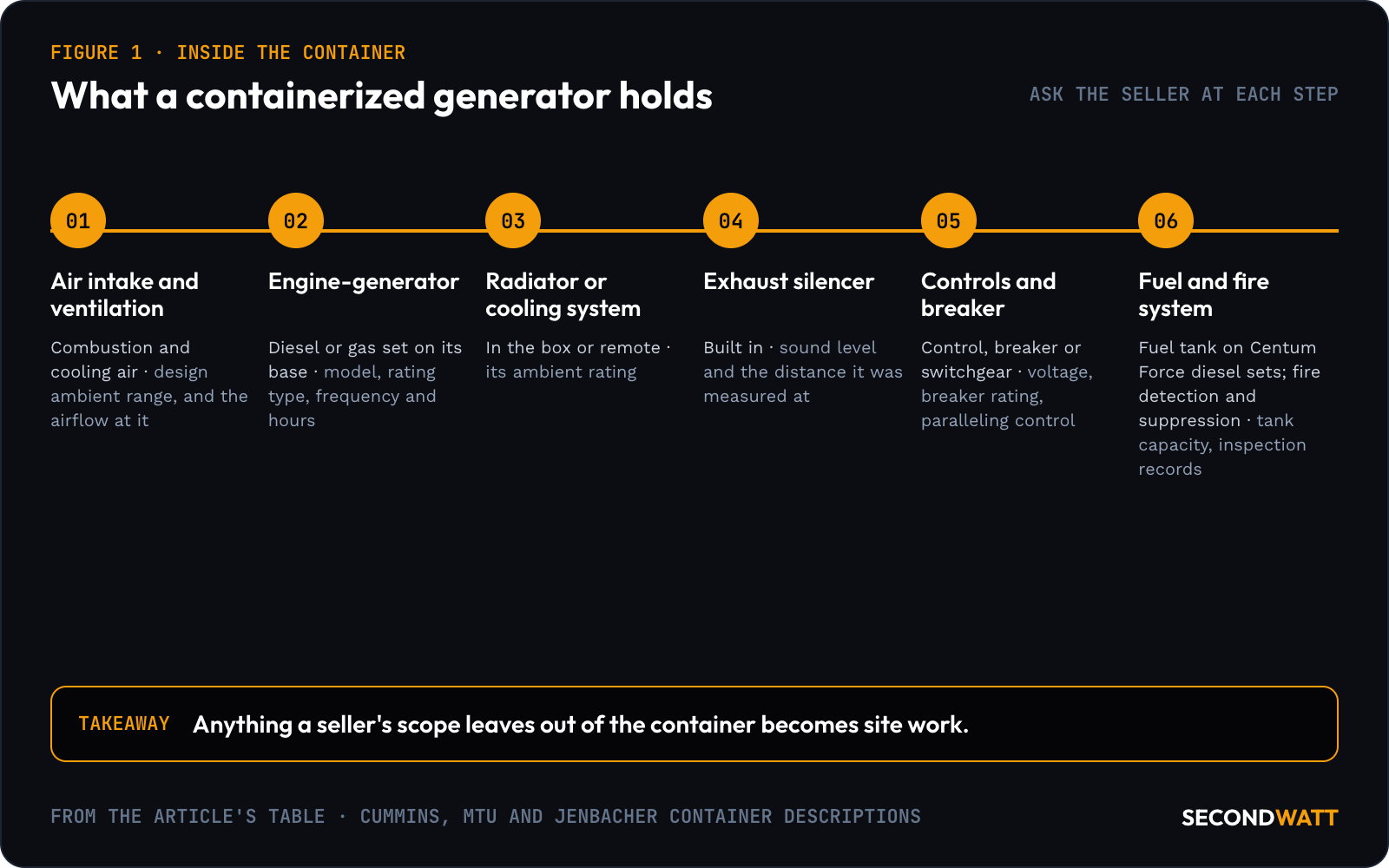
The 2021 edition of Rolls-Royce's mtu Series 4000 gas brochure lists the contents of its standard mtu container. They are the generator set, the switchgear with its control and monitoring system, and "all necessary connection and supply systems". Anything a seller's scope leaves out of that list becomes site work.
In its bulletin, Cummins puts the fuel tank, grounding resistor cabinet, exhaust silencer, fire-fighting systems and quick external socket connections inside the Centum Force container at delivery.
ISO containers and custom enclosures#
ISO 668:2020, edition 7, classifies series 1 freight containers by external dimensions and specifies their ratings. ISO's ISO 668:2020 page notes that the internal dimensions of each type are defined in the relevant part of ISO 1496. The standard has one amendment, from 2022.
ISO dry containers: external and internal dimensions and maximum gross mass, from SeaCube's published specs#
| Container | External L × W × H | Internal L × W × H | Max gross mass |
|---|---|---|---|
| 20 ft dry | 6,058 × 2,438 × 2,591 mm | 5,898 × 2,352 × 2,393 mm | 30,480 kg |
| 40 ft dry | 12,192 × 2,438 × 2,591 mm | 12,032 × 2,352 × 2,393 mm | 32,500 kg |
| 40 ft high cube | 12,192 × 2,438 × 2,896 mm | 12,032 × 2,352 × 2,698 mm | 32,500 kg |
SeaCube calls these figures approximate on its 40-foot standard dry spec page and its sister pages. Hapag-Lloyd gives its own as examples, since containers vary by manufacturer. Its 40-foot standard box is 2,352 × 2,395 mm inside (W × H), with a 2,340 × 2,292 mm door opening. Its 40-foot high cube is 2,350 × 2,700 mm inside, with a 2,340 × 2,597 mm door.
Jenbacher builds to that external length for its smaller engines. Its Type 2, 3 and 4 containers have "a standard 40-foot length" of 12,192 mm, with widths of 2,438 mm to about 3,000 mm. Type 6 containers consist of two or three pre-assembled modules. On Jenbacher's containerized solutions page, single-bank J612, J616 and J620 units run 13,500–20,500 mm long and 3,000–4,000 mm wide.
12,192 mm — the external length of a 40-foot ISO container, which Jenbacher keeps as the standard length for its Type 2, 3 and 4 genset containers.
By length, the J616 genset alone fits a 40-foot box. Jenbacher's J616 page lists the 50 Hz genset at 8,300 × 2,200 × 3,000 mm and the 60 Hz genset at 400 inches long. Worked example, against a 40-foot container's 12,032 mm internal length:
12,032 − 8,300 = 3,732 mm spare at 50 Hz; 400 in × 25.4 = 10,160 mm, and 12,032 − 10,160 = 1,872 mm spare at 60 Hz.
Height is the limit. The 50 Hz genset stands 3,000 mm tall, against 2,395 mm inside Hapag-Lloyd's 40-foot standard and 2,700 mm inside its high cube: 3,000 − 2,700 = 300 mm too tall even for the high cube.
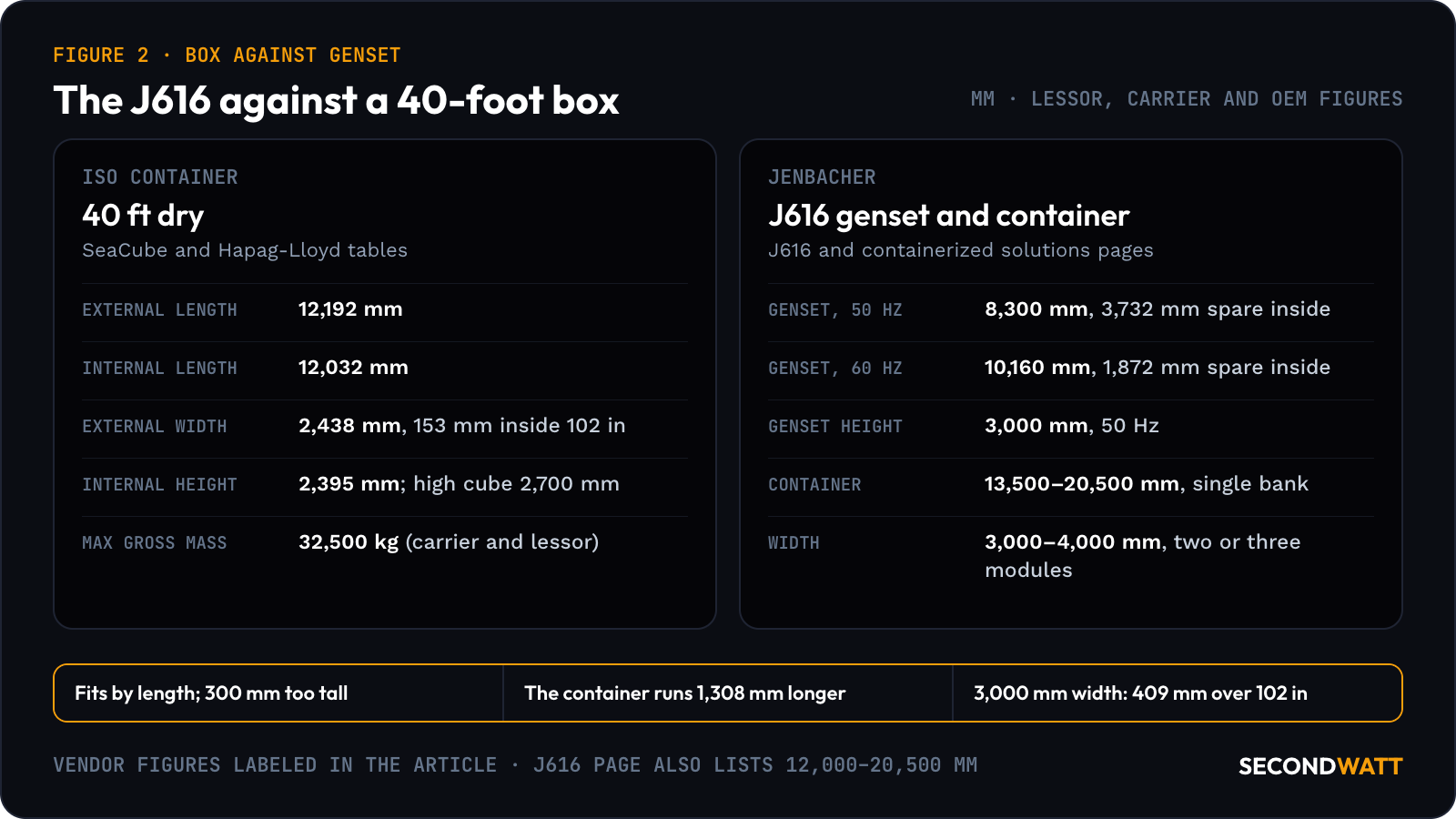
The J616's own container is still longer than the box: 13,500 − 12,192 = 1,308 mm at the short end of the single-bank range. The J616 product page gives a wider container range of 12,000–20,500 mm, so ask for the drawing for the exact configuration. The J616 and J624 dossiers hold the ratings.
A Cat 3512C diesel genset fits inside a high cube with thin margins, and the door is the catch. Caterpillar's August 2023 sheet lists it at 5,618 × 2,279 × 2,652 mm, for reference only, too tall for a standard box's 2,395 mm. Inside Hapag-Lloyd's high cube, 2,350 − 2,279 = 71 mm is left across both sides and 2,700 − 2,652 = 48 mm above. The 2,597 mm door opening is 2,652 − 2,597 = 55 mm lower than the listed genset height.
Weight, transport and lifting#
Caterpillar lists the 3512C genset (1,500 ekW standby, 60 Hz) at 13,141 kg dry on the same sheet.
Rolls-Royce's 2021 brochure lists the mtu 20V Series 4000 gas set at 21,000 kg dry and 6,600 mm long, at a 1,500 rpm rated speed. Its 2024 60 Hz spec sheet gives the 20V4000 GS genset as 7,250 mm long. Ask which length a quoted container was drawn around.
On US roads, federal limits on the Interstate System are 20,000 pounds on a single axle, 34,000 on a tandem and 80,000 gross vehicle weight. On the National Network, the FHWA's size and weight overview says no state may set a width limit above or below 102 inches. A 40-foot box at Hapag-Lloyd's 32,500 kg (71,650 lb) maximum gross leaves 80,000 − 71,650 = 8,350 lb for the tractor and chassis.
102 inches — the federal vehicle width on the National Network (2,591 mm); a genset container about 3,000 mm wide exceeds it by 3,000 − 2,591 = 409 mm.
Width shows the difference. An ISO box at 2,438 mm sits 153 mm inside 102 inches. Cat's 3516C enclosure dimension tables give 2,671 mm (105.2 in) wide for both sound levels, 2,671 − 2,591 = 80 mm over; the sheet's footprint row lists Level 1 at 8 ft 6 in.
Length leaves more room. No state may limit a semitrailer in a tractor-semitrailer combination on the National Network to less than 48 feet (14,630 mm). That is longer than the 13,500 mm short end of Jenbacher's single-bank range.
The federal government issues no oversize or overweight permits; that is a state option. The FHWA's load permits page says states may permit nondivisible loads without regard to the axle, gross or bridge-formula limits. They may also grant special use permits above the 102-inch width. Before a container ships, ask for its shipping weight with fluids, its center of gravity, and the lifting drawing that shows where it may be picked.
Siting: clearances, sound and stacking#
NFPA 37, Standard for the Installation and Use of Stationary Combustion Engines and Gas Turbines, is in its 2024 edition. It "establishes criteria for minimizing the hazards of fire related to the installation and operation" of stationary combustion engines and gas turbines. The NFPA 37 page says the standard's scope covers units fueled by liquid or gaseous fuels and "used as prime movers for emergency generators, fire pumps, and stand-by and peak power systems".
Take clearance distances from the edition the authority having jurisdiction enforces, and from the OEM installation manual.
Ventilation sets the climate a container can work in. Jenbacher designs standard ventilation for −25 °C to +34 °C on Type 2–4 containers, with a −40 °C option and +45 °C upgrades for most variants. Type 6 ventilation is designed for −25 °C to +40 °C.
Sound figures need their distance and method. Jenbacher's Type 2–4 package is designed to meet 65 dB(A) at 10 m, and its Type 6 package is offered at 65, 70, 75 or 80 dB(A) at 10 m, each as surface sound pressure level to DIN 45635. Cat lists its 3516C enclosures at 79 dBA (Level 1) and 74 dBA (Level 2) at 7 m. With different distances, the two vendors' figures cannot be ranked as printed.
Stacking is a Cummins design feature. Centum Force has a vertical exhaust that allows head-to-head, back-to-back and two-layer stacked layouts, among others. In its bulletin, Cummins claims that stacking two high saves up to 34% of site space against a traditional container. For temporary sets that plug into a building, the generator docking station guide covers the connection side.
Containerized gas engines and power blocks#
Gas containers can carry gas-specific systems. Jenbacher's Type 6 options include pre-chamber gas compressors and medium-voltage equipment, plus heat recovery and exhaust aftertreatment. In its brochure, mtu offers power containers that generate electricity only and CHP containers that generate electricity and heat.
On natural gas, the J616 reaches up to 2,779 kW electrical at 60 Hz, at full load and at the generator terminals. The mtu 20V4000 GS L64FNER is rated at 2,520 kW electrical at 480 V and 60 Hz, at power factor 1.0, on the 2024 sheet. Jenbacher's J624 page lists the J624's electrical output at up to 4,499 kW at 50 Hz and 4,477 kW at 60 Hz on natural gas; its containers use the multi-bank layout.
A power block scales the same idea to a plant. SecondWatt's mtu 20V4000 power block article covers a gas power block built on that engine, with its dossier under power blocks. The gas turbines vs reciprocating engines comparison covers when engines win.
Rental and used containerized sets#
Cummins lists rental generators among Centum Force applications, and its 2024 bulletin names temporary power and rental alongside data centers. Jenbacher lists mobile and emergency power among its applications. For a data center waiting on the grid, rental sets are one form of bridge power, with mobile gas turbines another option.
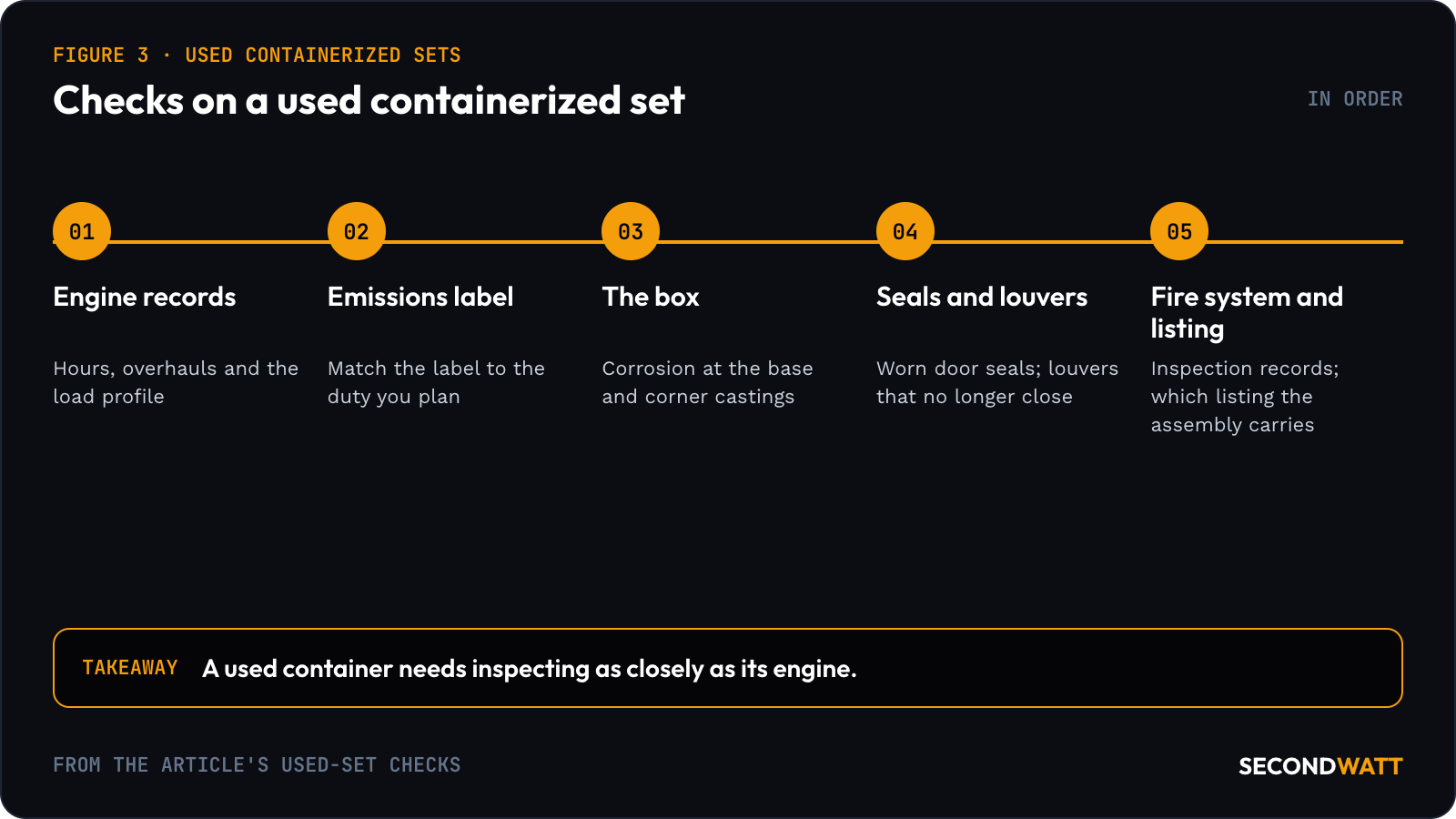
On a used containerized set, start with the engine records: hours, overhauls and the load profile. The used natural gas generator checks and the used 2 MW standby checklist cover those in detail.
Then read the emissions label. Caterpillar's 3512C sheet, for example, says its 60 Hz sets meet U.S. EPA "Stationary Emergency Use Only (Tier 2)" emission standards. Match the label on a used set to the duty you plan.
Then inspect the box. Look for corrosion at the base and corner castings, worn door seals and louvers that no longer close. Ask for the fire-detection and suppression system's inspection records.
Ask, too, which listing the assembly carries. UL 2200, edition 3 (2020, last revised 5 September 2025), covers stationary engine generator assemblies for ordinary locations, installed under codes including NFPA 70, NFPA 37 and NFPA 110. UL Standards & Engagement's UL 2200 page says the hazards the standard addresses include mechanical hazards from enclosures and moving parts.
Cummins lists CE certification for its 50 Hz Centum Force sets and names its markets as Asia Pacific, India, Latin America, Africa Middle East and Europe. A North American buyer should ask how such a set is listed.
FAQ: containerized generators#
What output range do containerized generators cover?#
It depends on the OEM and the engine family. Jenbacher lists its containers at 249–1,562 kW output on Type 2, 3 and 4 engines and 1,634–4,507 kW output on Type 6, without a frequency. Cummins rates its 50 Hz Centum Force sets at 1,650–2,200 kW standby and 1,500–2,000 kW prime.
Does a containerized generator need a building?#
No, by design. Rolls-Royce describes its mtu container units as a "completely autonomous overall design that does not require an additional building". It presents them as an alternative to a static system in a generator room, for mobile use or sites short of space.
Is the fuel tank part of the container?#
On some diesel sets it is. Centum Force has built-in fuel tanks, and Cat's 3516C enclosures offer a UL 142 listed integral tank base with 24 hours' run time at 2.0 eMW standby. Gas sets draw their fuel from a site gas supply instead.
How fast can a containerized generator be installed?#
Often faster, Jenbacher says, because major components arrive pre-installed and pre-engineered. The schedule still depends on permitting, grid connection, civil works, fuel supply and country-specific requirements.
Does a containerized generator count as a shipping container?#
Only as far as its maker builds it to one. Cummins lists Centum Force as "CSC certified" and says the set is shipped within its ISO standard container. Jenbacher's Type 6 containers are built from modules. Ask whether the box is certified for intermodal shipping or only for trailer transport.
Specifying the container#
SecondWatt publishes equipment research and helps buyers source power equipment; it earns a fee when a sale it arranges closes. If you are buying, send a request that states the output, frequency, fuel, sound limit at a stated distance and the site's delivery route. If you own a containerized set with its records in order, the generator seller page sets out how SecondWatt works with owners.