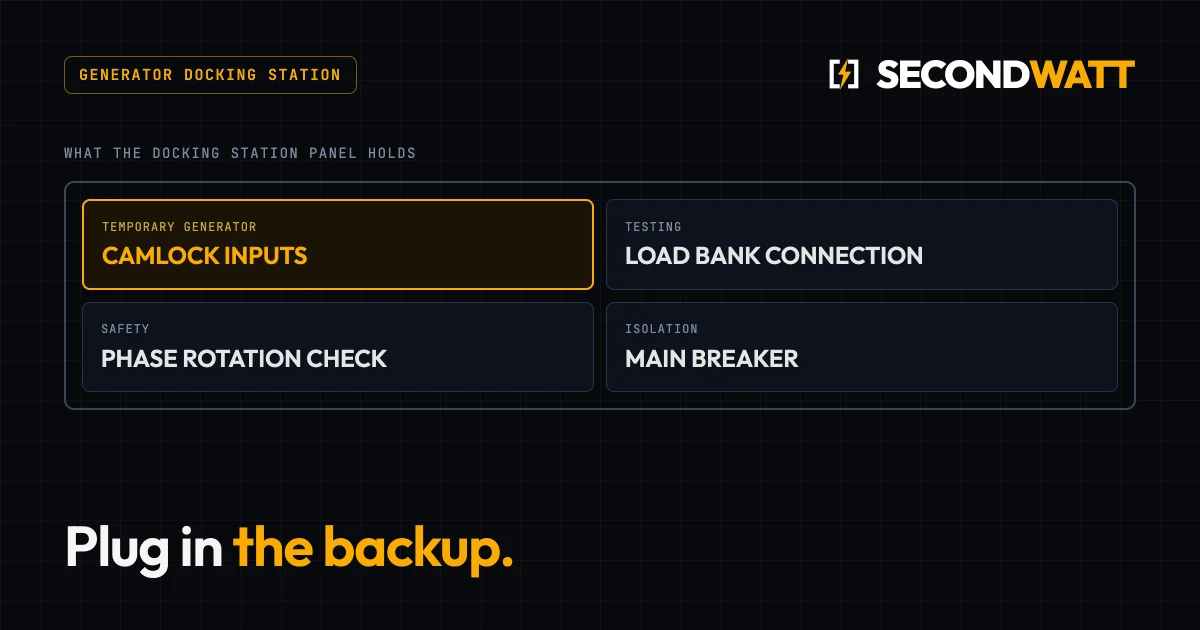
A generator docking station is a permanently installed, prewired connection point. A temporary or rental generator plugs into it through quick-connect inlets, so an electrician does not have to hard-wire the generator each time. Transfer equipment and interlocks prevent the temporary source from being connected while utility or permanent generation is also connected. Depending on the product, overcurrent protection is either built into the cabinet or provided by a separately selected disconnect.
Manufacturers describe the benefit in terms of speed. On its product page, Trystar says its docking stations help facilities "return to normal operations in minutes rather than hours". That claim refers to less setup work at the connection point, not a measured restoration time. Whether a data center's IT load stays up while a rental generator is brought in depends on UPS ride-through, existing generation and the transfer sequence, not on the cabinet alone.
Key takeaways#
- "Docking station," "tap box," "cam-lok panel" and "generator connection cabinet" are informal names. Compare products by installation type, switching, connection method and listing.
- Not every docking station contains a breaker or transfer switch. The one-line diagram shows where protection and source isolation actually come from.
- "Minutes" describes the connection step. A rental generator connected by operators cannot by itself meet NFPA 110 Type 10 (ten-second) restoration, and the UPS or existing generation must carry the load in the meantime.
- Where 2023 NEC 700.3(F) applies, the temporary-source connection must be permanent, interlocked, located outdoors and labeled. Confirm load classification and the adopted code edition with the AHJ.
- Use the three-phase current formula only to screen amperage. Connector ratings do not prove the rating of the complete assembly.
- A Type 3R enclosure does not protect against windblown dust. Stainless steel construction alone does not make an enclosure Type 4X.
- Load-bank connection must be designed into the station. It cannot be assumed on a generator-only inlet cabinet.
- Price and lead-time data are limited to isolated, dated examples. Obtain dated quotes that match your configuration.
What a generator docking station is (and what it is called)#
This equipment goes by several names. In a manual transfer switch brochure, ESL Power Systems uses both "tap box" and "docking station" for its TempTap product and describes it as mounted outside a building. A "portable generator tap box" may therefore be a permanent facility interface that serves portable generators, not a portable device. "Cam-lok panel" and "camlock connection panel" refer to the connector style: Cam-Lok is an Eaton Crouse-Hinds line of single-pole quick-connect connectors, and other makers describe equivalent "cam-style" connectors.
Because the naming is informal, a product's label says little about what is inside it. Compare candidate products on four attributes:
- Installation type: a permanently wired, pad- or wall-mounted interface, or genuinely portable distribution equipment.
- Switching: whether the unit includes a breaker, disconnect or transfer switch, or relies on equipment elsewhere in the system.
- Connection method: the quantity, gender and conductor range of the cam-style connectors on the generator side, and lugs or bus on the facility side.
- Listing: the standards the assembly and its components are approved to. For example, ESL's catalog lists its receptacles to UL 1691, and the complete 3644 assembly carries NRTL field labeling to UL 1008, the transfer switch equipment standard. A nationally recognized testing laboratory (NRTL) is a lab accredited to certify equipment to such standards.
How a generator docking station ties into the data center electrical system#
What a docking station must do depends on where it sits on the one-line diagram, the simplified drawing of a facility's sources, switching, protection and loads. Some units are only an inlet assembly, some include a main breaker, and some are built into a transfer switch. Eaton, for example, shows temporary generation connected to a transfer switch's emergency input. It also shows a selector between permanent and temporary generators that feeds the emergency side of a second automatic transfer switch (ATS).
An arrangement ahead of an existing ATS should be documented by its actual one-line. It should not be described loosely as a connection onto the utility bus. The table below compares four common configurations.
| Configuration | Overcurrent protection | Source isolation | Typical use | Source |
|---|---|---|---|---|
| Inlet assembly without breaker (e.g., ESL TempTap 3644, 4000 A, up to 480 Vac, pad-mounted) | None in the unit; requires an appropriately sized feeder disconnect | Provided by switching equipment elsewhere on the one-line | Connection point where protection and transfer already exist upstream or downstream | ESL |
| Docking station with integral main breaker | Main breaker in the cabinet | Depends on the transfer and interlock arrangement | Self-contained connection point, including service-entrance options | PSI/Salient, Eaton |
| Transfer switch with Cam-Lok receptacles on the emergency input, or a selector feeding a second ATS | Configuration-specific; the service-entrance version includes an integral breaker | Mechanically interlocked power switch in the open-transition model | Temporary generator as an alternate source, or a choice between permanent and temporary generators | Eaton |
| Dual-purpose generator inlet plus load-bank outlet | Zero-, one- or two-breaker variants; shunt trip on the load-bank breaker in the two-breaker design | Portable and permanent generators interlocked against simultaneous connection | Temporary generation and load-bank testing from one cabinet | ESL |
Source isolation is the central safety function: the temporary generator must not be connected at the same time as utility or permanent generation. In Eaton's open-transition model, the power switch is mechanically interlocked to prevent simultaneous connection of both sources. According to its installation manual, Trystar offers an optional Kirk-key arrangement intended to keep utility and docking sources from being energized together. In a Kirk-key interlock, a switch cannot be operated without a key that is held captive by another device. Confirm whether the design uses mechanical, Kirk-key or combined interlocking, and whether a separate feeder disconnect is required.
The two sides of the cabinet serve different purposes. The one-lines in Trystar's spec sheet show mechanical or compression lugs for the permanent load connection and quick-connect inlets for the generator cables. The facility side is terminated once at installation. The generator side is the only part that changes at each docking event.
What "connect in minutes" does and does not cover#
Trystar's speed claim is qualitative. Its product page does not state measured durations or test conditions. The real benefit is that electricians no longer have to terminate temporary cables on permanent equipment for every event. Total time to restore power from a rental generator involves several other steps.
A site that wants its own realistic timeline should measure each of these elapsed-time components:
- Mobilization: dispatch and delivery of the rental generator
- Positioning the generator on the pad
- Deploying and connecting the cables
- Safety and phase-rotation checks
- Generator startup
- Transfer of load to the temporary source
Until transfer is complete, the load must be carried by the uninterruptible power supply (UPS) or by existing generation. The UPS ride-through is the length of time its stored energy can carry the load without another source.
Schneider Electric's design guide summarizes how the emergency-power standard NFPA 110 classifies emergency power supply systems (EPSS) by Type, Class and Level. Type is the maximum time an EPSS can remain unpowered after loss of the normal source, Class is operating duration, and Level reflects consequence-related requirements; Type 10 allows ten seconds. A generator that operators must deliver, position and connect cannot by itself establish Type 10 restoration. A docking station shortens one step of a temporary-power plan. It does not replace the UPS, the permanent standby system or a documented transfer sequence.
Code context: NEC Article 700 and temporary-source provisions#
The 2023 National Electrical Code (NEC) directly addresses temporary-source connections for emergency systems. Eaton's January 2024 Bussmann series code-change guide reproduces Section 700.3(F) with NFPA permission. The section applies when an emergency system's single alternate source is disabled for maintenance or repair, subject to stated exceptions. Where it applies, it requires:
- A permanent switching means for connecting the temporary source, without modifying the permanent system wiring
- Listed switching or interlocks, using mechanical or combined mechanical and electrical interlocking
- Identification of phase rotation and bonding requirements
- Remote indication when the permanent source is disconnected
- An outdoor connection point, so temporary cables do not pass through exterior doors or windows
- Labels showing voltage, maximum amperage, the short-circuit current rating (SCCR) of load-side equipment, and the ungrounded conductors
The same switching means may also be used to connect a load bank.
Article 700 does not automatically govern every circuit in a data center. The same Schneider Electric design guide distinguishes Article 700 emergency systems, Article 701 legally required standby systems and Article 702 optional standby systems. Classify the loads the station will actually serve. Before relying on any provision, confirm the adopted code edition and any local amendments with the authority having jurisdiction (AHJ), the agency or official responsible for enforcing the code at the site.
Sizing docking station amperage from generator kW#
Start with a screening calculation using the balanced three-phase current formula from Cummins' generator application manual: I = (kW × 1,000) ÷ (√3 × line-to-line volts × power factor). Power factor (PF) is the ratio of real power to apparent power. At 480 V and 0.8 PF, the formula gives the following currents:
| Generator kW | Calculated current (A) | Next nominal band (A) |
|---|---|---|
| 250 | 376 | 400 |
| 500 | 752 | 800 |
| 750 | 1,128 | 1,200 |
| 1,000 | 1,504 | 1,600 |
| 1,250 | 1,879 | 2,000 |
| 2,000 | 3,007 | 3,200 |
| 2,500 | 3,759 | 4,000 |
Figures are calculated values rounded to the nearest ampere. They are not equipment selections.
Final selection must check:
- Continuous-loading capability
- Conductor size and quantity
- Protection
- Available fault current
- The rating of the complete assembly
Connector ratings apply only to the component. Eaton's E1016-1706 Cam-Lok receptacle, for example, is rated up to 400 A continuous at 600 Vac/dc and accepts 1/0–4/0 AWG conductors. That rating does not show that the connected cable or the complete docking station can carry 400 A under every installation condition.
Published product families cover the full range of the screening table:
- Trystar publishes stations from 100 to 4,000 A at up to 600 V.
- Eaton's transfer switches with Cam-Lok receptacles cover 40 to 3,000 A.
- Enercon lists 400 to 4,000 A.
Connecting safely: sequence, phase rotation and connector gender#
Docking is work for qualified personnel, performed under lockout. Connectors are not swapped while live. Trystar's manual requires qualified personnel to install, inspect and maintain cabinets, and it documents a connection order of ground first, then neutral, then phases. Neutral bonding, cable bracing and compatibility between the generator and station nameplates are also part of the procedure. Follow the manufacturer's manual for the switching and lockout steps.
Verify these items at every docking event:
- Phase rotation: Commission rotation against the facility, because matching cable colors does not verify it. Some units include a phase-rotation monitor, as Trystar's spec sheet shows.
- Connector gender: Conventions vary by vendor. ESL's DualConnect uses male inlets for generators and female outlets for load banks, while PSI/Salient's 400 A station uses female Cam-Lok receptacles. Confirm gender against the rental fleet's cables before an event.
- Neutral, ground and bonding: Match the arrangement to the design and to the station's labeling.
- Interlock status: Confirm that the competing source is isolated before the temporary generator is energized.
Enclosure selection: Type 3R vs 4X#
According to Eaton's ratings guidance, Type 3R protects against outdoor precipitation and external ice but provides no protection against windblown dust. Type 4 adds protection against dust and hose-directed water, and Type 4X adds corrosion protection. Consider Type 4 or 4X for pads exposed to dust, washdown or corrosive atmospheres.
Enclosure material does not determine the rating. Stainless steel construction alone does not make an enclosure Type 4X, and Eaton also identifies corrosion-resistant Type 3RX classifications. ESL's 3644 uses a Type 3R enclosure, while Trystar offers aluminum Type 3R or stainless Type 4X construction. Check the marked rating of the completed assembly in the submittal.
Load-bank testing: generator-only vs dual-purpose stations#
A load bank is a portable test load used to run a generator at a controlled load. Some docking stations are designed to connect one, and some are not. ESL's DualConnect pairs male generator inlets with female load-bank outlets, offered with zero, one or two breakers. Its two-breaker design adds a shunt trip to the load-bank breaker; a shunt trip is a coil that opens the breaker on an external signal.
Enercon also offers generator-only, load-bank-only and dual-purpose arrangements. Where the 2023 NEC 700.3(F) provisions apply, they permit the temporary-source switching means to serve load-bank connection, as Eaton's code-change guide shows. Specify load-bank capability as an engineered function, including outlet gender, breaker arrangement and controls. Do not assume a generator inlet cabinet can be used in reverse.
What to send a manufacturer for a generator docking station quote#
Quotes based only on generator kW cannot be compared, because kW alone leaves protection, switching, connectors and enclosure undefined. Enercon's quotation guidance asks for:
- Electrical ratings
- Mounting location
- Generator and load-bank needs
- Available space
- Compliance requirements
- Project timing
- Supporting drawings, including one-line diagrams
A complete request includes:
- One-line diagram and existing emergency power system details
- Voltage, frequency and phase configuration
- Maximum required current
- Available fault current
- Protection arrangement (integral breaker, separate feeder disconnect or transfer switch)
- Conductor sizing and routing
- Connector gender and quantity, matched to the rental fleet
- Neutral, ground and bonding arrangement
- Whether a switched neutral is required
- Control and remote-indication interfaces
- Enclosure environment (precipitation, dust, washdown, corrosion)
- Load-bank requirement
- Mounting method and available space
- Applicable code edition and AHJ requirements
- Required delivery date
Cost, lead time and availability: what the data supports#
The available pricing evidence is thin and does not establish a price band. In one storefront example, PSI/Salient listed $3,186 on October 14, 2026 for a 400 A docking station with a main breaker, female Cam-Lok receptacles, a Type 3R enclosure and 208–240 V selection. That is an equipment-only catalogue price for a lower-voltage unit, not an installed cost or a 480 V data center specification. A used Trystar GDS-04-5W-CM-ACGH1 listed by S&S Electrical Supply at $3,699.99 was marked sold out when observed the same day.
The installed scope can be much larger than the cabinet itself. A September 2, 2022 contractor quotation in the City of Rowlett's council packet states a $200,726 total for a 3,000 A service-entrance docking installation at a community centre. The quoted scope includes a main breaker, reconstruction of the underground service feeder, temporary bypass arrangements, engineering, freight, startup and testing, and excludes fuel and taxes. Its line items, $90,118 for equipment and $128,466 for installation, add up to $218,584 rather than the stated total. Use this quote to see what an installed scope can include, not as a cost benchmark.
Power Assemblies advertised a 0–4-week lead time for standard docking and load-bank station configurations in a May 3, 2024 article and asked customers to inquire about custom equipment. That is a dated example, not a current delivery commitment for any configuration.
Request dated quotations that match your configuration. Ask for itemized freight, tax, cables, switching equipment, engineering, civil work, outage work and commissioning. To test whether the investment pays for itself, a simple starting point is:
break-even events = incremental installed investment ÷ avoided cost per event
The result is meaningful only when the avoided cost per event is positive. Maintenance, training, cable readiness, financing and the value of reduced outage risk each need separate inputs.
If you are sourcing a docking station or connection cabinet, you can send the checklist above through the SecondWatt equipment enquiry form.