GE Zenith ZTG Series general purpose automatic transfer switch
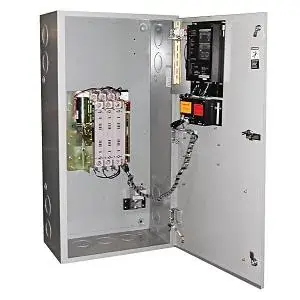
The Zenith general purpose line, where the nameplate says GE and every current document says ABB
This model is part of SecondWatt’s transfer switche research catalogue. Specifications and price observations are included where supported by sources. Equipment availability and commercial terms require confirmation.
GE Zenith ZTG dossier: legacy 40-3000 A ratings, the MX150 controller, ABB ownership since 2018, observed used pricing and inspection guidance.
ZTG is the general purpose Zenith transfer switch line, and it now exists in two forms that a buyer must not confuse. ABB lists a current ZTG T-series built on its integrated switch-and-controller technology with a touchscreen interface, and separately an explicitly labelled previous-generation ZTG that is service entrance rated and offered in standard or delayed transition. A used unit will almost always be the second.
The legacy line, as documented in the manufacturer's own operation manual, spans 40 to 3000 A across 2, 3 and 4 pole configurations, with control transformer voltages from 120 to 600 V, listing to UL 1008, CSA C22.2 No. 178 and IEC 947, and an operating range of minus 20 to plus 60 degrees C. The controller is the MX150, a microprocessor unit with an LCD and keypad, and it is available on the secondary parts market under part number 50P-1160RPL.
One published conflict should travel with any listing. ABB's own news item gives the combined ZTX and ZTG range as 30 to 1,200 A while the current ZTG product page states 30 to 3,000 A. Both figures are published by the same manufacturer and neither page supersedes the other on its face, so a buyer should confirm the frame against the unit rather than against either page.
Why it matters
This is the clearest brand-drift case in the category and it costs buyers money. The nameplate reads GE Zenith or Zenith Controls, no current ABB page mentions GE at all, and at least one legacy part number is documented by a reseller as replaced by the ZTX name rather than continued as ZTG. Anyone searching parts under the wrong brand will conclude support has ended when it has not.
Who buys it
Facilities with a legacy Zenith installed base buying like-for-like, and contractors sourcing general purpose transfer switches against a 24 to 40 week new lead time. GE Zenith is the fourth most listed brand in the used transfer switch channel after ASCO, Cummins and Kohler, and its ZB bypass-isolation siblings turn up regularly alongside the base line.
Role in the data center
General purpose and service entrance transfer on legacy installations, with the ZB bypass-isolation siblings carrying critical duty. The current ZBTS T-series is the line ABB positions for mission-critical and emergency power systems.
Key specifications
| Ampere range, legacy line | 40 to 3000 A |
|---|---|
| Ampere range, current ABB page | 30 to 3,000, conflicting with 30 to 1,200 in an ABB news item A |
| Poles | 2, 3 and 4 |
| Control transformer voltages | 120 through 600 across 8 taps V |
| Transition types | standard direct transfer; ZTGD delayed with neutral position timers |
| Listings | UL 1008, CSA C22.2 No. 178, IEC 947 |
| Controller | MX150 microprocessor with LCD and keypad |
| Controller replacement part | 50P-1160RPL on the secondary parts market |
| Operating temperature | minus 20 to plus 60 degrees C |
| Legacy 400 A footprint | 46 x 24 x 14 in and 175 lb three-pole |
| Sibling ZTS ampere range | 40 to 4000 A |
| Sibling ZTS withstand and closing | 50 at 400 A, 85 at 1600 A, 100 at 4000 A on 480 V kA |
| Sibling ZTS closed transition overlap | under 100 on the ZTSCT model ms |
| Withstand and closing rating, ZTG legacy | not stated in the manufacturer operation manual |
Technical summary
Ampere range, legacy line: 40 to 3000 A per the manufacturer operation manual. Ampere range, current ABB line: 30 to 3000 A on the product page against 30 to 1,200 A in a news item. Poles: 2, 3 and 4 pole, with true four-pole neutral switching on the sibling ZTS family. Control transformer voltages: 8 taps from 120 to 600 V. Transition: standard direct transfer, with ZTGD adding delayed transition on neutral-position timers. Listings: UL 1008, CSA C22.2 No. 178 and IEC 947. Controller: MX150 microprocessor with LCD and keypad, available as replacement part 50P-1160RPL. Operating temperature: minus 20 to plus 60 degrees C, stated for 40 to 4000 A units. Sibling ZTS ratings: 40 to 4000 A at 50 kA at 400 A and 100 kA at 4000 A on 480 V. Sibling ZTS bypass and closed transition: ZBTS, ZBTSD and ZBTSCT, with closed transition under 100 ms. Legacy 400 A footprint: 46 by 24 by 14 in and 175 lb three-pole.
Major variations
The legacy generation runs ZTG for standard transfer and ZTGD for delayed transition, with the sibling ZTS family covering ZTS, ZTSD and ZTSCT and the ZB prefixed bypass-isolation models ZBTS, ZBTSD and ZBTSCT. The current generation is split between a ZTG T-series and a separately published ZBTS T-series for mission-critical duty, for which ABB publishes no ampere range or ratings on its product pages as of August 2026.
Configurations and options
A typical legacy build is a three-pole or four-pole standard transition switch with the MX150 controller, service entrance rated on the previous-generation product. The ZTS sibling adds the MX200 controller with a proprietary control network, a LonWorks interface and Modbus options, plus five enclosure types from open construction to NEMA 4X.
Compatibility and dependencies
ZTG and ZTS are physically distinct families despite the shared MX controller lineage: a legacy 400 A ZTG measures 46 by 24 by 14 inches at 175 lb against a ZTS 400 A at 46 by 24 by 24 inches and 75 lb, so enclosure and mounting are not interchangeable. Current-generation ABB product uses an integrated switch and controller architecture that has no field relationship to an MX150 host.
Pricing and availability
Published price range: $2,200 - $12,800 depending on frame and condition. Trend: stable No published price series exists. Seven ZTG-coded observations, two used and five unused or new surplus, run from 4.33 USD per ampere on a 1200 A new three-pole unit to 21.33 USD per ampere on a 600 A NEMA 3R unit, with a median of 6.24. The unused listings sit at or above the used ones on a per-ampere basis, which is the inversion this category shows across every brand: surplus stock is priced against dealer list, not against a discount curve. Lead time, new: 24-40 weeks (category benchmark). Lead time, used or refurbished: Days to 4 weeks from dealer stock.
Lifecycle and maintenance
Manufacturers publish maintenance intervals for this equipment rather than a service life. The pattern across ASCO, Cummins and Kohler literature is consistent: a monthly electrical transfer test, an annual preventive visit covering enclosure cleaning, contact inspection and lug retorquing, and a lithium control battery replaced every two years on the lines that carry one. No manufacturer in this set publishes a mechanical or electrical endurance figure in operations, and ASCO's own manuals state only that the non-replaceable main contacts are designed to last the life of the switch. That absence is why a used unit is priced on evidence of exercise and on controller availability rather than on a cycle count. Arc flash incident energy is calculated under IEEE 1584-2018 and is installation-specific, so NFPA 70E requires an electrically safe work condition before the enclosure is opened.
Thermal and emissions profile
A transfer switch produces no emissions. It is the device that decides when an emitting machine runs, so the environmental accounting belongs to the generator it starts and to the hours that generator accumulates meeting the monthly exercise obligations in NFPA 110. Two facts do belong to the switch itself. Low-voltage transfer equipment is air-insulated, so sulphur hexafluoride is not part of this product class and should never be claimed as a differentiator. The end-of-life recovery case is copper, silver-alloy contacts and a steel enclosure, and the working exposure is arc flash, calculated under IEEE 1584-2018 and managed through the NFPA 70E process.
Common failure points
- Main contacts — Arc erosion pits and can weld the contacts, so the switch fails to transfer or fails to break
- Controller board — Power supply instability or logic fault stops the switch communicating with the generator control
- Voltage sensing drift — Pickup and dropout thresholds drift, so the switch does not register a real source loss
- Actuator and springs — Solenoid or linear actuator failure, capacitor failure or spring fatigue leaves the switch mid-travel
- Terminations — Vibration and moisture loosen lugs and corrode terminals, producing heat at the connection
- Exercise neglect — A switch that has not transferred in months fails on the first real outage
Inspection checklist
Withstand and closing rating: match the nameplate WCR to the actual upstream device, because UL 1008 Edition 9-2022 does not let a specific-breaker rating carry over to a different breaker. Rating convention: establish whether the WCR is specific-breaker or any-breaker time-based, commonly 3-cycle, since the 2 conventions are not interchangeable. Ampere frame and poles: confirm the frame rating and whether the unit is 2, 3 or 4 pole. Neutral configuration: a 3-pole solid-neutral switch dropped into a separately derived system will nuisance-trip ground-fault relays. Transfer test under load: operate normal to alternate and back, the monthly test NFPA 110 requires, and time it against the 10-second Type 10 threshold. Contact condition: inspect for pitting and erosion; discoloration is normal and the manufacturer instruction is to use light emery paper rather than a file.
Procurement channels
Surplus Record is the primary priced channel, carrying both the base ZTG line and the ZB bypass-isolation siblings, with several listings gated behind a request-price form rather than a number. The MX150 controller is separately available through industrial parts sellers, which matters because ABB publishes no field retrofit kit for legacy Zenith controllers.
Regional notes
North American product listed to UL 1008 and CSA C22.2 No. 178, with IEC 947 also cited on the legacy manual. Support now runs through ABB's electrification organisation, whose previous-generation product pages direct buyers to a customer service line rather than to self-service retrofit literature.