Cummins OTPC transfer switch, 40-4000 A
Manufacturer: Cummins
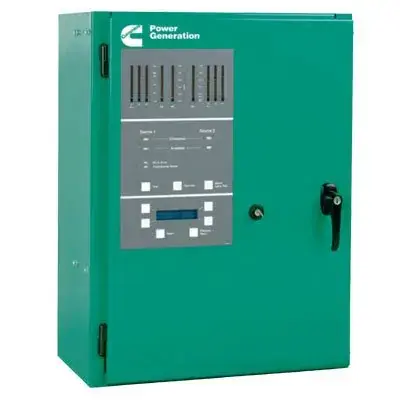
Cummins' open and closed transition workhorse, whose model code hides its configuration in the order file
This model is part of SecondWatt’s transfer switche research catalogue. Specifications and price observations are included where supported by sources. Equipment availability and commercial terms require confirmation.
Cummins OTPC dossier: 40-4000 A frames, closed transition at 100 ms, why the model code hides the configuration, and secondary market guidance.
OTPC is Cummins' open and closed transition transfer switch family, spanning 40 to 4000 A across 16 frame points and nine letter frames from OTPCA to OTPCJ. It runs 120 to 600 VAC at 50 or 60 Hz in three-pole solid-neutral or four-pole switched-neutral form, with open, closed and programmed transition available and a published closed transition overlap of 100 milliseconds or less. Withstand and closing ratings run from 14 kA on the smallest frames to 200 kA with coordinated current-limiting fuses at the top.
The nomenclature is the buyer's problem here. The trailing letter marks an ampere frame tier rather than a feature, and Cummins publishes no letter-by-letter legend for OTPC; the actual configuration lives in a feature code string on the original order covering current rating, voltage, poles, application, enclosure, control level and accessories. A used OTPC nameplate therefore tells a buyer the family and roughly the frame, and almost nothing else. That is the opposite of Kohler's published position-by-position order code.
Bypass isolation is not an OTPC variant. It is a separate family, BTPC at 150 to 4000 A, with the newer PowerCommand B-Series CBL and CBR at 1200 to 3000 A announced in March 2023 on the PowerCommand 80 controller. Anyone specifying maintenance-without-outage capability on a Cummins drawing is looking at BTPC or B-Series, not at OTPC.
Why it matters
OTPC is the case study in why a transfer switch listing needs a specification sheet rather than a photograph of a nameplate. Two units carrying the same OTPCF code can differ in voltage, poles, enclosure, transition type and control level, and none of that is legible from the plate. A buyer of any unit in this family needs the original order or the submittal drawing to know what the switch actually is.
Who buys it
Facilities standardised on Cummins generator sets, buying the switch and the engine from the same distributor network of roughly 450 locations. The Power Systems segment reported record 2025 sales with fourth-quarter revenue up 11% to 1.9 billion dollars, attributed to data center backup demand, so the installed base this line feeds is growing rather than static.
Role in the data center
Utility-to-generator transfer at the service entrance or main switchboard on Cummins-standardised sites. Bypass-isolation duty belongs to the BTPC or B-Series lines rather than to this family, so an OTPC nameplate on a critical bus drawing is worth questioning.
Key specifications
| Ampere range | 40 to 4000 across 16 frame points A |
|---|---|
| Voltage range | 120 to 600 at 50 or 60 Hz VAC |
| Poles | 3-pole solid neutral or 4-pole switched neutral |
| Closed transition overlap | 100 or less ms |
| WCR at 40-125 A | 14 at 480 V kA |
| WCR at 300-600 A | 65 at 480 V kA |
| WCR at 1600-4000 A | 85 to 100, to 200 with coordinated fuses kA |
| Listing | UL 1008 |
| Enclosures | Type 1, 3R, 4, 4X, 12 |
| Controller levels | feature code C023 level 1 and C024 level 2 |
| Communications | LonWorks through optional module M031 |
| Smallest frame | 40-125 A at 27 x 20.5 x 12 in and 82 lb |
| Largest frame | 4000 A at 90 x 46.5 x 60 in and 1,850 lb |
| Operating temperature | minus 40 to 140 degrees F |
| Seismic option | feature code A080; no preapproval number published |
Technical summary
Ampere ratings: 40 to 4000 A across 16 frame points and 9 letter frames from OTPCA to OTPCJ. Voltage: 120 to 600 VAC at 50 or 60 Hz, with 120 V single-phase only and not above 1200 A. Poles: 3-pole solid neutral or 4-pole switched neutral. Transition types: open, closed at 100 ms overlap or less, and programmed. Withstand and closing rating at 480 V: 14 kA at 40-125 A, 30 kA at 150-260 A, 65 kA at 300-600 A, 85-100 kA at 1600-4000 A, to 200 kA with coordinated fuses. Listing: UL 1008 listed with type-rated cabinets and terminals. Enclosures: Type 1, 3R, 4, 4X stainless and 12. Controller: PowerCommand digital platform at feature code C023 level 1 or C024 level 2. Communications: LonWorks-compatible through the optional M031 network module. Dimensions: 40-125 A at 27 by 20.5 by 12 in and 82 lb; 4000 A at 90 by 46.5 by 60 in and 1,850 lb. Operating temperature: minus 40 to 140 degrees F, operating and storage.
Major variations
OTPC covers open, closed and programmed transition in one family, with a separate service entrance SKU designated OTPC-SE. Bypass isolation sits outside the family in the BTPC line at 150 to 4000 A and in the PowerCommand B-Series CBL and CBR at 1200 to 3000 A. The economy sibling is OTEC at 40 to 1000 A, open and programmed transition only.
Configurations and options
A typical build is a three-pole solid-neutral open transition switch in a Type 1 enclosure at control level 1. Network integration is an option rather than a standard fitment, through the LonWorks-compatible M031 module; native Modbus and Ethernet appear on the newer PowerCommand 80 platform used by the X-Series and B-Series rather than on OTPC.
Compatibility and dependencies
Configuration must be reconstructed from the original order feature codes, because the model code does not carry it. Closed transition units need utility review: Cummins' own technical paper notes that many utilities require a shunt-trip means to guard against sources remaining paralleled beyond 100 milliseconds, and cites IEEE 1547 allowances for generator systems between 1.5 and 10 MVA.
Pricing and availability
Comparable secondary-market band: 1.69–5.07 $ per ampere. Trend: rising No price series exists for this family. The single priced OTPC observation is a 225 A three-pole 480 V unit in new open-box condition at 2,500 USD, or 11.11 USD per ampere. The nearest adjacent data points are a 400 A BTPC bypass unit at 5,395 USD (13.49 USD per ampere) and a legacy 300 A Onan OTC nameplate at 1,850 USD (6.17 USD per ampere), neither of which is an OTPC. Lead time, new: 24-40 weeks (category benchmark); OTPC channels are quote-only. Lead time, used or refurbished: Days to 4 weeks from dealer stock.
Lifecycle and maintenance
Manufacturers publish maintenance intervals for this equipment rather than a service life. The pattern across ASCO, Cummins and Kohler literature is consistent: a monthly electrical transfer test, an annual preventive visit covering enclosure cleaning, contact inspection and lug retorquing, and a lithium control battery replaced every two years on the lines that carry one. None of ASCO, Cummins or Kohler publishes a mechanical or electrical endurance figure in operations, and ASCO's own manuals state only that the non-replaceable main contacts are designed to last the life of the switch. That absence is why a used unit is priced on evidence of exercise and on controller availability rather than on a cycle count. Arc flash incident energy is calculated under IEEE 1584-2018 and is installation-specific, so NFPA 70E requires an electrically safe work condition before the enclosure is opened.
Thermal and emissions profile
A transfer switch produces no emissions. It is the device that decides when an emitting machine runs, so the environmental accounting belongs to the generator it starts and to the hours that generator accumulates meeting the monthly exercise obligations in NFPA 110. Two facts do belong to the switch itself. Low-voltage transfer equipment is air-insulated, so sulphur hexafluoride is not part of this product class and should never be claimed as a differentiator. The end-of-life recovery case is copper, silver-alloy contacts and a steel enclosure, and the working exposure is arc flash, calculated under IEEE 1584-2018 and managed through the NFPA 70E process.
Common failure points
- Main contacts — Arc erosion pits and can weld the contacts, so the switch fails to transfer or fails to break
- Controller board — Power supply instability or logic fault stops the switch communicating with the generator control
- Voltage sensing drift — Pickup and dropout thresholds drift, so the switch does not register a real source loss
- Actuator and springs — Solenoid or linear actuator failure, capacitor failure or spring fatigue leaves the switch mid-travel
- Terminations — Vibration and moisture loosen lugs and corrode terminals, producing heat at the connection
- Exercise neglect — A switch that has not transferred in months fails on the first real outage
Inspection checklist
Withstand and closing rating: match the nameplate WCR to the actual upstream device, because UL 1008 Edition 9-2022 does not let a specific-breaker rating carry over to a different breaker. Rating convention: establish whether the WCR is specific-breaker or any-breaker time-based, commonly 3-cycle, since the 2 conventions are not interchangeable. Ampere frame and poles: confirm the frame rating and whether the unit is 2, 3 or 4 pole. Neutral configuration: a 3-pole solid-neutral switch dropped into a separately derived system will nuisance-trip ground-fault relays. Transfer test under load: operate normal to alternate and back, the monthly test NFPA 110 requires, and time it against the 10-second Type 10 threshold. Contact condition: inspect for pitting and erosion; discoloration is normal and the manufacturer instruction is to use light emery paper rather than a file.
Procurement channels
No distributor publishes a real-time online price for a new OTPC unit; every OTPC channel, including Global Power Supply and Woodstock Power, is quote-only. Cummins prices its economy OTEC line online through at least one retailer, at 1.69 to 5.07 USD per ampere across 125 to 600 A, which is a same-manufacturer reference point rather than an OTPC comparison.
Regional notes
North American product to UL 1008, supported through roughly 450 distributor locations and more than 19,000 certified dealer locations across about 190 countries. A seismic option exists as feature code A080, but no IBC edition or preapproval number is published.