ASCO Power Technologies 7000 Series power transfer switch, D through G frames to 4000 A
Manufacturer: ASCO Power Technologies
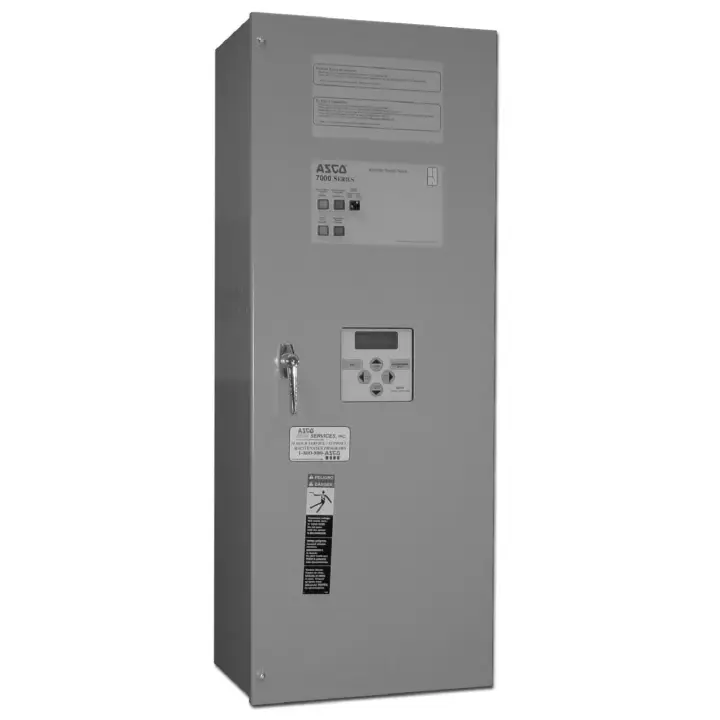
ASCO's mission-critical tier, where 3000 A is a rating inside the G frame rather than a model of its own
This model is part of SecondWatt’s transfer switche research catalogue. Specifications and price observations are included where supported by sources. Equipment availability and commercial terms require confirmation.
ASCO 7000 Series dossier: D through G ampere frames to 4000 A, bypass-isolation sequence, withstand ratings, observed used pricing and inspection guidance.
The 7000 Series is ASCO's mission-critical transfer switch line and the only ASCO tier here still in production with bypass isolation. Low-voltage units are built on four ampere frames: D at 30 to 230 A, J at 150 to 600 A, H at 600 to 1200 A and G at 1000 to 4000 A. A 3000 A rating sits inside the G frame rather than forming a distinct product, and a separate medium-voltage 7000 Series line also offers 3000 A at 5 kV and 15 kV.
The catalogue nomenclature is unusually legible for a used buyer. 7ATS and 7NTS are the automatic and non-automatic conventional switches, 7ACTS is closed transition, 7ADTS is delayed transition, and the bypass-isolation family substitutes a B for the final S: 7ATB, 7ACTB and 7ADTB. Service entrance variants carry US in place of TS. A nameplate therefore decodes to transition type, bypass capability and service entrance rating without the seller's help.
One documentation detail belongs on any listing. ASCO's 7000 Series technical data states testing to UL 1008 7th Edition, while the current standard is Edition 9-2022, and the withstand and closing ratings quoted in that document are tied to specific breakers and current-limiting fuses. A rating tested against a named breaker does not transfer to a different one, which makes upstream device coordination the single most consequential check on a used 7000 Series unit.
Why it matters
The Uptime Institute ranks transfer switch failure second among power-related causes of data center outages, at 34%, behind only the UPS. A line that can be isolated and serviced with load still on is the direct answer to that statistic, and it is why bypass-isolation construction carries a premium that shows up clearly in the used data as well as in new quotations.
Who buys it
Data center, healthcare and other NFPA 110 Level 1 operators specifying transfer equipment that can be maintained without dropping load, plus contractors sourcing against a 24 to 40 week new lead time. This is the line that appears on mission-critical drawings, and used units at 400 A, 800 A, 1200 A and 1600 A all appear in priced public listings.
Role in the data center
Critical bus and service entrance transfer in NFPA 110 Level 1 and mission-critical designs, upstream of the UPS. The bypass-isolation variants are the ones that satisfy maintenance-without-outage requirements.
Key specifications
| D frame | 30 to 230 A |
|---|---|
| J frame | 150 to 600 A |
| H frame | 600 to 1200 A |
| G frame | 1000 to 4000, including the 3000 rating A |
| Voltage range | 115 to 600 by catalogue letter code V |
| WCR, J frame 600 A | 65 at 240 V, 42 at 480 V, 35 at 600 V kA |
| WCR, G frame bypass 1600-2000 A | 125 at 240 and 480 V, 100 at 600 V kA |
| Standard cited | UL 1008 7th Edition on the technical data sheet |
| Enclosures | Type 1, 3R, 3RX, 4, 4X, 12 with 316 stainless option |
| Controller | Group 5, replacement part K601800-002 |
| Smallest frame dimensions | 30 A Type 1 at 18 x 48 x 13 in and 70 lb |
| Largest frame dimensions | 4000 A Type 1 at 60 x 92 x 72 in and 2,250 lb |
| Medium voltage ratings | 1200, 2000 and 3000 A at 5 kV and 15 kV |
| Medium voltage interrupting classes | 25, 40 or 50 symmetrical kA |
Technical summary
Frames: D at 30-230 A, J at 150-600 A, H at 600-1200 A, G at 1000-4000 A. Voltage: catalogue letter codes A through R spanning 115 to 600 V; 200 A and 230 A limited to 480 V. Poles: 2-pole and 3-pole across most ratings. Transition types: 7ATS and 7NTS conventional, 7ACTS closed, 7ADTS delayed, plus 7ATB and 7ACTB bypass. Service entrance variants: 7AUS, 7NUS, 7ACUS and 7ADUS plus bypass equivalents. Withstand and closing rating: J-frame 600 A at 65 kA/240 V, 42 kA/480 V, 35 kA/600 V; G-frame 1600-2000 A bypass at 125 kA. Listing: tested to UL 1008 7th Edition; the current standard is Edition 9-2022. Enclosures: Type 1, 3R, 3RX, 4, 4X, 12 with a 316 stainless option. Controller: Group 5, with PowerQuest 5300 series and 5350 eight-channel annunciators as accessories. Dimensions: 30 A at 18 by 48 by 13 in and 70 lb; 4000 A at 60 by 92 by 72 in and 2,250 lb. Medium voltage line: 1200, 2000 and 3000 A at 5 and 15 kV, 25-50 kA, vacuum breakers to UL 1008A.
Major variations
Three distinct products share the 7000 name: the base low-voltage power transfer switch, the bypass-isolation switch, and a medium-voltage line built on metal-clad switchgear with removable vacuum breakers rather than a contactor. The medium-voltage line adds a soft-load source-paralleling transition the low-voltage line does not offer. Service entrance rated versions exist for every low-voltage transition type.
Configurations and options
The mission-critical build is a bypass-isolation unit in the 7ATB, 7ACTB or 7ADTB family with the Group 5 controller. The bypass handle works through OPEN, NORMAL and EMERGENCY positions with window indicators, and the isolation handle rotates counterclockwise through TEST to ISOLATE, at which point the transfer switch retracts on rails with a lockout tab preventing reconnection.
Compatibility and dependencies
Withstand and closing ratings on this line are quoted against specific breakers and current-limiting fuses, so the rating does not survive a change of upstream device. The Group 5 controller is shared with the discontinued 4000 Series but carries a different replacement part number. Medium-voltage units are a separate architecture and share nothing mechanically with the low-voltage frames.
Pricing and availability
Published price range: $599 - $20,000 depending on frame and condition. Comparable secondary-market band: 5–15.38 USD per amp. Trend: stable No published price series exists. Six used observations run from 1.63 USD per ampere on a 400 A working takeout to 19.97 USD per ampere on a confirmed sold 30 A unit, with a median of 7.19 across the set. The spread is driven by frame size and by whether the unit carries bypass isolation, not by age, which is the pattern to expect in a category where fixed cost dominates. Lead time, new: 24-40 weeks (category benchmark). Lead time, used or refurbished: Days to 4 weeks from dealer stock.
Lifecycle and maintenance
A bypass-isolation switch is bought so the automatic section can be serviced or replaced while load stays energised, which changes the maintenance economics rather than the maintenance interval. The monthly transfer test and the annual preventive visit still apply, and NFPA 110 adds a 36-month, four-hour test for Level 1 systems. Value concentrates in the power section and the bypass mechanism, both of which outlive several controller generations, so a controller retrofit is the normal route to extending service life. ASCO, Eaton and Russelectric all publish retrofit or modernisation programmes for the installed base, and the existence of those programmes is what sets a floor under a used power section. Bypass-isolation construction is what allows that electrically safe work condition under NFPA 70E without dropping the load, with arc flash energy calculated per IEEE 1584-2018.
Thermal and emissions profile
A transfer switch has no emissions of its own, and for a bypass-isolation unit the honest environmental and safety content is the maintenance condition rather than the exhaust. NFPA 70E requires an electrically safe work condition before a technician works inside the enclosure, and bypass-isolation construction is the mechanism that makes that possible without dropping the load. Arc flash incident energy is calculated under IEEE 1584-2018 from bolted fault current, clearing time, working distance and electrode geometry, so it is installation-specific and cannot be quoted from a nameplate. Sulphur hexafluoride does not apply to this class, which is air-insulated at low voltage and vacuum-interrupted at medium voltage. What the switch does control is generator run hours.
Common failure points
- Bypass interlocks — Solenoid interlocks bind or get defeated, so the bypass sequence cannot be completed safely
- Drawout hardware — Racking rails, guides and lifting hardware go missing between sites, stranding the automatic section
- Bypass contacts — The bypass path is rarely exercised, so its contacts and mechanism age untested
- Main contacts — Arc erosion pits and can weld the automatic section contacts
- Controller board — Controller failure disables automatic transfer while the bypass path stays manual
- Closed transition paralleling — A closed transition unit that overruns its overlap window trips the utility protection
Inspection checklist
Bypass mechanism: confirm a true bypass-isolation type with a drawout automatic section, not a 2-position switch with a separate maintenance bypass panel. Isolation position: verify the isolation handle disconnects both primary and control power so the automatic section can be withdrawn. Interlocks: solenoid interlocks must prevent out-of-sequence operation, and no handle should ever be forced past 1 of them. Bypass under load: demonstrate a live bypass and return, because maintenance without a 100% load interruption is the entire reason the unit costs more. Withstand and closing rating: match the WCR to the upstream device under UL 1008 Edition 9-2022, and record whether it is 3-cycle or 30-cycle. Cycle rating: a 30-cycle rated switch and a 3-cycle switch are different products and price accordingly.
Procurement channels
eBay and Surplus Record carry the priced inventory, with confirmed sold listings at 30 A and used listings at 400, 800, 1200 and 1600 A. One 4000 A unit was listed at 148,400 USD and ended unsold, so that figure is an asking price rather than a transaction.
Regional notes
North American product to UL 1008 with NEMA enclosures, and a medium-voltage line built to UL 1008A with vacuum circuit breakers. ASCO publishes no model-specific seismic preapproval number for this line, consistent with the category-wide absence of published seismic numbers for transfer equipment.