
A synchronous condenser is a synchronous machine that runs on the grid without driving a load or burning fuel. Its field current is raised or lowered to produce or absorb reactive power, and it also supplies fault current and inertia. Grids are adding them as coal and gas units retire, and some are converted from those retiring generators.
For the owner of a retiring gas or steam unit, conversion is a second life for the generator and its grid connection. For a large-load developer, the question is whether the local grid is strong enough, which a study answers. Either way, ratings and records come first, and the gas turbines hub covers the machines themselves.
Key Takeaways
- A synchronous condenser supplies reactive power without burning fuel. Raising its excitation produces reactive power; lowering it absorbs reactive power.
- Inertia depends on rotating mass. AEMO says condensers used for a fault-level shortfall will not address an inertia shortfall unless coupled with a rotating mass or flywheel.
- At Townsville, condenser mode carries a quarter of the generation-mode inertia. Siemens Energy calculates about 250 MWs in condenser mode and about 1,000 MWs in generation mode.
- A conversion reuses the generator, so its records come first. Stator partial discharge trends, rotor flux probe tests, starts, hours and turning-gear hours set the starting point.
- In Queensland, new condensers are costly and slow. Powerlink reports about A$185 million each, in 30 June 2025 dollars, and put lead times around four years from contract award.
What a synchronous condenser is#
A synchronous condenser is a large synchronous machine connected to the grid that exchanges no mechanical energy in normal operation. It works solely to provide or absorb reactive power for voltage control and grid stability, according to Siemens Energy's synchronous condenser page. The same machine is also called a synchronous compensator.
The control is the field, as GE Vernova's synchronous condensing page and its 08/2025 grid-firming white paper GEA35830 explain. Raising the excitation current to the rotor makes the machine produce reactive power (over-excited); lowering it makes the machine absorb reactive power (under-excited). It draws a small amount of electrical power from the grid to keep spinning.
A dedicated condenser is not driven by an engine or turbine, as ABB's synchronous condensers page notes. One exception matters to turbine owners: in GE Vernova's clutchless option for the 7F.05, the gas turbine stays coupled and synchronized, unfired, while the generator runs as a condenser.
What it gives the grid#
NERC, AEMO and NREL describe three services, each rated in a different unit.
Grid services of a synchronous condenser (NREL report TP-6A20-73856, May 2020; AEMO system strength explainer, March 2020; NERC reliability guideline, December 2017; OEM ratings as labeled)#
| Service | What it means | How it is rated | Source |
|---|---|---|---|
| Reactive power and voltage support | Supplying or absorbing reactive power to hold voltage | Mvar, as a range such as +25/−12.5 Mvar | NERC; GE Vernova and Siemens Energy ratings |
| Short-circuit (fault) current | Current that flows during a fault, which protection relies on | Fault current in amps; three-phase fault level or short-circuit contribution in MVA | AEMO; Siemens Energy ratings |
| Inertia | Stored rotational energy that slows frequency change after a trip | Inertia constant H in seconds; stored energy in megawatt-seconds (MWs) | NREL; Siemens Energy ratings |
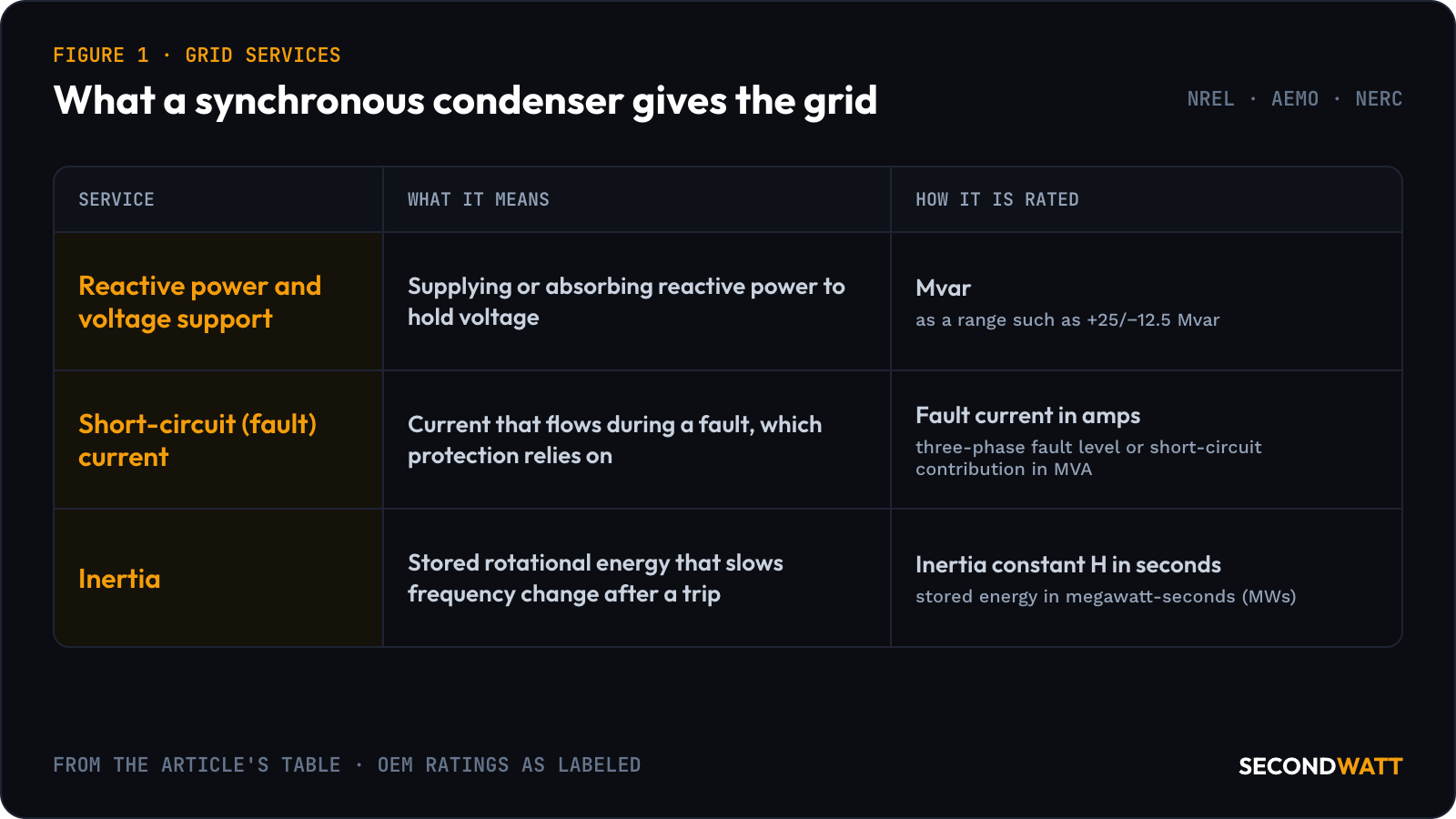
NERC's December 2017 reliability guideline, Integrating Inverter-Based Resources into Low Short Circuit Strength Systems, lists the benefits of condensers on weak grids. They include a large capability to supply fault current, increased system inertia, voltage capability and improved voltage stability. AEMO's March 2020 explainer, System Strength in the NEM Explained, defines fault level in MVA as proportional to fault current and voltage. It treats synchronous condensers as a source of system strength.
The inertia constant is stored energy per unit of rated capacity. NREL's example: a 1 GW generator with an inertia constant of 4 seconds holds 4 GW·s (gigawatt-seconds) and could deliver 1 GW for 4 seconds from that energy alone. Typical power plants sit at 2 to 7 seconds, according to NREL's May 2020 guide, Inertia and the Power Grid: A Guide Without the Spin. NREL is now the National Laboratory of the Rockies.
AEMO notes that condensers used for a fault-level shortfall will not address an inertia shortfall unless they are coupled with a rotating mass or flywheel. NREL adds that condensers have historically had lower amounts of usable inertia.
Why grids are adding them again#
Condensers are an old machine. GE Vernova's Synchronous Condenser Systems brochure GEA-12804A cites more than 200 applications of its design over nearly a century. What changed is the supply of the services they provide.
AEMO's March 2020 explainer says system strength and inertia are by-products of synchronous generation. As those machines are displaced during high inverter-based output, or retire, the power system loses both. NERC's December 2017 guideline calls condensers "often the primary solution for weak grid issues." It adds that they are particularly useful where synchronous resources are being retired, since new condensers can be installed or existing units may be able to be used as condensers.
AEMO now sets minimum fault levels by node in Australia's National Electricity Market. Its 2024 System Strength Report, published February 2025, says these must be met by solutions able to deliver protection-quality fault current. It says the options may include synchronous condensers, contracts with market participants and conversion of existing thermal units into condensers.
Powerlink's preferred option for Queensland, published 30 June 2025 in its PACR summary, includes nine synchronous condensers in Central and Southern Queensland by June 2034. Its draft reassessment of 19 October 2026 keeps condensers as the preferred portfolio, cut to five in Central Queensland within its 10-year horizon. Clutched gas turbines rank second.
In GE Vernova's account, gas turbines without condensing capability typically run at peak demand and shut down at other times, often when renewable output is high and inertia and fault current are most needed. That is the duty pattern of peaker plants.
Converting a retired generator#
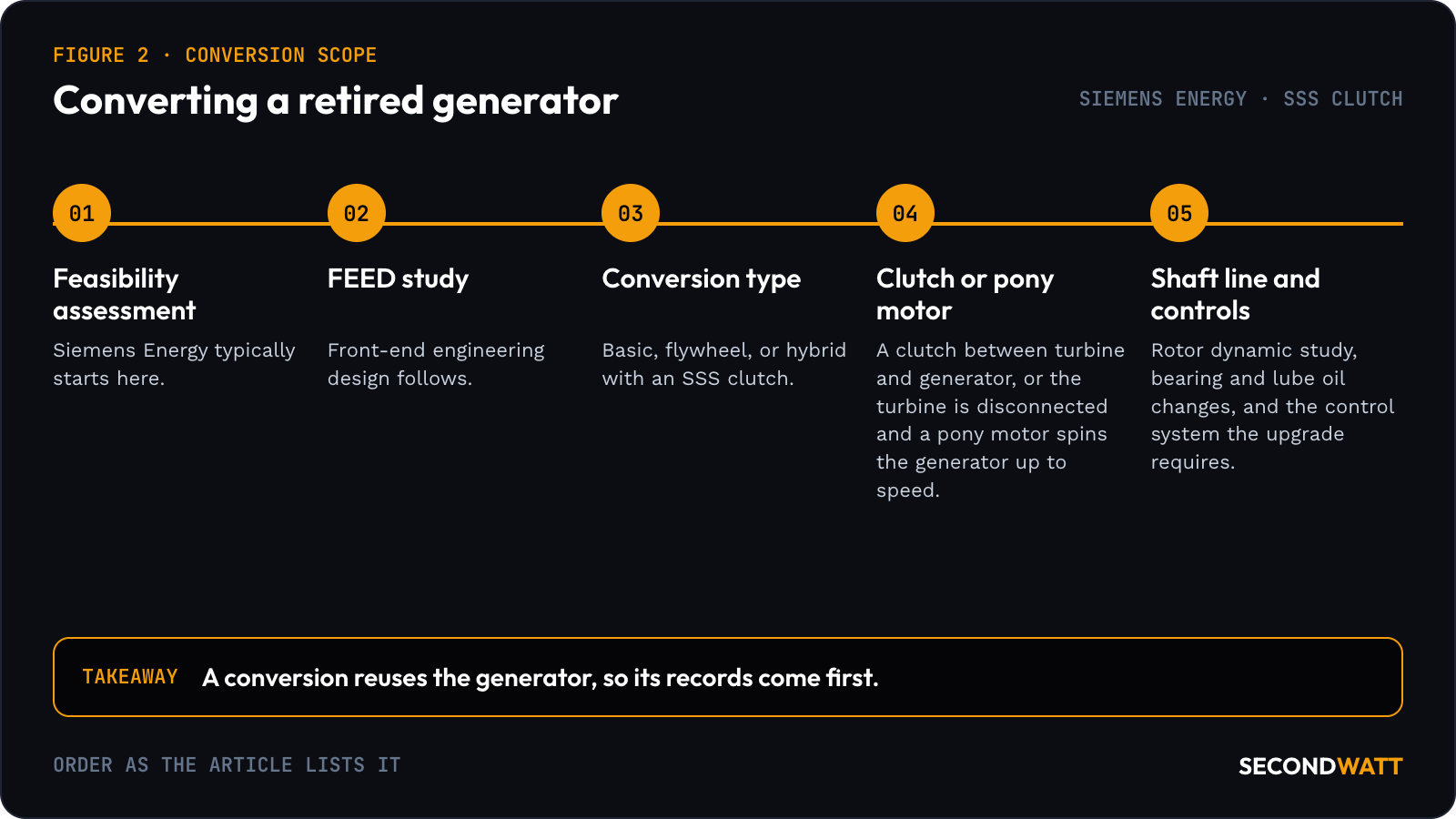
A synchronous condenser conversion reuses the generator and its existing grid connection but changes what turns the rotor, according to SSS Clutch. Siemens Energy typically starts with a feasibility assessment, then a front-end engineering design (FEED) study, according to its RGS conversion page. It offers a basic conversion with a new start-up and acceleration system, a flywheel conversion, and a hybrid conversion with an SSS clutch between generator and turbine.
The clutch maker describes two layouts. A clutch can sit between turbine and generator, sometimes inside a replacement gearbox. Or the turbine is disconnected and a pony motor with a clutch spins the generator up to speed.
Two projects show the two layouts. At Xcel Energy's Tolk coal plant in Texas, there was no room between turbine and generator. The generator was disconnected and a starting package with a 95T SSS clutch was added at its free end, according to SSS Clutch's Tolk case study. Changing back to generation takes about 7 hours.
At Townsville in Queensland, a 280T clutch went between a Siemens Energy SGT5-2000E gas turbine and its generator. SSS Clutch's Townsville case study says the clutch sits in its own casing with two tilting-pad bearings. The oil system was moved aside, and Siemens Energy ran rotor dynamic studies with SSS to select the bearings. A 21 Aug 2025 Siemens Energy story says Powerlink chose the clutch as the least-cost of eight options and signed a system strength services agreement with the plant.
Siemens Energy calculates the Townsville unit's electrical inertia at around 250 MWs in condenser mode, with about 350 to 400 MVA of short-circuit contribution, and around 1,000 MWs in generation mode. For the same unit, condenser mode carries about a quarter of the generation-mode figure:
250 ÷ 1,000 = 0.25
250 MWs — Siemens Energy's approximate calculated inertia, in megawatt-seconds of stored energy, for the Townsville unit in condenser mode, against around 1,000 MWs when the same unit generates.
GE Vernova keeps the turbine on the shaft instead. Its clutchless upgrade lets an existing 7F.05 run unfired as a condenser, with a power demand of about 55 MW, and return to generation in under 8 minutes. The scope covers thrust bearing and lube oil flows and the Mark VIe control system. GE Vernova's 7F.05 synchronous condenser page says the upgrade is validated on the 7F.05; extending it to other E-, F- and HA-class frames is pending a successful instrumented test.
On the LM2500, GE Vernova's clutchless upgrade runs the turbine starter in condensing mode to lubricate the turbine bearings. It needs a Mark VIe or Woodward control system and a sump evacuation system, according to GE Vernova's LM2500 synchronous condensing page. The site relay scheme and local rules may limit Mvar. The natural gas plant conversion guide covers the wider plant decisions.
New-build condensers and flywheels#
New condensers come as dedicated machines, with or without a flywheel. The ranges below are each vendor's own.
Ratings in GE Vernova's line run from 10 to 100 Mvar per machine, with static or brushless excitation, according to brochure GEA-12804A. GE Vernova says a unit can carry more than twice its rating for up to 10 seconds. Siemens Energy offers generators up to 1,300 MVA at full speed. Material strength caps its largest flywheel alone at about 3,500 MWs at 50 Hz and 2,000 MWs at 60 Hz.
A flywheel adds rotating mass. Siemens Energy runs its flywheels in partial vacuum to cut friction losses. ABB says its flywheel versions provide high, instantaneous inertia. AEMO reported in its 2023 System Strength Report that, anecdotally, adding a typical 1,000 MWs flywheel to a synchronous condenser adds about 3% to its cost if decided up front; retrofitting one is substantially more expensive.
Reactive range and stored energy are separate specifications. Two Siemens Energy flywheel condensers show it. The Siemens Energy product page rates Rassau at ±60 Mvar at 132 kV with 1,100 MWs of kinetic energy. The company's Grid Stabilization brochure rates Shannonbridge B at ±63 Mvar at 220 kV with 4,000 MWs.
Both are Siemens Energy kinetic energy figures, with reactive ranges stated at grid voltage. Worked example: Shannonbridge B stores about 3.6 times Rassau's kinetic energy, on reactive ranges within 5% (63 ÷ 60 = 1.05):
4,000 ÷ 1,100 = 3.6
Siemens Energy's product page says a flywheel gives a condenser an inertia constant similar to that of a large steam turbine.
Synchronous condensers, STATCOMs and grid-forming inverters#
Condensers have limits of their own. NERC's 2017 guideline cautions that they can introduce new modes of angular instability, and may also introduce protection and maintenance challenges.
A STATCOM is a power-electronic device that provides dynamic reactive support. NERC says such FACTS devices are limited in their contribution to fault current and do not provide any system inertia. GE's SVC and STATCOM fact sheet GEA30734 says its STATCOMs, built on IGBT voltage source converters, respond faster than static var compensators.
A grid-forming inverter creates its own voltage and uses controls to behave much like a synchronous machine. GE Vernova's white paper rates a grid-forming inverter with a battery as giving synthetic inertia and limited fault current. AEMO's 2024 report lists grid-forming technology among options for the efficient level of system strength, while minimum fault levels need protection-quality fault current.
What an owner or buyer checks#
A conversion buys the generator's history, so the records matter as much as the rating.
Checks before converting or buying a retired generator (GE Vernova generator services page and white paper GEA35830, 08/2025; Siemens Energy product and project pages; SSS Clutch project pages; NERC reliability guideline, December 2017)#
| Item | Record or test | Why |
|---|---|---|
| Stator winding | Partial discharge analysis trend; rewind history | GE Vernova names the insulated copper winding the top cause of stator-side service issues |
| Rotor (field) | Periodic flux probe test; rotor rewind history | GE Vernova recommends periodic flux probe testing; grounds and shorts lead its list of rewind causes |
| Operating history | Total starts and hours; turning-gear hours; last outage results | GE Vernova's questions for timing generator service |
| Shaft line, bearings and lube | Rotor dynamic study for the new coupling; bearing and lube oil changes | GE Vernova says retrofits should complete checks such as rotor dynamics |
| Excitation and controls | Excitation type; control system the upgrade requires | Excitation sets the Mvar output; some upgrades need specific controls |
| Step-up transformer and breaker | GSU condition records; generator circuit breaker | Siemens Energy's condenser connects to the high-voltage network through a step-up transformer |
| Protection and limits | Relay scheme; tested lagging operating limit | NERC's wind-plant example expects protection to be challenging to coordinate and calls determining the actual lagging limits key |
| Grid service status | Any system strength or reactive service contract | Townsville's conversion followed a services agreement with Powerlink |
The first three rows come from GE Vernova's generator services page. Its white paper adds that a retrofit should involve the OEM to integrate controls and protection and complete checks such as rotor dynamics.
The GSU specification guide and the GE Prolec GSU dossier cover the transformer. The generator circuit breaker guide covers the breaker, and the remaining-life method turns turbine counters into a forecast if the turbine stays. The seller's documentation guide lists the records buyers ask owners for.
FAQ: synchronous condensers#
Is a synchronous condenser the same as a capacitor bank?#
No: a capacitor bank is a static device, and the two can share a substation. At Granite substation in Vermont, VELCO installed four +25/−12.5 Mvar condensers alongside four 25 Mvar mechanically switched shunt banks. Low-voltage ride-through and high short-time overload were among the reasons cited for choosing condensers over static devices. The overload gives the 115 kV shunt capacitors time to be switched in, according to GE Vernova's brochure GEA-12804A.
How much does a synchronous condenser cost?#
Powerlink's draft material change assessment of 19 October 2026 says procurement activities indicate costs of about A$185 million per synchronous condenser, in 30 June 2025 Australian dollars. It states no MVA rating for that figure.
$185 million — Powerlink's approximate cost per synchronous condenser from procurement activities, in 30 June 2025 Australian dollars; its October 2026 draft reassessment gives no MVA rating.
Conversion can cost less. Siemens Energy says the Townsville hybrid conversion delivers grid stabilization capability at up to 50% less cost than a new synchronous condenser.
Can a gas turbine generator run as a condenser and still generate?#
Yes, if the turbine stays coupled or a clutch is added. The 7F.05 clutchless upgrade reaches baseload from condenser mode in under 15 minutes, per GE Vernova. Its white paper lists the LM6000VELOX, a package built around an LM6000 gas turbine and generator, with a clutch integrated in the gearbox. The first LM6000VELOX in commercial operation, Dominion Energy's Bushy Park unit (1 November 2024), includes synchronous condensing, according to a GE Vernova release of 13 Feb 2025.
Do large data center loads need synchronous condensers?#
The site's interconnection and stability studies decide. In NERC's weak-grid wind-plant example, studies showed no stable response for certain credible contingencies, and a condenser was proposed and sized to give stable behavior for the conditions tested. ABB, for one, will supply VoltaGrid 35 synchronous condensers with flywheels for behind-the-meter data center power projects, according to an ABB release of March 2026. The large-load interconnection guide covers the US process.
How long does a conversion take?#
Installation and project time differ. The 7F.05 clutchless upgrade installs in under 10 days, per GE Vernova, as a stand-alone outage or during a hot gas path or major inspection. Siemens Energy says the Townsville conversion can be completed in 18 months, against three years for a new condenser. For new units, Powerlink put lead times around four years from contract award in June 2025.
Converting or selling a retired unit#
SecondWatt publishes equipment research and helps buyers source power equipment; it earns a fee when a sale it arranges closes. If you need a generator, turbine or step-up transformer for a condenser project, send a request that states the Mvar range, inertia and grid connection you need. If you own a retiring gas turbine generator, the gas turbine seller page sets out how SecondWatt works with owners.