A peaker plant is a power plant normally reserved for the hours when electricity demand, and usually the price of power, is highest. Peaking units tend to run infrequently and for short periods, and they can respond quickly when the grid needs extra supply. In the U.S., natural gas combustion turbines are generally used to meet peak load, and some peaking turbines still burn oil.
For a buyer, a peaker plant is a source of fast-start equipment with a particular history: many starts, few hours, and often decades in service. For an owner, a retiring peaker raises the question of what its units are worth to someone else. Both questions start with the machines and their records: the gas turbines and engines in peaking duty.
Key Takeaways
- Peakers are defined by when they run. EIA describes peaking capacity as equipment normally reserved for the hours of highest daily, weekly or seasonal load.
- US gas combustion turbines produced 13.6% of their possible output in 2025. Natural gas combined-cycle plants reached 58.7% in the same EIA table.
- Turbines start in minutes; fast-response engines in seconds. OEM claims run from 5–10 minutes for three aeroderivatives to 7 seconds for Caterpillar's G3516 with Fast Response.
- Trips count as several starts. On GE Vernova heavy-duty frames, one trip from 80–100% load carries the life effect of eight normal start-stop cycles.
- Planned retirements are a small, old slice. EIA-860M lists 1,992 MW net summer capacity of gas combustion turbines planned to retire in 2027–2030; median first-operating year, 1975.
What a peaker plant is#
The EIA glossary defines peaking capacity as generating equipment "normally reserved for operation during the hours of highest daily, weekly, or seasonal loads." The same entry notes that some equipment serves as peaking capacity at some times and runs around the clock at others. A peaker is therefore defined by its duty, and the same turbine model can sit in a peaker or a baseload plant.
EIA's glossary entry for a peak load plant lists the usual hardware: old, low-efficiency steam units, gas turbines, diesels or pumped-storage hydro. EIA's Today in Energy article of 1 October 2013 notes that natural gas combustion turbines cost more to operate than other plant types but can respond quickly. They tend to be used for short-term increases in demand, during ramping or when loads and prices are higher.
Price usually drives dispatch. In the same EIA piece, average generation of the combustion-turbine fleet in the Texas (TRE) region rose and fell with real-time wholesale hourly prices. Generation tended to nearly double from 3:00 to 6:00 p.m. against early-morning off-peak hours.
GE Vernova's own duty classes give the equipment view. Its heavy-duty frame guide is GER-3620-P, revision P, released 15 March 2021. In Appendix C, peaking duty means a service factor of 1–17% and 3 to 10 fired hours per start. Standby sits below 1%, and continuous duty above 90%.
Capacity factors: how much peakers generate#
Capacity factor compares a fleet's net generation with its available capacity, so it measures energy produced against the maximum possible. It is not a count of hours run: a turbine at half load for two hours and one at full load for one hour produce the same energy.
Annual capacity factors by technology, 2024 and 2025 (EIA Electric Power Annual 2025, Table 4.08.A, released 21 Oct 2026; values final)#
| EIA technology category | 2025 capacity factor | 2024 capacity factor | 2025 time-adjusted summer capacity (MW) |
|---|---|---|---|
| Natural gas combined cycle | 58.7% | 60.5% | 292,281.3 |
| Natural gas gas turbine | 13.6% | 13.9% | 134,388.3 |
| Natural gas steam turbine | 19.6% | 19.9% | 76,503.5 |
| Natural gas internal combustion | 18.0% | 18.0% | 6,595.2 |
| Petroleum gas turbine | 1.7% | 1.9% | 13,300.6 |
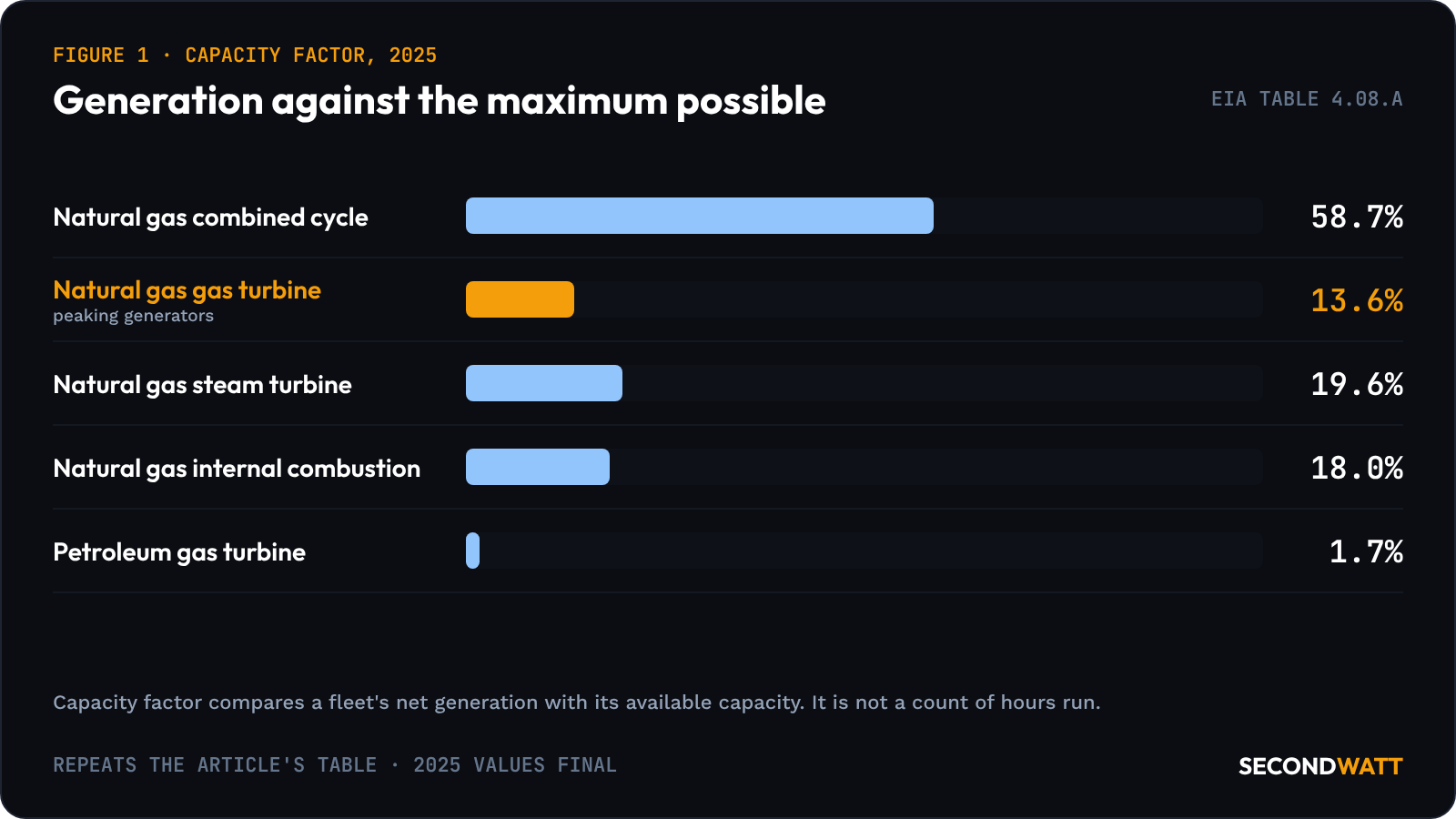
EIA's own analysis treats the natural gas gas turbine category as peaking generators. In 2025 its capacity factor was less than a quarter of the combined-cycle figure: 13.6 ÷ 58.7 = 0.23. Table 4.08.A of the EIA Electric Power Annual 2025 gives gas engines, the internal combustion row, an 18.0% capacity factor.
13.6% — the 2025 capacity factor of US natural gas combustion turbines, against 58.7% for natural gas combined-cycle plants, in EIA's Electric Power Annual Table 4.08.A.
Seasons matter. In the same table, the gas turbine fleet's monthly capacity factor in 2025 ran from 9.5% in March to 22.5% in July. EIA's Today in Energy article of 15 January 2014 links higher summer operation of peaking generators to the periods of highest demand, driven primarily by air conditioning.
The machines that run peaking duty#
The gas-fired machines in peaking duty fall into three classes: aeroderivative turbines, heavy-duty frames and reciprocating gas engines. Each OEM states output and start time on its own basis, and the table keeps each basis.
Peaking-capable units compared: OEM ratings and OEM start-time claims (GE Vernova fact sheets GEA35743 09/2025, GEA35742 09/2025, GEA35773 05/2025 and 7E page; Mitsubishi Power, Jenbacher, INNIO, Wärtsilä and Caterpillar pages and sheets as dated in the text)#
| Unit | Class | Output and basis | Efficiency or heat rate | Start-time claim (OEM's) |
|---|---|---|---|---|
| GE Vernova LM6000VELOX PF+ Sprint | Aeroderivative | 56.9 MW net, ISO, natural gas, simple cycle, 50/60 Hz | 41.0%; 8,328 Btu/kWh (LHV) | 5 minutes fast start |
| GE Vernova LMS100 PA+ | Aeroderivative, intercooled | 112.9 MW net (50 Hz) or 115.8 MW net (60 Hz), ISO, natural gas | 43.0% or 43.9%; 7,935 or 7,773 Btu/kWh (LHV) | 8 minutes to full load |
| Mitsubishi Power FT4000 SWIFTPAC 140 | Aeroderivative, twin engine | 144,243 kW ISO base rating, 60 Hz; net or gross not stated | 41.6%; 8,209 Btu/kWh (LHV) | 10 minutes, cold start to full power |
| GE Vernova 7E.03 | Heavy-duty frame | 90 MW net, ISO, natural gas, 60 Hz, simple cycle | 33.8%; 10,107 Btu/kWh (LHV) | 23 minutes rapid-response hot start; fast-start capability to 100% load in under 10 minutes |
| Wärtsilä 34SG power optimised (20V) | Gas engine | 10,368 kW at generator terminals, 60 Hz, 25 °C suction air | 47.5%; 7,586 kJ/kWh | Grid in 30 seconds, full load in 2 minutes (fast start) |
| Jenbacher J620 Fast Start | Gas engine | 3,091 kW at generator terminals, 60 Hz, full load | Up to 43.0% | Full 3 MW in under 45 seconds |
| Cat G3516 with Fast Response | Gas genset | 1,500 ekW standby at 0.8 pf, 60 Hz | 10.30 MJ/ekW-hr at 100% load, with fan | Ready in 7 seconds; accepts 100% block load in one step |
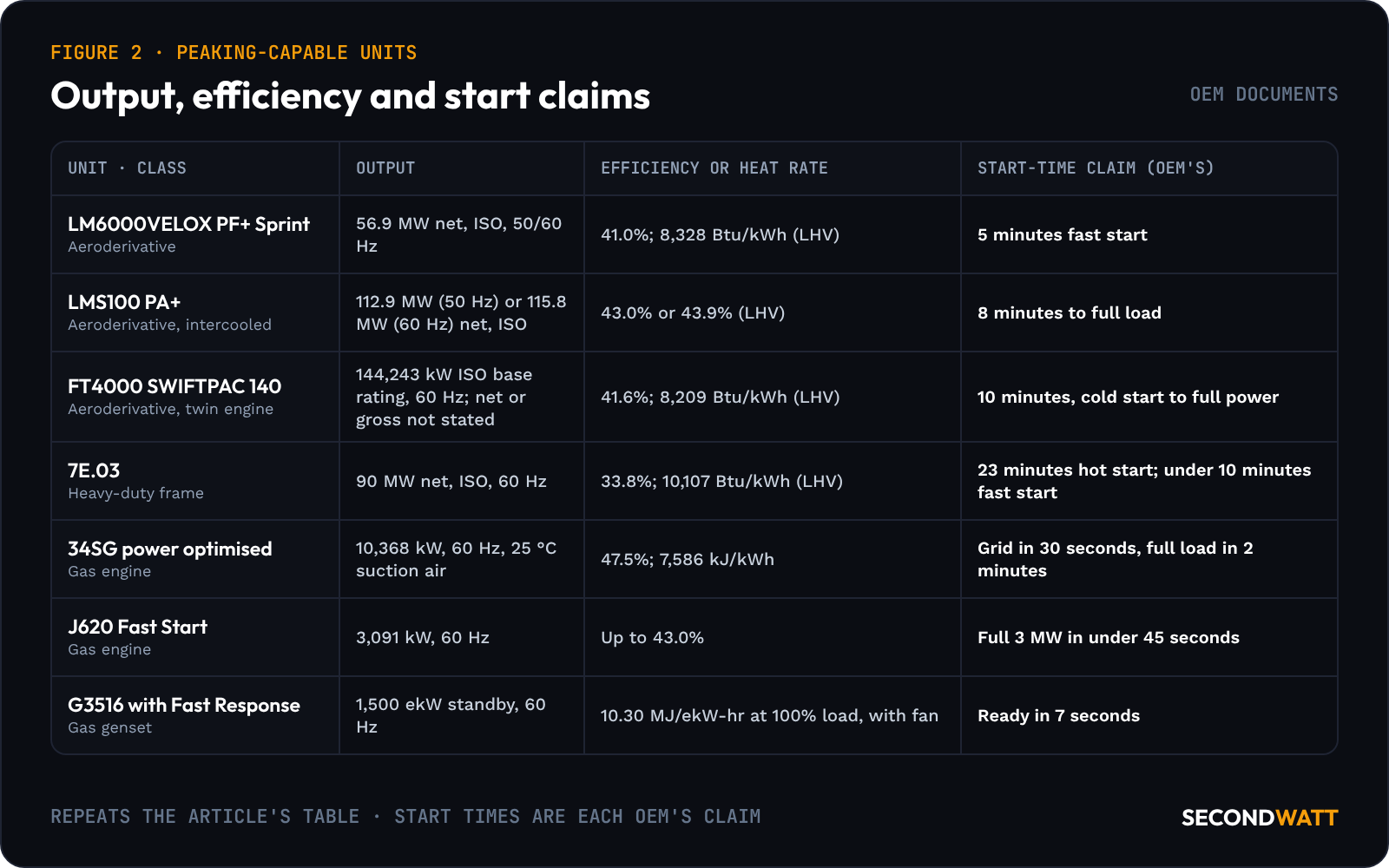
The LM6000 and LMS100 ratings include inlet and exhaust losses and exclude balance-of-plant equipment. GE Vernova states that basis on its September 2025 LM6000 fact sheet and LMS100 fact sheet. GE Vernova's LM6000 product page names the model LM6000VELOX PF+ Sprint; the fact sheet calls it the LM6000 PF+ Sprint.
The FT4000 comes from Pratt & Whitney Power Systems, renamed Mitsubishi Power Aero in 2021, according to its company history. Under its first name, Turbo Power and Marine Systems, the United Technologies subsidiary built 25- and 50-megawatt simple-cycle units from 1970. The FT4000 figures are from the FT4000 SWIFTPAC page.
GE Vernova's 7E.03 page shows two start figures. Its specification table lists a 23-minute rapid-response hot start. Its text says the 7E's fast-start, fast-load capability "can deliver up to 100% load in less than 10 minutes".
Engine figures sit on a different basis again. Wärtsilä's 34SG power optimised page rates the 20V34SG at the generator terminals. The basis is 100 kPa, 25 °C suction air and 30% relative humidity, with 5% tolerance on efficiency. INNIO's 45-second claim for the J620 Fast Start dates from the press release announcing its launch on 29 October 2019; the rating is on the Jenbacher J620 Fast Start page.
Why peakers run in simple cycle#
Peakers are built for the peak, so start time comes first. A simple-cycle turbine exhausts its heat; a combined-cycle plant recovers it to raise steam for a second turbine. The heat recovery adds efficiency but slows the start. GE Vernova's LM6000 fact sheet shows the trade on one machine: 5-minute fast start in simple cycle, against a 30-minute rapid-response hot start for the 1x1 combined-cycle plant.
The efficiency gap is large on a frame. GE Vernova's May 2025 7E fact sheet gives both cycles on one basis: net plant, ISO, natural gas, 60 Hz. The simple-cycle 7E.03 burns 10,107 Btu per kWh (LHV); the 1x1 combined-cycle plant burns 6,514.
Worked example, fuel per net MWh on that basis:
10,107 ÷ 6,514 = 1.55, so the simple-cycle 7E.03 burns about 55% more fuel per net MWh.
On the LM6000VELOX PF+ Sprint, the same comparison is 8,328 ÷ 6,218 = 1.34, or about 34% more fuel per MWh in simple cycle. A plant that runs few hours a year spends less on that extra fuel than a baseload plant would. The simple-cycle vs combined-cycle comparison covers the cycle choice in full.
Peaking units and data centers#
Fast-start gas fits a data center in two roles: bridge power while a grid connection is built, and behind-the-meter supply that runs through grid peaks. Trailer-mounted units are covered in the mobile gas turbine guide.
Start time decides where each class fits. The aeroderivative claims in the table run from 5 to 10 minutes, and the frame's from under 10 to 23 minutes, so a turbine cannot pick up a data hall's load the moment the grid fails. On its product page, Caterpillar states that the G3516 with Fast Response is ready in 7 seconds and complies with NFPA 110 Level 1 Type 10 specifications.
Ratings carry hour assumptions too. On Caterpillar's May 2024 G3516 spec sheet, the standby rating assumes typical operation of 200 hours per year and a maximum expected 500. The same sheet lists continuous ratings for the set, and the page lists U.S. EPA certification for emergency and non-emergency use.
Under federal NSPS Subpart JJJJ, for the stationary spark-ignition engines it covers, an emergency engine has no time limit in emergency situations. Under 40 CFR 60.4243(d), recommended maintenance checks and readiness testing are capped at 100 hours per calendar year. The recommendation can come from government, the manufacturer, the vendor, the grid operator or the insurer. More hours need a petition to the Administrator, unless records show that federal, state or local standards require more testing.
Up to 50 of those hours may be non-emergency, but they cannot be used for peak shaving, non-emergency demand response, or income from supplying power to the grid or under a financial arrangement. The one exception, (d)(3)(i), needs all five listed conditions, starting with dispatch by the local balancing authority or local transmission and distribution system operator. An engine run outside these limits is not an emergency engine under the subpart and must meet all requirements for non-emergency engines.
Retirements and the secondary market#
EIA's monthly generator inventory, EIA-860M, records owners' planned retirements. In the September 2026 file (released 23 Oct 2026), the Operating sheet lists 2,263 natural gas fired combustion turbines with 137,162.6 MW of net summer capacity.
Filtered to that technology and to planned retirement years 2027 through 2030, the file lists 44 generators at 20 plants in 14 states. Their net summer capacity is 1,992.1 MW, or 1.45% of the fleet: 1,992.1 ÷ 137,162.6 = 0.0145. None has a planned retirement date in the last quarter of 2026.
1,992 MW — net summer capacity of US natural gas combustion turbines with planned retirement dates in 2027–2030, from the September 2026 EIA-860M.
These are old machines. The median first-operating year of the 44 generators is 1975, and the range runs from 1969 to 2006. Retirements already reported in the same file's Retired sheet total 156 gas combustion turbines and 3,819.9 MW of net summer capacity from 2020 through 2025.
State rules also shape which units keep running. In New York, 6 NYCRR Subpart 227-3, effective 16 January 2020, sets NOx limits for simple-cycle and regenerative combustion turbines that apply only in the ozone season, 1 May to 30 September. It covers units of 15 MW nameplate or more that inject power into the transmission or distribution system, but not black start resources.
By 1 May 2025, the limits are 25 ppmvd on gaseous fuels and 42 ppmvd on distillate oil or other liquid fuel, corrected to 15% oxygen and met as a facility-level weighted average of all applicable turbines. An existing turbine may instead stop running in the ozone season, if a final permit or permit modification issued before the compliance deadline makes that stop enforceable. Units leaving service under such rules can reach the used market; the seller's documentation guide lists what buyers ask owners for.
What to check on a used peaking unit#
Peaking machines wear differently. The GER-3620-P guide notes that on GE Vernova heavy-duty frames, thermal-mechanical fatigue is the dominant life limiter for peaking machines. Creep, oxidation and corrosion dominate in continuous duty. GE Vernova bases most maintenance requirements on independent counts of starts and hours, and whichever limit is reached first sets the interval.
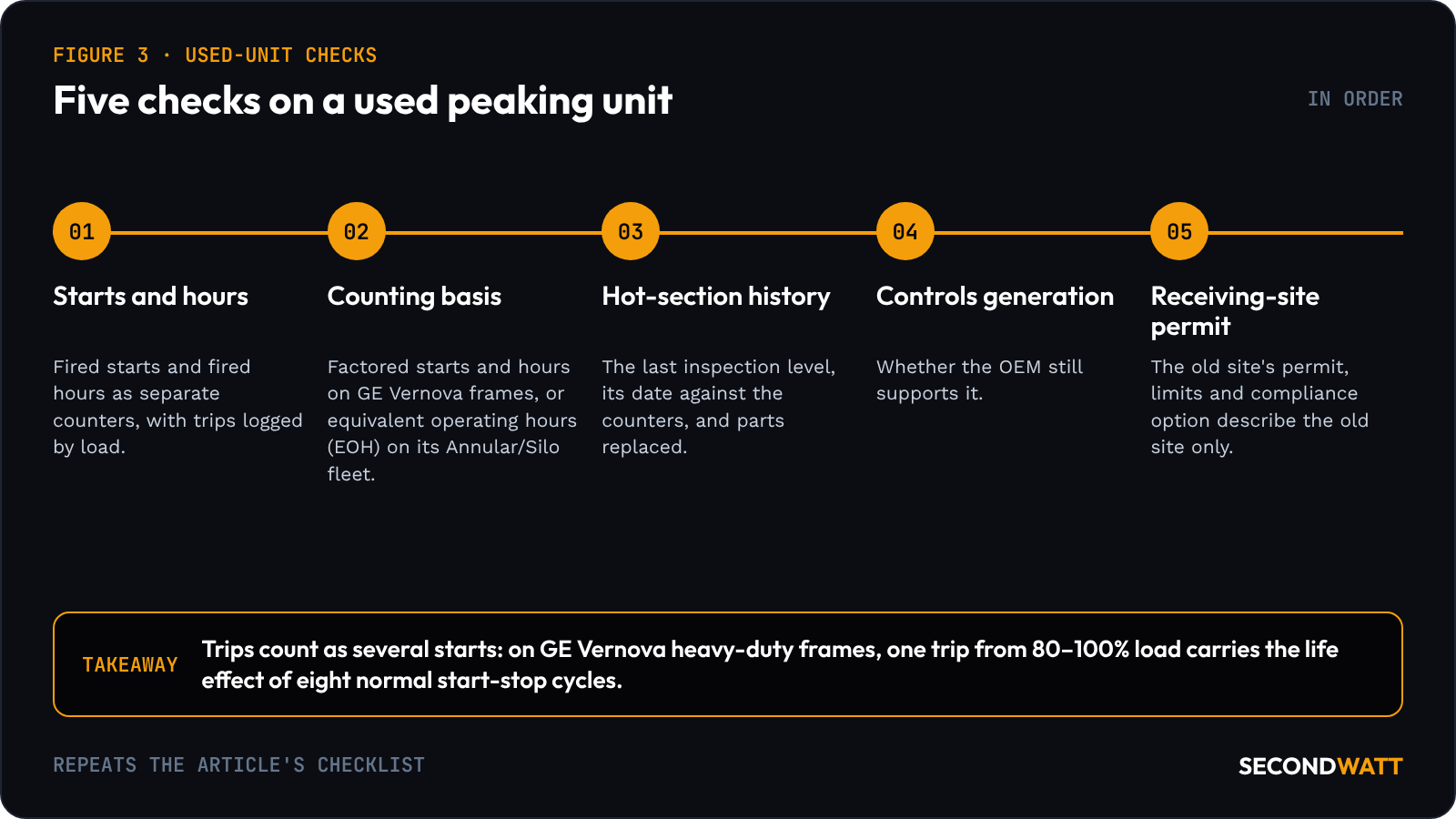
Trips weigh heavily. In the same guide, a trip from 80–100% load has the life effect of eight normal start-stop cycles. A trip from full speed no load counts two, and a trip from peak load ten. A peaker with modest hours and many trips can be closer to its next inspection than its hour meter suggests.
Five checks follow from that:
- Fired starts and fired hours as separate counters, with trips logged by load.
- The OEM's counting basis: factored starts and hours on GE Vernova frames, or equivalent operating hours (EOH) on its Annular/Silo fleet.
- Hot-section history: the last inspection level, its date against the counters, and parts replaced.
- The controls generation, and whether the OEM still supports it.
- The air permit at the receiving site, since the old site's permit, limits and compliance option describe the old site only.
Standby records matter more on a peaker. GE Vernova performs standby inspections on all its gas turbines, but they pertain particularly to peaking and intermittent-duty units "where starting reliability is of primary concern." The guide lists what they cover: the battery system, filters, oil and water levels, relays and calibrations. The remaining-life method turns those counters into a forecast, and the condition labels guide explains what each overhaul label should name.
Batteries as the alternative#
Far more battery capacity than gas combustion turbine capacity entered service in 2025. The September 2026 EIA-860M Operating sheet lists 1,147 battery generators with 55,707.8 MW of net summer capacity. Batteries with a 2025 first-operating year total 16,304.4 MW net summer, against 2,259.5 MW of natural gas combustion turbines from the same year.
Duration sets the limit. Across the batteries in that inventory, nameplate energy divided by nameplate power gives 2.75 hours on a capacity-weighted basis. Batteries rated four hours or less hold 96.5% of that nameplate power. A peak event longer than a battery's rating still needs another source, whether fuel-fired generation, imports or demand response.
The two technologies also work together. GE Vernova's LM6000 fact sheet describes the model as the company's first gas turbine paired with a battery energy storage system. Sizing storage for a site is covered in the battery energy storage guide.
FAQ: peaker plants#
How fast can a peaker plant start?#
It depends on the class and on what the OEM's clock measures. GE Vernova's fact sheets list a "fast start capability" for simple cycle and a "rapid response/hot start" time for combined cycle. On the LMS100 sheet, the first is 8 minutes and the second, for the 1x1 combined-cycle plant, is 30.
Ask which start the claim describes: cold or hot, regular or fast, to synchronization or to full load. Wärtsilä's 34SG table separates them: a regular start reaches the grid in under 2 minutes and full load in under 5, against 30 seconds and under 2 minutes for a fast start.
Why do peaker plants cost more per MWh to run?#
Partly because they burn more fuel per MWh. Fuel cost per MWh is roughly heat rate times fuel price, so the simple-cycle penalty in the worked example carries straight into the fuel bill. Peaking machines also differ among themselves: the 7E.03 at 10,107 Btu/kWh burns 30% more fuel per MWh than the LMS100 PA+ at 7,773 (10,107 ÷ 7,773 = 1.30).
Both are GE Vernova net simple-cycle ratings at ISO, natural gas and 60 Hz, on a lower-heating-value (LHV) basis. The LMS100 sheet states that balance-of-plant equipment is excluded; the 7E sheet does not say. Match the fuel price's heating-value basis before multiplying, as the operating-cost guide shows.
Can a data center use a peaker as backup power?#
It depends on the machine. A turbine that needs minutes to reach full load leaves a gap that a UPS or a seconds-class engine has to cover until the turbine is on line. Fast-response gas engines such as the G3516 with Fast Response carry seconds-class start claims of their own. The black-start and load-acceptance guide explains how turbines take load in steps.
Do peaker plants burn oil?#
Some do. EIA's Table 4.08.A shows 13,300.6 MW of time-adjusted petroleum gas turbine capacity in 2025, at a 1.7% capacity factor. Some gas units can also switch: GE Vernova's LM6000 page lists dual-fuel capability (gas and diesel), and Mitsubishi Power lists the FT4000 SWIFTPAC as dual fuel (gas and oil). New York's peaker rule sets a separate liquid-fuel NOx limit.
Are batteries replacing peaker plants?#
Some rules link the two directly. New York's Subpart 227-3 lets a turbine owner comply by meeting facility-level daily NOx limits, in pounds per MWh, that count electricity from storage or renewables. Those resources must share the turbine's substation or sit within half a mile, under common control.
Buying or selling a peaking unit#
SecondWatt publishes equipment research and helps buyers source power equipment; it earns a fee when a sale it arranges closes. If you are buying, send a request that states the start time, duty and site permit you need, so offers can be compared on starts, trips and records as well as output. If you own a peaking turbine leaving service, the gas turbine seller page sets out how SecondWatt works with owners.