Caterpillar G3516 with FAST RESPONSE
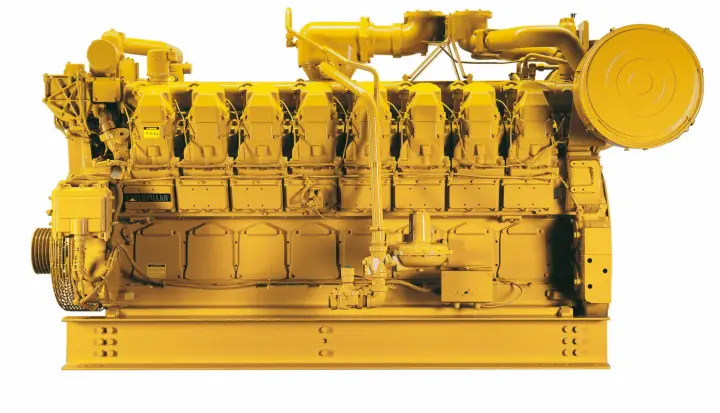
1,500 ekW of natural gas standby that reaches full load in 6.5 to 7.5 seconds and takes 100 percent block load in one step
Caterpillar G3516 with FAST RESPONSE is one of 23 gas engines tracked in the SecondWatt catalogue, each with specifications, lead times and indicative secondary-market pricing.
Caterpillar G3516 FAST RESPONSE: 1,500 ekW standby at 0.8 pf, 60 Hz, full load in 6.5 to 7.5 seconds. Specs, used pricing and inspection points.
The Cat G3516 with FAST RESPONSE is a 1,500 ekW standby gas generator set rated at 0.8 power factor for 60 Hz North America, inside a published band of 1,061 to 1,500 kW. Caterpillar states a cold start to full load of 6.5 to 7.5 seconds and says the set accepts and recovers from a 100 percent block load in one step. It was the first natural gas genset Caterpillar certified with the US EPA for both emergency and non-emergency service. The package is UL 2200 listed and meets NFPA 110 Level 1 Type 10. The engine underneath is the Cat 3500 block. Caterpillar's G3516 TA specification publishes a V-16 four-stroke layout with a 170 mm bore, a 190 mm stroke and 69 L of displacement, and describes the design as built on G3500 reliability and durability. Those are the same three figures Caterpillar publishes for the 3516B diesel generator set, which is why a reader will assume the two are interchangeable. This is the machine behind Caterpillar's largest published data center commitment. On 28 January 2026 Caterpillar, dealer Boyd CAT and American Intelligence & Power announced a 2 GW deployment of G3516 fast-response sets at the Monarch Compute Campus in West Virginia. That order includes battery storage, controls and selective catalytic reduction, with deliveries running September 2026 through August 2027.
Why it matters
Load acceptance is the whole argument. A 6.5 to 7.5 second cold start to full load with 100 percent block load capability puts a gas set in diesel territory on response while burning pipeline gas. Paired with the Cat dealer network, it is the quickest procurable route to behind-the-meter capacity in North America at 1.5 MW granularity.
Who buys it
Hyperscale and colocation operators buying behind-the-meter capacity where the utility interconnection queue is the binding constraint rather than the equipment. Healthcare, campus and municipal buyers who need a non-emergency standby node that can also peak-shave. Caterpillar names data centers, hospitals, schools, government buildings, universities, research facilities and retail complexes for this package.
Role in the data center
Behind-the-meter prime and non-emergency standby capacity at 1.5 MW granularity, sized as multi-unit plants rather than single sets. The Monarch deployment pairs the engines with battery storage for load management, plant controls and selective catalytic reduction. At 1,500 ekW standby per unit, 2 GW implies roughly 1,300 sets. That is arithmetic from two published figures rather than a Caterpillar statement.
Key specifications
| Standby rating | 1,500 ekW at 0.8 pf, 60 Hz |
|---|---|
| Published rating band | 1,061 to 1,500 kW |
| Frequency | 60 Hz |
| Cold start to full load | 6.5 to 7.5 seconds |
| Block load acceptance | 100 percent in one step |
| Fuel | Natural gas, hydrogen blend to 5 percent fuel type |
| Cylinder configuration (G3516 TA sheet) | V-16, four-stroke layout |
| Bore (G3516 TA sheet) | 170 mm (6.7 in) |
| Stroke (G3516 TA sheet) | 190 mm (7.5 in) |
| Displacement (G3516 TA sheet) | 69 L (4,211 cu in) |
| Aspiration (G3516 TA sheet) | Turbocharged, two-stage aftercooled aspiration |
| Codes and listings | UL 2200 listed, NFPA 110 Level 1 Type 10 compliance |
| Subpart JJJJ NOx ceiling for this class | 1.0 g/HP-hr or 82 ppmvd at 15 percent O2 regulatory limit |
Technical summary
Standby rating: 1,500 ekW at 0.8 power factor, 60 Hz. Published rating band: 1,061 to 1,500 kW. Cold start to full load: 6.5 to 7.5 seconds (Caterpillar, 2022). Load acceptance: accepts and recovers from 100 percent block load in one step. Fuel: natural gas, hydrogen blend up to 5 percent. Engine block, from the G3516 TA sheet: V-16 four-stroke, bore 170 mm, stroke 190 mm, 69 L. Aspiration: turbocharged, two-stage aftercooled. Certification: US EPA certified for emergency and non-emergency stationary use. Codes: UL 2200 listed, NFPA 110 Level 1 Type 10. Fast-response portfolio span: 175 kW to 2.5 MW.
Major variations
MWM is Caterpillar. Caterpillar Energy Solutions GmbH of Mannheim was renamed from MWM GmbH on 1 November 2013 and the MWM brand continues. The Cat CG-series is the MWM TCG engine under a Cat badge, and the published numbers prove it rather than merely suggesting it. The CG260 and the MWM TCG 2032 both publish 260/320 mm bore and stroke and match on output and efficiency to the decimal, at 3,333, 4,300 and 4,500 kWe and 43.9, 44.1 and 44.6 percent electrical. The CG170 and the TCG 2020/3020 share 170/195 mm and 53.1, 70.8 and 88.5 L. The CG132B-16 and the TCG 3016 V16 share 132/160 mm and 35 L. For a North American buyer the badge decides the support, not the hardware. Caterpillar routes yellow Cat sets through the worldwide Cat dealer network and blue MWM units through direct sales and the MWM distributor network. Ask a Cat dealer for the CG designation.
Configurations and options
Caterpillar packages the G3516 as a containerised mobile unit under XQ designations. XQ1250G, XQ1475G and XQ1900 all appear in the North American used market, and Surplus Record labels the XQ1475G as carrying a G3516C engine. Generation suffixes on this line run plain, B, C, K, H and LE for low emission. The suffix changes the rating: G3516 units in this market span roughly 740 to 1,500 kW across generations and the G3516C reaches 1,555 kW. Hydrogen blending is offered up to 5 percent on this package.
Compatibility and dependencies
The G3516 and the 3516B diesel share the Cat 3500 block. Caterpillar publishes 170 mm bore, 190 mm stroke, 69 L and a V16 layout on both. They are not the same engine: the diesel is a 14.0:1 compression-ignition unit with electronic unit injection, while the gas set is spark-ignited with a gas fuel train and a different emissions package. What carries across is parts overlap, shared service tooling and a Cat technician base already fluent in the 3500 platform. What does not carry across is ratings, duty, overhaul intervals or the emissions rule. Diesel sets fall under 40 CFR 60 Subpart IIII for compression ignition; this one falls under Subpart JJJJ for spark ignition.
Pricing and availability
Comparable secondary-market band: 273.31–505.55 $ per kW. Trend: rising Condition in this category is dominated by hours to overhaul, not by model year or cosmetic state. A 40,000-hour engine three years from a major is worth materially less than an older unit fresh out of one, and the resale boards rarely publish hours at all. That is why the used spread is so wide. Ask for hours since major and hours since top-end before any other question, and treat a listing without an hour meter reading as unpriceable. Lead time, new: No Caterpillar-published lead time exists. The Monarch alliance announced 28 January 2026 schedules G3516 deliveries from September 2026 through August 2027, which is roughly eight months to first units at 2 GW scale.. Lead time, used or refurbished: Immediate where inventory exists, but inventory is the constraint..
Lifecycle and maintenance
Caterpillar publishes no MTBF figure and no overhaul interval in hours for this package. The only Cat-published interval anywhere in this product line is maintenance up to 4,000 operating hours on the CG170 series. MWM, on the CG-series engines Caterpillar also owns, publishes major overhauls at 48,000 to 80,000 operating hours and cylinder head inspections at 12,000 to 40,000 hours. Those are MWM figures on different engines, not Caterpillar figures for this package. Field evidence is more useful here: Cat gas sets in this market transact at 37,000 to 62,000 hours and still command a price.
Thermal and emissions profile
Caterpillar publishes this engine family at two NOx points, 1.0 and 0.50 g/bhp-hr. The 1.0 g/bhp-hr figure is exactly the 40 CFR 60 Subpart JJJJ ceiling for lean-burn natural gas non-emergency spark-ignition engines at or above 500 HP, which is 1.0 g/HP-hr or 82 ppmvd at 15 percent O2. A set ordered on that rating carries zero compliance margin on a stock tune. The 0.50 g/bhp-hr rating is an engine-out tune rather than aftertreatment. Selective catalytic reduction appears when a local permit rather than the federal rule governs, which is why the 2 GW Monarch deployment includes it. Non-attainment friction is therefore a site question, not a model question. Caterpillar publishes no carbon monoxide or formaldehyde figure; formaldehyde falls under NESHAP RICE.
Common failure points
- Detonation from low methane number gas — Audible knock under load, rising exhaust temperature, controller retarding ignition timing
- Spark plugs and ignition coils — Misfire, rough running, rising carbon monoxide and unburned hydrocarbons, output derate
- Charge-air and aftercooler fouling — Rising charge air temperature, heat rate drift, derate on hot days
- Exhaust valve and seat recession — Falling compression on one cylinder, widening exhaust temperature spread, hard starting
- Emissions drift past Subpart JJJJ — Annual stack test returns NOx above 1.0 g/HP-hr or 82 ppmvd at 15 percent O2
- Turbocharger bearing failure — Oil in the charge air, surge, sudden loss of boost and output
- Controls obsolescence — EMCP2+ era panel with no path to plant-level dispatch or modern supervisory control
Inspection checklist
Hours since major overhaul: the single biggest price driver; ask before any other question. Hours since top-end: cylinder head work falls due between 12,000 and 40,000 hours on this class. Nameplate duty: confirm standby, prime or continuous; 1,500 ekW standby is not 1,500 ekW continuous. Power factor on the nameplate: the 1,500 ekW rating is quoted at 0.8 pf, not 1.0 pf. Bore and stroke on the data plate: 170 x 190 mm is a 3500 block; 170 x 215 mm is an H-series. NOx tune: confirm whether the set is certified at 1.0 or 0.50 g/bhp-hr; it decides SCR. Engine manufacture date: the 1.0 g/HP-hr Subpart JJJJ limit binds engines built on or after 1 July 2010. Block load test record: verify the 100 percent step acceptance rather than accepting the brochure.
Procurement channels
New units go through Cat dealers and Cat dealer pages price as Request a Quote. Named dealers holding gas stock include Quinn, Hawthorne, Empire, Western States, Cleveland Brothers, Carter, Stowers, Foley, Holt, Milton, Mustang, Ring Power, Toromont, Wheeler and Boyd CAT. The used channel is quote-driven and deep in Texas and western Canada. DEPCO Power Systems publishes more numbers than anyone else; Industrial Motor Power, Power Generation Enterprises, McKain, Powersafe, Collicutt, Lenmark, NineX, Aaron Equipment and Worldwide Power Products carry inventory but mostly withhold price. Price opacity is the defining feature here.
Regional notes
This package is a 60 Hz North American product and Caterpillar positions it that way. The resale channel mixes in 400 V and 3,300 V export machines that are not North American spec, so confirm frequency and voltage on the nameplate. Caterpillar's own claim for the Cat dealer network is 24/7 service, 99 percent parts availability and a 24-hour response guarantee. That is a Caterpillar claim rather than a measured figure. It is still the commercial argument that matters most in this category, because every large competitor is European or thinner on the ground in North America.