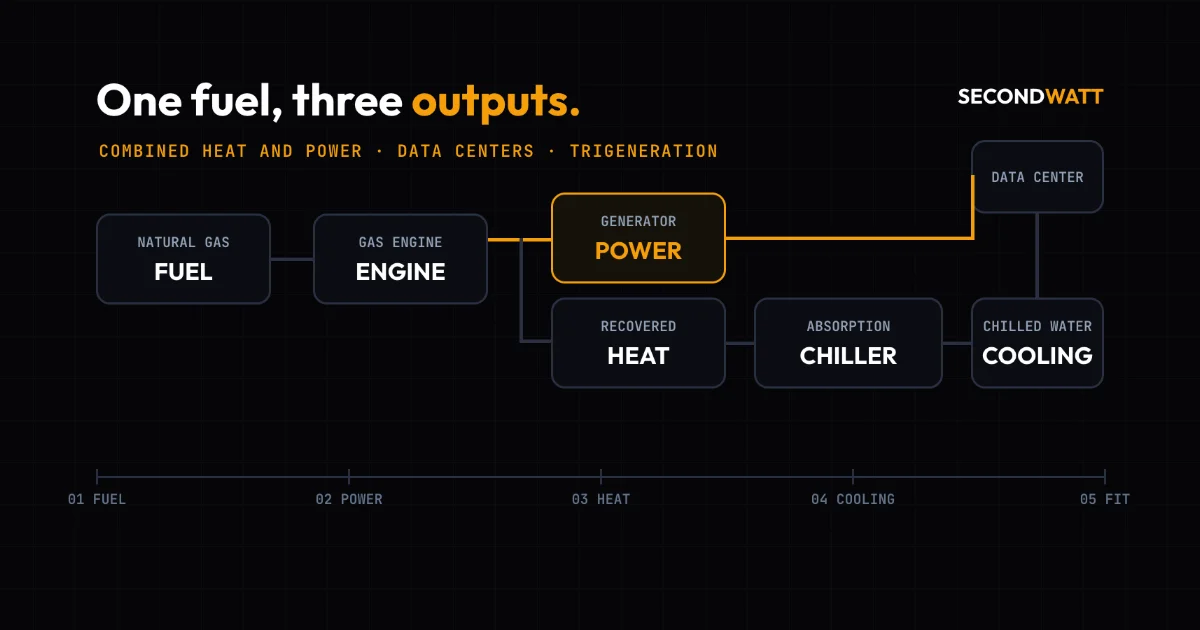
Combined heat and power, also called cogeneration, makes electricity and useful heat from one fuel at the point of use. A gas engine's generator supplies the power, while heat exchangers capture the heat the engine rejects through its cooling water and exhaust. Counting both outputs, OEM data for large gas engines puts total efficiency between about 89% and 94%, but only when every kilowatt of that heat finds a use.
A data center needs cooling more than heat. Its recovered heat can meet that need by driving an absorption chiller, and a single-stage chiller returns less cooling than the heat it takes in. CHP is one of several ways to run gas engines on a campus. It fits best where electrical load is steady and chilled-water demand runs all year.
Key Takeaways
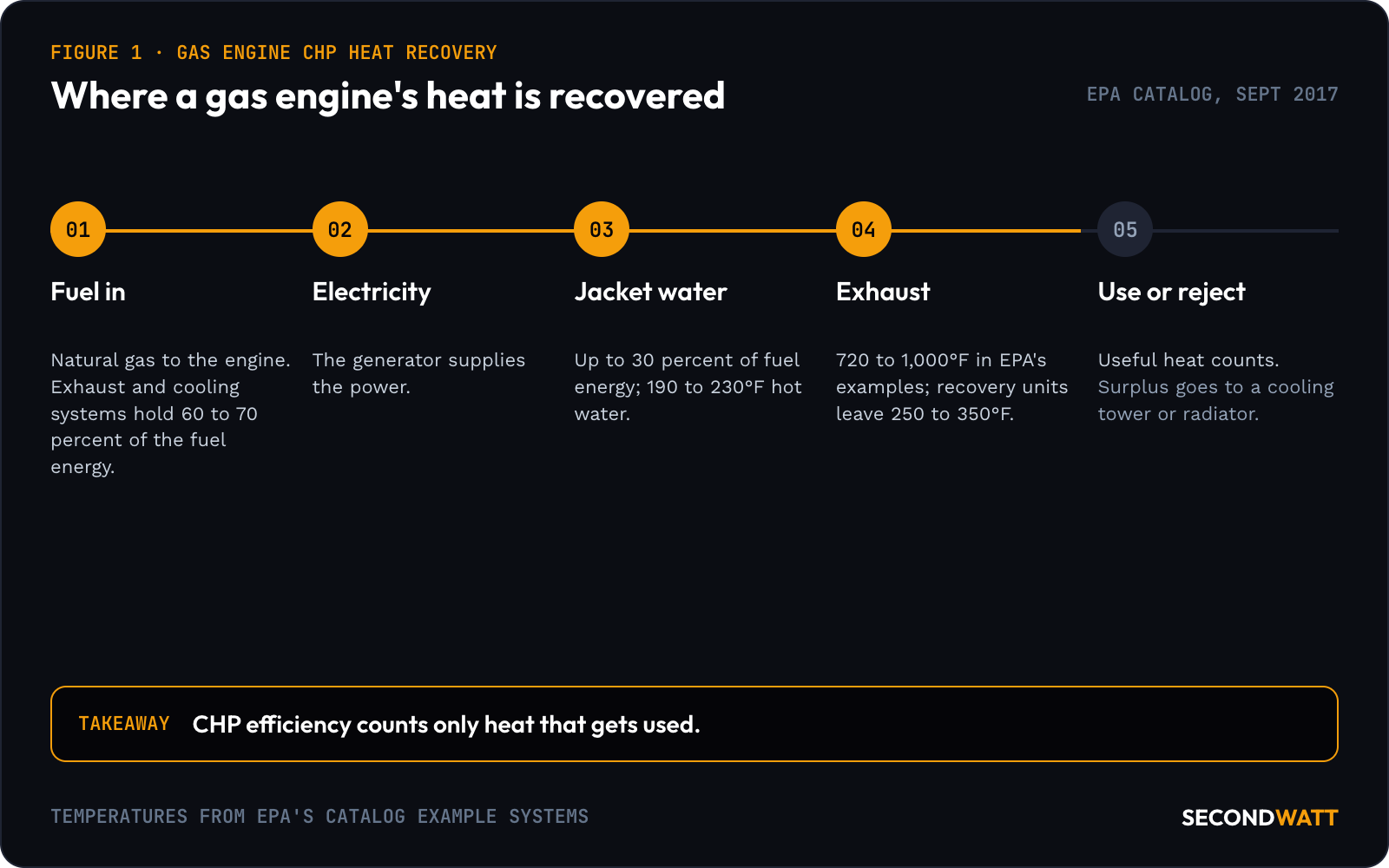
- CHP efficiency counts only heat that gets used. EPA's total-system measure adds net useful thermal output to electric output; heat dumped to a radiator or cooling tower adds nothing.
- Adding separate "up to" values gives a ceiling. Jenbacher lists the J616 at up to 45.5% electrical and 47.0% thermal at 60 Hz, so 92.5% is an upper bound.
- Totals from one OEM data set land near 89%. Cummins' C2000N6CD ISO data give 88.9%; mtu publishes 88.7% for its 20V4000 GS L64 FNER at 60 Hz, standard conditions.
- Single-stage absorption chillers return less cooling than heat. At DOE's 0.70 COP, the J616's 2,906 kW thermal upper bound (60 Hz) yields 2,034 kW of cooling output, or 578 tons.
- A CHP engine spends part of each year offline. EPA's catalog puts reciprocating-engine availability at 96–98%, which leaves roughly 175 to 350 hours a year without that engine.
What combined heat and power is#
Combined heat and power is "the concurrent production of electricity or mechanical power and useful thermal energy (heating and/or cooling) from a single source of energy." It is a type of distributed generation, sited at or near the point of consumption, and DOE's CHP basics page notes it is also known as cogeneration.
The recovered heat goes to facility loads as process heat, steam, hot water or chilled water. According to EPA, CHP can exceed 80% efficiency, against 50% for typical separate supply. DOE puts the reasonable expectation for CHP applications at 65%–75%.
In EPA's CHP efficiency methods, total system efficiency adds net useful electric output and net useful thermal output, then divides by total fuel input. EPA puts typical total system efficiency at 60 to 80 percent.
How a CHP system recovers heat#
The September 2017 revision of EPA's Catalog of CHP Technologies covers five prime movers: reciprocating engines, combustion turbines, steam turbines, microturbines and fuel cells. As EPA explains, engines and turbines burn fuel to turn a generator. Heat recovery devices turn their waste heat into useful thermal energy, usually steam or hot water.
In a gas engine, the exhaust and cooling systems hold 60 to 70 percent of the fuel energy. Jacket coolant carries up to 30 percent and can make 190 to 230°F hot water; high-pressure or ebullient systems run up to 265°F. Exhaust temperatures in EPA's example systems range from 720 to 1,000°F.
Exhaust heat recovery typically makes hot water up to about 230°F or steam up to 400 psig. Most recovery units are designed for a 250 to 350°F exhaust outlet, which keeps condensation out of the piping. Between 45 and 55 percent of an engine's waste heat comes from jacket and lube oil cooling, at temperatures too low for steam.
OEM data splits the heat the same way. mtu's Series 4000 gas generator set brochure, edition 01/21, lists engine heat and exhaust heat cooled to 120°C (248°F), each ±8%, and a separate 43°C low-temperature circuit. Jenbacher's J920 FleXtra page recovers jacket water, oil cooler, charge air cooler and exhaust heat into a circuit with 70°C return water and 90°C or more supply.
A gas turbine sends its exhaust to a heat recovery steam generator instead. In the turbine examples in Table 3-2 of EPA's catalog, exhaust leaves the turbine at 838 to 916°F and the HRSG at 300 to 336°F. Adding a steam turbine to that exhaust is what makes a plant combined cycle.
CHP efficiency from OEM ratings#
OEM pages state CHP efficiency in two ways. Some publish electrical and thermal output from one fuel input: a single operating point. Others list each value as a separate maximum.
CHP efficiency of selected gas engines at 60 Hz on natural gas, from OEM pages and brochures (full or maximum load; OEM energy-input basis)#
| Model and source | Electrical output | Electrical efficiency | Thermal output | Thermal efficiency | Total | How the total is stated |
|---|---|---|---|---|---|---|
| Jenbacher J616, CHP module (product page) | up to 2,779 kW at full load | up to 45.5% | up to 2,906 kW at full load | up to 47.0% | up to 92.5% | Computed from separate "up to" values; an upper bound |
| Jenbacher J920 FleXtra (product page) | 9,542 kW at full load | up to 48.7% | 9,300 kW at full load | up to 47.0% | about 94% | Published by Jenbacher for the CHP module; no frequency given |
| Cummins HSK78G C2000N6CD (data sheet D-6409f) | 2,000 kW continuous | 43.5% ISO | 2,088 kW usable heat | 45.4% ISO | 88.9% | Computed from one ISO 3046/1 data set, 4,599 kW fuel (LHV) |
| Cummins HSK78G C1600N6CD (series page) | 1,600 kW continuous | 43.2% ISO | 1,752 kW usable heat | 47.3% ISO | 90.4% | Computed from one ISO data set, 3,707 kW fuel |
| mtu 20V4000 GS L64 FNER, standard conditions (brochure) | 2,521 kW at maximum load | 43.6% | 2,604 kW at maximum load | 45.0% (computed) | 88.7% | Published as fuel energy utilization |
| mtu 20V4000 GS L64 FNER, hot and humid (brochure) | 2,521 kW at maximum load | 43.6% | 2,697 kW at maximum load | 46.7% (computed) | 90.3% | Published as total efficiency |
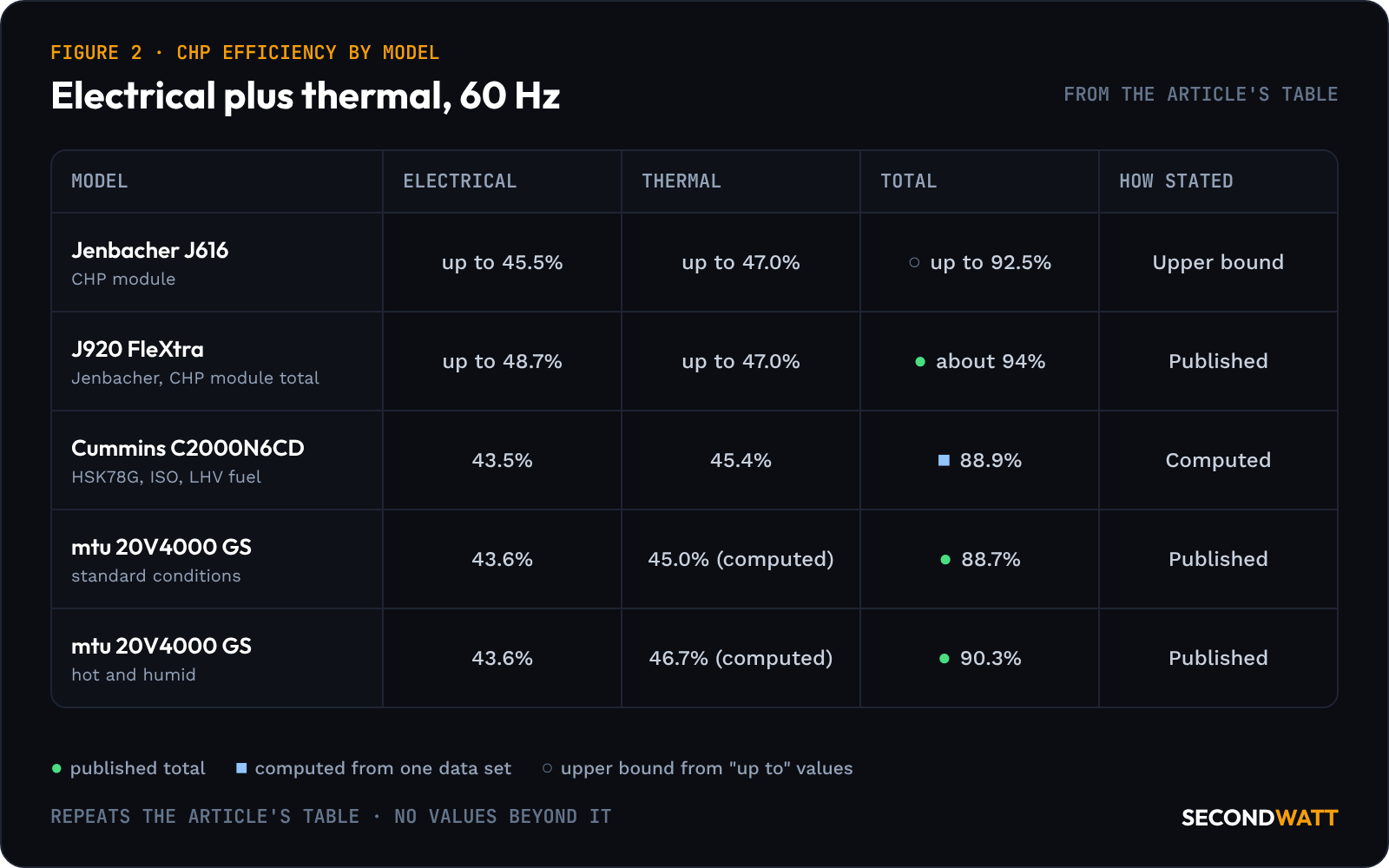
On Jenbacher's product page, every 60 Hz natural gas value for the Jenbacher J616 is listed as "up to." Its data ranges cover various gas qualities and ambient conditions, so the maxima need not occur together. The page's own numbers show it.
If the two electrical maxima held together, fuel input at full load would be 2,779 ÷ 0.455 = 6,108 kW. The thermal output maximum would then mean 2,906 ÷ 6,108 = 47.6%, above the page's 47.0% thermal maximum. Adding both output maxima on that fuel gives (2,779 + 2,906) ÷ 6,108 = 93.1%. The page's efficiency maxima set the tighter ceiling: 45.5 + 47.0 = 92.5%.
92.5% — the J616 upper bound from adding its separate 60 Hz natural gas maxima, 45.5% electrical and 47.0% thermal, which describes a ceiling rather than a rating.
The J920 FleXtra shows the same pattern: its two "up to" maxima would sum to 95.7%, above the total Jenbacher publishes. Jenbacher's J920 FleXtra page states "about 94%" total efficiency with 48.7% electrical, and credits two-stage turbocharging for reaching "around 94%." The table carries that published figure.
The Cummins HSK78G rows come from one ISO data set per model, so they recompute. For the C2000N6CD, Cummins' December 2019 data sheet D-6409f gives 4,599 kW of fuel on a lower heating value basis and 2,088 kW of heat output: (2,000 + 2,088) ÷ 4,599 = 88.9%. The series page headline of 47.1% thermal efficiency and 2,110 kW thermal output matches none of its six model rows.
The mtu 20V4000 L64 totals recompute from engine and exhaust heat alone: (2,521 + 1,368 + 1,236) ÷ 5,781 = 88.7%. The 211 kW of low-temperature heat output sits outside that total. The hot and humid case carries more engine heat and reaches 90.3%.
EPA's catalog notes that engine makers quote heat rates on a lower heating value basis, while its own tables use higher heating value; for natural gas the ratio is about 930 ÷ 1,030 = 0.90. Cummins' data sheet confirms the lower heating value basis for the C2000N6CD. On EPA's ratio, its 88.9% becomes about 88.9 × 0.90 = 80% HHV, the top of EPA's 77–80% range for engine CHP.
Why data centers are an unusual CHP host#
CHP is best suited to facilities with year-round coincident power and thermal loads, by EPA's account. EPA's list of facilities where CHP is used successfully names offices, hotels, hospitals, colleges, district energy systems and industry. A data center's steady thermal load is cooling.
Heat that finds no use leaves the efficiency count. EPA's catalog adds that when no hot water is needed, less engine heat is recovered "and total CHP system efficiency drops accordingly." Surplus engine heat then goes through an excess heat exchanger to a cooling tower or radiator.
Absorption cooling turns recovered heat into that load. DOE names data centers among sites that may need steady year-round cooling, where absorption chillers are most cost effective. EPA's catalog calls packaged CHP with absorption chillers well suited to applications that consistently need chilled water, such as supermarkets and data centers.
How that plant sits against the grid and the utility meter is covered in behind-the-meter power for data centers.
Trigeneration: turning heat into cooling#
Trigeneration, or combined cooling, heat and power (CCHP), adds an absorption chiller to the CHP plant. One fuel then serves three outputs: electricity, heat and cooling. DOE's May 2017 fact sheet on absorption chillers for CHP systems explains that the chiller replaces the electric compressor with a thermal one. An absorbent takes up refrigerant vapor, a small pump moves the solution, and recovered heat boils the refrigerant back out.
Coefficient of performance (COP) is chiller load divided by heat input, excluding pumps and fans. Single-stage machines run below 1 and two-stage machines above 1.
In DOE's Table 2, three single-stage water/lithium bromide chillers of 50 to 1,320 tons show COPs of 0.70 to 0.79, and four two-stage units 1.35 to 1.42. All seven make 44°F chilled water from 54°F return.
Absorption chiller types for CHP, from DOE fact sheet DOE/EE-1608 (May 2017), Tables 1 and 2 (typical water/lithium bromide values)#
| Design | Heat input DOE lists | Full-load COP in Table 2 | Pairing DOE describes |
|---|---|---|---|
| Single stage | Hot water at 200–240°F or 15 psig steam; Table 2 examples at 190–208°F and 14.5 psig | 0.70–0.79 | Often used with reciprocating engines |
| Two stage | Hot water at, for example, 350°F or 115 psig steam; Table 2 examples at 116 psig steam or 530 and 850°F exhaust | 1.35–1.42 | Often used with combustion turbines |
A two-stage chiller needs a generator temperature about 150°F higher than a single-stage one. Exhaust-fired absorption chillers typically need exhaust above 750°F, by DOE's Table 1. Absorption chillers also reject more heat, so they need a larger cooling tower than an electric chiller of the same capacity. Compare that against the plant's water budget and the electric chillers it would sit beside.
Worked example, illustrative only. It assumes the J616's full 2,906 kW thermal output, an upper bound, reaches a single-stage chiller at a usable temperature. It uses DOE's lowest single-stage COP, from its 50-ton hot-water example. It also uses NIST's ton of refrigeration, 3.516853 kW of cooling capacity, from Appendix B.9 of NIST SP 811:
2,906 kW heat input × 0.70 = 2,034 kW cooling output; 2,034 ÷ 3.517 = 578 tons.
At COP 0.74, the same heat gives 2,150 kW of cooling output, or 611 tons. Against the engine's 2,779 kW electrical output upper bound, that cooling is about 73% at COP 0.70 (2,034 ÷ 2,779) and 77% at 0.74 (2,150 ÷ 2,779). The J616 page gives no hot-water temperature. Jenbacher's 90°C (194°F) J920 supply sits near the bottom of DOE's 190–208°F Table 2 examples and below its 200–240°F Table 1 range.
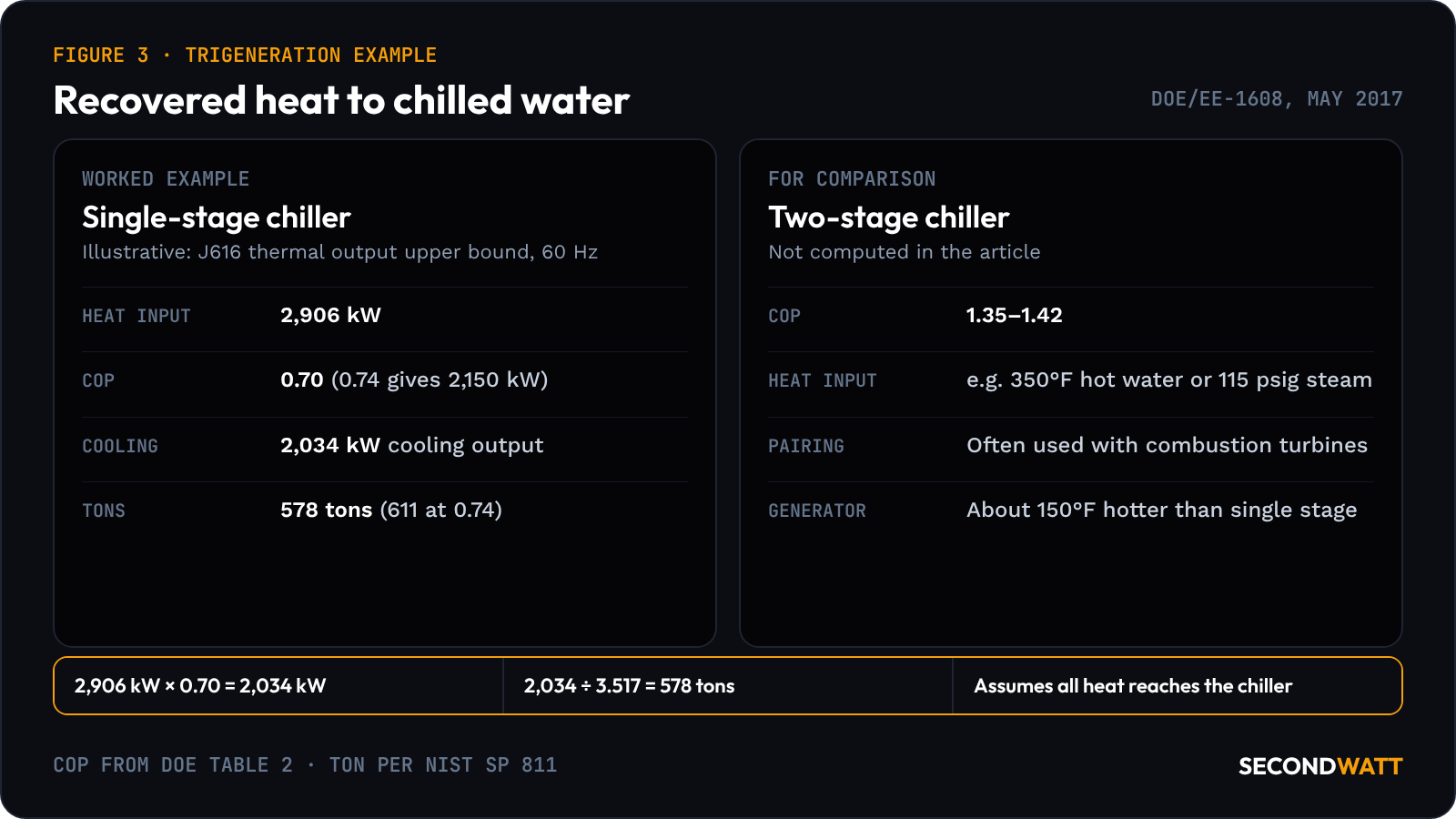
578 tons — the cooling a single-stage absorption chiller at DOE's 0.70 COP would make from the J616's 2,906 kW thermal output upper bound.
The used-equipment side of the cooling plant is covered in used chillers for GPU data centers.
Engines, turbines or fuel cells for CHP#
EPA's catalog compares the prime movers on one higher heating value basis. Its engine data come from gensets commercially offered in 2013.
CHP prime movers compared, from EPA Catalog of CHP Technologies (September 2017), Table 1-3 (HHV basis)#
| Prime mover | Electric efficiency | Overall CHP efficiency | Power-to-heat ratio | Start-up time | Availability |
|---|---|---|---|---|---|
| Reciprocating engine | 27–41% | 77–80% | 0.5–1.2 | 10 sec | 96–98% |
| Gas turbine | 24–36% | 66–71% | 0.6–1.1 | 10 min–1 hr | 93–96% |
| Microturbine | 22–28% | 63–70% | 0.5–0.7 | 60 sec | 98–99% |
| Fuel cell | 30–63% | 55–80% | 1–2 | 3 hrs–2 days | >95% |
Heat quality decides much of the choice. EPA calls engine exhaust heat ideal for hot water, which suits a single-stage chiller. Turbine exhaust can raise high-pressure steam, the input a two-stage chiller wants. Fuel cells usually deliver hot water or steam below 30 psig.
Gas turbines also need high-pressure gas or a compressor, and their output falls as ambient temperature rises, according to Table 1-2 of EPA's catalog. The trade-offs between the two combustion options are set out in gas turbines vs reciprocating gas engines. Output, fuel and service for fuel cells are compared in buying fuel cells for data centers, and one solid oxide CHP result is weighed in the SOFC CHP benchmark.
Reliability, redundancy and the grid#
A CHP engine is a running machine that stops for maintenance and repair. EPA's catalog puts reciprocating-engine availability at 96–98% and hours to overhaul at 30,000–60,000. At 8,760 hours a year, 2% to 4% unavailability is about 175 to 350 hours.
OEMs claim longer overhaul intervals. Cummins states an 80,000-hour major overhaul cycle for the HSK78G. mtu lists 84,000 operating hours to major overhaul for its natural gas Series 4000. Both are vendor figures; EPA's catalog lists routine inspections and preventive maintenance alongside overhauls.
EPA notes CHP can keep a site powered through grid outages and pair with solar and storage. A data center still has to carry its load when a CHP unit is down, from the grid, standby generation or spare units. The design choices are set out in data center redundancy, and a packaged multi-engine example in the mtu 20V4000 2.5 MW gas power block.
Air permits come with the engines. Jenbacher bases its data on 250 and 500 mg/Nm3 NOx at 5% O2, and Cummins states as low as 250 mg/Nm3 without aftertreatment. Whether a site needs more is a permitting question, covered in gas turbine emissions permitting for data centers.
FAQ: combined heat and power#
Is CHP the same as cogeneration?#
Yes. DOE uses the terms for the same thing. The tax code, at 26 U.S.C. 48(c)(3)(A)(i), defines CHP system property as using one energy source for "the simultaneous or sequential generation" of power together with useful thermal energy.
What is trigeneration in practice?#
It is CHP whose heat also drives cooling. mtu describes a trigeneration module at Osram's Eichstätt plant, which entered service in January 2015, built on a 16V Series 4000 L64 engine. It delivers 1,999 kW of electrical power output and around 1,900 kW of heat output. In winter it heats production halls; in summer its absorption chiller cools machine controls and laser systems.
Can a data center reuse server heat instead?#
Yes, for heating. At DOE's National Laboratory of the Rockies (NLR, formerly NREL), warm-water liquid cooling heats water to around 100°F. That water serves as a source of heating for laboratory and office spaces. That is well below the 190–208°F hot water in DOE's single-stage chiller examples.
Do CHP systems qualify for federal tax credits?#
Not under section 48 for a project that begins construction now.
The Internal Revenue Code limits section 48 combined heat and power system property to systems "the construction of which begins before January 1, 2025." The limit is at 26 U.S.C. 48(c)(3)(A)(iv), in the US Code as current through Public Law 119-124. Those systems must also produce at least 20% of useful energy as heat and 20% as power, exceed 60% efficiency on the fuel's lower heating value, and have no more than 50 MW of electrical capacity.
Under 26 U.S.C. 48E(b)(3)(A), the clean electricity investment credit for facilities placed in service after 2024 requires an anticipated greenhouse gas emissions rate not greater than zero.
How is a CHP system sized?#
To the load that can use both outputs. EPA's catalog says packaged CHP capacity is typically selected so the facility uses all the electric and thermal energy on site while running at or near full load. EPA names operating hours, thermal energy requirements and electricity and gas rates as the site-specific factors that decide technical and economic fit.
Scoping a CHP plant#
SecondWatt publishes equipment research and helps buyers source power equipment; it earns a fee when a sale it arranges closes. Buyers scoping gas engines for CHP or trigeneration can request equipment with the site's electrical load, frequency, chilled-water demand and the heat-recovery scope they need.