Carrier AquaEdge 19MV
Manufacturer: Carrier
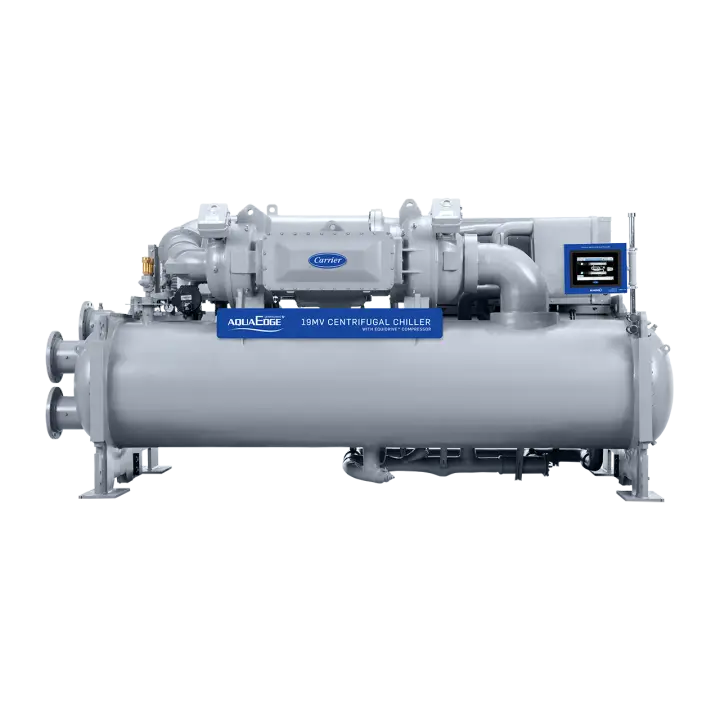
Oil-free magnetic-bearing centrifugal chiller, 150-700 tons, for data centers and hospitals
This model is part of SecondWatt’s chiller research catalogue. Specifications and price observations are included where supported by sources. Equipment availability and commercial terms require confirmation.
Chilled water is only the upstream half of a high-density cooling loop: once heat is picked up at the die rather than in the room, the plant feeds coolant distribution units and immersion tanks tracked under liquid cooling, which run off the same chilled-water supply as the units on this page. The catalogue entries closest to that decision are GRC ICEtank Immersion Cooling and Vertiv Liebert XDU Coolant Distribution Unit.
Carrier AquaEdge 19MV oil-free magnetic-bearing chiller: verified specs, vintage-dependent refrigerant GWP position, inspection checklist, and pricing status.
The Carrier AquaEdge 19MV is a water-cooled, two-stage centrifugal chiller with magnetic-bearing, oil-free compressors, per Carrier's literature. It spans 150-700 tons (527-2,461 kW) per Carrier's U.S. spec page, though a 2024 Australian catalogue states 200-700 tons for the same family. Full-load efficiency reaches 0.52 kW/ton (6.8 COP) and IPLV 0.31 kW/ton (11.3 COP), with Carrier claiming 10% better than ASHRAE 90.1-2019 Path B. It launched in the U.S. in December 2021 for data centers, hospitals, and offices, not industrial process refrigeration.
Buyers conflate it with AquaEdge siblings that share the name but not the bearing design. The 19DV uses ceramic, refrigerant-lubricated bearings on R-1233zd(E), not magnetic. The 19XR/19XRV is oil-lubricated, with a documented oil pump, filter, cooler, and reclaim system the 19MV lacks. Even "19MV" is no guarantee: the 19MVR variant swaps in oil-lubricated bearings on the same shell, and the smaller 19PV (100-350 tons) is magnetic and oil-free but ships on legacy R-134a.
Refrigerant is the decisive commercial fact, and it is vintage-dependent, not fixed by the model name. At its December 2021 launch the 19MV shipped on R-513A or R-134a, the latter at GWP 1,430, above EPA's 700 GWP comfort-cooling limit (Jan 1, 2025). Carrier added R-515B (GWP 293-299) in February 2023 and R-1234ze(E) (about 1.37 GWP) in July 2024; current sheets list only those two plus R-513A. A used 2021-2023 unit may still carry R-134a with the same exposure as any legacy machine; only the nameplate and build date settle it.
Why it matters
The 19MV is the clearest case in this category for why a model name alone cannot establish refrigerant compliance: identical nameplates from 2021-2023 and from 2023 onward carry GWP values roughly 1,000 apart. At about 4.5 years old, no used 19MV has been publicly priced on any channel as of August 2026, making refrigerant and build-date verification the entire due-diligence question for a used unit today.
Who buys it
Data centers, hospitals, and commercial offices specify the 19MV where continuous, near-full-load operation and rapid recovery after a power event outweigh price. Carrier markets a 150-second restart to full capacity, 10% minimum load without hot-gas bypass, and a 40-95F condenser-water range tolerant of cooling-tower upset. On the secondary market, only 2023-or-later units on R-515B or R-1234ze(E) suit a buyer needing a clean refrigerant-compliance path for relocation.
Role in the data center
In a data center chiller plant, the 19MV sits as the primary water-cooled centrifugal machine feeding the chilled-water loop to CRAH units or CDUs, sized for the plant's continuous near-full-load profile rather than the diurnal swing a comfort-cooling IPLV curve assumes. Its stated ability to hold 10% load without hot-gas bypass and restart to full capacity within 150 seconds targets N+1 or 2N redundant plant configurations where a unit may cycle in response to a partner unit's fault or a utility interruption.
Key specifications
| Capacity range (US current) | 150-700 (527-2,461) tons (kW) |
|---|---|
| Refrigerant options (US current) | R-513A, R-515B, R-1234ze(E) |
| Full-load efficiency (best case) | 0.52 (6.8) kW/ton (COP) |
| IPLV (best case) | 0.31 (11.3) kW/ton (COP) |
| Compressor type and count | Two-stage back-to-back EquiDrive semi-hermetic centrifugal, one per chiller |
| Bearing type | Magnetic (standard, oil-free) with backup roller bearings; oil-lubricated angular-contact ball bearings on 19MVR option |
| Evaporator/condenser | ASME shell-and-tube, 3/4 in. or 1 in. OD enhanced tubing, marine waterboxes to 150 psig |
| Electrical supply | 380V-3ph-60Hz / 416V-3ph-60Hz / 460V-3ph-60Hz / 400V-3ph-50Hz V-ph-Hz |
| Dimensions (by frame, sample range) | 4,075-4,728 (L) x 1,576-1,994 (W) x 1,987-2,542 (H) mm |
| Operating weight (sample models, 200-600 ton frames) | 6,264-10,652 kg |
| Factory refrigerant charge (sample models, 200-600 ton frames) | 508-855 kg |
| Sound level | below 80 (AU catalogue) / below 82 (US tech-spec page) dBA |
| Minimum entering condenser water temperature | 40 (4.4) F (C) |
| Minimum stable load (without hot-gas bypass) | 10 % of design capacity |
| Restart time to full design capacity after power loss | 150 seconds |
| Claimed ASHRAE 90.1 compliance margin | 10% better than 90.1-2019 Path B, full and part load |
Technical summary
Capacity range (US): 150-700 tons (527-2,461 kW). Refrigerant (US current): R-513A, R-515B, R-1234ze(E). Full-load efficiency: 0.52 kW/ton (6.8 COP). IPLV: 0.31 kW/ton (11.3 COP). Compressor: One two-stage EquiDrive semi-hermetic centrifugal. Bearings: Magnetic, oil-free standard; oil-lubricated on 19MVR option. Sound level: below 80-82 dBA at AHRI conditions. Min. entering condenser water: 40F (4.4C). Min. stable load: 10% without hot-gas bypass. Restart to full capacity: 150 seconds. Electrical supply: 380V/416V/460V-3ph-60Hz, 400V-3ph-50Hz.
Major variations
19MV vs. 19DV: the 19DV uses ceramic, refrigerant-lubricated bearings on R-1233zd(E), not magnetic bearings, and covers a higher 1,400-3,500 kW band. 19MV vs. 19XR/19XRV: the older 19XR is conventionally oil-lubricated, with a documented oil pump, filter, cooler, and reclaim system, across a larger 300-3,400 ton range depending on stage count. 19MV vs. 19MVR: the 19MVR shares the 19MV's shell and EquiDrive compressor but swaps in oil-lubricated angular-contact ball bearings in place of the magnetic-bearing rotor. 19MV vs. 19PV: the smaller 19PV (100-350 tons) is also magnetic-bearing and oil-free but ships on legacy R-134a rather than the 19MV's current low-GWP options.
Configurations and options
Refrigerant is a build-time configuration choice among R-513A, R-515B, and R-1234ze(E) on current U.S. units. Bearing type is likewise a build option: standard magnetic, oil-free, or the oil-lubricated 19MVR variant on the same shell. Electrical supply options span 380V, 416V, and 460V at 60 Hz, or 400V at 50 Hz. Frame sizes, documented as 21, 23, 31, 33, 41, 43, 51, and 53, set the physical envelope and tube-bundle length within the 150-700 ton range.
Compatibility and dependencies
The 19MV pairs with a condenser-water loop and cooling tower rated for its 40-95F entering condenser water range, and marine waterboxes rated to 150 psig set the piping-side pressure ceiling. SmartVu is the onboard control platform; building-automation integration depends on its firmware and communication-card revision, which should be confirmed directly with Carrier on any used unit. Dual electronic expansion valves provide cold-weather redundancy, but both must be functional for the full 40F low-ECWT range to be usable.
Pricing and availability
Trend: stable
Lifecycle and maintenance
The 19MV launched in the U.S. in December 2021, short of the 20-30-year service life water-cooled centrifugal chillers typically reach; secondary-market volume is effectively zero as of 2026. Carrier's "Certified Rebuild Program" overhaul offering covers the older 19XR line, not the 19MV, and Carlyle's remanufactured-compressor line covers only reciprocating, screw, and rotary compressors, not this model's centrifugal design. DOE FEMP estimates roughly 96 person-hours and $500 in materials over ten years for a magnetic-bearing compressor. Carrier publishes no end-of-support date for the SmartVu controls platform as of August 2026.
Thermal and emissions profile
Current U.S. spec sheets list only R-513A (GWP 631), R-515B (GWP 293-299), and R-1234ze(E) (GWP roughly 1.37) for the 19MV, all under the EPA's 700 GWP comfort-cooling limit effective January 1, 2025. But the model launched in December 2021 on a choice of R-513A or R-134a (GWP 1,430), and R-515B was not added until February 2023, R-1234ze(E) not until July 2024. A used 2021-2023 unit may still be R-134a-charged with the same limit exposure as any legacy centrifugal; "AquaEdge 19MV" on the nameplate does not by itself establish compliance. A 2024-dated Carrier Australia catalogue lists R-134a as standard, confirming refrigerant also varies by market.
Common failure points
- Magnetic bearing position sensor/controller — Vibration alarm, active fault code, or a logged backup-bearing touchdown event in the SmartVu history
- Refrigerant-cooled semi-hermetic motor winding — Insulation resistance under 10 Mohm on megger test, or motor amp draw above nameplate at design load
- Evaporator/condenser tube fouling or wall loss — Condenser approach temperature drift above 3F over baseline, or capacity shortfall at design condenser water temperature
- Dual electronic expansion valve — Reduced low-ECWT capacity, or erratic superheat control at part load
- Refrigerant charge and seal integrity — Annual loss approaching or exceeding the EPA 10% comfort-cooling leak-rate threshold
- SmartVu controls-board obsolescence — Firmware revision no longer current, or a network communication card incompatible with the buyer's building automation system
- Refrigerant identity mismatch at relocation — Nameplate refrigerant differs from the seller's verbal description, most likely on 2021-2023-vintage units originally sold on R-134a
Inspection checklist
Nameplate refrigerant verification: confirm the charge is R-134a, R-513A, R-515B, or R-1234ze(E); a 2021-2023-vintage unit (GWP 1,430 if R-134a) carries different relocation exposure than a 2023-or-later unit. Refrigerant charge quantity: confirm against nameplate; factory charge on documented sample frames runs 508-855 kg depending on tonnage (200-600 ton range). Eddy-current tube test: demand the most recent dated evaporator and condenser tube report; annual testing is standard industry practice per ASME/AHRI guidance. Motor winding insulation (megger) test: insulation resistance above 100 Mohm is healthy per IEEE 43; below 10 Mohm is a documented action threshold on the refrigerant-cooled motor. Full-load efficiency verification: run at design conditions and compare to the factory 0.52 kW/ton (6.8 COP) rating; a material shortfall signals fouling or wear.
Procurement channels
No dealer or aggregator channel (Machinio, Surplus Record, Salvex, EquipNet, eBay, GovDeals, GovPlanet) carried a verifiable used 19MV listing as of August 2026. New units and any early secondary-market examples currently move through Carrier's own commercial dealer network rather than the general used-HVAC-equipment channels that carry older AquaEdge lines like the 19XR.
Regional notes
U.S.-market units currently ship on R-513A, R-515B, or R-1234ze(E) only; Carrier's 2024 Australian catalogue for the same model lists R-134a as standard with R-513A and R-515B as options. A used or imported 19MV sourced outside the U.S., or specified against a non-U.S. catalogue, cannot be assumed to meet the EPA's 700 GWP comfort-cooling limit without checking the specific unit's nameplate.