Daikin Applied Magnitude WME
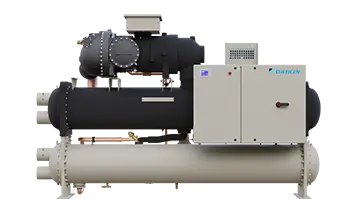
Oil-free magnetic-bearing centrifugal chiller with Danfoss Turbocor compressors, 400-1,600 tons
This model is part of SecondWatt’s chiller research catalogue. Specifications and price observations are included where supported by sources. Equipment availability and commercial terms require confirmation.
Chilled water is only the upstream half of a high-density cooling loop: once heat is picked up at the die rather than in the room, the plant feeds coolant distribution units and immersion tanks tracked under liquid cooling, which run off the same chilled-water supply as the units on this page. The catalogue entries closest to that decision are Vertiv Liebert XDU Coolant Distribution Unit and ZutaCore HyperCool Two-Phase Direct-to-Chip.
Daikin Applied Magnitude WME oil-free magnetic-bearing chiller: specs, refrigerant GWP position, inspection checklist, and pricing status.
Daikin Applied's oil-free, magnetic-bearing water-cooled centrifugal chiller ships today as Magnitude, not "Navigator." Model code WMC covers the legacy generation (86-400 tons), WME the current line (400-1,600 tons), and WME-C "Quad" the newest frame (2,000-3,000 tons, four parallel Danfoss Turbocor compressors), launched September 2025 for hyperscale data centers. Compressor count scales with frame size: single (S) at small frames, dual (D) through most sizes, four on the Quad.
This is the single most consequential identification fact for a used-equipment buyer: Daikin's current product actually named "Navigator" is an unrelated single-screw chiller (model WWV), not this magnetic-bearing machine. A used nameplate reads "WMC" or "WME" plus digits, such as WMC250DSC-ER10, never "Navigator" - every secondary-market listing titles the machine "Magnitude," "WMC," or "Daikin-McQuay Magnetic Bearing." WMC was the original model code from at least 2007, years before Daikin layered the "Magnitude" brand onto it in 2009.
Refrigerant is generation-dependent: legacy WMC shipped on R-134a (GWP 1,430), while current Magnitude models specify R-513A, R-515B, or R-1233zd(E), all under the EPA's 700 GWP comfort-cooling limit effective January 1, 2025. A legacy R-134a WMC unit stays legal to own, operate, and resell indefinitely, but relocating it to a new site falls into an unresolved EPA "new installation" gray area. Every compressor on every generation is a Danfoss Turbocor oil-free magnetic-bearing unit, so oil analysis is not a maintenance category here.
Why it matters
The nameplate says WMC or WME, never Navigator - a buyer, dealer, or search index using the wrong term finds nothing, a real sourcing failure in a market already this thin. Compressor count also sets failure economics: a dual-compressor WMC/WME frame keeps running at roughly 60% of rated capacity if one Turbocor compressor fails, while a single-compressor frame loses all cooling on that same failure.
Who buys it
Hyperscale data center operators specify the WME-C Quad (2,000-3,000 tons, four Turbocor compressors) for new mission-critical plants. Hospitals, universities, and office towers buy mid-range WME and legacy WMC frames (86-1,600 tons) for continuous comfort-cooling loads. WME-D buyers need a single machine that delivers simultaneous heating and cooling for heat-recovery plants.
Role in the data center
In a hyperscale data center chiller plant, the WME-C Quad frame (2,000-3,000 tons, four parallel Turbocor compressors) serves as the primary large-capacity machine feeding chilled water to CRAH units or CDUs, marketed by Daikin explicitly for this role since its September 2025 launch. Smaller WME and legacy WMC frames (86-1,600 tons) fill mid-size or N+1 redundant plant positions at edge or colocation facilities.
Key specifications
| Capacity range, WMC (legacy) | 86-400 tons (300-1,400 kW) |
|---|---|
| Capacity range, WME (current) | 400-1,600 tons (1,400-5,600 kW) |
| Capacity range, WME-C Quad | 2,000-3,000 tons |
| Refrigerant, current family | R-513A / R-515B / R-1233zd(E) |
| Refrigerant, legacy generation | R-134a (GWP 1,430, AR5) |
| Full-load efficiency, WME-C Quad | 0.52 kW/ton |
| IPLV, WME-C Quad and WMT | 0.30 kW/ton |
| Compressor type | Danfoss Turbocor, oil-free, magnetic-bearing, semi-hermetic centrifugal |
| Compressor count by frame | 1 (S suffix) / 2 (D suffix) / 4 (Quad) count |
| Evaporator/condenser tube material options | copper, 90/10 CuNi, 70/30 CuNi, stainless steel, titanium |
| Tube wall thickness options | 0.025 / 0.028 / 0.035 inches |
| Electrical supply | 380-480 and 575 V, 50/60 Hz |
| Operating/shipping weight, WMC145S-400D | 5,399-14,292 lbs |
| Sound level, WMC generation, 100% load | 75.6-83.3 dBA @ 1m (AHRI 575) |
| Minimum entering condenser water temp | 40 (CAT628/CAT632) vs. 55 (product document) F, figures conflict by source/generation |
| AHRI certification | Certified to AHRI Standard 550/590 (OEM catalog claim) |
Technical summary
Capacity range, WMC legacy: 86-400 tons (300-1,400 kW). Capacity range, WME current: 400-1,600 tons (1,400-5,600 kW). Capacity range, WME-C Quad: 2,000-3,000 tons. Refrigerant, current family: R-513A, R-515B, or R-1233zd(E). Refrigerant, legacy WMC: R-134a (GWP 1,430). Full-load efficiency, WME-C Quad: 0.52 kW/ton. IPLV, WME-C Quad and WMT: 0.30 kW/ton. Compressor: Danfoss Turbocor, oil-free, magnetic-bearing. Compressor count by frame: 1 (S) / 2 (D) / 4 (Quad). Tube materials: copper, 90/10 CuNi, 70/30 CuNi, stainless, titanium. Electrical supply: 380-480V and 575V, 50/60Hz. AHRI: certified to AHRI Standard 550/590 (OEM catalog claim).
Major variations
The model carries three sequential model codes under one Magnitude brand: WMC (legacy, in documented use since at least 2007), WME (current general-purpose generation), and WMT (newest, ultra-low-GWP two-stage line launched November 2023). Daikin filed the "Magnitude" trademark in July 2009, years after WMC was already in the field, so Magnitude is a marketing layer over an existing model code, not a rename of "Navigator" - Daikin's current product literally named Navigator (model WWV) is an unrelated single-screw, non-magnetic-bearing chiller. Within WME, the WME-D heat-recovery sub-variant (launched October 2024, 250-450 tons cooling / 1,000-1,550 kW heating) adds simultaneous heating output on R-515B.
Configurations and options
Refrigerant is a build-time choice among R-513A, R-515B, and R-1233zd(E) on current Magnitude production, with R-134a limited to legacy WMC units. Compressor count is a frame-size configuration: single-compressor (S) at the smallest sizes, dual-compressor (D) through most of the WMC/WME range, and four Turbocor compressors on the WME-C Quad. Evaporator/condenser tube material is a build option among copper, 90/10 CuNi, 70/30 CuNi, stainless steel, or titanium, at 0.025-, 0.028-, or 0.035-inch wall thickness. Electrical supply spans 380-480V or 575V at 50/60Hz.
Compatibility and dependencies
A dual-compressor WMC/WME frame (D suffix) continues at roughly 60% of rated capacity if one Turbocor compressor fails, buying time before a repair; a single-compressor frame (S suffix) loses all cooling on that same failure. The WME-C Quad's four compressors in a dual-circuit series counter-flow arrangement give the deepest partial-failure margin in the line. MicroTech II or III control platform is required for compressor diagnostics, and a pre-2016 WMC unit's board and OITS software revision should be confirmed as still supported before purchase. The chiller depends on an external condenser-water loop and cooling tower; no factory-integrated free-cooling coil exists on this water-cooled family.
Pricing and availability
Trend: stable No published price series exists for this line. The only priced Magnitude observation is a single 250-ton WMC250DSC-ER10, cross-listed by one dealer at three asking prices between 59,000 and 71,134 USD, or roughly 236 to 285 USD per ton. Because all three listings describe the same physical unit by serial number, they establish one dealer's asking spread rather than a market range, and no current-generation WME frame has traded publicly since the 2023-2025 launches.
Lifecycle and maintenance
Water-cooled centrifugal chillers as a class run 25+ years, some past 40; Daikin publishes no Magnitude-specific service-life figure, so the class figure is the only guide. The magnetic-bearing design eliminates oil analysis: DOE FEMP estimates roughly 96 person-hours and $500 in materials over 10 years for a magnetic-bearing compressor. Daikin publishes no certified-pre-owned or overhaul-and-resale program for Magnitude; only in-place OEM overhaul exists industry-wide. Controls span at least MicroTech II and III across the WMC-to-WME transition, so a pre-2016 WMC unit's board and OITS software should be confirmed as still supported before purchase.
Thermal and emissions profile
Daikin's current Magnitude family (WME, WME-C, WME-D, WMT) specifies R-513A, R-515B, or R-1233zd(E) - GWP roughly 573-673, 299, and 1 respectively - all under the EPA's 700 GWP comfort-cooling limit effective January 1, 2025. Legacy WMC units shipped on R-134a alone, GWP 1,430, well above that limit; such units are grandfathered for continued operation and service under EPA's stated policy that existing-equipment use is unrestricted. Relocating and reinstalling a legacy R-134a WMC unit at a new site falls into an EPA "new installation" gray area that EPA guidance does not resolve. Daikin publishes no refrigerant reclaim program specific to the Magnitude line.
Common failure points
- Turbocor compressor motor/bearing electronics — Repeated bearing-status fault or failure to levitate on start, compressor will not spin up
- Compressor VFD/inverter — Elevated Inverter Temperature or Cavity Temperature register readings, nuisance trips
- Evaporator/condenser tubes — Reduced approach temperature, rising head pressure
- MicroTech control board/software revision — An OITS or control-software version older than current-supported builds
- Refrigerant charge and seals, legacy R-134a units — Recurring low-charge alarms, frequent top-offs
- IGV (inlet guide vane) actuator — IGV percentage-open reading stuck or erratic on the MicroTech display
- Compressor starts/stops count — A high cumulative start count relative to run hours, frequent short-cycling
Inspection checklist
Nameplate model, serial number, and tonnage cross-check: verify a "250 Ton" dataplate against the model-number suffix itself, since WMC and WME frames span 75 to 3,000 tons across generations and a swapped or mismatched dataplate is easy to miss on a used unit. Compressor count and configuration: confirm single (S), dual (D), or quad (Quad) Turbocor arrangement; a dual unit continues operating at roughly 60% of rated capacity on one compressor after the other fails, a single-compressor unit does not. Compressor Run Hours register (MicroTech Modbus points 40175/40236/40239/40242, one set per compressor): pull and compare against the seller's claimed in-service years; an implausibly low reading on an older-vintage unit is a red flag.
Procurement channels
GovDeals, EquipNet, Aaron Equipment, Federal Equipment, Surplus Record and GovPlanet carried no further priced Magnitude, WMC or WME match as of August 2026. No current-generation WME, WME-C, WME-D or WMT unit is publicly priced, consistent with these being 2023-2025 launches with little secondary-market supply yet.
Regional notes
Sold across North American and international markets on 380-480 V and 575 V supplies at 50 or 60 Hz, so a used unit must be matched to site voltage and frequency before it is quoted. Refrigerant availability is generation-dependent rather than regional: legacy WMC shipped on R-134a alone, while current WME, WME-C, WME-D and WMT frames specify R-513A, R-515B or R-1233zd(E).