York YVAM
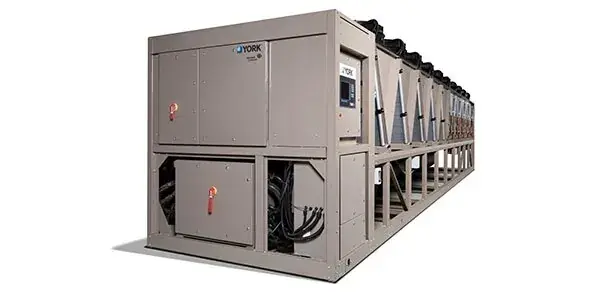
Air-cooled magnetic-bearing centrifugal chiller with no cooling tower or condenser water loop
This model is part of SecondWatt’s chiller research catalogue. Specifications and price observations are included where supported by sources. Equipment availability and commercial terms require confirmation.
Chilled water is only the upstream half of a high-density cooling loop: once heat is picked up at the die rather than in the room, the plant feeds coolant distribution units and immersion tanks tracked under liquid cooling, which run off the same chilled-water supply as the units on this page. The catalogue entries closest to that decision are ZutaCore HyperCool Two-Phase Direct-to-Chip and CoolIT Systems DCLC Direct Liquid Cooling.
York YVAM air-cooled magnetic-bearing chiller from Johnson Controls: capacity range, refrigerant GWP position, and pre-purchase inspection checklist.
The YORK YVAM pairs magnetic-bearing centrifugal compression, normally water-cooled, with an air-cooled package, removing the cooling tower, condenser loop, and water use a centrifugal machine this size would otherwise need. That buys part-load efficiency without a water source; it costs a capacity ceiling below York's water-cooled centrifugals, in a single-compressor, single-circuit design with no built-in redundancy. Johnson Controls markets it at hyperscale and colocation data centers wanting that trade.
Two Johnson Controls channels state 250-475 TR (880-1,670 kW); an Engineering Guide title states 250-500 ton (880-1,750 kW). Johnson Controls publishes no absolute EER, kW/ton, IPLV or NPLV figure, only two non-interchangeable marketing claims against an unspecified screw baseline: 49% NPLV improvement (2023 US launch) and 40% less annual power (2025 Europe launch). An ASHRAE 90.1 figure requires an AHRI-format request to York.
YVAM ships in two documented refrigerants: R-1234ze(E), GWP approximately 7 (AR4), marketed on every release, and R-134a, GWP 1,430, documented only in technical literature against model code YVAM0350. R-1234ze(E) sits far under the EPA's 700 GWP limit and, as an HFO not HFC, falls outside the AIM Act's production caps entirely.
Quick Start returns the unit to full load in roughly three minutes after a power interruption; full-load sound is 65 dBA at 10 meters per the brochure, though the product page states 96 dBA or less, basis unstated. YVAM sits between the smaller YLAA scroll line (40-230 TR) and the larger YDAM (710-950 TR), built on the YVAM platform.
Why it matters
Refrigerant identity is the decisive fact on any YVAM: an R-1234ze(E) unit sits comfortably under the EPA's 700 GWP comfort-cooling limit and outside the AIM Act's tightening HFC supply caps entirely, while a documented R-134a variant would not meet that limit for new US installation after January 1, 2025. No absolute efficiency figure is public, so code-compliance claims require a direct AHRI-format request. The line is young enough that no secondary-market pricing exists yet.
Who buys it
Hyperscale and colocation data center operators specify YVAM where centrifugal-class part-load efficiency is wanted without a condenser water loop, including water-constrained sites where zero on-site water consumption is a siting requirement rather than a preference. Mission-critical facility owners buy into the Quick Start restart feature for power-interruption resilience. A buyer should read refrigerant off the nameplate rather than assume it, since two options exist.
Role in the data center
Chiller-plant heat rejection for hyperscale and colocation facilities that want centrifugal-class part-load efficiency without a condenser water loop, feeding CRAH units or cooling distribution units downstream rather than conditioning room air directly.
Key specifications
| Capacity range | 250-475 TR / 880-1,670 kW (product page); 250-500 ton / 880-1,750 kW (Engineering Guide title) tons/kW |
|---|---|
| Refrigerant, primary/marketed | R-1234ze(E); GWP approximately 7 (AR4) / 1.37 (AR6); ASHRAE 34 A2L |
| Refrigerant, alternate (model YVAM0350) | R-134a; GWP 1,430 (AR5); ASHRAE 34 A1 |
| Compressor | Single-stage magnetic-bearing centrifugal, direct-drive, semi-hermetic permanent-magnet motor; 1 compressor, 1 refrigerant circuit |
| Evaporator | Shell-and-tube, hybrid falling-film type, internally/externally enhanced copper tubes |
| Condenser | Microchannel, parallel-flow aluminum-alloy tube coil |
| Condenser fans | 16-26, model-dependent, variable-speed EC motors count |
| Refrigerant charge | approximately 750 lb |
| Operating weight | 23,850-28,500, model-dependent lb |
| Footprint, largest model (code 1650) | 600.0 L x 88.6 W x 98.5 H inches |
| Sound level | 65 dBA at 10 m (brochure) vs. 96 dBA or less (product page, basis unstated) dBA |
| Ambient operating range | -20F to 125F / -28.8C to 51.6C (US Engineering Guide) vs. -29C to +55C (Europe launch) F/C |
| Electrical supply | 3-phase, single-point connection; minimum 0.95 power factor; 5% max current TDD; IEEE-519 compliant |
| Capacity turndown | 100% to 15% of design % |
| Control panel | OptiView Control Center; 10.4 in minimum color LCD; BACnet/Modbus/N2/LON protocols |
| Quick Start restart time | as little as 3 minutes to full load after power restoration; requires integral UPS; dedicated sales guide scopes it to 250-375 ton models minutes |
Technical summary
Capacity range: 250-475 TR (880-1,670 kW) per product page; Engineering Guide title states 250-500 ton (880-1,750 kW). Refrigerant, primary: R-1234ze(E), GWP approximately 7 (AR4) / 1.37 (AR6), ASHRAE 34 A2L. Refrigerant, alternate (model YVAM0350 only): R-134a, GWP 1,430 (AR5), ASHRAE 34 A1. Compressor: single-stage magnetic-bearing centrifugal, direct-drive, 1 compressor, 1 refrigerant circuit. Evaporator: shell-and-tube, hybrid falling-film type. Condenser: microchannel, parallel-flow aluminum-alloy tube coil, 16-26 variable-speed EC fans. Refrigerant charge: approximately 750 lb. Operating weight: 23,850-28,500 lb, model-dependent. Sound level: 65 dBA at 10 m (brochure) vs. 96 dBA or less (product page, basis unstated). Ambient operating range: -20F to 125F per US Engineering Guide vs. -29C to +55C per Europe launch. Capacity turndown: 100% to 15% of design. Quick Start restart: as little as 3 minutes to full load after power restoration.
Major variations
YORK YVAA, YVFA, and YCIV are air-cooled variable-speed screw chillers, not magnetic-bearing centrifugal machines; York's own current lineup page lists YVAM and YDAM as the only magnetic-bearing centrifugal entries. A used YVAA0500 listing on Surplus Record shows this confusion already surfaces on the secondary market, since it shares three letters of YVAM's model prefix.
Configurations and options
Refrigerant is a real configuration split, not a marketing choice: model code YVAM0350 is documented against R-134a in Johnson Controls' technical literature, while model codes YVAM1150, YVAM1500, and YVAM1650 are documented against R-1234ze(E). Condenser fan count scales by frame size, from 16 fans on the smallest documented model up to 26 on the largest. Quick Start restart is standard across the line, though the dedicated Quick Start sales guide scopes its published restart-timeline detail specifically to the 250-375 ton models.
Compatibility and dependencies
Ambient operating range is documented two ways, -20F to 125F in the US 60 Hz Engineering Guide versus -29C to +55C in the 2025 Europe launch material, so a buyer should confirm the applicable figure for their unit's build region before assuming either range. Electrical supply is 3-phase at the site's scheduled voltage with a single-point power connection, so voltage and frequency must be matched before assuming a cross-region relocation is straightforward. A2L-classified R-1234ze(E) units require mechanical-room leak detection and ventilation interlocks under ASHRAE 15/UL 60335-2-40 that an R-134a unit does not need.
Pricing and availability
Comparable secondary-market band: 800–1300 $ per ton. Trend: stable
Lifecycle and maintenance
Johnson Controls publishes no YVAM-specific whole-unit overhaul interval as of August 2026. Category figures put water-cooled centrifugal service life at 25+ years and air-cooled units at 15-20 years, and DOE FEMP estimates roughly 96 person-hours and $500 in materials over 10 years for a magnetic-bearing compressor, since the oil-free design removes the oil-degradation wear mode that limits conventional centrifugal machines. Johnson Controls was still issuing OptiView firmware in the Y.OPT.20.xx.yyy series as of August 2026, indicating current controls support; no long-run support commitment length is published.
Thermal and emissions profile
R-1234ze(E), the refrigerant on YVAM's customer-facing marketing, carries a GWP of approximately 7 on an AR4 basis and about 1.37 on an AR6 basis, far under the EPA's 700 GWP comfort-cooling limit effective January 1, 2025. As an HFO rather than an HFC, it also sits outside the AIM Act's production and consumption caps entirely, so service-refrigerant supply is not exposed to the same tightening schedule HFC-charged machines face. A second, R-134a variant (GWP 1,430) is documented against model code YVAM0350 in Johnson Controls' technical literature only, never in marketing; it would not meet the 700 GWP limit for new US installation after January 1, 2025. Johnson Controls does not document its low-pressure refrigerant, R-1233zd(E), for YVAM.
Common failure points
- Magnetic bearing controller / power amplifier — repeated touchdown-bearing events, bearing fault codes, or a compressor that will not levitate on start
- Microchannel aluminum condenser coil — refrigerant staining, pitting, or galvanic corrosion at fin-to-header joints, especially in coastal or de-icing-salt environments
- Variable-speed drive / active front end — capacitor bulging or discoloration, fault history, loss of IEEE-519 harmonic compliance
- Integral UPS battery — unit fails to hold bearing levitation and control power through a simulated outage
- EC condenser fan motors — one or more of the unit's fans not spinning, vibration, or bearing noise
- A2L refrigerant leak-detection and ventilation interlock — expired sensor calibration, disabled interlock, or missing mechanical-room ventilation tie-in
- Evaporator waterside fouling — rising approach temperature, reduced capacity at rated flow
Inspection checklist
Magnetic bearing levitation log: pull the OptiView controller's full levitation and touchdown-event history for the unit's entire service life (YVAM launched May 2023 in the US, so the oldest units in the field are roughly 3 years old as of 2026) and confirm no unexplained gap. Compressor start count and run hours: request total compressor starts and total run hours from the OptiView trend log; a unit logging more than roughly 15,000-20,000 starts warrants closer bearing-electronics diagnostics before purchase. Backup/touchdown bearing wear: physically inspect the mechanical touchdown bearings that support the shaft on any loss of levitation; YVAM ships as a single-compressor, single-refrigerant-circuit machine, so there is exactly one compressor's worth of touchdown-bearing wear to evaluate.
Procurement channels
No used YVAM is listed on Machinio, Surplus Record, EquipNet, GovPlanet/GovDeals, eBay or Salvex as of August 2026, so new-unit purchase through York/Johnson Controls' direct sales channel is the only documented procurement path. That is consistent with the line's youth, since the oldest US units are roughly three years old as of 2026 and are likely still within an initial ownership or warranty period.
Regional notes
YVAM launched in the US in May 2023 and reached Europe in March 2025. Ambient operating range and sound-level figures differ between the US Engineering Guide and the Europe launch material, so confirm the applicable figure for the unit's build region.