Trane Sintesis RTAF
Manufacturer: Trane
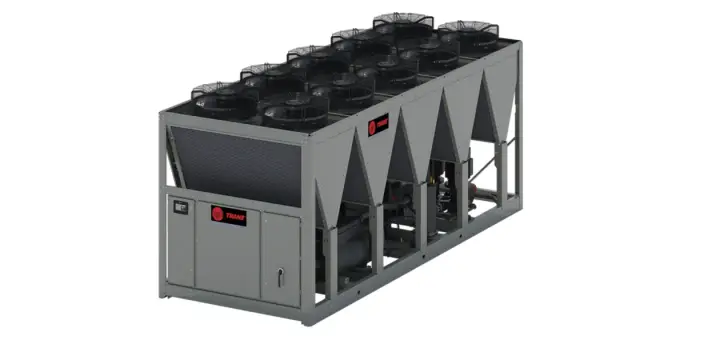
Air-cooled helical-rotary screw chiller, 115-520 tons, oil-lubricated, three-way refrigerant choice
This model is part of SecondWatt’s chiller research catalogue. Specifications and price observations are included where supported by sources. Equipment availability and commercial terms require confirmation.
Chilled water is only the upstream half of a high-density cooling loop: once heat is picked up at the die rather than in the room, the plant feeds coolant distribution units and immersion tanks tracked under liquid cooling, which run off the same chilled-water supply as the units on this page. The catalogue entries closest to that decision are CoolIT Systems DCLC Direct Liquid Cooling and GRC ICEtank Immersion Cooling.
Trane Sintesis RTAF air-cooled screw chiller: specs, refrigerant GWP compliance, inspection checklist, and secondary-market pricing status.
Trane's air-cooled, oil-lubricated helical-rotary (twin-screw) chiller ships as model RTAF, marketed since 2015 as Sintesis, rebranded in current European catalogs as Sintesis Prime RTAF. North American capacity runs 115-520 nominal tons; EMEIA catalogs list the platform from 300-2,090 kW. RTAF did not replace Trane's older Series R screw lines: RTAC (140-500 tons, R-134a only) and the earlier RTAA (70-400 tons, originally R-22) both still sit on Trane's price list, with RTAC a current, cheaper, parallel offering rather than a discontinued predecessor.
A second, unrelated machine complicates the picture: Trane also sells Sintesis eXcellent, model GVAF, which uses magnetic-bearing centrifugal compressors, not screws, standard on R-1234ze(E) from a French factory. Trane expanded GVAF to 2.5 MW in April 2026, explicitly for data centers, the same buyers RTAF targets. A quote or listing that says only "Sintesis" does not identify compressor architecture by itself, so confirming RTAF versus GVAF on the nameplate is the single most consequential identification step in this family.
Refrigerant is a factory-time choice, not a fixed spec: North American RTAF ships on R-134a or R-513A since 2015, while EMEIA adds a third option, R-1234ze(E), on the RTAF-G sub-line. R-513A (GWP about 630) and R-1234ze(E) (GWP under 5) both clear the EPA's 700 GWP comfort-cooling limit effective January 1, 2025; R-134a (GWP 1,430) does not. Trane states converting an installed unit from R-134a to R-513A is offered only in Europe, making a used R-134a unit a refrigerant dead end domestically.
Why it matters
RTAF's three-way refrigerant choice is the commercial hinge: R-513A and R-1234ze(E) clear the EPA's 700 GWP comfort-cooling limit, R-134a does not, and North America has no documented in-region path to convert an R-134a unit to R-513A after the fact. Free cooling and refrigerant are both locked in at the factory via model-number digits, so a used RTAF's full configuration string, not just its tonnage, decides whether it substitutes for another unit of the same nominal size.
Who buys it
Data center operators and colocation developers specify RTAF for chilled-water plants where a condenser-water loop is not practical, often paired with the factory free-cooling option chosen at order time. Hospitals, universities, and commercial campuses buy mid-range RTAF tonnages for comfort cooling. Process-cooling buyers select the dedicated RTAF-G Process variant. An EMEIA buyer wanting the lowest refrigerant GWP orders RTAF-G on R-1234ze(E), unlisted in North America.
Role in the data center
In an air-cooled data center plant the RTAF sits as the primary chilled-water machine where no cooling tower or condenser water loop is available, sized between 115 and 520 nominal tons in North America. Trane positions the parallel RTAC line for lowest installed cost and the magnetic-bearing GVAF for efficiency, so RTAF occupies the middle of that three-way choice.
Key specifications
| Capacity range (North America) | 115-520 nominal tons |
|---|---|
| Capacity range (EMEIA, RTAF-G) | 320-1,720 kW |
| Refrigerant (North America) | R-134a or R-513A |
| Refrigerant (EMEIA) | R-134a, R-513A, or R-1234ze(E) |
| R-513A GWP | 630 AR5-basis |
| R-1234ze(E) GWP | under 5 (Trane states <1 and also 4 in different documents) |
| Full-load EER (EMEIA RTAF-G, XSE) | 3.53-3.80 kW/kW (EU convention) |
| Compressor type and count | Semi-hermetic, direct-drive helical-rotary (twin) screw; 2 (115-270T), 3 (280-390T), or 4 (410-520T) per unit count |
| Evaporator type | Shell-and-tube, CHIL (Compact-High performance-Integrated-Low charge); 2-pass at or below 270T, 1-pass 280-520T |
| Electrical supply (North America) | 380/60/3, 400/50/3, 460/60/3, 575/60/3 V/Hz/phase |
| Operating weight (North America) | 8,091 (115T) - 23,907 (500T) lb |
| Operating weight (EMEIA, RTAF-G) | 3,410-9,840 kg |
| Sound level (EMEIA RTAF-G, by acoustic package) | 91-103 dB(A) |
| Minimum ambient operating temperature (North America) | 14 standard; -4 with low-ambient option F |
| Ambient operating range (EMEIA, high-ambient option) | -10 to +55 C |
| Free-cooling configuration | Factory-installed only, selected at order via model-number digit (Total/Partial x Direct/Glycol-Free); no field-add path documented |
Technical summary
Capacity, North America: 115-520 nominal tons. Capacity, EMEIA RTAF-G: 320-1,720 kW. Refrigerant, North America: R-134a or R-513A. Refrigerant, EMEIA: R-134a, R-513A, or R-1234ze(E). R-513A GWP: approximately 630. R-1234ze(E) GWP: under 5 across Trane figures (as low as <1). Compressor: oil-lubricated helical-rotary twin screw, 2-4 per unit. Evaporator: shell-and-tube CHIL design, low refrigerant charge. Electrical supply: 380/400/460/575V, 50/60Hz, 3-phase. Operating weight, North America: 8,091-23,907 lb. Sound level, EMEIA: 91-103 dB(A) by acoustic package. Free cooling: factory-installed only, chosen at order.
Major variations
Three model codes span one lineage under Trane's Series R/Sintesis naming: RTAA (original air-cooled screw platform, 70-400 tons, originally R-22, documented since at least 1999), RTAC (current "workhorse" line, 140-500 tons, R-134a only), and RTAF/Sintesis (115-520 tons, refrigerant choice). RTAC and RTAF are sold as parallel, concurrent product lines today, not sequential generations; Trane's own 2023 government price list carries both as active, separately configurable items, and RTAC is positioned for lowest installed cost against RTAF's higher efficiency and refrigerant flexibility. Within the Sintesis brand itself, a second, architecturally different machine exists: Sintesis eXcellent, model GVAF, uses magnetic-bearing centrifugal compressors rather than screws and ships standard on R-1234ze(E) from Trane's French plant.
Configurations and options
Refrigerant is a factory build-time choice: R-134a or R-513A in North America, with R-1234ze(E) added as a third option in EMEIA on the RTAF-G sub-line. Compressor count scales with frame size: 2 compressors for 115-270 ton units, 3 for 280-390 tons, 4 for 410-520 tons, each unit built with two independent refrigerant circuits. Free cooling is a factory-installed option only, selected at order via a model-number digit across Total/Partial and Direct/Glycol-Free configurations. Sound packages in EMEIA literature span Standard through Extra/Whisper-Low-Noise tiers, roughly 91 to 103 dB(A).
Compatibility and dependencies
Free cooling cannot be added in the field: a unit ordered without the free-cooling digit in its model number has no documented retrofit path, so two used RTAF units of identical tonnage are not automatically interchangeable if one has factory free-cooling and the other does not. Refrigerant is similarly locked at the factory, and Trane's own oil-compatibility rules state that the wrong oil type in the wrong refrigerant circuit causes catastrophic failure, ruling out an informal field refrigerant swap. Acoustic package is also fixed at build time and is not a field-retrofit option.
Pricing and availability
Comparable secondary-market band: 123.33–136 $ per ton. Trend: stable No published price series exists for RTAF itself. The nearest observations are its older screw-chiller siblings: a 1996 125-ton RTAA at 136.00 USD per ton on Salvex and a 2006 300-ton RTAC at 123.33 USD per ton on eBay. Both sit at the far end of a 15-20 year service life, so they describe end-of-life screw chiller values rather than what a 2015-or-later RTAF would command.
Lifecycle and maintenance
Air-cooled screw chillers carry a 15-20 year service-life estimate by cooling-medium and compressor-type classification, versus 25+ years for water-cooled centrifugals. Trane recommends condition-based, not calendar-based, oil changes for the Series R/Sintesis family, changed only when annual oil analysis flags an issue such as severe motor burnout. Trane's CenTraVac R'newal factory overhaul program does not cover RTAF; it is documented as covering only CVHE, CVHF, and CDHF centrifugal machines. Trane's Extended Warranty is a pre-ship-date purchase on new equipment, not a used-unit remanufacture path, and its R-134a-to-R-513A conversion service is documented as unavailable in North America.
Thermal and emissions profile
RTAF ships on a factory-selected refrigerant that varies by region: North America offers R-134a or R-513A, EMEIA adds R-1234ze(E) on the RTAF-G sub-line. R-513A carries a GWP of about 630 and R-1234ze(E) under 5 by every figure Trane publishes, both clearing the EPA's 700 GWP comfort-cooling limit effective January 1, 2025. R-134a carries a GWP of 1,430, above that limit; an already-installed R-134a unit can be serviced indefinitely under EPA's continued-use exemption, but Trane states converting it to R-513A is offered only in Europe, and relocating a pre-2025 R-134a unit to a new site sits in an unresolved EPA "new installation" gray area. Oil type is refrigerant-locked: Trane documents that the wrong oil in an R-134a/R-513A circuit causes catastrophic compressor failure.
Common failure points
- Twin-screw rotor set — Rising discharge temperature and falling volumetric efficiency, confirmed by a climbing Fe/Cu wear-metal count on oil analysis
- Discharge and suction bearings — Vibration-spectrum peaks at bearing-pass frequency, often preceding audible grinding by months
- Slide valve / Variable Volume Index mechanism — Compressor will not load past a fixed capacity step, or hunts between steps
- Oil separator and oil circuit — Recurring low-oil-flow fault trips on the controller, or oil carryover in the sight glass
- Aluminum-alloy condenser coil — Bent fins, hail-guard damage, or a white corrosion film that cuts rated heat-rejection capacity
- Symbio 800 control board — Obsolete firmware revision, an unavailable replacement board, or loss of BACnet/LonTalk/Modbus integration
- Refrigerant circuit and seals — Annualized leak rate above roughly 10 percent of full charge, or frost and oil residue at joints
Inspection checklist
Compressor oil sample: pull at least one lab sample per compressor, repeated on a 12-month interval, and track acid number, moisture, and Fe/Cu/Al wear-metal trend against baseline. Refrigerant identity confirmation: verify the actual in-circuit refrigerant against the nameplate and the model-number's digit-45 code before pricing a replacement. Oil type match: confirm OIL315 is the oil physically present in the R-134a or R-513A circuit, not a substituted product, since Trane documents that cross-contamination causes catastrophic compressor failure. Rotor lobe wear and mesh clearance: request a bore-scope or teardown clearance check on the male/female rotor set once run hours exceed roughly 60,000-80,000, or immediately if oil analysis shows a rising Fe/Cu trend.
Procurement channels
New units move through Trane commercial sales and its government price list, which carries RTAF and the parallel RTAC line as separately configurable items. The secondary market is thin because RTAF launched in 2015 and has not reached the 15-20 year window at which air-cooled screw chillers typically resell; the used channel is dominated by the older RTAA and RTAC lines instead.
Regional notes
North American RTAF ships on R-134a or R-513A, while EMEIA catalogs add R-1234ze(E) on the RTAF-G sub-line and quote the platform in kilowatts rather than nominal tons. The regional split has a commercial consequence: Trane offers the R-134a to R-513A field conversion only in Europe, so a North American R-134a unit has no documented refrigerant upgrade path.