Vertiv Liebert AFC
Manufacturer: Vertiv
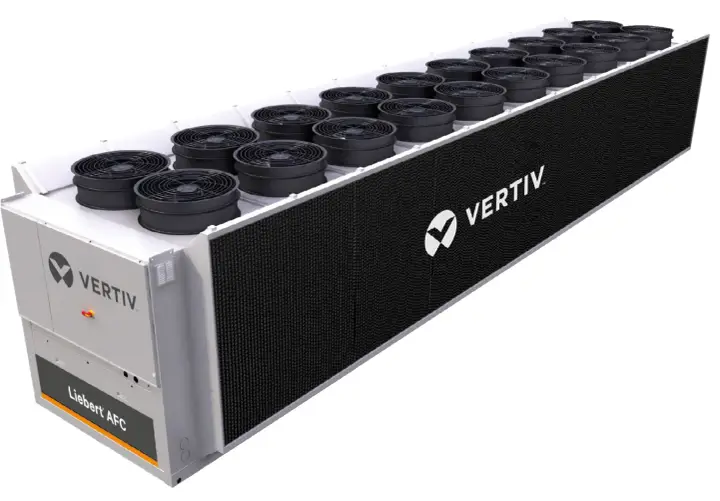
Adiabatic freecooling chiller with evaporative pre-cool, free-cooling coil, and screw or scroll backup compression
This model is part of SecondWatt’s chiller research catalogue. Specifications and price observations are included where supported by sources. Equipment availability and commercial terms require confirmation.
Chilled water is only the upstream half of a high-density cooling loop: once heat is picked up at the die rather than in the room, the plant feeds coolant distribution units and immersion tanks tracked under liquid cooling, which run off the same chilled-water supply as the units on this page. The catalogue entries closest to that decision are CoolIT Systems DCLC Direct Liquid Cooling and GRC ICEtank Immersion Cooling.
Vertiv Liebert AFC adiabatic freecooling chiller: capacity, refrigerant GWP by series code, water consumption, and inspection checklist.
Liebert AFC is an outdoor, air-cooled chiller Vertiv engineers specifically for data centers, sold across series CH3/CH4/CIZ (chiller-only), FH3/FH4/FIZ (integrated free cooling), and NH4 (glycol-free). Vertiv calls it the first integrated adiabatic freecooling chiller on the market: wetted pads pre-cool incoming air 5-10 deg C, that air crosses an aluminum microchannel free-cooling coil compressor-free, and screw or scroll compressors cover only the residual load.
The three stages blend continuously under Liebert iCOM control; a modeled London profile ran hybrid mode near 100 percent of full-load hours, Dubai roughly 50 percent. Refrigerant tracks the series code: CH4/FH4/NH4 on R-134a, CH3/FH3 on R-513A, CIZ/FIZ on R-1234ze(E), and R-515B joined at the November 2023 North America launch, which skipped R-134a entirely ahead of EPA's January 1, 2025 deadline.
Water is what the adiabatic stage spends for that efficiency: pad irrigation runs 76-152 L/min by fan count with bleed-off near 10 percent of flow, but no nameplate net water consumption is published for any AFC frame. Vertiv's closest real figure, a separate white paper's modeled 3 MW Ashburn, Virginia plant, moves WUE from zero to 0.165, or 4.3 million gallons a year, with adiabatic misting added, illustrated with an AFC photo rather than a disclosed nameplate spec.
Why it matters
The AFC's efficiency comes from evaporating water, and Vertiv publishes irrigation and bleed-off flow but no nameplate net water consumption for any frame, so a buyer cannot size a water budget from the spec sheet alone. Water rights, discharge permitting, and makeup-water quality are therefore a go/no-go site screen that belongs before capital cost. Series code also decides refrigerant compliance: CH4/FH4/NH4 predates the EPA's 700 GWP limit, while CH3/FH3, CIZ/FIZ, and R-515B clear it.
Who buys it
Hyperscale, colocation, and cloud operators specify Liebert AFC for chilled-water plants without a condenser-water loop, especially for high-density GPU clusters and hybrid liquid-cooling facilities. Enterprise and telecom operators select smaller frames from the same series for comfort cooling. A buyer should read the series code off the nameplate, since CH4/FH4/NH4 units still carry the legacy R-134a refrigerant newer CH3/FH3 and CIZ/FIZ frames replaced.
Role in the data center
Vertiv engineers the AFC specifically for data centers, so it sits as the outdoor chilled-water plant feeding CRAH units or coolant distribution units, with the adiabatic and free-cooling stages carrying most of the annual hours and the screw or scroll compressors covering only residual load. A modelled London profile ran hybrid mode near 100 percent of full-load hours against roughly 50 percent in Dubai.
Key specifications
| Capacity range (current global) | 877-2,025 (up to 2,200 single-frame) kW |
|---|---|
| Capacity range (current global) [derived] | 249.4-575.8 (up to 625.6) tons |
| Refrigerant and series: R-134a | CH4 / FH4 / NH4, GWP 1,430 (AR5) GWP |
| Refrigerant and series: R-513A | CH3 / FH3, GWP 631 (AR5) GWP |
| Refrigerant and series: R-1234ze(E) | CIZ / FIZ, GWP 1.37 (AR6) GWP |
| Refrigerant: R-515B | North America launch option since Nov 2023, GWP 293 (AR4) / 299 (AR5) GWP |
| Compressor type | Screw (fixed-speed or full-inverter) or scroll, multiple per frame |
| Free-cooling/condensing coil | Full-aluminum microchannel coil |
| Adiabatic pad irrigation flow | 76-152 (10 to 20 fans) L/min |
| Adiabatic bleed-off default setpoint | ~10 % of total irrigation flow |
| Makeup water total hardness (CaCO3) spec | 20-100 mg/L |
| Full-load EER, North America datasheet | 13.2-14.7 Btu/(W-h) |
| Full-load EER, global brochure rev. 3 | 3.84-5.52 kW/kW |
| Sound level | 67.5-83.1 (ultra-silent to standard configuration) dB(A) |
| Electrical supply | 400V/3ph/50Hz (EU/EMEA) or 460V/3ph/60Hz (North America) V/phase/Hz |
| Minimum ambient operating temperature | -25 (R513A/R134a frames) or -10.5 (current low-GWP catalog range) C |
Technical summary
Capacity, current global range: 877-2,025 kW (up to 2,200 kW single-frame). Capacity, current global range: 249-576 tons (up to 626 tons) [derived, 1 ton = 3.516853 kW]. Three-stage cooling: adiabatic pre-cool pads, then free-cooling coil, then screw/scroll compressor back-up. Refrigerant by series: R-134a (CH4/FH4/NH4), R-513A (CH3/FH3), R-1234ze(E) (CIZ/FIZ), R-515B (NA launch option). Full-load EER, North America datasheet: 13.2-14.7 Btu/(W-h). Full-load EER, global brochure rev. 3: 3.84-5.52 kW/kW, covering a wider frame span than the North America sheet. Adiabatic pad irrigation flow: 76-152 L/min by fan count (10-20 fans). Adiabatic bleed-off default: approximately 10 percent of total irrigation flow. Sound level: 67.5-83.1 dB(A), ultra-silent to standard configuration. Electrical supply: 400V/3ph/50Hz (EU/EMEA) or 460V/3ph/60Hz (North America). Minimum ambient operating temperature: -25 deg C to -10.5 deg C depending on frame and refrigerant.
Major variations
Four refrigerant/series combinations span the AFC's documented history: CH4/FH4/NH4 on legacy R-134a (GWP 1,430), CH3/FH3 on R-513A (GWP 631), CIZ/FIZ on R-1234ze(E) (GWP 1.37), and R-515B as a fourth option offered from the November 2023 North America launch without a distinct series code in Vertiv's published series list. Documented capacity spans have also grown across brochure revisions, from roughly 500-1,700 kW in an early EMEA brochure to 877-2,025 kW, and up to 2,200 kW in a single frame, in the current global catalog and an October 2024 expansion announcement. Chiller-only frames (CH-prefixed and CIZ) omit the integrated free-cooling coil that FH-prefixed and FIZ frames carry, and NH4 is a glycol-free loop variant of the R-134a line.
Configurations and options
Compressor architecture is a build-time choice between fixed-speed screw, full-inverter screw, and a smaller-frame scroll configuration. Electrical supply is regional: 400V/3ph/50Hz for EU/EMEA-built units and 460V/3ph/60Hz for North America-built units. Sound packages range from a standard 73.5-83.1 dB(A) tier to an ultra-silent 67.5-69 dB(A) option, and the adiabatic pre-cooling stage itself is the line's defining configuration choice against a plain free-cooling chiller.
Compatibility and dependencies
The adiabatic stage is the compatibility gate: a site needs a continuous make-up water supply meeting Vertiv's hardness (20-100 mg/L CaCO3) and total-dissolved-solids (under 450 mg/L) specification, plus a discharge path for bleed-off water, before the unit can run adiabatically at all. Water rights, discharge permitting, and metered water cost are therefore a go/no-go site screen that belongs before capital cost, since Vertiv publishes irrigation and bleed-off flow rates but no nameplate net-consumption figure a buyer can size a water budget against. Electrical nameplate voltage and frequency (EU 400V/50Hz versus North America 460V/60Hz) and minimum ambient rating must also match the destination site before a cross-region relocation is assumed straightforward.
Pricing and availability
Trend: stable
Lifecycle and maintenance
Vertiv publishes no AFC-specific service life, overhaul interval or OEM service-programme scope as of August 2026. General category figures put air-cooled chillers at 15-20 years and screw compressors at 15-20 years by compressor type, treated here as a proxy, not an AFC-specific OEM claim. The adiabatic pad media, irrigation pump, and bleed-off system add wear items beyond a standard dry air-cooled chiller's scope, with no published media-replacement interval. Vertiv publishes no support-duration commitment for the Liebert iCOM controls platform either.
Thermal and emissions profile
Refrigerant tracks the AFC's series code, not a single spec: CH4/FH4/NH4 ship on R-134a (GWP 1,430), CH3/FH3 on R-513A (GWP 631), CIZ/FIZ on R-1234ze(E) (GWP 1.37), and R-515B (GWP 293 on a 4th-assessment basis) joined as a third compliant option at the November 2023 North America launch. Only R-134a exceeds the EPA's 700 GWP comfort-cooling limit effective January 1, 2025; the North America launch entered the market only with compliant refrigerants, skipping R-134a entirely. An installed R-134a unit can still be serviced indefinitely, but relocating it to a new site sits in an EPA "new installation" gray area that published guidance does not resolve, and Vertiv has published no formal discontinuation of R-134a in EMEA.
Common failure points
- Adiabatic pad media — scale crust and uneven wetting reduce evaporative pre-cooling delta-T, forcing earlier and more frequent compressor engagement
- Microchannel aluminum coil — corrosion or pitting leading to refrigerant leak; an aluminum microchannel coil cannot be spot-repaired tube-by-tube like copper fin-and-tube
- Irrigation pump, solenoid, and nozzles — scaling or clogging cuts adiabatic pre-cooling effectiveness, silently shifting more load onto compressors without an obvious alarm
- Screw or scroll compressor — bearing wear and valve-plate damage accumulating from repeated hybrid-mode cycling rather than steady full-load running
- Liebert iCOM control board — an obsolete hardware or firmware revision cannot receive current Vertiv updates or integrate cleanly with a new site's building management system
- EC fan motors — bearing wear and vibration from constant speed-modulation duty across hybrid-mode operation
- Cabinet and frame corrosion near adiabatic section — structural steel and drain-pan corrosion concentrated around the wetted pad zone, distinct from the dry sections of the cabinet
Inspection checklist
Adiabatic pad media and bleed-off setpoint: inspect the cassette for mineral scale crust and uneven wetting, and verify the bleed-off valve is field-set near the OEM's ~10% of total irrigation flow default, not bypassed or zeroed to cut water cost. Makeup water hardness log: request history against the OEM's 20-100 mg/L CaCO3 total-hardness spec for the irrigation supply. Makeup water TDS log: request history against the OEM's under 450 mg/L total-dissolved-solids spec. Irrigation pump and manifold flow test: field-verify delivered flow against the OEM's 76-152 L/min table keyed to the unit's 10-20 fan count. Free-cooling and condensing coil: pressure-test the full-aluminum microchannel coil, since it cannot be repaired tube-by-tube like a copper fin-and-tube coil, so any leak is a coil-replacement event.
Procurement channels
New units move through Vertiv sales and its data center channel rather than through general HVAC distribution. There is effectively no secondary market: Machinio, Surplus Record, eBay, GovDeals, Salvex, HiBid, EquipNet and Aaron Equipment carry Liebert-branded CRAC and in-row units but no AFC chiller as of August 2026, which is consistent with a purpose-built data center machine that stays with the site.
Regional notes
Electrical supply splits the market: 400 V three-phase 50 Hz for EU and EMEA against 460 V three-phase 60 Hz for North America, so a unit cannot cross regions without a supply match. Refrigerant follows the same split. The November 2023 North America launch skipped R-134a entirely and entered on R-513A, R-1234ze(E) and R-515B, while R-134a series remain documented in EMEA.