
How much water do data centers use? It depends mostly on how a site rejects heat and how its electricity is made. Evaporative cooling towers consume water every hour they run, while air-cooled chillers and dry coolers use little water on site but generally more electricity. For US data centers in 2023, the power plants supplying their grid electricity consumed more water than the sites themselves.
For a buyer, that makes data center water usage an equipment question. The heat-rejection plant chosen alongside the chillers, and any on-site generation, sets most of a site's direct water consumption, and its energy trade can be counted before ordering.
Key Takeaways
- Heat rejection sets most on-site water use. In LBNL's 2024 modeling, water-cooled chillers without economizers had the highest site WUE; air-cooled chillers use no water but more energy.
- Withdrawal and consumption are different numbers. Consumption is withdrawn water that evaporates or otherwise leaves the immediate water environment; AWS's company-reported 2025 WUE of 0.12 L/kWh counts withdrawal.
- US data centers' grid power consumed more water than the sites. In LBNL's estimate, direct consumption was 66 billion liters in 2023; indirect consumption at power plants, nearly 800 billion.
- One megawatt of tower heat evaporates about 1.49 m³ an hour. That assumes all-latent heat rejection at 30 °C; at an assumed four cycles, blowdown adds 0.50 m³/h.
- On-site generation can add water use or avoid it. SPRINT and water-injected turbines consume demineralized water; Wärtsilä and Bloom claim near-zero water for their engines and fuel cells.
How much water do data centers use#
Water-cooled chillers without economizers showed the highest site WUE of nine cooling systems modeled for LBNL's 2024 United States Data Center Energy Usage Report, published in December 2024. The report says that result is "largely attributed to substantial cooling tower water usage."
US data centers consumed 66 billion liters of water on site in 2023, about 17.4 billion US gallons, up from 21.2 billion liters in 2014. Hyperscale and colocation sites accounted for 84% of the 2023 total, the same report says. This is direct consumption, mainly from cooling.
The power plants supplying those sites consumed far more: nearly 800 billion liters in 2023, a national average of 4.52 liters per kWh of data center electricity, based on the regional grid mix. On the same basis and year, indirect consumption was about 12 times direct consumption (800 ÷ 66 = 12.1). The estimate leaves out power purchase agreements and on-site generation.
These remain the latest water figures in LBNL's report series. The 2025 Update, published in June 2026, revises electricity estimates, carries the 2024 facility methods forward and gives no new water figures.
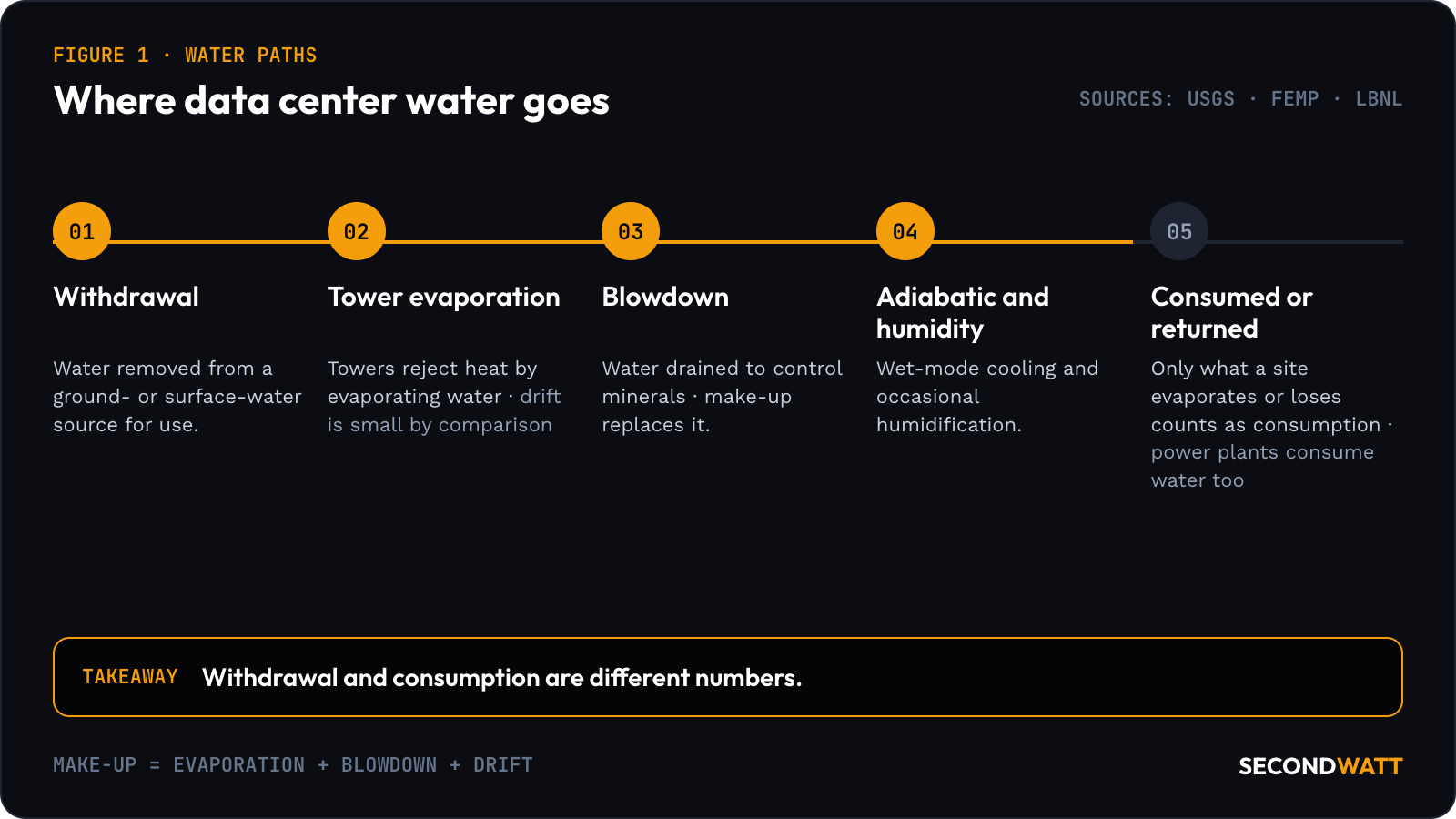
The USGS Water Science glossary defines withdrawal as "water removed from a ground- or surface-water source for use." Consumptive use is the part of withdrawn water that is evaporated, transpired, built into products or otherwise removed from the immediate water environment. A site can withdraw water and send part of it back to a sewer; only what it evaporates or loses counts as consumption.
Where the water goes#
Water leaves a cooling tower system as evaporation, drift, blowdown, and basin leaks or overflows. Make-up water replaces it. DOE FEMP's Best Management Practice #10 gives the balance as make-up = evaporation + blowdown + drift. Towers reject heat by evaporating water, so they "use significant amounts of water" by design.
Blowdown is water drained to control minerals. As water evaporates, dissolved solids such as calcium, magnesium, chloride and silica concentrate; draining a share and adding fresh make-up limits scale and corrosion. Controlling blowdown is the most significant opportunity to conserve tower water. The same FEMP practice adds that drift, the mist carried out of the tower, is small by comparison and controlled with drift eliminators.
Adiabatic coolers consume water mainly in wet mode. Spraying or circulating water through pads upstream of a dry cooler's coils enhances cooling, especially when the dry-bulb temperature is high and the wet-bulb temperature low. Evaporative air handling evaporates water directly into the supply air, as Table 4.2 of the LBNL 2024 report describes.
Humidification is another on-site use. In LBNL's simulations, the systems with minimal WUE owed their water use mainly to occasional humidification. DOE FEMP's federal data center cooling water page notes that where humidity controls are not centralized, excessively narrow control can leave one unit dehumidifying while another adds humidity to the same space.
Grid power plants use water too, and a plant's cooling system often decides its water use more than its generating technology does. An NREL review of operational water factors appeared in Environmental Research Letters in December 2012. It found that once-through cooling withdraws 10 to 100 times more water per unit of generation than cooling towers, yet towers can consume twice as much. On-site turbines bring their own mechanisms, covered in the gas turbine water consumption guide.
Cooling systems and their water use#
The table sets out each approach's water mechanism and timing, with an OEM example where one applies.
Cooling approaches and when they consume water (LBNL 2024 report, Table 4.2 and pp. 44–47; OEM pages and data sheets)#
| Cooling approach | Water mechanism | When it consumes water | Water figure as the source states it | Equipment example |
|---|---|---|---|---|
| Water-cooled chillers with cooling towers | Condenser heat evaporated in the tower, plus blowdown and drift | Whenever the chillers reject heat through the tower | Highest simulated WUE of the systems modeled, without economizers (LBNL) | Carrier AquaEdge 19MV water-cooled centrifugal chiller, 150–700 tons (527–2,461 kW) capacity range |
| Air-cooled chillers | Refrigerant condenser rejects heat to outdoor air | No cooling water | "use no water" (LBNL) | York YVAM air-cooled magnetic-bearing centrifugal chiller, 250–475 TR (880–1,670 kW) capacity; Vertiv Liebert AFC air-cooled free cooling chiller, 889–2,025 kW total nominal capacity across the no-free-cooling versions listed |
| Dry coolers with adiabatic assist | Water sprayed on or circulated through pads upstream of the coils | In wet mode, during adiabatic pre-cooling | Highest of the remaining systems LBNL simulated, mostly during adiabatic pre-cooling (LBNL) | — |
| Airside economizer with direct evaporative (adiabatic) cooling | Water evaporates directly into the supply air | When outdoor air alone cannot meet the load | Some hyperscale facilities report 0.1–0.3 L/kWh for similar systems (LBNL, p. 47) | — |
| Closed direct-to-chip liquid loops | Closed coolant loop to a CDU; heat passes to the facility water system | Depends on the heat rejection behind the CDU | With a waterside economizer and water-cooled chiller, "substantial amounts of water"; with dry coolers, "water-friendly" (LBNL) | Vertiv CoolChip CDU 1350, 1,350 kW nominal cooling capacity at 4 °C ATD |
| Immersion cooling | Liquid cooling that LBNL lists with direct-to-chip as well suited to a waterside economizer | Depends on the heat rejection behind it | Not stated | GRC ICEtank IT20 and IT40, which GRC describes as self-contained immersion-cooled data centers |
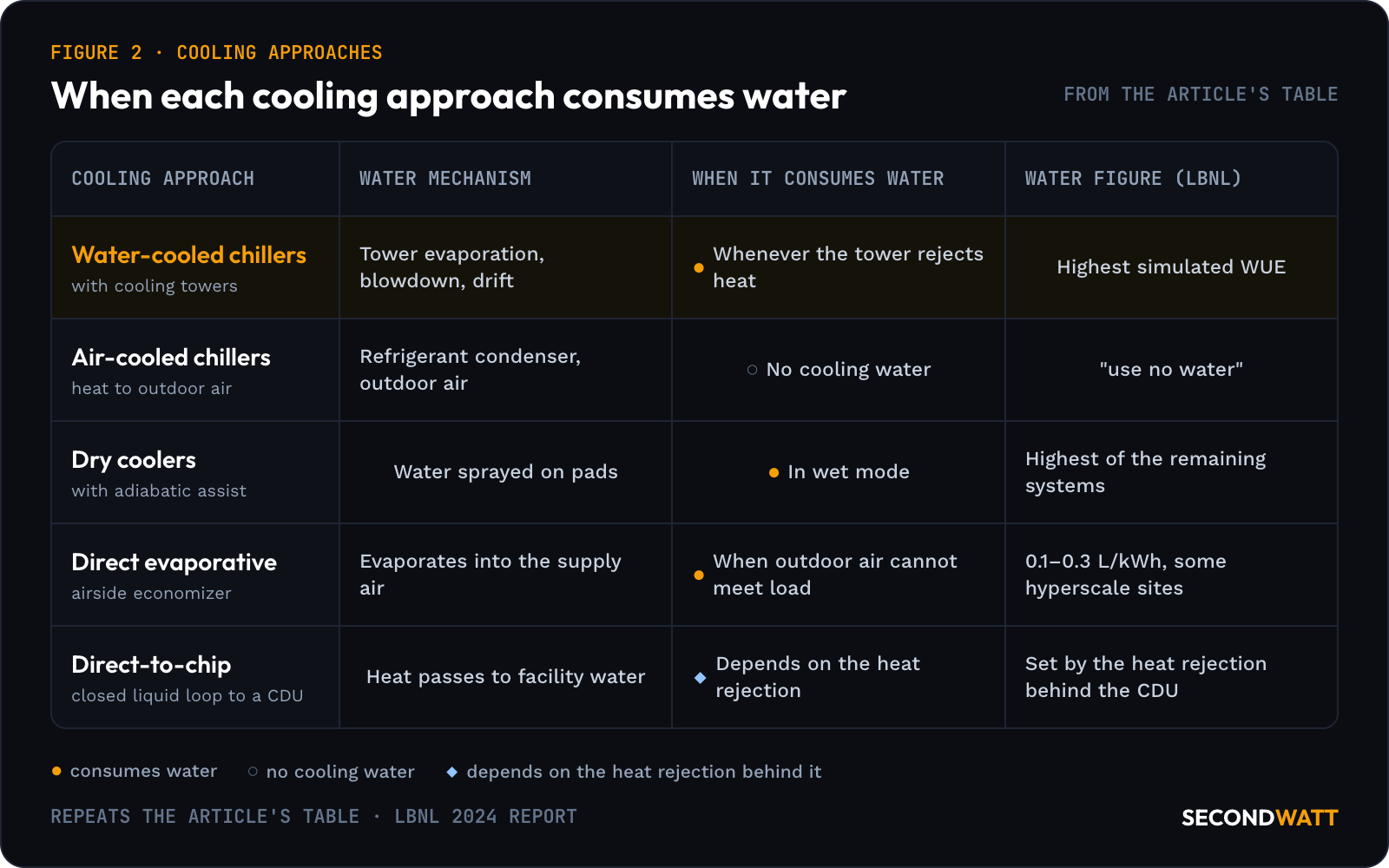
Read the table from the heat rejection outward. The Carrier AquaEdge 19MV consumes water through the tower it is piped to. The York YVAM and Vertiv Liebert AFC reject heat to air, according to York's YVAM page and Vertiv's Liebert AFC page. The used chillers guide applies the same logic to GPU loads.
A liquid cooling loop moves the question rather than settling it. The CDU 1350 is a liquid-to-liquid unit, according to the 05/26 edition of Vertiv's CoolChip CDU data sheet. Its primary side takes chilled water or a glycol mixture from the facility. A tower or a dry cooler behind that facility water sets the water use; the CDU selection guide covers sizing.
How WUE is measured#
FEMP's data center page defines water usage effectiveness (WUE) as annual site water usage in liters divided by IT equipment annual energy use in kWh. It is a site-based metric in liters per kWh. LBNL's 2024 report puts total water consumption in the numerator instead. The Green Grid proposed the metric in white paper WP#35 of 1 March 2011, calling it "a natural extension of PUE."
Site WUE measures water at the facility only. Source WUE adds the water used to generate the facility's electricity, a calculation LBNL's 2024 report calls complex and highly dependent on the electricity source.
Worked example, with illustrative inputs: a site averages 10,000 kW of IT load for a year, so its IT energy is 10,000 × 8,760 = 87,600,000 kWh. If it uses 35,000,000 liters of site water that year, its WUE is 35,000,000 ÷ 87,600,000 = 0.3995, about 0.40 L/kWh. In the LBNL 2024 report, the modeled US average site WUE stays just over 0.36 L/kWh through 2023.
Company figures need their definitions read first. AWS's sustainability page reports a global data center WUE of 0.12 L/kWh for 2025, counting water withdrawn per kWh of IT load.
Microsoft's datacenter efficiency page reports a global WUE of 0.27 L/kWh for FY25 (July 2024 to June 2025). That figure counts liters used for humidification and cooling, at datacenters fully owned and controlled and operating for 12 months. Both are company-reported, on different bases.
0.12 L/kWh — AWS's company-reported global data center WUE for 2025, counted as liters of water withdrawn per kWh of IT load.
Cooling tower water per MW of heat#
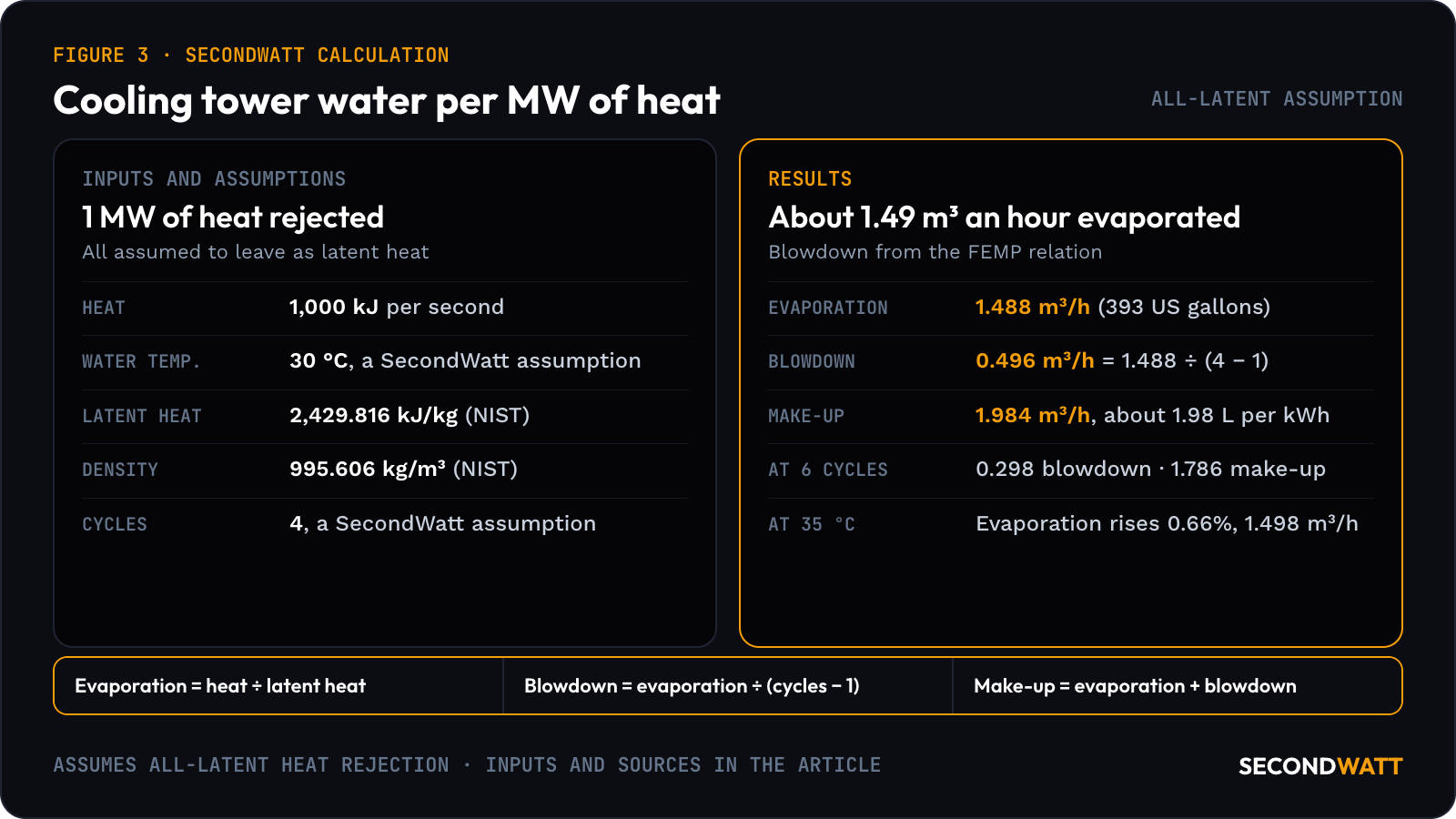
A tower's water budget starts from the heat it rejects. If all of that heat leaves as evaporation, the water evaporated equals the heat divided by water's latent heat of vaporization at the tower temperature. Blowdown then follows from the cycles of concentration the water chemistry allows.
SecondWatt calculation, inputs and assumptions:
- Heat rejected: 1 MW of heat load, or 1,000 kJ per second, all assumed to leave as latent heat.
- Tower water temperature: 30 °C, a SecondWatt assumption.
- Latent heat at 30 °C, from the IAPWS-95 saturation properties for water in the NIST Chemistry WebBook: saturated vapor enthalpy 2,555.55 kJ/kg minus saturated liquid enthalpy 125.734 kJ/kg, which gives 2,429.816 kJ/kg.
- Water density at 30 °C: 995.606 kg/m³, from the same NIST table.
- Cycles of concentration: 4, a SecondWatt assumption inside FEMP's typical range.
Evaporation: 1,000 ÷ 2,429.816 = 0.4116 kg/s, or 1,481.6 kg/h.
Volume: 1,481.6 ÷ 995.606 = 1.488 m³/h, about 1.49 m³ (393 US gallons) an hour.
Blowdown comes from the FEMP relation: blowdown = evaporation ÷ (cycles of concentration − 1). The relation is equation 6 in DOE FEMP's February 2011 Cooling Towers: Understanding Key Components of Cooling Towers and How to Improve Water Efficiency. There, blowdown covers all losses other than evaporation, including leaks and drift.
Blowdown at 4 cycles: 1.488 ÷ (4 − 1) = 0.496 m³/h. Make-up: 1.488 + 0.496 = 1.984 m³/h, about 1.98 liters per kWh of heat rejected. At 6 cycles, blowdown falls to 1.488 ÷ 5 = 0.298 m³/h and make-up to 1.786 m³/h.
2 to 4 cycles of concentration — the range FEMP says many cooling tower systems operate at, with six cycles or more possible depending on make-up water quality and treatment.
The tower's heat load can exceed the IT load. FEMP's data center page says chiller compressor heat can add up to 20% of the total heat a tower rejects. On that limit, a 1 MW chilled-water load can mean 1 ÷ (1 − 0.2) = 1.25 MW of heat load at the tower.
Water temperature changes this result little. At 35 °C the latent heat is 2,417.916 kJ/kg, and evaporation rises 0.66% to 1.498 m³/h. If none of the make-up is condensate or recycled water, all 1.984 m³/h is withdrawn; the 1.488 m³/h evaporated is consumed, and most of the blowdown leaves through a drain.
On-site power and water#
On-site generation adds its own water use, which depends on the machine. Depending on uncontrolled NOx levels, water or steam injection cuts gas turbine NOx by 60% or more, to as low as 25 ppm at 15% oxygen on natural gas. Section 3 of the US EPA CHP Partnership's Catalog of CHP Technologies, dated March 2015, says the water "needs to be demineralized thoroughly."
Lean premixed combustion, sold as dry low-NOx (DLN) or dry low-emissions (DLE), premixes fuel and air to avoid the hot spots that form NOx. The same EPA catalog says most manufacturers typically offer 15–25 ppm DLN or DLE systems on natural gas. Evaporative inlet cooling, a separate option, "can consume large quantities of water."
GE Vernova's SPRINT page says SPRINT spray intercooling on the LM6000 atomizes demineralized water and sprays it into the compressor inlet to raise output, more so as ambient temperature rises. GE Vernova's 09/2025 fact sheet rates the LM6000 PF+ SPRINT at 56.9 MW simple-cycle net output, ISO, natural gas, 50/60 Hz. The LM6000 SPRINT article and the LM6000 page cover its water demand.
Combined cycles add a steam cycle and its cooling. Natural gas combined-cycle plants with cooling towers have a median consumption of 205 gal/MWh across published estimates, about 776 liters per MWh, against 2 gal/MWh with dry cooling. Their median withdrawal is 255 gal/MWh with towers and 11,380 with once-through cooling, according to Tables 2 and 3 of the same NREL review. The CHP for data centers guide covers heat recovery on site.
Wärtsilä's engines and Bloom's fuel cells carry vendor claims of near-zero water. Wärtsilä's water consumption comparison says its engines use closed-loop water-to-air radiators, so "process water consumption is almost zero." The page adds that a Wärtsilä engine plant in simple cycle on natural gas consumes under five liters of demineralized water an hour, and that turbines with DLN burners need no water for NOx control. See the gas engines page and the reciprocating gas engine guide.
Bloom's February 2026 Energy Server data sheet rates the Bloom Energy Server 6.5 at 325 kW net AC nameplate output at 50/60 Hz. It lists water as "None during normal operation." In a blog post dated 3 Aug 2026 and updated 30 Sep 2026, Bloom says the systems need a one-time water fill at startup, after which reaction water is recycled. Both are vendor claims; the Bloom Energy Server 6.5 and the fuel cell buying guide cover the rest.
Equipment choices that cut water use#
Lower-water choices come with trades. The LBNL 2024 report notes that water-cooled chillers and other evaporation-based systems are generally more energy efficient than air-cooled chillers or other waterless systems. As a result, low PUE and low site WUE often pull against each other. Table 4.2 of the same report adds that adiabatic assist conserves water compared with evaporative cooling towers.
LBNL's Table 4.2 notes that with dry coolers, the higher operating temperature of liquid cooling means fewer chiller run hours and less adiabatic assist. Lenovo Press describes ASHRAE TC 9.9's 2021 liquid cooling guidelines in Neptune Direct Water-Cooling Standards, published in September 2024. In those guidelines, facility water classes such as W17 or W45 set the upper bound of inlet fluid temperature to the compute infrastructure, in degrees Celsius. Vertiv's CoolChip CDU data sheet says the family supports ASHRAE W45 cooling at low approach temperatures.
Other water sources and better chemistry cut what is withdrawn. FEMP's Best Management Practice #10 says air handler condensate and, where available, high-quality municipal wastewater effluent or recycled water can serve as tower make-up. It adds that where hardness limits cycles, softening can allow higher cycles, as can acid treatment where appropriate. FEMP's data center page adds that reverse osmosis on blowdown can return permeate as make-up, at the cost of higher PUE.
FAQ: data center water use#
How much water does an AI data center use?#
LBNL's 2024 report answers at national scale, across all US data centers. It projects average site WUE rising after 2023 to 0.45–0.48 L/kWh, and hyperscale direct consumption of 60 to 124 billion liters in 2028. Those ranges multiply IT electricity by modeled WUE, under scenarios for GPU shipments, GPU server operation and cooling choices.
Do data centers return the water they withdraw?#
Part of it. In a tower system, blowdown is drained, while evaporated water and drift leave as vapor and mist. At 4 cycles of concentration, blowdown is 25% of make-up (0.496 ÷ 1.984). Where a water utility offers sewer credits for evaporative losses, FEMP's Best Management Practice #10 says they can be calculated as metered make-up minus metered blowdown.
Does liquid cooling use less water?#
Only if the heat rejection behind it does. In the projection in LBNL's 2024 report, average site WUE rises after 2023 partly through "the increased water consumption of liquid-cooled systems."
What is a good WUE?#
It depends on climate, cooling design and power source. The LBNL 2024 report adds that a low site WUE is not necessarily good. Microsoft's datacenter efficiency page shows its company-reported FY25 WUE running from 0.03 L/kWh in Europe, Middle East and Africa to 0.34 L/kWh in the Americas, on a single definition. Compare like with like: the same definition, withdrawal or consumption, site or source, and reporting year.
Can a data center cool without using water?#
Yes for cooling, at the cost of more electricity. A Microsoft datacenter design launched in August 2024 uses chip-level cooling in a closed loop and evaporates no water for cooling, though restrooms and kitchens still use water. A 9 Dec 2024 Microsoft Cloud blog post estimates the saving at more than 125 million liters a year per datacenter, measured against Microsoft's FY24 withdrawal WUE. That saving comes with a nominal increase in annual energy use.
Sourcing cooling and power equipment#
SecondWatt publishes equipment research and helps buyers source power equipment; it earns a fee when a sale it arranges closes. If you are planning a site where water is limited, send a request that states the heat to reject, the water you can withdraw and the on-site power you need. If you own surplus equipment, start on the seller page.