
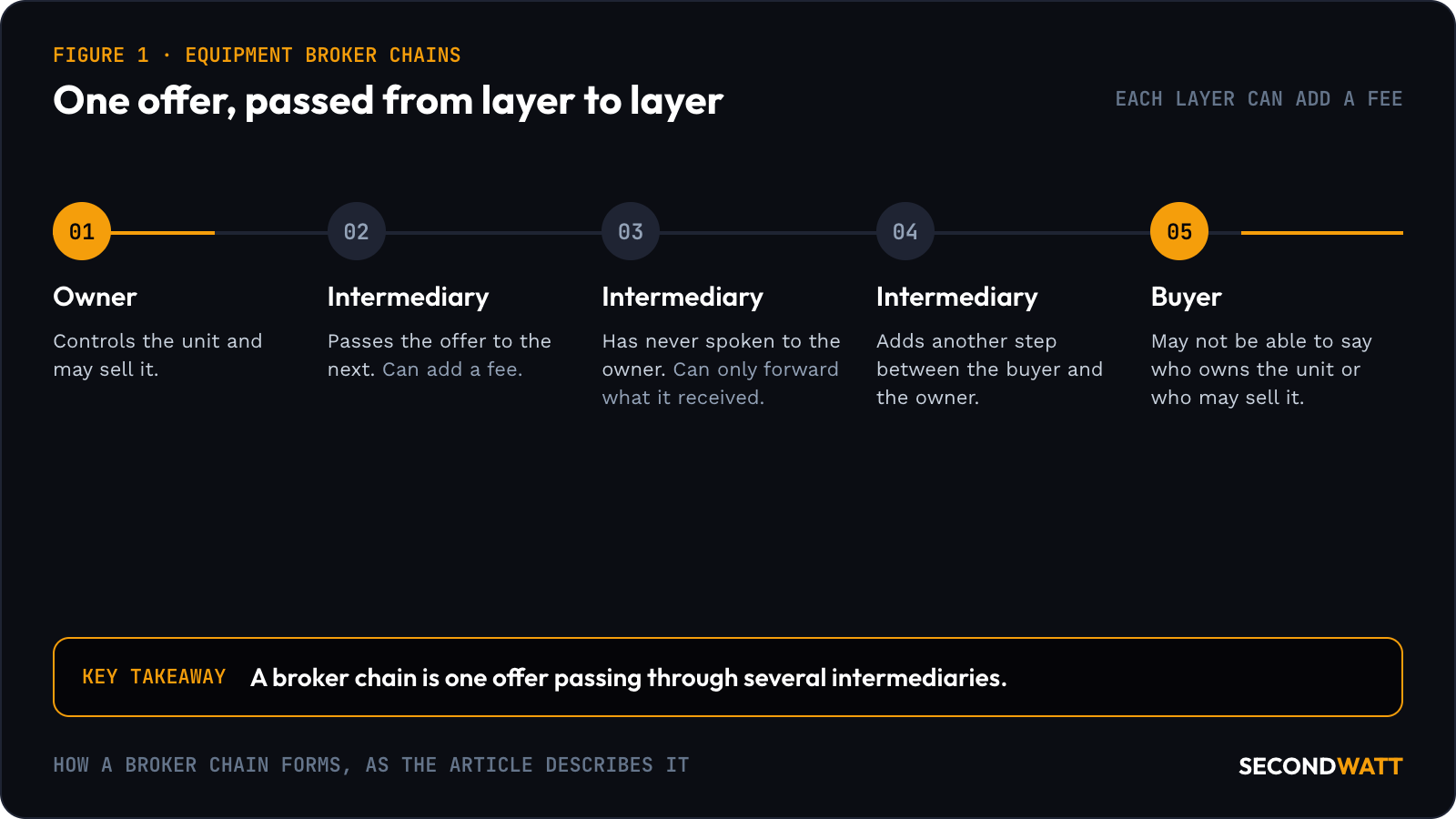
An equipment broker chain forms when one offer passes from the owner through several intermediaries before it reaches a buyer. Each layer can add a fee and another step between the buyer and whoever controls the unit. By the time it arrives, nobody may be able to say who owns the unit, who may sell it, or what each layer expects to be paid.
The fix is to cut the chain down to the owner, the buyer, their authorized representatives and anyone each side has agreed to pay. Each link that stays should show who it is and what it is authorized to do, the test SecondWatt's How we work page sets for both sides.
Key Takeaways
- A broker chain is one offer passing through several intermediaries. Several authorized representatives may describe one unit; trouble starts when links are unauthorized, unnamed or stacked without either end knowing.
- Markups that price off the last layer compound. Five illustrative layers at 3% each raise a US$20 million price (2026 dollars) by about 15.9%; fees on the base add 15%.
- A claim repeated down a chain with no document stays unsupported. SecondWatt's evidence statuses call it "Reported" until something supports it, and stale or recycled documents pause an opportunity.
- Five of SecondWatt's pause conditions double as chain warning signs. They include the same unit at different prices, identifiers withheld indefinitely and a deposit requested outside the agreed escrow.
- Cutting a chain starts with naming every participant. Record each one's role and who expects to pay it, then confirm authority directly with the named owner or signatory.
What an equipment broker chain is#
Cornell Law School's Legal Information Institute defines a broker as a person or entity that arranges contracts and acts as an intermediary between a buyer and seller for a commission. The same entry describes a broker as an independent party to a transaction, distinct from an agent who acts on behalf of a principal. Brokers usually specialize in a particular type of asset or contract, according to the Vernimmen finance glossary.
A chain is several of these roles in a row, each passing the offer to the next. SecondWatt's How we work page puts the problem plainly: "The secondary power market is full of forwarded offers, borrowed listings and requests that go nowhere." The page names the pattern "Long broker chains": "Offers passed through people who have never spoken to the owner."
Not every intermediary is a problem. As SecondWatt's guide to working with multiple equipment opportunities puts it, "Several authorized representatives may legitimately describe the same equipment." The trouble starts when representatives are unauthorized, unnamed, or stacked one behind another without either end knowing.
Buyer-side chains form the same way, one requirement passed from contact to contact. SecondWatt's Representing a buyer page asks a buyer's representative to describe "the intermediary chain" and "who expects to compensate you".
How each layer adds to the price#
"Many of the offers we see have passed along a chain of brokers, each adding 1 to 3 percent. Information gets taken, people get gone around, and both sides end up refusing to share what the other needs, because they expect another waste of time: sellers claiming rights to equipment they can't sell, and representatives without real clients," says Gary W. Martin, founder and CEO of SecondWatt.
That range is his observation from the offers SecondWatt receives. It is not a market survey, and it says nothing about what SecondWatt charges.
A commission is often calculated as a percentage of the total transaction, the Legal Information Institute notes. In a chain, the question is which total. If each layer adds its percentage to the price it received, the markups compound. If every layer takes a fee on the owner's base price, the fees add.
The illustration below uses Gary's 1 to 3 percent range on a US$20 million equipment-only price in 2026 dollars. Compounding multiplies by (1 + markup) once per layer: five layers at 3% give 1.03^5, about 1.159274, an increase of about 15.93%. Fees on the base add instead: 5 × 3% = 15%.
Illustrative price increase from intermediary layers on a US$20 million equipment-only base, 2026 dollars (SecondWatt arithmetic, not market data)#
| Layers between owner and buyer | 1% per layer, compounding (increase · US$ added) | 2% per layer, compounding (increase · US$ added) | 3% per layer, compounding (increase · US$ added) | 3% per layer as fees on the base, additive (increase · US$ added) |
|---|---|---|---|---|
| 2 | 2.01% · 402,000 | 4.04% · 808,000 | 6.09% · 1,218,000 | 6.00% · 1,200,000 |
| 3 | 3.03% · 606,020 | 6.12% · 1,224,160 | 9.27% · 1,854,540 | 9.00% · 1,800,000 |
| 4 | 4.06% · 812,080 | 8.24% · 1,648,643 | 12.55% · 2,510,176 | 12.00% · 2,400,000 |
| 5 | 5.10% · 1,020,201 | 10.41% · 2,081,616 | 15.93% · 3,185,481 | 15.00% · 3,000,000 |
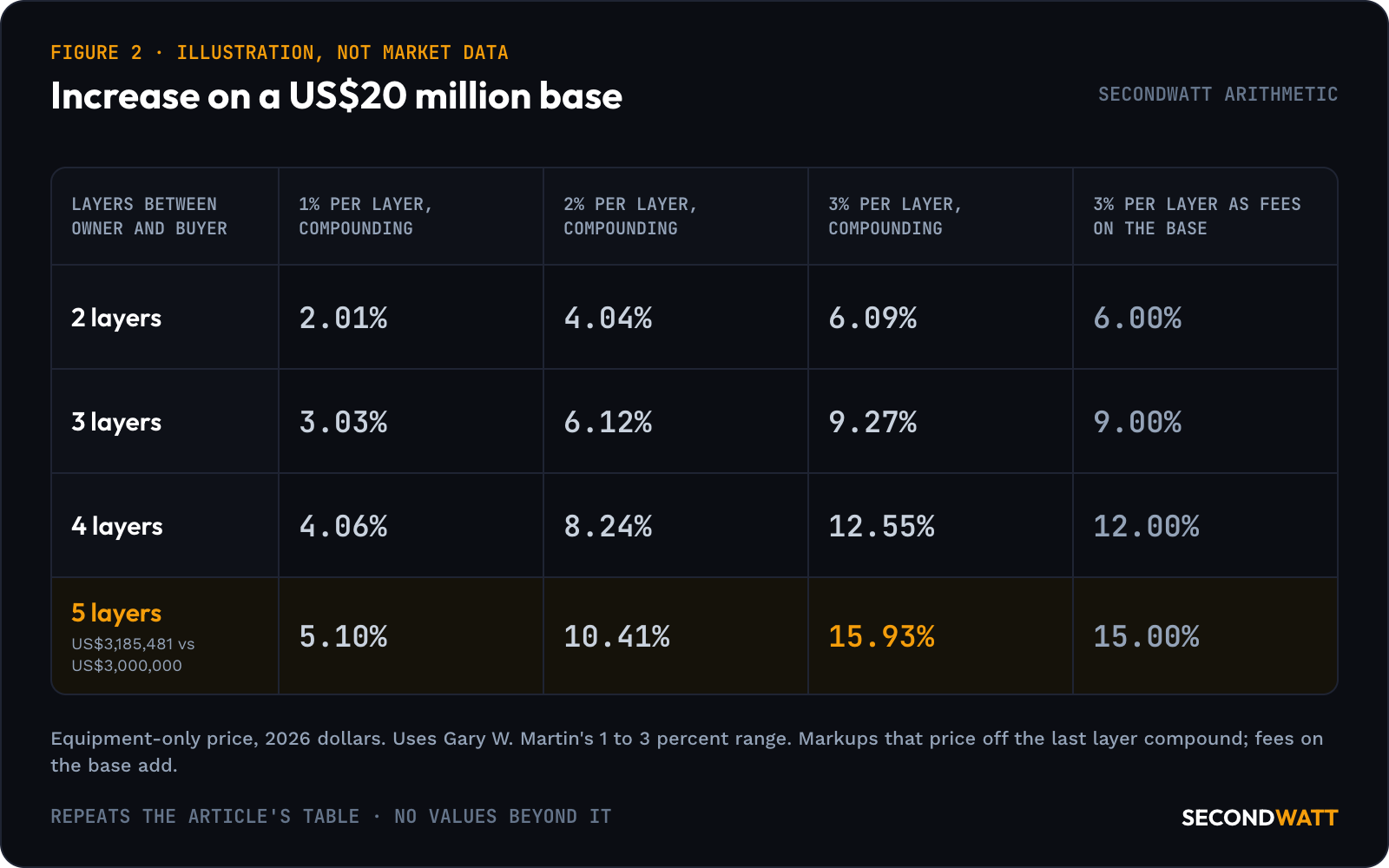
The gap between compounding and adding grows with each layer. At five layers and 3%, compounding adds US$185,481 (2026 dollars) more than fees on the base. Either way, the increase sits in the price before anyone has inspected the equipment.
The base here is the equipment alone. Freight, installation and commissioning sit on top, and the used gas turbine cost guide shows how scope changes what an offer price covers. How we work calls one version of this "Mark it up and blast it out": "One offer re-priced and sent to every buyer on a list."
Information lost along the chain#
A layer that has never spoken to the owner can only forward what it received.
SecondWatt's How we work page gives every item in a Transaction Readiness Summary one of four statuses: Directly confirmed, Document reviewed, Reported or Pending. A "Reported" item is one where "The information has been stated but is not yet adequately supported." A "Document reviewed" item means a document was received and reviewed, which "does not by itself independently establish its contents". On those definitions, a claim repeated down a chain with no document behind it is Reported until something supports it.
One of the page's pause conditions is an information failure: "Documents are stale, inconsistent or recycled from another opportunity."
A gas turbine condition label such as zero-hour or overhauled is a claim about work done and records kept, as the gas turbine condition labels guide explains. Repeated three layers from the owner, a label is only as good as the records that travel with it.
Circumvention and taken information#
Being "gone around", in Gary's words, means one side reaches the other direct and leaves the intermediary out. A seller's intermediary who reveals the owner's name or the unit's serial number takes that risk. So does a buyer's representative who names the client, which gives both sides a reason to hold back names and identifiers.
That defense starves the deal. A buyer cannot assess a unit without its identifiers and records.
Written terms are one answer. In SecondWatt's standard buyer-side process, the representative's firm or the applicable contracting party "signs the Buyer Confidentiality and Non-Circumvention Agreement". It then "registers each buyer and project before SecondWatt identifies a source".
Recipients are also asked to respect limits: "no unauthorized forwarding, advertising, use for another buyer or reuse for another project." How we work adds, "We document introduced relationships and respect the protections in the applicable agreements." Under SecondWatt's disclosure record, each release of a serial number, nameplate photo or exact location "is recorded with the recipient, the date and the purpose".
The authority problem on both sides#
The Legal Information Institute defines an agent as a person authorized to act on behalf of another person, the principal. At every link in a chain, the question is whose agent each party is, and what it may do.
How we work names the failure on each side. On the seller side it is the listing with nobody behind it: "'Exclusive' units with no owner, no records and no authority to sell." On the buyer side it is "A buyer's name used without their knowledge or mandate." Gary describes the same two problems: sellers claiming rights to equipment they can't sell, and representatives without real clients.
The result is a deadlock, with each side waiting for the other to show who it is first. SecondWatt's answer is the access rule its How we work page calls "Both sides earn access":
"A buyer earns access to sensitive equipment details. A source earns access to the buyer. Neither is released until the other side has shown who it is and what it is authorized to do."
Two rules under "What pauses an opportunity" set the standard. "Authority that can't be confirmed isn't established. Authority counts when it is confirmed directly with the named owner or signatory." And "A confirmed company is not yet a funded buyer. Inspections, document pulls and taking equipment off the market wait for funding evidence in proportion to the commitment."
Warning signs of a long chain#
Besides stale documents, the five other pause conditions on SecondWatt's How we work page fit a long or unsound chain. FTC and FBI fraud reports add the payment side.
Warning signs from the pause list on SecondWatt's How we work page#
| Warning sign | The page's wording |
|---|---|
| The same unit is offered at several prices or locations | "Several parties offer the same unit at different prices or locations." |
| Identifiers, nameplate photos or location kept back with no end date | "Identifiers, nameplate photos or location are withheld indefinitely." |
| Pressure for the buyer's identity, funding evidence or an LOI from someone who has not shown authority | "Someone presses for a buyer's identity, funding evidence or an LOI before showing their own authority." |
| Neither owner nor authorized source is named after confidentiality is in place | "An owner or authorized source still isn't identified once confidentiality is in place." |
| A deposit outside the agreed escrow, or late changes to payment details | "A deposit is requested outside the agreed escrow, or payment details change late." |
The first row can mean the same unit has reached the buyer through more than one chain, each with its own markup.
A September 2026 FTC consumer alert describes scammers posing as farm equipment businesses who send a purchase agreement and invoice. They typically ask for thousands of dollars, usually by wire transfer, as a deposit or full payment. The delivery never comes.
The FBI's IC3 2025 Annual Report defines non-delivery fraud as payment sent for goods or services that are never received, or are of less quality. The report counts it in one category with non-payment.
$503,373,587 — non-payment and non-delivery losses reported to the FBI's IC3 in 2025, from 56,478 complaints.
Payment fraud raises the stakes. The same report describes business email compromise as targeting businesses or individuals working with suppliers and/or businesses that regularly perform wire transfer payments. Fraudsters compromise email accounts and other communications to make unauthorized transfers of funds.
$3,046,598,558 — business email compromise losses reported to the FBI's IC3 in 2025, from 24,768 complaints.
How to cut a chain down#
To cut out the middleman, keep only the links that can be named and confirmed. These steps leave a chain in which every link is known:
- Identify every participant between the buyer and the equipment, with its role and who expects to pay it.
- Confirm authority directly with the named owner or signatory, and confirm a buyer's representative with the buyer.
- Ask for funding evidence in proportion to the commitment being considered, and offer the same.
- Register relationships under a written confidentiality and non-circumvention agreement before names are exchanged.
- Share information only with named recipients, for an agreed purpose.
- Pay through independent escrow with written disbursement instructions, to the account the transaction documents name.
Several of these steps match "What we do instead" lines on How we work. For long broker chains, "Every participant between the buyer and the equipment is identified, with their role and who expects to pay them." For re-priced offers, "Information goes to named recipients, for an agreed purpose, on the price basis the source approved." For listings, "Authority to offer is checked with the source, and open items are named before anyone commits."
For representatives, "We record what each representative is engaged to do, and confirm it with the client." The sourcing partner page asks each opportunity to show "the material intermediaries, who expects to compensate them, the approved price basis and any disclosure restrictions."
On payment, How we work says, "We do not hold deposits or purchase funds," and "Payments follow the transaction documents, and independent escrow with written disbursement instructions is our default." Under "Money and wire controls", "Payments go to the account the transaction documents name, not to an intermediary."
At a controlled introduction, "Each side receives a dated Transaction Readiness Summary of the checks completed and the items still open." The page sets its limit: the summary "is not a guarantee of title, condition, funding, performance or closing." The guide to how SecondWatt works covers the routes and who pays on each.
FAQ: equipment broker chains#
Are equipment brokers a problem in themselves?#
No. A named representative with confirmed authority is a legitimate link. SecondWatt's sourcing partner page says, "We do not need to remove a legitimate representative to establish the principal's role." Owners comparing channels can see how intermediaries fit in the guide to selling surplus equipment.
Who pays the intermediaries in a chain?#
The buyer pays any markup built into the price it receives. A fee on the base comes from whichever party agreed to pay it. The Legal Information Institute also notes that commission-based transactions may create conflicts of interest. On SecondWatt's own process, "Compensation from both a source and the buyer on the same transaction requires the buyer's written agreement."
Is a broker chain the same as a daisy chain?#
No. In the oil trade, the Vernimmen glossary defines a daisy chain as "a series of back-to-back transactions where the same oil cargo is re-sold several times within a short period". In a broker chain, the offer is forwarded from layer to layer. In electronics, the Cambridge Dictionary defines a daisy chain as "a number of electronic devices that are connected in series".
How can a buyer tell whether a seller has the right to sell?#
Ask who owns the unit, what the seller's role is and what document gives it authority. SecondWatt's sourcing partner page asks sellers' representatives for "the owner or authorized principal, your role, supporting authority and a practical way to confirm it". A direct conversation with an owner "does not by itself authorize you to offer or commit the equipment", as SecondWatt's guide to working with multiple equipment opportunities notes. The gas turbine RFQ checklist lists the condition records to request.
What is a finder's fee?#
The Legal Information Institute defines a finder's fee as a commission paid to a person who identified, brought to the attention of, or facilitated a business transaction between interested parties. The buyer, the seller or both may pay it, depending on the transaction or the agreement. Its payment terms are commonly set by agreement between the finder and the party that pays.
Starting from the requirement#
SecondWatt publishes equipment research and helps buyers source power equipment; it earns a fee when a sale it arranges closes. If you are buying, send a request that states the equipment, scope and timing you need. If you own equipment or represent an owner, bring the opportunity to SecondWatt with its authority and records.