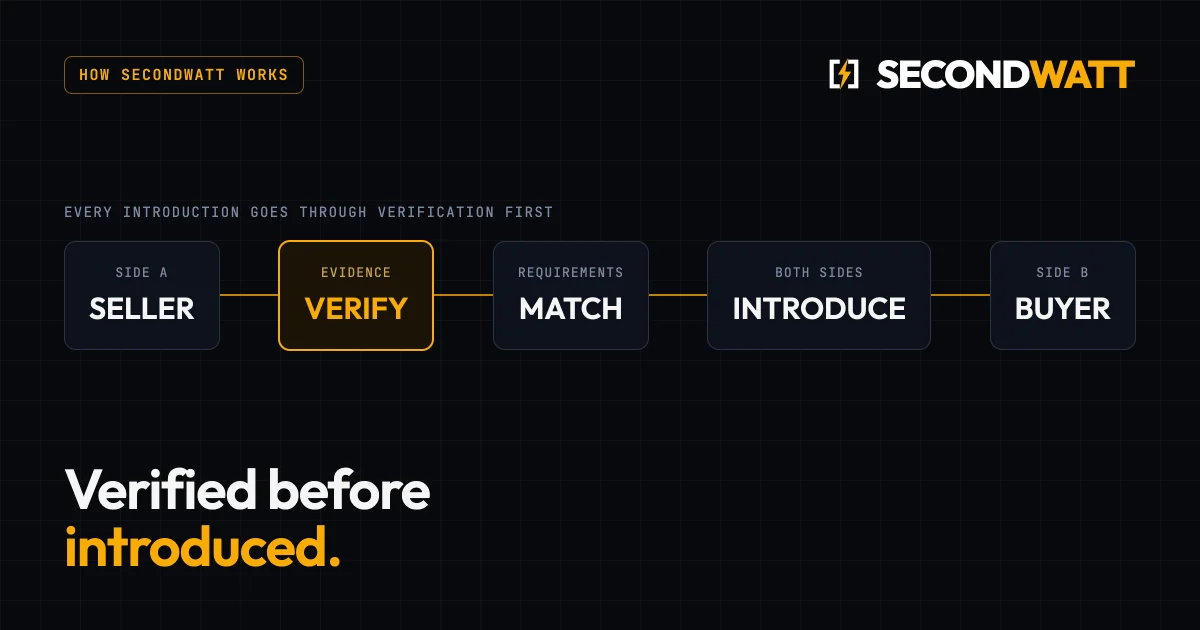
SecondWatt is a power intelligence and equipment procurement platform for data center power. It publishes model-level research, and it runs a private sourcing service that turns a requirement into a documented conversation about specific units.
The service runs the same way for every counterparty. A requirement or an offer comes in, the parties and the equipment are checked, and every claim is labelled for what it is. The buyer and the source meet in a controlled introduction that SecondWatt attends, and SecondWatt coordinates the open items through closing. How it is paid is explained before any introduction, and on most introductions the seller side pays.
If a unit doesn't fit, SecondWatt says so early, and the same goes for the service itself. It fits when the site needs power sooner than a new unit can arrive, the unit will run a duty the secondary market serves, and the buyer intends to own the asset.
When those three do not line up, one of four other routes is the better call: buy new or pre-owned from the OEM, rent or bridge, or wait for the grid.
The first half of this page explains how SecondWatt works and who pays it. The second half gives the published facts behind each alternative, dated, so you can place your own case.
Key Takeaways
- Two routes, one disclosed fee. On a standard introduction SecondWatt coordinates between the parties and the seller side pays; a buyer who wants an agent signs a separate procurement engagement.
- Every claim is labelled before an introduction. Directly confirmed, document reviewed, reported or pending, in a dated Transaction Readiness Summary that each side receives before the meeting.
- Sellers and partners sign first and stay private. Authority on each lot, records, availability refreshed every 14 days; identities shared only when an introduction is agreed; nothing submitted is published.
- SecondWatt stays in the deal. It attends every introduction meeting it arranges, sends a written recap, holds no deposits or purchase funds, and coordinates the open items through closing.
- Three facts choose the route. Months to energization, the duty and who carries the asset; OEM slots run to 2028 and beyond, rental buys months, queues run years.
How SecondWatt works, step by step#
An introductory conversation needs no account and carries no fee. Before it, SecondWatt sends the How we work pages, specific to your role, and asks for brief written answers to five questions. The meeting itself is then spent on the requirement or the equipment.
5 questions — answered in writing before a first meeting: your company and role, the capacity you act in, the requirement or equipment and its timing, who else is involved and what you are authorized to do, and what can be shared now.
From there every opportunity moves through the same five stages, in the same order. Each stage permits only certain actions. Identities, documents and funds are what the sequence protects; the conversation itself can start at once.
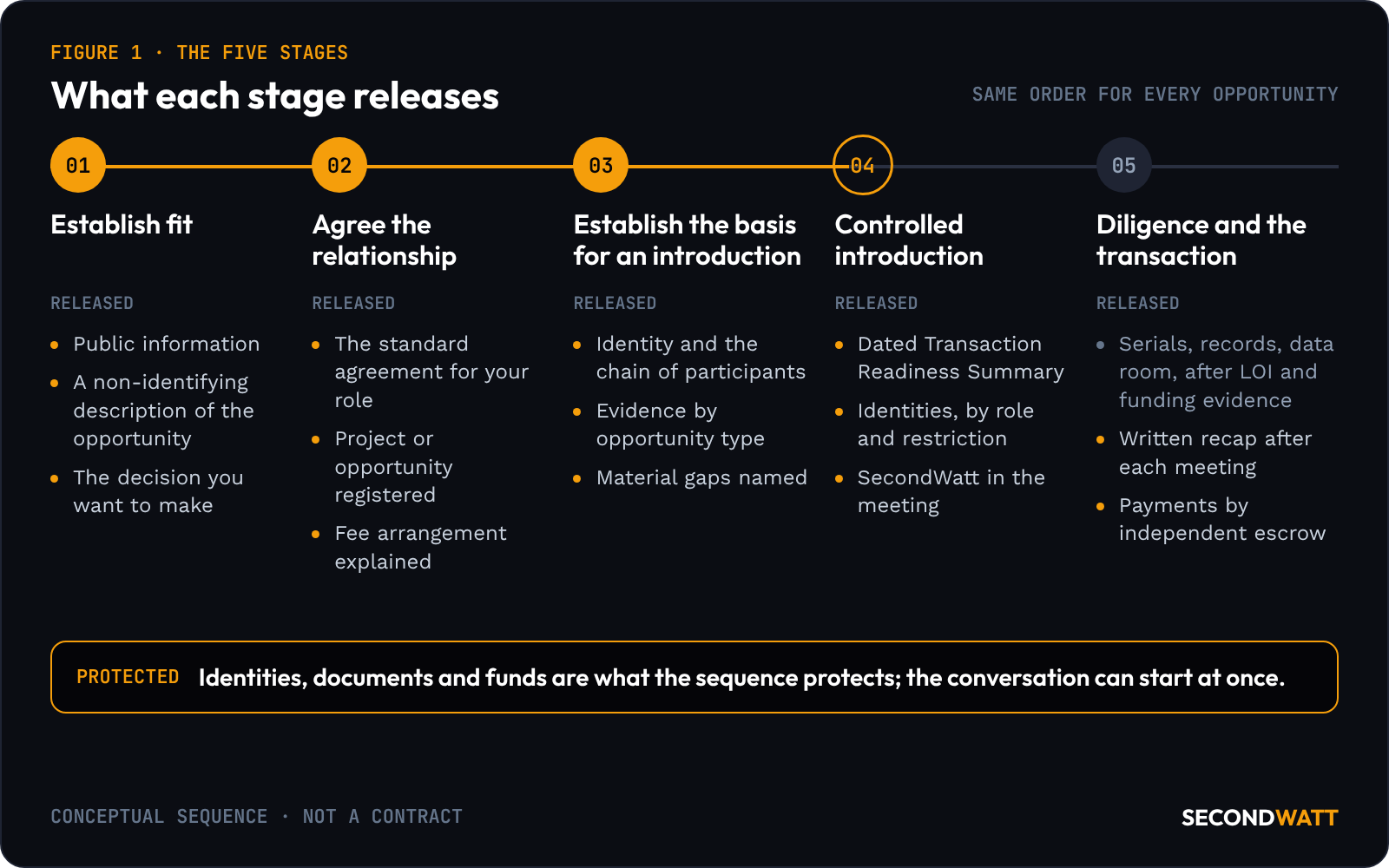
How an opportunity progresses, from first conversation to closing#
| Stage | What happens | What you receive |
|---|---|---|
| 1. Establish fit | Your role, the requirement or supply, and the decision you want to make. Public information and a non-identifying description of the opportunity are enough | A defined next step and the information request that goes with it, with the reason for each item |
| 2. Agree the relationship | The standard agreement for your role: confidentiality established, the project or opportunity registered, the parties' roles and commercial arrangements addressed | The applicable agreement, and the fee arrangement explained before any introduction |
| 3. Establish the basis for an introduction | Identity, the route to the buyer or the source, and the evidence the opportunity type needs. Every participant between the buyer and the equipment is identified, with its role and who expects to compensate it | Material gaps named before either side commits more time or information |
| 4. Controlled introduction | The parties are introduced once the requirements and permissions are in place. Information is shared according to each recipient's role and the agreed restrictions | A dated Transaction Readiness Summary of the checks completed and the items still open. SecondWatt attends the meeting |
| 5. Diligence and the transaction | Your appointed advisers handle technical review, inspection, title, funding and the transaction documents. Access to serials, records and the data room follows the source's requirements, which commonly means an LOI and funding evidence | A written recap after each meeting, and coordination of the open items through closing |
For a buyer, stage 1 means writing the requirement in the terms a supplier can quote against. That is net output at a stated point, frequency, voltage, rating type and duty; the site, delivery and commissioning dates; the budget basis, the purchasing entity and the funding route. The gas turbine RFQ checklist is the long form of that conversation.
Early-stage projects are welcome. Their status sets the level of sourcing effort and the next evidence request, and funding evidence is requested in proportion to the commitment under consideration. Sensitive confirmations can follow an agreed process rather than general circulation of account records.
Pricing for specific equipment comes from its seller. It is shown to a buyer only on the basis the seller has approved, dated and attributed.
Who SecondWatt works for, and who pays it#
Two routes exist, and the agreement you sign tells you which one you are on.
The two routes: what is signed, who SecondWatt works for, who pays#
| Standard introduction | Procurement engagement | |
|---|---|---|
| Who signs what | The buyer or buyer-side lead signs the Buyer Confidentiality and Non-Circumvention Agreement and registers the buyer and project | The buyer signs a separate written engagement with scope and fee terms, agreed project by project |
| SecondWatt's role | Coordinates between the parties. A confidentiality agreement does not appoint SecondWatt as a procurement agent | Works for the buyer: agrees the requirement and target price, takes it to market, passes on every written offer as received, negotiates where invited |
| Who pays | The seller side, under a separate source-side agreement. The agreement creates no buyer fee | The buyer, on a fee per lot set in writing before any source is named: savings against an agreed equipment-only benchmark, with a minimum |
| Seller-side compensation | Explained before the introduction | Credited against the buyer's fee; all compensation disclosed in writing before the buyer commits |
| What the buyer controls | Its own diligence, contract and acceptance, with its advisers | Every term and every signature. SecondWatt never binds the buyer or commits its funds |
On the standard route, a buying organization signs for itself. A representative discloses its actual relationship and authority, and a separate client is never required to sign SecondWatt's paperwork. The agreement protects each introduced source for a defined period and creates confidentiality obligations both ways.
Under an engagement, SecondWatt requests pricing in the buyer's name only with approval, coordinates inspection, title and escrow through closing, and reports in writing every two weeks while the engagement is active. The benchmark is a basis for the fee rather than a guarantee of savings.
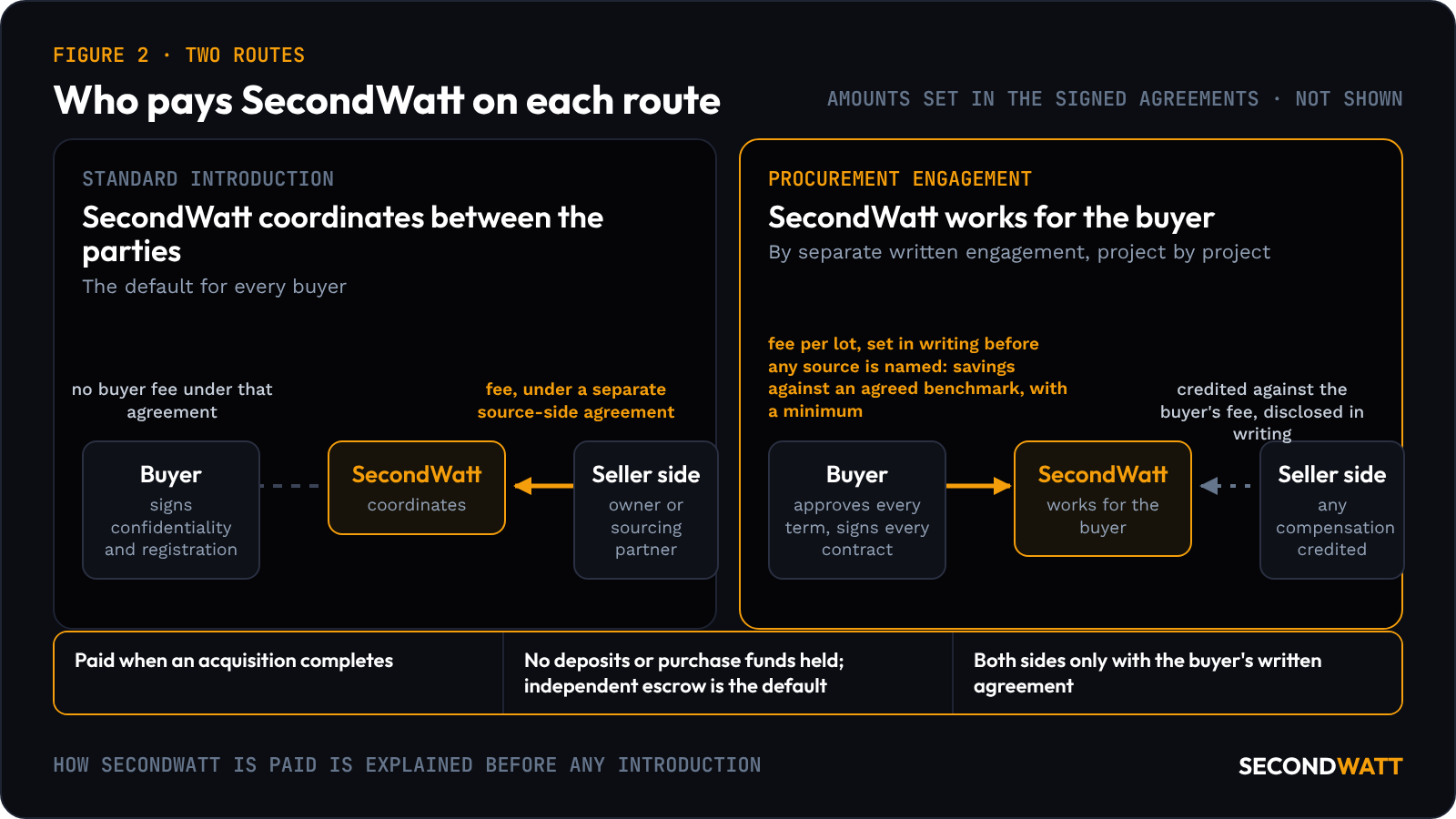
Three rules hold on both routes. SecondWatt is paid when an acquisition completes, under the signed agreements, and the fact that it earns a fee on close is stated at the foot of this article. Compensation from both a source and the buyer on the same transaction requires the buyer's written agreement.
SecondWatt holds no deposits or purchase funds. Payments follow the transaction documents, independent escrow with written disbursement instructions is the default, and wire instructions are confirmed by a call-back on contact details already on file.
What sellers and sourcing partners sign, and what they get back#
Equipment reaches a buyer through owners, dealers, packagers, refurbishers and professionals who work with sellers. The first thing SecondWatt records for each of them is role: whether they own the equipment, hold selling authority or an allocation, have authorized access, or can introduce the principal. Technical experience is valuable and is recorded separately from authority to offer a specific asset.
The sourcing network includes former GE and Mitsubishi Power executives with experience building power plants around the world. Collectively, these partners have helped deliver more than 500 turbine installations over their careers. That experience shows in the questions they ask of an offer before it reaches a buyer.
Each opportunity carries its own evidence, and the evidence differs by what is being offered.
Evidence by opportunity type, before a unit can be matched to a requirement#
| Opportunity | Evidence recorded |
|---|---|
| Existing equipment | Configuration, identifiers where available, location, condition basis, scope and dated availability |
| Production or refurbishment allocation | Issuer or packager, contract holder, program reference, schedule and assignment conditions. A rebuild slot identifies the engine or core being rebuilt; serial numbers are expected only once a production slot has been assigned |
| Seller representation | The owner or authorized principal, the representative's role, the supporting authority and a practical way to confirm it. A conversation with an owner is useful; authority to offer comes from the owner's written mandate |
| Every opportunity | The material intermediaries, who expects to compensate them, the approved price basis and any disclosure restrictions |
The sourcing agreement is signed and the opportunity and fee arrangement registered before any identifying introduction. A buyer requirement is presented anonymously first; the partner accepts it; the agreed introduction process follows, with SecondWatt in the meeting. Confirmation with an owner or packager is arranged with the partner involved, and a legitimate representative keeps its place in the chain.
What SecondWatt holds, it holds privately: the company, signatories and agreement terms; each unit's model, identifiers, ratings, hours and starts, location, condition basis and photographs; authority documents and the participants in each opportunity; dated pricing and availability. Identifiers and owner identities are disclosed only as the agreements and the partner's permissions allow. Pricing is shared only on the basis approved, and fee terms stay between SecondWatt and the partner. Submitting equipment creates no public listing.
14 days — the longest an availability statement stands before SecondWatt asks the partner to refresh it, with a fresh confirmation before any presentation or commitment.
When the same equipment arrives through two routes, the identifiers and authority are reconciled before it advances. Several authorized representatives may legitimately describe the same unit; conflicting ownership or price claims are resolved first.
Sellers get the same protection buyers do, in the other direction. Before an introduction, the seller side receives its own Transaction Readiness Summary covering the buyer: the entity, the representative's capacity and relationship, the project's status, funding readiness in proportion to the commitment, and the chain of participants. Sellers lose as many hours to unqualified buyers as buyers lose to unauthorized offers, and the summary is how both sides get those hours back.
The public dossiers stay on the other side of that line. A page such as the LM6000 dossier describes a model and its published information; a particular machine's availability, suitability and offer basis are established separately, for that machine. Owners thinking about a sale can read documentation for a turbine sale first; firms that source for sellers can start at the sourcing partner page.
One accountable intermediary: four things you can check#
"Are you a broker?" is a fair question in a market where the same turbine reaches a buyer three ways: from the party with real authority, through a chain at a higher price, and as a slot that is not yet a machine.
SecondWatt's answer is that it is one accountable intermediary. It does not own the equipment and does not pass offers along a chain; it establishes who controls the equipment and who represents whom, and it stays involved through closing. Each part of that answer can be checked.
The first is the role in writing. On a standard introduction SecondWatt coordinates between the parties; under a procurement engagement it works for the buyer. Either way, how it is paid is explained before any introduction, and the applicable agreement says which it is.
The second is the chain. Every participant between the buyer and the equipment is identified, with its role and who expects to compensate it, before an introduction. Registering a name or forwarding an offer creates no fee entitlement by itself, and a direct conversation with an owner is different from authority to sell.
Both sides earn access. A buyer earns access to sensitive equipment details, and a source earns access to the buyer, once each has shown who it is and what it is authorized to do.
That is also why an opportunity pauses. It pauses when an owner is still unidentified once confidentiality is in place, when several parties offer the same unit at different prices or locations, or when identifiers or location are withheld indefinitely.
It also pauses when documents are stale or recycled from another opportunity, when someone presses for a buyer's identity or an LOI before showing their own authority, or when a deposit is requested outside the agreed escrow. SecondWatt says what is needed to reconsider it.
The third is how claims are labelled. The Transaction Readiness Summary records every check at one of four levels, and the level is the one the evidence has reached.
How SecondWatt labels evidence in a Transaction Readiness Summary#
| Status | What it means |
|---|---|
| Directly confirmed | SecondWatt checked a specific fact with the relevant party through an authenticated channel. The summary identifies the source and the date |
| Document reviewed | A document was received and reviewed. That by itself does not independently establish its contents |
| Reported | The information has been stated and is not yet adequately supported |
| Pending | Evidence needed for the next step has not yet been obtained |
A confirmation from the party making a claim is different from an independent professional assessment. The summary records the scope of the review, with the source and date of each confirmation; it is not a guarantee of title, condition, funding, performance or closing.
The fourth is continuity. SecondWatt attends every introduction meeting it arranges, sends a written recap afterwards, and coordinates the open items through closing, with one person at SecondWatt accountable for each opportunity and its next step. If a deal dies, the requirement keeps its record and goes back to matching under the same agreement. Every introduction is earned, and the process only feels slow to people who cannot show what they claim.
Go to the OEM, new or pre-owned, when the warranty counterparty matters#
New equipment comes with the maker's warranty, the maker's commissioning and a service agreement written for that unit. The cost of that certainty is the slot. OEMs publish their backlogs at company level, so the table below records what each has said and when.
116 GW — GE Vernova's gas equipment backlog and slot reservations at the end of June 2026, up from 100 GW a quarter earlier, with at least 125 GW under contract expected by year-end 2026.
GE Vernova's second-quarter 2026 results (22 July 2026) also set production at 20 GW of annual gas turbine output in the third quarter of 2026, 24 GW in 2028 and 30 GW in 2030. The release reports one figure for heavy-duty frames and aeroderivatives together; the LM6000 and LM2500 get no separate slot statement.
In December 2025 its chief executive told investors he expected reservations to be sold out through 2030 by the end of 2026, and the company said new reservations were pricing above current orders.
Siemens Energy's chief financial officer put lead times across the company at three years or more (reported 10 August 2026), against a 69 GW gas services backlog.
Gensets are no looser. Cummins' second-quarter release (4 August 2026) schedules deliveries under one data center agreement from 2026 through 2030, and its chief financial officer said the company is selling new power generation equipment into the second half of 2028. Caterpillar will triple its large reciprocating engine capacity from 2024 levels between 2027 and 2029, against a backlog more than 3.5 times its January 2024 level (reported 1 May 2026).
The 2026 OEM backlog and the slot buyer's guide cover how slots are reserved and what a reservation binds.
Published new-unit backlog and lead-time statements by equipment class (OEM statements, dated)#
| Class | OEM statement | Date | Source |
|---|---|---|---|
| Heavy-duty and aeroderivative gas turbines, reported together | 116 GW backlog and slot reservations; at least 125 GW under contract by year-end 2026; output 20 GW a year in Q3 2026, 24 GW in 2028, 30 GW in 2030 | 22 July 2026 | GE Vernova results release |
| Large and medium gas turbines | 69 GW gas services backlog; lead times three years or more; 15 large-frame units added to about 35 in 2027; medium capacity to about 100 units by 2028 | 10 August 2026 | Siemens Energy CFO and earnings presentation, reported by Utility Dive |
| Data center gensets | Deliveries scheduled 2026 through 2030 under one hyperscaler agreement; selling new equipment into the second half of 2028; 2026 growth constrained by capacity for larger configurations | 4–5 August 2026 | Cummins Form 8-K and earnings call |
| Large reciprocating engines | Backlog more than 3.5 times January 2024; capacity to triple from 2024 levels, investment 2027–2029 | 1 May 2026 | Caterpillar CEO on the Q1 2026 call, reported by Manufacturing Dive |
Between new and the open used market sits equipment the OEM itself has taken back, serviced and warranted. Solar Turbines runs a pre-owned equipment offering covering used, unused, refurbished and low-hour power generation packages, compressor packages and mobile power units. The families listed are Centaur 40 and 50, Taurus 60 and 70, Mars 90 and 100, Titan 130 and Titan 250.
Solar's service uses Solar-approved parts, warranty re-instatement is included, and units carry a standard warranty with options for extended cover. The page gives no durations, so the term is a question for the quote.
GE Vernova's aeroderivative exchange programme supplies a new, refurbished or partial-life engine from pools GE Vernova owns, lists warranty as included without stating its terms, and performs the exchange on site in a two-to-three-day outage. An exchange assumes an engine to exchange, so it serves the owner of an existing package, including one bought used, who wants the engine itself under an OEM warranty.
The OEM route, new or pre-owned, suits a buyer whose committee wants the manufacturer as warranty counterparty, whose energization date sits beyond the horizons above or inside the OEM's refurbishment schedule, and whose capital plan tolerates a deposit that waits.
Rent or bridge when the gap is measured in months#
Bridge power for a data center is generation installed to carry the site between its energization date and the arrival of permanent power, under a contract that ends on a date. It buys months, and the exit has to be planned on the day the contract is signed.
Rental fleets publish their classes. Aggreko's data center offering runs from bridging the gap between a planned energization date and permanent grid availability to continuous prime power and phased capacity. Aggreko puts timing where it belongs: it depends on capacity, site readiness, permitting, fuel strategy and electrical integration.
Its 3 June 2026 release lists gas generators from 210 kW to 1,500 kW, Tier 4 Final diesel generators from 25 kW to 1,200 kW and battery systems up to 1 MW/1.2 MWh for North America. The release states no rating basis, so ask for the prime rating when the duty is bridge.
At turbine scale the mobile unit is the TM2500. GE Vernova rates the TM2500 DLE at 34.5 MW net at ISO conditions on natural gas, inlet and exhaust losses included; the specification table shows the 50 Hz selection, so confirm the 60 Hz figure for a US site.
The same page describes installation in approximately 14 days and calls the unit a baseload bridge to permanent power installations. Mobile gas turbines as bridge power covers how those units are contracted.
Rent or bridge suits a project whose permanent route is already running, whether a grid date or an OEM slot, and whose gap is counted in months. A rental with no permanent route behind it is a plant on a short lease.
Wait for the grid when the schedule allows it#
Waiting costs nothing in equipment and everything in schedule, so decide it with the queue data in front of you.
2,061 GW — generation and storage capacity actively seeking transmission interconnection in the United States at the end of 2025, per Lawrence Berkeley National Laboratory.
LBNL's Queued Up 2026 edition (1 July 2026) puts the time from interconnection request to commercial operation above five years in the regions with data, and the 2025 median at well over three years just to reach a signed interconnection agreement. Of capacity that requested interconnection between 2000 and 2020, 13% had come online by the end of 2025. Those are generator queues; they describe the supply a data center would be waiting for.
On the load side, ERCOT told its board on 1–2 June 2026 that it was tracking 438 GW of large load interconnection requests and that the vast majority had no studies submitted. About 3.9 GW was expected to energize in the fourth quarter of 2026, and the process was to move to batches from 10 July 2026. A request in a queue is a position; a date is something else.
Waiting fits when the utility has given a written energization date the project can carry, when the duty is standby only once the grid arrives, and when capital is better spent later. The interconnection roadmap sets out the study steps and what each asks of the project.
The three facts and the route table#
The first fact is schedule: the months between today and the date the site must be energized. Every route above has a published time to power, and the schedule either fits inside it or it does not.
The second is duty. A standby genset that runs 50 hours a year, a prime-rated block that carries the site until the grid arrives, and a continuous plant behind the meter are three different purchases. Rating type travels with the number: a 2,000 kW standby set and a 2,000 kW prime set are different machines, and the secondary market is deep in some duties and thin in others.
The third is capital: who carries the asset when the project is running. An owner buys and depreciates, and a lessee pays for use and hands the unit back. A rental customer pays for months. A project that can defer pays nothing yet.
An introduction fits when the date falls short of what new production can deliver, the duty is one the used fleet serves and the buyer intends to own. Move any one of those and another row wins. The first diligence step in each row is the one that proves or disproves the fit within a week.
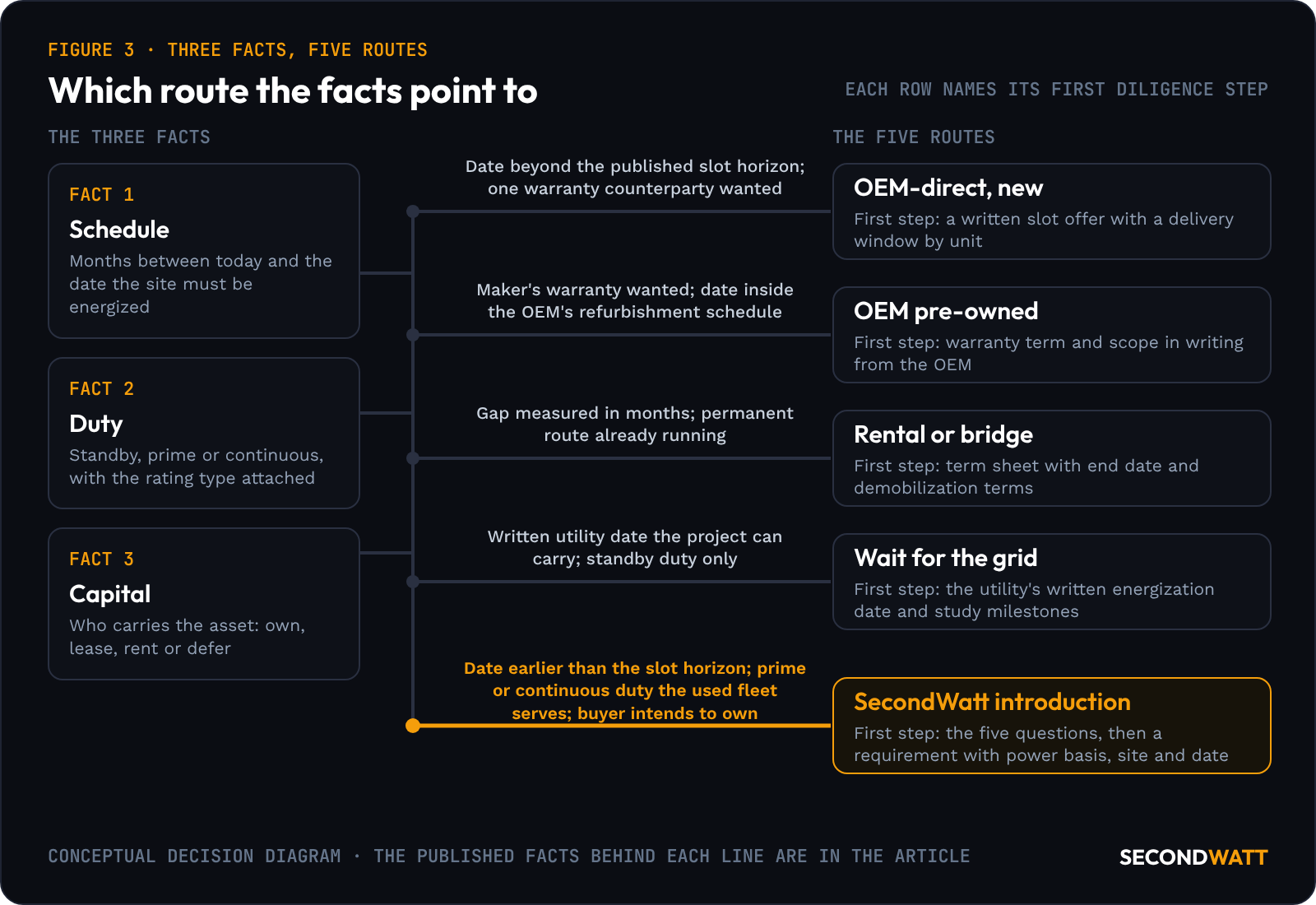
Five routes compared on fit, deciding facts, first diligence step and trade-off#
| Route | When it fits | What decides it | First diligence step | What you give up |
|---|---|---|---|---|
| OEM-direct, new | Energization date beyond the published slot horizon; one warranty counterparty wanted | Date against the OEM statements above; deposit tolerance | Written slot offer with a delivery window by unit | Years of schedule; capital parked in a deposit |
| OEM pre-owned | Used acceptable if the maker warrants it; date inside the OEM's refurbishment schedule | Who writes the warranty; whether the model family is on the programme | Warranty term and scope in writing from the OEM | Model choice limited to the programme's families |
| Rental or bridge | Gap measured in months; permanent route already running | Permanent-route date; fuel and permit for a temporary plant | Term sheet with end date and demobilization terms | The plant itself; nothing is owned at the end |
| Wait for the grid | Written utility date the project can carry; standby duty only | Queue position and study status | The utility's written energization date and study milestones | Schedule; exposure to queue reform |
| SecondWatt introduction | Energization date earlier than the slot horizon; prime or continuous duty the used fleet serves; buyer intends to own | Schedule, duty and ownership together | The five questions, then a requirement with power basis, site and date | The new-build warranty; model choice bounded by what the secondary market holds |
FAQ: choosing a route#
Can a project change route mid-way, for example from rental to a used unit?#
Yes, and the sequencing is the work. A rental contract has an end date and a demobilization clause; a used unit has a delivery, installation and commissioning window. The two must overlap by the commissioning period or the site goes dark between them. Write the hand-over date into both contracts before either is signed.
What if the unit is outside the United States?#
Supply from outside the United States is in scope, and the checks then cover the countries of origin, transit and destination as well as the parties, with export-control and customs review assigned before any commitment. Import documentation, tariff treatment, frequency (a 50 Hz package needs a documented conversion scope before it serves a 60 Hz site) and the emissions configuration for the destination state all enter the diligence file.
What if an OEM slot and a used unit are both available on the date?#
Compare them on the three facts, then on warranty counterparty and scope. The slot carries the maker's warranty and a delivery window the OEM controls. The used unit carries its records and the supplier's warranty, and it can be inspected before a deposit is paid. If the committee's requirement is the manufacturer's warranty, the slot wins on that fact alone; if it is a unit that can be inspected first, the used unit does.
What does a buyer see before signing anything?#
Public research and a non-identifying description of an opportunity: equipment type, size class and the basis of its availability. Serials, records, pricing on the seller's approved basis and the source's identity follow the agreement, the registration and the agreed introduction. The Transaction Readiness Summary you receive at that point says which items are confirmed and which are still open.
Who answers emissions and permitting questions on a used unit?#
The party supplying the unit. Its emissions configuration, test history and any prior permit conditions belong to the unit's owner and are documented by them; the air permit for the destination site is the buyer's own filing. Ask for the configuration and the last emissions test report with the first set of records.
Deciding your route#
SecondWatt publishes equipment research and helps buyers source power equipment; it earns a fee when a sale it arranges closes. If your date falls short of the OEM horizons above, the duty is one the used fleet serves and you intend to own the unit, send a request with the power basis, site and date. Owners with equipment to place can start at the sell page. If you placed yourself in another row, that is the right call, and the gas turbine category is there when the facts change.