
A proof of funds letter is a bank document recording an account's balances as of the day it is produced, as Capital One describes its own version. It answers one narrow question: did the buyer have the money then? It is not a payment, and it says nothing about the seller.
For a large power equipment purchase, the useful question is when to send proof of funds, and in what form. A seller earns funding evidence by first showing its own authority, and the evidence should grow with the commitment being considered. In SecondWatt's process, a buyer earns access to sensitive equipment details, and a source earns access to the buyer. SecondWatt's How We Work page says neither is released "until the other side has shown who it is and what it is authorized to do."
Key Takeaways
- A proof of funds letter is a dated record of balances. Capital One's version shows the available balance "as of today" and is not used to confirm payments.
- Funding evidence should grow with the commitment. SecondWatt requests it in proportion to the commitment being considered, and asks that no bank statements be sent in an initial inquiry.
- A buyer can narrow what one bank's balance document shows. At Capital One, customers choose the accounts and months included; the document still carries account and routing numbers.
- Pressing for funding evidence before showing authority is a pause signal. SecondWatt pauses when it happens; the FBI lists "proof of funds" among features of standby letter of credit scams.
- Check the bank behind the funds independently. A 2019 FBI IC3 alert says independent checks should cover a purchase's terms and every party, including the bank the funds come from.
What a proof of funds letter is#
The document goes by several names: the Capital One Help Center says the bank's version may also be called a proof of funds letter or an account balance letter. Customers generate it in online banking, or request it by phone, for 360 Checking, 360 Performance Savings and 360 CD accounts. Closed accounts, accounts not in good standing and Small Business Bank accounts are excluded.
Its contents show what the letter proves. The listed contents include the account owners, account and routing numbers, account type, open date, average daily balance and the available balance as of the day it is generated. That makes it a dated record of balances.
The document is not used for wire transfer or payment confirmations, transaction history or credit reports, among other exclusions Capital One lists. A seller holding the letter learns what the account held as of that day.
Who owns the equipment, who is authorized to sell it and how many intermediaries sit in between are left to the seller's own evidence.
Proof of funds, comfort letters and financing commitments#
Each funding document proves something different. The table compares four, each as a bank or bank regulator describes it.
Funding documents compared, from Capital One, Truist and Chase bank pages and the Rating Credit Risk booklet of the OCC Comptroller's Handbook (April 2001, updated 2017 and 2025)#
| Document | Issued by | What it shows | What it leaves open | Where the source places it |
|---|---|---|---|---|
| Proof of funds letter (Capital One's version) | The account holder's bank; Capital One customers generate it in online banking or request it by phone | Account owners, account and routing numbers, type, open date, average daily balance, available balance as of the day | Whether the balance stays; Capital One says it is not used for payment confirmations | Mortgage, rental and visa applications; "general proof of funds" |
| Preapproval letter | A lender (Truist) | An estimate of the amount a buyer could qualify for, based on credit, debt, employment history and income | Funding itself: a preapproval "isn't a guarantee to fund the loan" (Chase) | Early in a home purchase (Chase) |
| Commitment letter | A lender (Chase) | A commitment to provide a loan for a specific amount, conditional or final | The conditions still to be met, such as appraisal, insurance and clear title | After underwriting (Chase) |
| Comfort letter | Usually a domestic parent company (OCC) | Acknowledgment of a foreign subsidiary's debt | Enforceability: the OCC says comfort letters "are not legally binding" | "A common convention in international financing" (OCC) |
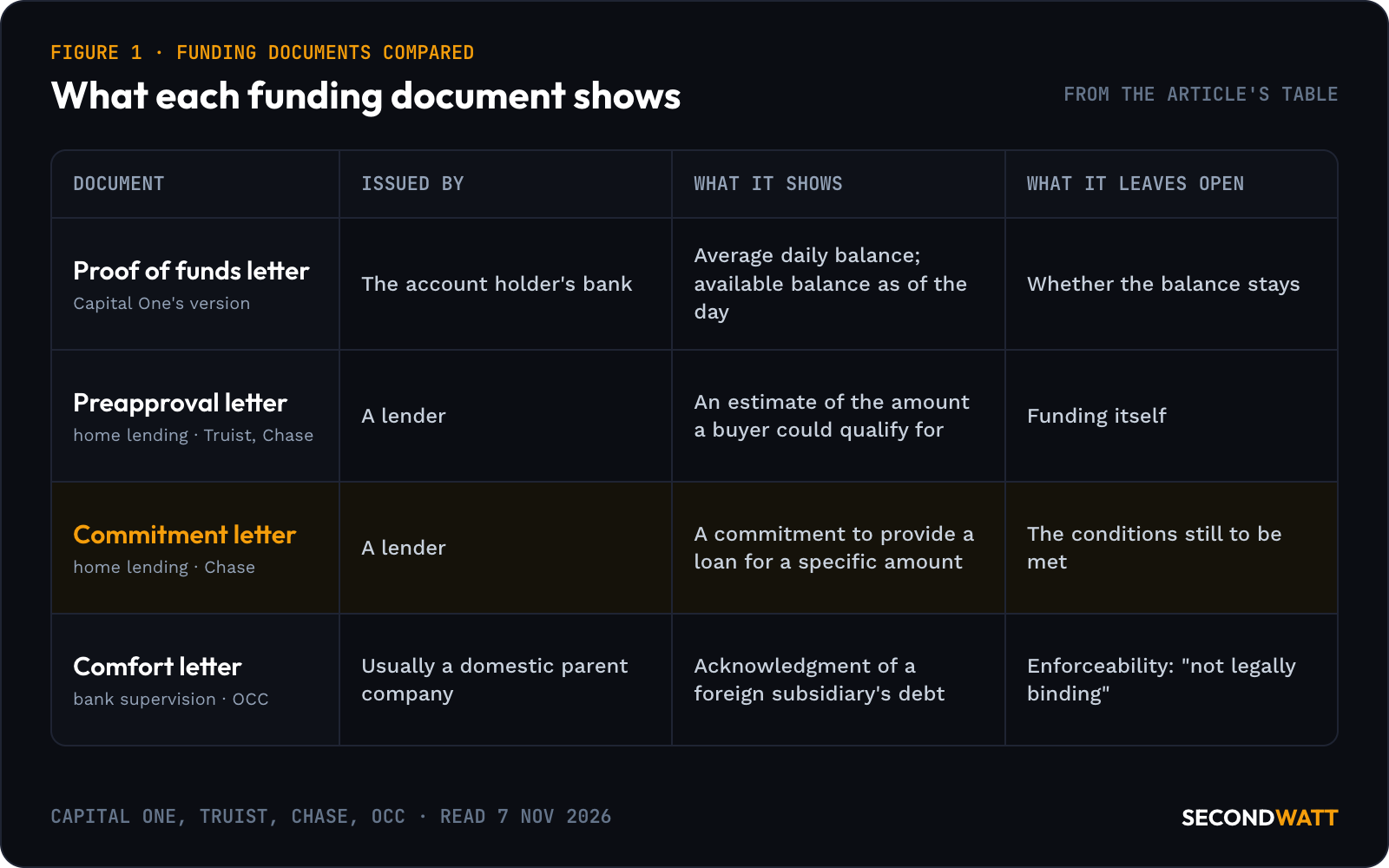
Both lender rows describe home loans, drawing on mortgage pages from Chase and Truist. Of the four, only the commitment letter commits a lender to a loan amount, and a conditional one still carries its conditions.
The comfort letter row comes from bank supervision. The OCC's Rating Credit Risk booklet says comfort letters "generally do not enhance a credit's rating", because they are not legally binding and some have not been honored.
30 to 60 days — how long a mortgage commitment letter typically remains valid, according to Chase, which adds that the exact period depends on the lender and the terms in the letter.
When sellers ask for funding evidence#
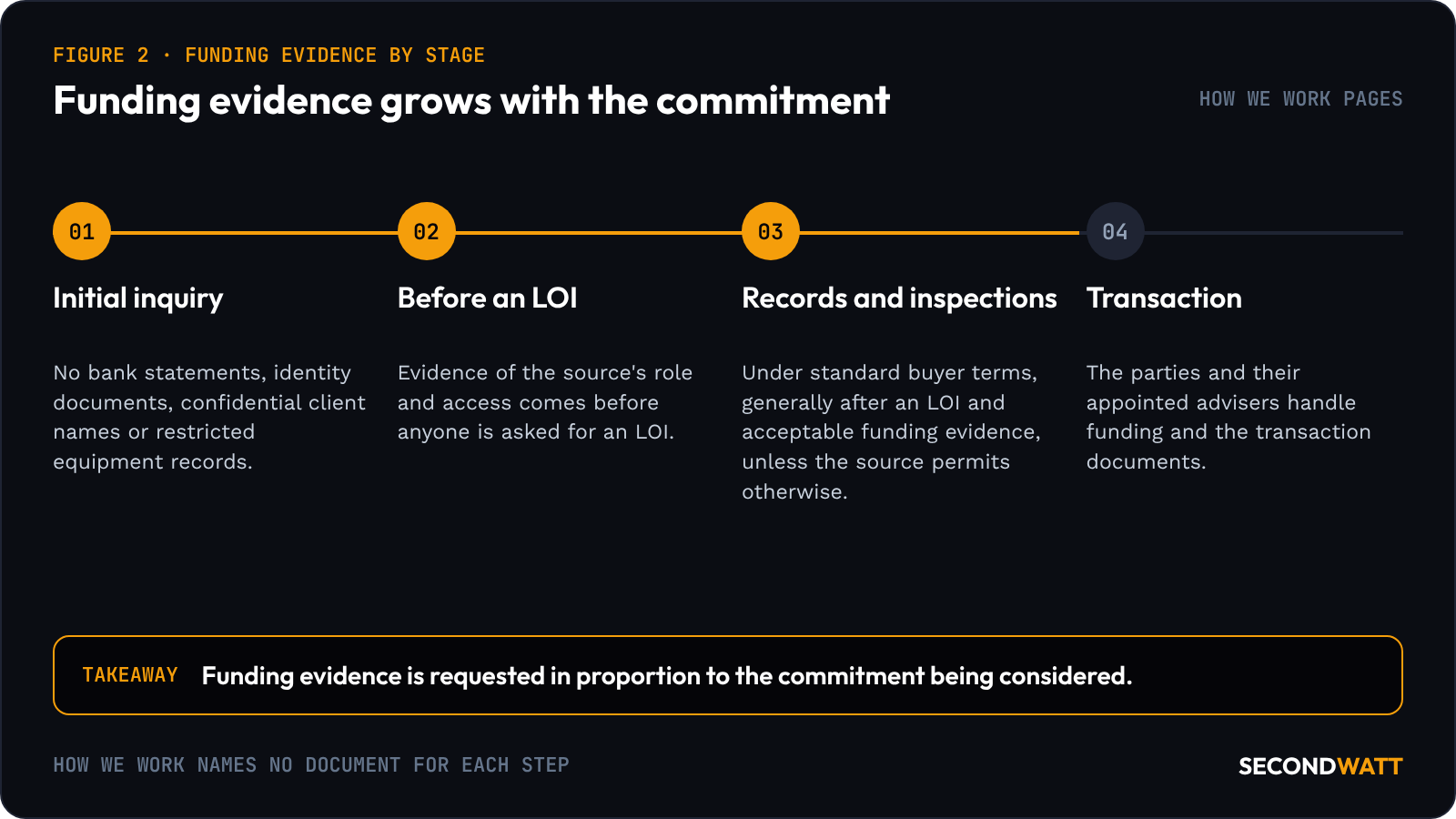
SecondWatt's process starts from the opposite of a day-one demand. "Bank statements on day one" is on its list of what it sees in the market. Its How We Work page states the alternative under "Why we work this way": "Funding evidence is requested in proportion to the commitment being considered."
Funding evidence is then tied to specific steps. Under "What pauses an opportunity", the page says: "A confirmed company is not yet a funded buyer. Inspections, document pulls and taking equipment off the market wait for funding evidence in proportion to the commitment." LOIs have a gate of their own, set out under "Fishing for LOIs". SecondWatt looks for evidence of the source's role and access before asking anyone for an LOI.
The How We Work page for buyers describes the usual order for sensitive records. Detailed records, serial numbers, inspections and data-room access follow the source's requirements. It adds: "Under our standard buyer terms, these generally follow an LOI and acceptable funding evidence unless the source permits otherwise."
How We Work names no document for each step. In home lending, Chase places the preapproval early in the process and the commitment letter after underwriting.
What a letter should contain#
Two published lists show what a POF letter can carry. The first comes from IRCC's proof of funds rules, Canada's immigration rules for Express Entry applicants who must show settlement funds.
Applicants need official letters from each bank or financial institution where they hold an account, printed on the institution's letterhead. Each letter must include:
- the institution's contact information: address, telephone number and email address;
- the applicant's name;
- outstanding debts, such as credit card debts and loans;
- for each current banking and investment account: the account number, the date it was opened, the current balance and the average balance for the past six months.
The funds must also be available both when the applicant applies and when a permanent resident visa is issued, if the application is approved. A letter dated at application speaks for that date. An equipment seller faces the same gap between a letter's date and a closing date.
The second list, for Capital One's self-generated document, shares the account numbers, open dates and balances, adds the routing number and includes no bank contact details.
Sharing it with the least exposure#
Bank statements stay out of a first contact. Under "Before we meet", SecondWatt's How We Work page says: "Please do not send bank statements, identity documents, confidential client names or restricted equipment records in an initial inquiry." The page for buyers covers diligence and the purchase decision: "Sensitive confirmations can follow an agreed process rather than general circulation of account records."
Capital One's tool allows a narrower document. Customers select which accounts appear and choose 3, 6, 12, 18 or 24 months of activity, or a custom range within two years. A buyer can match that scope to the request in front of it. The document still prints account and routing numbers, so each copy carries those details.
Recipients matter as much as contents. SecondWatt does not publish confidential buyer identities, source identities, unit records or commercial terms without permission. Under "Your information and relationships", it asks recipients "to respect the same limits: no unauthorized forwarding, advertising, use for another buyer or reuse for another project."
SecondWatt's own records have stated limits. A Transaction Readiness Summary records the scope of the review; it "is not a guarantee of title, condition, funding, performance or closing." In the fifth stage, Coordinate diligence and the transaction, the parties and their appointed advisers handle technical review, inspections, title, funding and the transaction documents.
Fake letters and other warning signs#
Fraud schemes use funding documents as props. Complaints to the FBI's IC3 describe fraud actors selling fictitious standby letters of credit, according to an IC3 alert of 18 March 2019. The FBI adds that they use counterfeit SWIFT messages or documents, such as "MT 799" or "MT 760", to legitimize the scam.
The alert's list of common features includes "blocking of funds" or "proof of funds", typically with a SWIFT MT 799 or MT 760. The list also includes advance fees before funding, unnecessary secrecy or a non-disclosure agreement, and the use of escrow accounts, including attorney escrow accounts. The alert's advice is to independently check the terms of any purchase and all parties involved, including the bank the funds come from.
Two FDIC pages describe related checks. The August 2019 issue of FDIC Consumer News covers bank checks: look up the bank's number on its official website rather than calling the number printed on the check. A June 2025 FDIC page covers websites claiming to be FDIC-insured banks: check the institution in FDIC BankFind and compare the bank's name with the web address.
The FTC's July 2022 consumer advice on advance-fee loans covers another warning sign: up-front fees for financing. Any up-front fee a lender wants to collect before granting a loan "is a cue to walk away", especially if it is called insurance, processing or paperwork. Real lenders can still require an application or appraisal fee before they consider a loan application. Lenders must also register where they do business.
$155,910,852 — advance-fee losses reported to the FBI's Internet Crime Complaint Center in 2025, from 7,762 complaints, up from $102,074,512 in 2024.
Reported losses grew faster than complaints. In the "Advanced Fee" category of the FBI IC3 2025 Annual Report, $155,910,852 ÷ 7,762 = about $20,086 per complaint in 2025, against $102,074,512 ÷ 7,097 = about $14,383 in 2024. Reported losses rose about 52.7% while complaints rose about 9.4%.
The 2024 figures were the lowest of the report's three years. In 2023, $134,516,577 ÷ 8,045 = about $16,721 per complaint. Against 2023, the 2025 figures show higher total and per-complaint losses from fewer complaints. All dollar figures are reported losses in each year's dollars.
The sequence itself is a warning sign. Under "What pauses an opportunity", SecondWatt lists this: "Someone presses for a buyer's identity, funding evidence or an LOI before showing their own authority." A buyer can apply the same test to any seller or intermediary.
What a seller should show in return#
Authority is the seller's equivalent of proof of funds. For seller representation, SecondWatt asks for "the owner or authorized principal, your role, supporting authority and a practical way to confirm it." The list sits under "What makes an opportunity useful" on its page for sourcing partners.
The evidence depends on what is being offered. Existing equipment calls for configuration, identifiers where available, location, condition basis, scope and dated availability. A production or refurbishment allocation calls for the issuer or packager, contract holder, program reference, scope, schedule and assignment conditions.
A confirmation has to reach the right person. Under "What pauses an opportunity", How We Work says: "Authority counts when it is confirmed directly with the named owner or signatory." A buyer's own request can ask for authority up front. The gas turbine RFQ checklist asks each respondent to identify its role and authority to offer the asset.
Seller records also shape the comparison between candidates. A seller's checklist tells sellers to establish the equipment identity, location and authority to offer it. The installed-cost guide sets the procurement task: make scope differences visible before a deposit, inspection visit or engineering program commits a project to one candidate.
FAQ: proof of funds for equipment#
Does a proof of funds letter hold the money for the seller?#
Nothing in its listed contents sets money aside: the Capital One and IRCC lists cover account details, balances and, for IRCC, outstanding debts. SecondWatt's How We Work page covers payment under "How we are paid". In its process, payments "follow the transaction documents", and "independent escrow with written disbursement instructions is our default." The same section says: "We do not hold deposits or purchase funds."
How long is a proof of funds letter valid?#
A balance letter carries its date: Capital One's shows the available balance as of the day it is generated. Lender letters carry their own periods: Truist says home-loan preapproval letters are typically valid for 60 to 90 days.
Can financing stand in for proof of funds?#
It can, if the seller accepts the lender's document and its conditions. According to Chase, a mortgage lender might rescind a commitment if the buyer's finances change, the property fails the lender's requirements on further inspection or a condition goes unmet. A mortgage commitment letter is also distinct from "clear to close", the point at which every condition is met.
When does a comfort letter carry weight?#
The OCC says that in bank supervision, a comfort letter might enhance a risk rating when the parent has a demonstrated track record of honoring such commitments. A strong continuing interest in maintaining the borrower's financial condition might do the same. Many bankers, the OCC notes, maintain that comfort letters are guarantees structured to avoid accounting conventions that would require the parent to show the guaranteed debt on its own financial statements. A seller offered one should ask what it commits the issuer to do.
Should a confidentiality agreement come before sending funding evidence?#
SecondWatt's process puts confidentiality in place before a sensitive introduction: "we establish confidentiality", under Agree the relationship. Access to records then follows the source's requirements, "which may include an LOI, funding evidence and its own NDA." Unnecessary secrecy or an NDA is also on the FBI's 2019 list of scam features, so the agreement should match a real next step.
Starting a purchase on the right footing#
SecondWatt publishes equipment research and helps buyers source power equipment; it earns a fee when a sale it arranges closes. Buyers can request equipment with a requirement and a funding route, and send funding evidence only when a step calls for it; questions about the process can go through contact.