
Adiabatic cooling is a way to reject data center heat with a dry coil and a little water. An adiabatic cooler runs as a dry cooler while the coil can carry the load. When the outdoor air gets too hot, it wets pads in front of the coil, and the evaporating water cools the air before it reaches the fins.
That choice decides two numbers for a cooling plant: the water it draws and the warmest fluid it can deliver on the hottest day. A dry cooler uses no water but can only cool fluid to a few degrees above the outdoor dry-bulb temperature. Pads move that floor toward the wet-bulb temperature for the hours they run. Whether that matters depends on the climate and on how warm the chillers or liquid-cooled racks can accept their water.
Key Takeaways
- One eco-Air dry cooler's fan motors are rated at about 4.3% of its heat rejection. The EAVWD15S1PI lists 7.5 kW of fans for 601 MBH (176.1 kW) nominal capacity.
- In an Atlanta illustration, pads cut leaving fluid 16–18°F. Mixing EVAPCO and BAC figures, the 0.4% dry-bulb design day gives 101°F dry, 83–85°F with pads.
- Pads keep the Atlanta illustration inside ASHRAE's W32 class. With cooler fluid as facility water, adiabatic stays under 32°C on both 0.4% design days; dry stays under 40°C.
- A hybrid dry cooler halved one HPC data center's water use. NREL's thermosyphon cooler, working with towers in Golden, Colorado, saved 1.16 million gallons in its first year.
- Devices that can spread water droplets containing Legionella should have a plan. The CDC says such devices in buildings should have a water management program even when the building does not.
What adiabatic cooling is#
An adiabatic cooler is a dry cooler with precooling pads. EVAPCO's Adiabatic Cooling 101 describes the cycle: water runs over the pads, fans draw air through them, and the air's dry-bulb temperature drops before it crosses the coil. The lower air temperature lets the same coil reject more heat. The eco-Air adiabatic units described there run as dry coolers until they cannot reach capacity dry.
BAC's 2020 TrilliumSeries brochure says pre-cooler mode cools the air to 1–3°F above the wet-bulb temperature in TrilliumSeries adiabatic products. Below a custom setpoint based on location, those units drain and run in dry mode.
The National Weather Service glossary defines an adiabatic process as one with no exchange of heat between a system and its environment. In cooling equipment the term names the evaporative precooling of air.
Dry coolers, adiabatic coolers and cooling towers#
Four kinds of equipment reject heat from a data center fluid loop. They differ in where the water goes and which air temperature sets their limit.
Heat rejection types compared (OEM product literature, DOE FEMP and DoD UFC 3-400-02; approaches derived by SecondWatt)#
| Type | How it rejects heat | Water in operation | Lowest leaving fluid temperature | Example in the sources |
|---|---|---|---|---|
| Dry cooler | Finned coil rejects heat to air at ambient dry-bulb | None | Dry-bulb plus approach (8°F, our derivation from EVAPCO's eco-Air nominal rating) | EVAPCO eco-Air EAVWD |
| Adiabatic cooler | Dry coil; pads precool entering air when needed | Only when ambient conditions and load require it | Pad-leaving air plus coil approach (BAC: air 1–3°F above wet-bulb) | BAC TrilliumSeries; EVAPCO eco-Air EAW-VA |
| Closed-circuit cooler | Spray water evaporates from the outside of a coil; fluid stays inside | Evaporation when spraying; none in dry operation | Wet-bulb plus approach (7°F, our derivation from BAC's 95/85/78°F rating) | BAC closed circuit cooling towers |
| Open cooling tower | Evaporation of the circulating water itself | Evaporation, blowdown and drift whenever it runs | Wet-bulb plus approach | Tower loops in DOE FEMP's data center schematic |
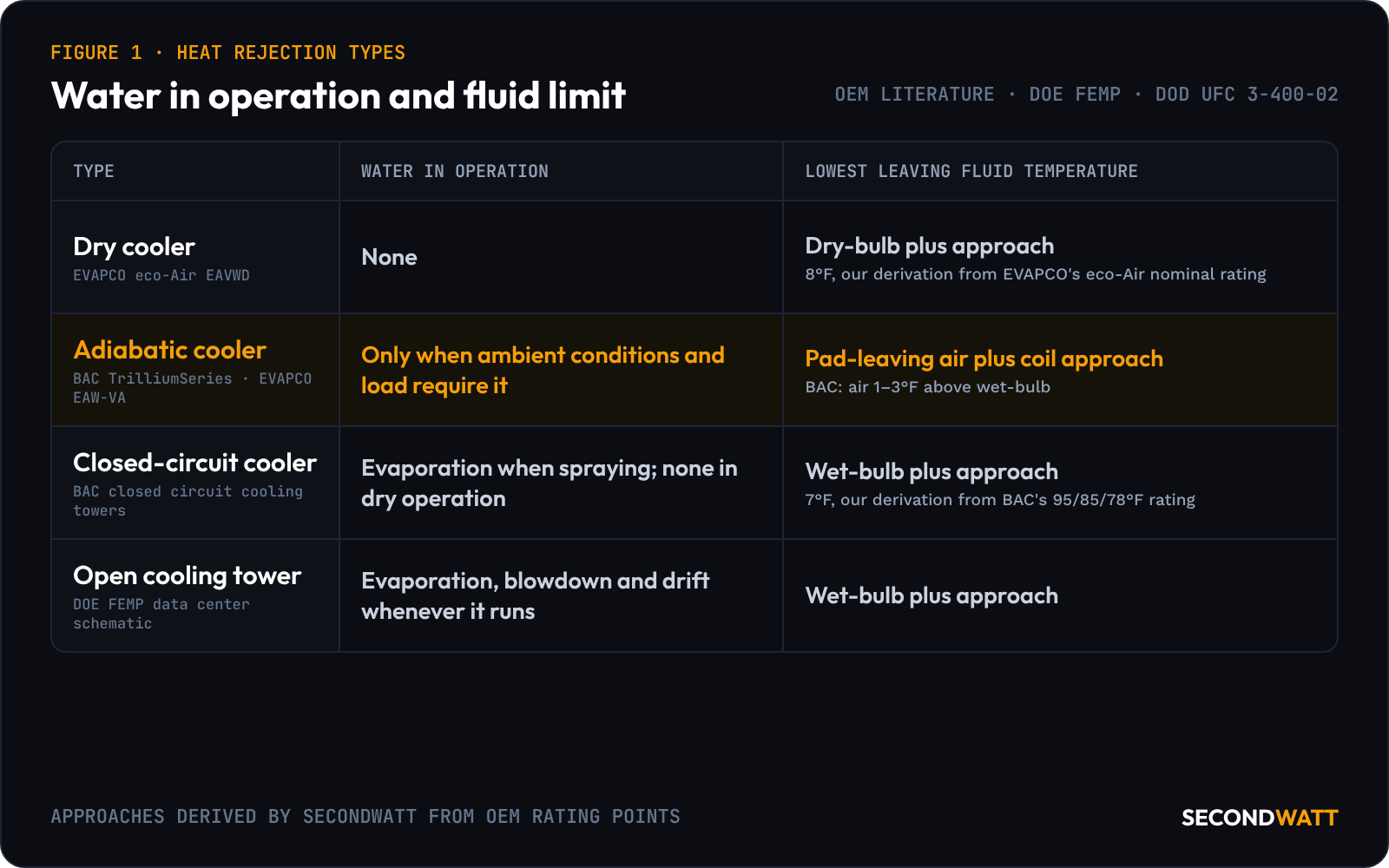
A May 2019 DOE FEMP thermosyphon fact sheet notes that a dry cooler uses the air's dry-bulb temperature as its heat sink and never needs water. Under paragraph 2-2.7.2 of the DoD's UFC 3-400-02, cooling towers and other evaporative equipment are sized on high wet-bulb temperature.
BAC's explainer on closed circuit cooling towers describes the design. A closed-circuit cooler keeps the process fluid in a coil, isolated from outside air, while spray water evaporates over it. Closed-circuit units can also run dry, a mode BAC says open towers cannot offer.
Both approach figures are our derivations from the OEMs' rating points. EVAPCO's 2020 Bulletin 270B rates eco-Air nominal capacity at 110°F to 100°F with 92°F dry-bulb air, so 100 − 92 = 8°F. BAC rates closed-circuit capacity at 95°F entering water, 85°F leaving and 78°F entering wet-bulb, so 85 − 78 = 7°F.
How much water each one uses#
As DOE FEMP's Best Management Practice #10 notes, a cooling tower rejects heat by evaporation, so by design it uses significant amounts of water. Its make-up water equals evaporation plus blowdown plus drift. Blowdown removes concentrated minerals that would otherwise form scale.
Cycles of concentration set the blowdown share. Many towers run at two to four cycles, and six or more may be possible. Raising cycles from three to six cuts make-up water by 20% and blowdown by 50%, according to FEMP.
EVAPCO's EAW-VA adiabatic cooler page says the eco-Air adiabatic models use water only when ambient conditions and load require it. Their standard EAW-VA pad system is once-through, with no cold water basin or pump, and EVAPCO says no water treatment is required. A pumpless recirculation system, PuRe-JET, is an optional accessory. BAC's TrilliumSeries adiabatic cooler uses a dual-pump recirculating system instead.
In 2016, NREL's high-performance computing data center in Golden, Colorado, added a Johnson Controls thermosyphon cooler, an advanced dry cooler. NREL was renamed the National Laboratory of the Rockies in December 2025. The cooler went in as a test bed beside existing evaporative towers, serving warm-water liquid-cooled HPC systems. Evaporative cooling there had needed more than 2 million gallons a year.
After heat reuse, the thermosyphon cooler takes heat when temperatures permit, and the towers take the rest.
1.16 million gallons — water the NREL thermosyphon dry cooler saved in its first year, about 4.39 million liters, cutting the data center's water use in half, according to DOE FEMP.
The towers stayed. For most operating cases, DOE FEMP says, the site still needs enough tower capacity for the entire IT load in the hottest hours of the year. The approach suits sites with year-round heat rejection load and loop temperatures high relative to average ambient, FEMP adds.
Dry-bulb, wet-bulb and approach on a hot day#
A dry coil cannot cool fluid below the air temperature it sees, plus an approach. Precooling lowers that air temperature.
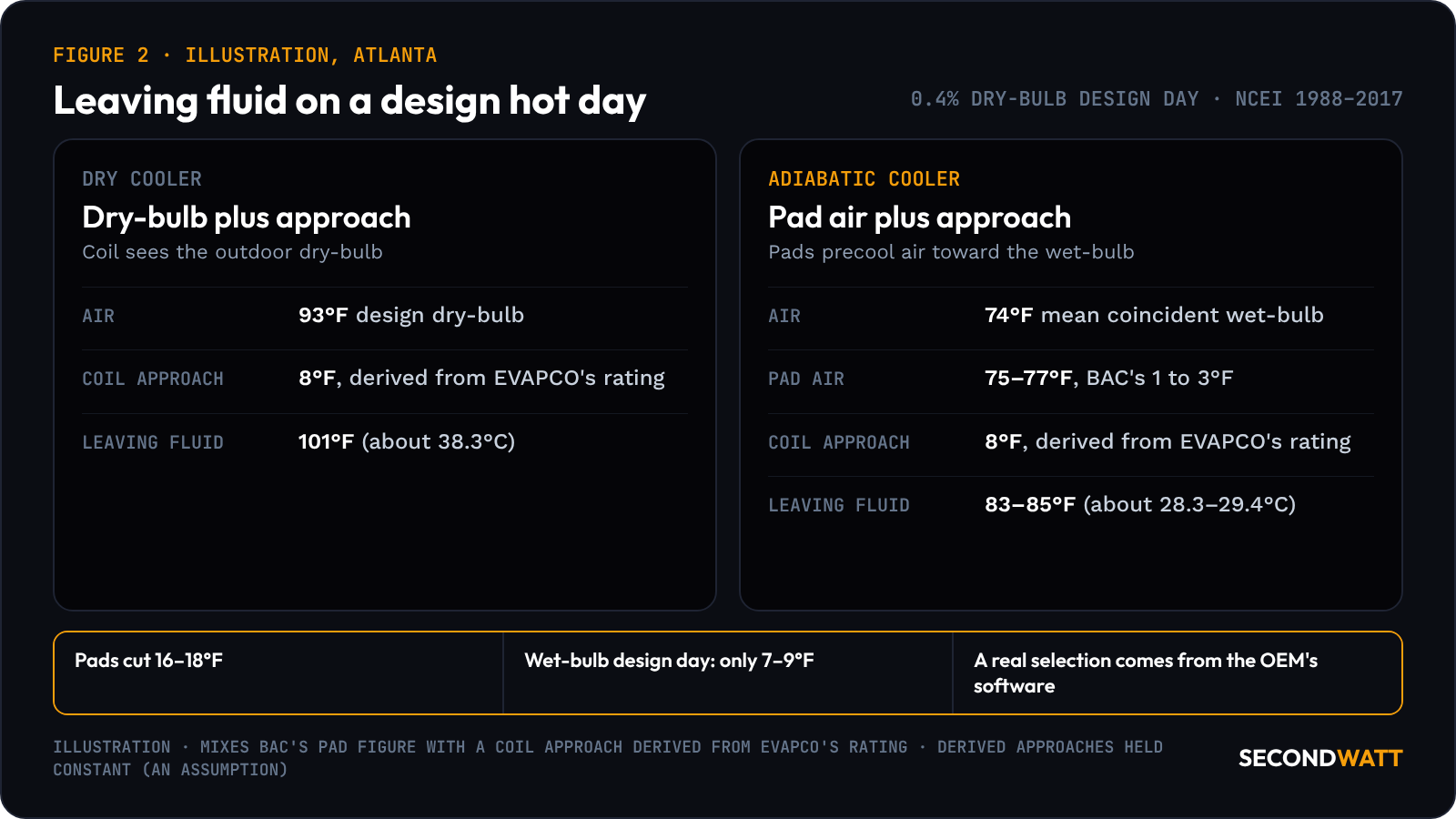
Take Atlanta's Hartsfield-Jackson airport. NOAA NCEI's engineering weather data gives the airport a 0.4% design dry-bulb of 93°F, with a mean coincident wet-bulb of 74°F, over a 1988–2017 period of record. Its 0.4% design wet-bulb is 77°F, with a mean coincident dry-bulb of 87°F.
These are annual values. Under paragraphs 2-2.2.1 and 2-2.2.2.2 of UFC 3-400-02, Change 2 (2024), a 0.4% value is the one exceeded for 0.4% of the time over the whole period of record. That is about 35 of a year's 8,760 hours, on average.
93°F — Hartsfield-Jackson's 0.4% design dry-bulb for 1988–2017 in NCEI's engineering weather data, with a mean coincident wet-bulb of 74°F.
Worked example, on the dry-bulb design day. It is an illustration: it holds each derived approach constant at design (an assumption), and its adiabatic line mixes BAC's pad figure with the coil approach derived from EVAPCO's rating.
- Dry cooler: 93°F + 8°F = 101°F leaving fluid (about 38.3°C).
- Adiabatic cooler: pad air at 74°F + BAC's 1 to 3°F = 75–77°F; plus the derived 8°F coil approach = 83–85°F (about 28.3–29.4°C). BAC's brochure gives no ambient or humidity condition for its 1–3°F.
- Closed-circuit cooler: 74°F + 7°F = 81°F (about 27.2°C).
On the wet-bulb design day (87°F dry-bulb, 77°F wet-bulb), the same arithmetic gives 95°F dry, 86–88°F adiabatic and 84°F closed-circuit. Pads cut 16–18°F from the dry case on the first day but only 7–9°F on the second. The gap between dry-bulb and wet-bulb shrinks from 19°F to 10°F.
A September 2024 Lenovo Press publication explains that ASHRAE's W classes name the upper bound, in degrees Celsius, of the facility water supplied to the IT equipment. W32 means 32°C (89.6°F) and W40 means 40°C (104.0°F). If the cooler's leaving fluid is that facility water, with no heat exchanger between (an assumption), the adiabatic case stays inside W32 on both design days. The dry case stays inside W40.
A real selection comes from the OEM's software. The depressed dry-bulb depends on the ambient dry-bulb and relative humidity, EVAPCO notes, and BAC offers selection software to evaluate its closed circuit towers at any conditions.
Pairing with chillers and liquid cooling#
Free-cooling chillers combine a dry coil with a compressor. The Liebert AFC is Vertiv's air-cooled free cooling chiller built around inverter screw technology. Its listed versions, fixed and inverter screw, with and without direct free cooling, span 877 kW to 2,025 kW total nominal capacity and -13°F to 132°F ambient. Model detail sits on the Liebert AFC dossier.
Adiabatic pads can sit on the chiller too. Vertiv's Liebert HPC-S page says that in the adiabatic models, wet pads humidify air entering the freecooling and condensing coils and increase freecooling operation. The adiabatic version can save 25% to 30% energy against a standard freecooling chiller when applied to data centers with high chilled water temperatures, by Vertiv's claim.
Warm-water liquid cooling widens the dry hours from the other end: the warmer the facility water a rack accepts, the more hours a dry coil can deliver it.
Lenovo lists facility water temperatures of 40°C to 45°C for its Neptune Gold tier, 27°C to 32°C for Silver and 17°C for Bronze. A 17°C (62.6°F) loop sits below every Atlanta design-day result above, so it needs mechanical cooling in those hours.
A CoolIT post on warm water cooling and AI argues that true chiller-free operation requires ambient conditions that can reliably supply 45°C water. Hot, humid regions still need chillers, CoolIT says. The used chillers guide covers checking a chiller's duty and heat rejection.
The coolant distribution unit adds one more step between facility water and the servers. Vertiv's XDU brochure rates the Liebert XDU1350 at 1,368 kW nominal at a 4°C approach temperature difference and 2,912 kW maximum at 8°C. Vertiv calls its CoolChip CDU 1350 the next generation of the Liebert XDU family.
The CoolIT CHx2000 is rated at 2,000 kW cooling capacity at a 5°C ATD, according to CoolIT's CHx2000 product page. The XDU dossier and the CDU selection guide show how those ratings shape a rack plan.
Specifying a dry or adiabatic cooler#
A request for quotation should fix the basis before it asks for a price:
- Design ambient: the station, data set, period and percentile, such as Hartsfield-Jackson's 1988–2017 0.4% values, plus the annual extreme high.
- Fluid temperatures: entering and leaving fluid at design, which set the approach and the W class the loop can serve.
- Glycol percentage: part of the rating basis; Vertiv quotes the XDU1350's primary pressure drop with 20% glycol.
- Fan power at design: motor kW at the rating point. The eco-Air EAVWD15S1PI lists 10 HP (7.5 kW) of fans for 601 MBH nominal capacity, which is 176.1 kW of rated heat rejection at 3,412.14 Btu/h per kW, so about 4.3% of it. EVAPCO's Adiabatic Cooling 101 says adiabatic units deliver the required capacity with a smaller footprint, lower fan motor horsepower or both than a completely dry cooler.
- Water quality and spray hours: the make-up water source, the dry switch point and the expected wet hours at the site.
- Pad water handling: once-through or recirculating, with drain and cleansing cycles.
- Sound: a limit at the property line and the fan options that meet it.
- Footprint and access: pad removal, access doors and service clearances.
- Controls: fan speed control, the switch between dry and wet modes, and the building management interface.
- Legionella plan: who owns the water management program for the pad or spray water.
Maintenance and water treatment#
BAC's 2020 brochure says circulating water is drained and replaced every two hours in its TrilliumSeries adiabatic products. Periodic cleansing cycles during wet mode prevent scaling. Their fans run in reverse once daily to prevent clogging, and the coated pads come out without tools for coil inspections.
Freeze protection works two ways. The TrilliumSeries cooler runs dry in sub-freezing temperatures, and the 2020 brochure says no winterization is needed. According to the DOE FEMP fact sheet, NREL's thermosyphon cooler uses its design and controls to cool the loop and prevent freeze-ups in subfreezing conditions.
Legionella water management programs are now an industry standard for large US buildings, according to version 1.2 of CDC's toolkit, dated September 2025. The toolkit cites ASHRAE Standard 188.
The device test is in CDC's worksheet of 15 March 2024. Devices in buildings that can spread water droplets containing Legionella should have a water management program even if the building itself does not. Its device questions name cooling towers and centrally installed misters, atomizers, air washers or humidifiers.
FAQ: adiabatic cooling and dry coolers#
Is adiabatic cooling the same as evaporative cooling?#
They overlap: both evaporate water, but the water goes to different places. An adiabatic cooler evaporates water into the air ahead of a dry coil. A closed-circuit cooler or open tower evaporates water from the coil surface or from the circulating water itself. Adiabatic units use less water than traditional evaporative units, in EVAPCO's description.
How much water does an adiabatic cooler use in a year?#
It depends on the hours above the switch point, so the answer is site-specific. The cooler uses water only in those hours. Ask the OEM to run its selection software with the site's weather data, setpoint and leaving fluid temperature, and to report wet hours and gallons.
Can dry coolers work in hot climates?#
Yes, if the loop can accept fluid a few degrees above the hottest dry-bulb. Check each year's hottest hour as well as the 0.4% value. At Hartsfield-Jackson, the median of the annual extreme highs is 96°F on the same NCEI sheet. Paragraph 2-2.2.2.1 of UFC 3-400-02 covers that measure.
A dry cooler at the derived 8°F approach would then deliver about 104°F (40°C), right at W40's upper bound. Loops that need cooler water add adiabatic assist or a trim chiller for those hours.
Do adiabatic coolers need water treatment?#
It depends on the design and the water. The once-through EAW-VA pad system needs no water treatment, EVAPCO says, while BAC's recirculating TrilliumSeries designs use cleansing cycles and timed water replacement. Either way, the CDC device test is the starting point for the site's Legionella plan.
Is a closed-loop cooling system water-free?#
The loop itself can be closed while the heat rejection behind it still evaporates water. As BAC describes it, a closed-circuit cooler keeps the process fluid sealed in its coil, yet rejects heat as part of its spray water evaporates. Only dry operation, in a dry cooler or in an adiabatic or closed-circuit cooler running dry, rejects heat with no water. The same check applies to on-site power: gas turbine water consumption depends on the inlet cooling and plant cooling chosen.
Sourcing heat rejection equipment#
SecondWatt publishes equipment research and helps buyers source power equipment; it earns a fee when a sale it arranges closes. Buyers planning chillers, coolers or liquid cooling can request equipment with the design ambient, fluid temperatures and glycol basis above, and owners with surplus cooling equipment can sell it.