
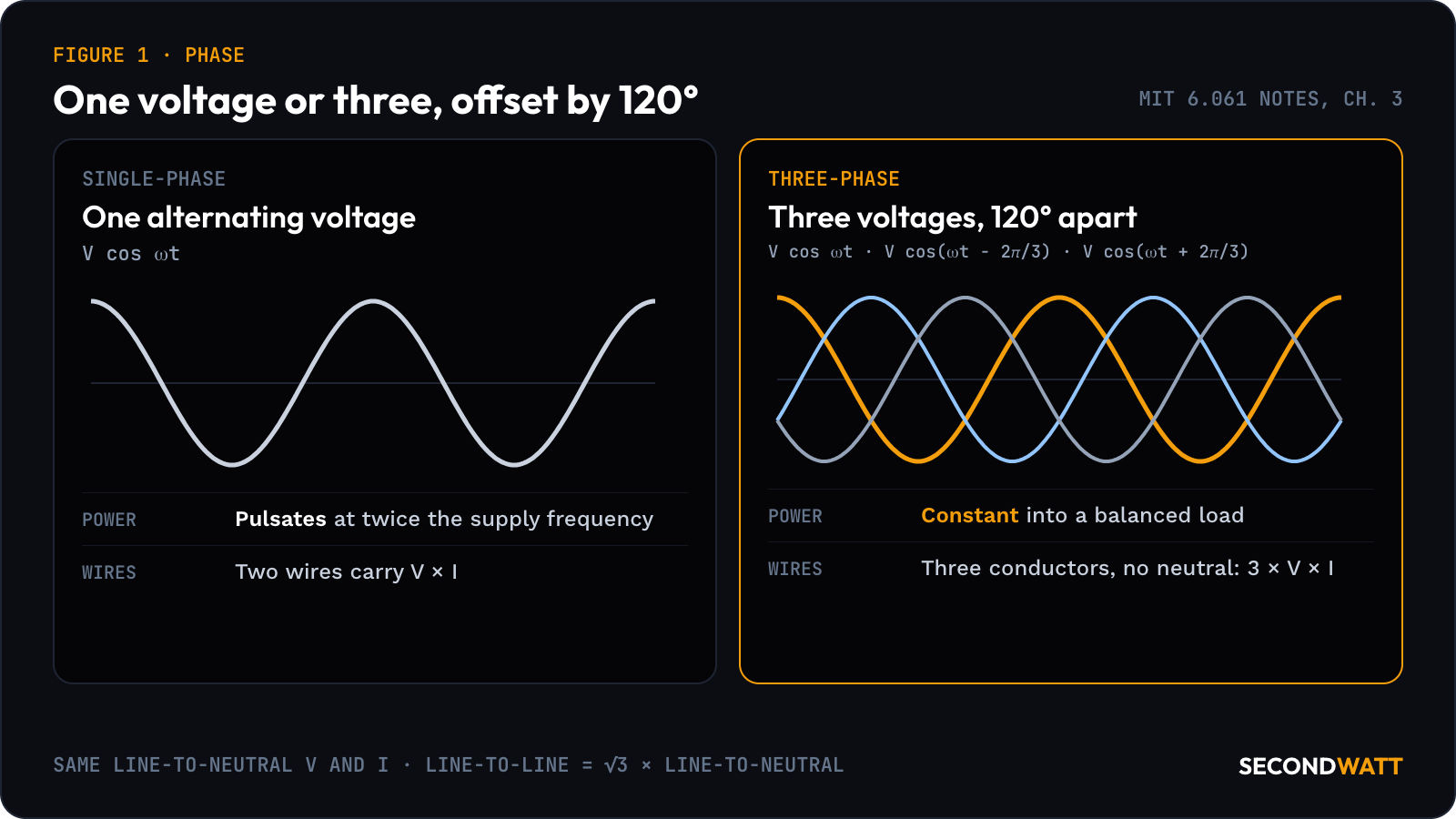
Single-phase vs three-phase power comes down to how many alternating voltages a circuit carries. Single-phase power uses one; three-phase power uses three, each offset from the next by 120°. The total power flowing into a balanced three-phase load stays constant. Chapter 3 of MIT's 6.061 class notes says most electric power applications use three phases, for economical use of conductors and nearly constant power flow.
For a buyer, the difference shows up as current. The same load on three phases at a higher voltage draws far less current per conductor, and current sets the size of cables, breakers and bus. It also decides what a standby generator must deliver: the set has to match the phase, voltage and neutral arrangement of the service it backs up.
Key Takeaways
- Three-phase power uses three voltages offset by 120°. In a balanced three-phase load the total instantaneous power is constant, while single-phase power flow pulsates.
- Phase and voltage multiply the current. For one 625 kVA load, 240 V single-phase draws 3.46 times the current of 480 V three-phase: 2 from voltage, 1.73 from phase.
- PPL's tariff assigns the service. Standard home service is 120/208 or 120/240 V single-phase; commercial and industrial customers can get 480Y V three-phase when 12 kV service is available.
- A 2007 Cummins sizing paper advises spreading single-phase loads across the phases. Rehlko lists the KD1000's unbalanced load capability as 100% of rated standby current.
- The transfer switch follows the grounding scheme. Kohler ties the choice between a 3-pole and 4-pole transfer switch to whether the standby source is a separately derived system.
Single-phase vs three-phase power explained#
A single-phase source is one sinusoidal voltage. A three-phase source is three equal voltages, written as V cos ωt, V cos(ωt − 2π/3) and V cos(ωt + 2π/3), so each phase is a third of a cycle, or 120°, from the next.
In a single-phase circuit, instantaneous power pulsates at twice the supply frequency. In a balanced three-phase load, the swings in the three phases cancel. As J.L. Kirtley Jr. writes in the MIT 6.061 notes, "The sum of these three expressions is total instantaneous power, which is constant."
Constant power flow helps rotating machines. The same notes say a balanced polyphase system avoids the power-flow pulsations due to AC voltage and current, which "has obvious benefits when dealing with motors and generators."
Three phases also give two voltages from one system. Line-to-line voltage is larger than line-to-neutral voltage by a factor of √3. Loads and windings connected line-to-neutral form a wye; those connected line-to-line form a delta. A wye can carry a neutral as a fourth wire, while a delta is inherently three-terminal.
The current arithmetic#
Take one load and supply it five ways. A 500 kW load at 0.8 power factor is 625 kVA: 500 ÷ 0.8 = 625. The two formulas, with V as the line-to-line voltage for three-phase:
Three-phase current = kVA × 1,000 ÷ (√3 × V)
Single-phase current = kVA × 1,000 ÷ V
Current per line for the same 625 kVA load (500 kW at 0.8 power factor), by phase and voltage (SecondWatt worked example)#
| Supply | Arithmetic | Current per line | Multiple of the 480 V three-phase current |
|---|---|---|---|
| Three-phase, 480 V | 625,000 ÷ (√3 × 480) | 751.8 A | 1.00 |
| Three-phase, 415 V | 625,000 ÷ (√3 × 415) | 869.5 A | 1.16 |
| Three-phase, 208 V | 625,000 ÷ (√3 × 208) | 1,734.8 A | 2.31 |
| Single-phase, 480 V | 625,000 ÷ 480 | 1,302.1 A | 1.73 |
| Single-phase, 240 V | 625,000 ÷ 240 | 2,604.2 A | 3.46 |
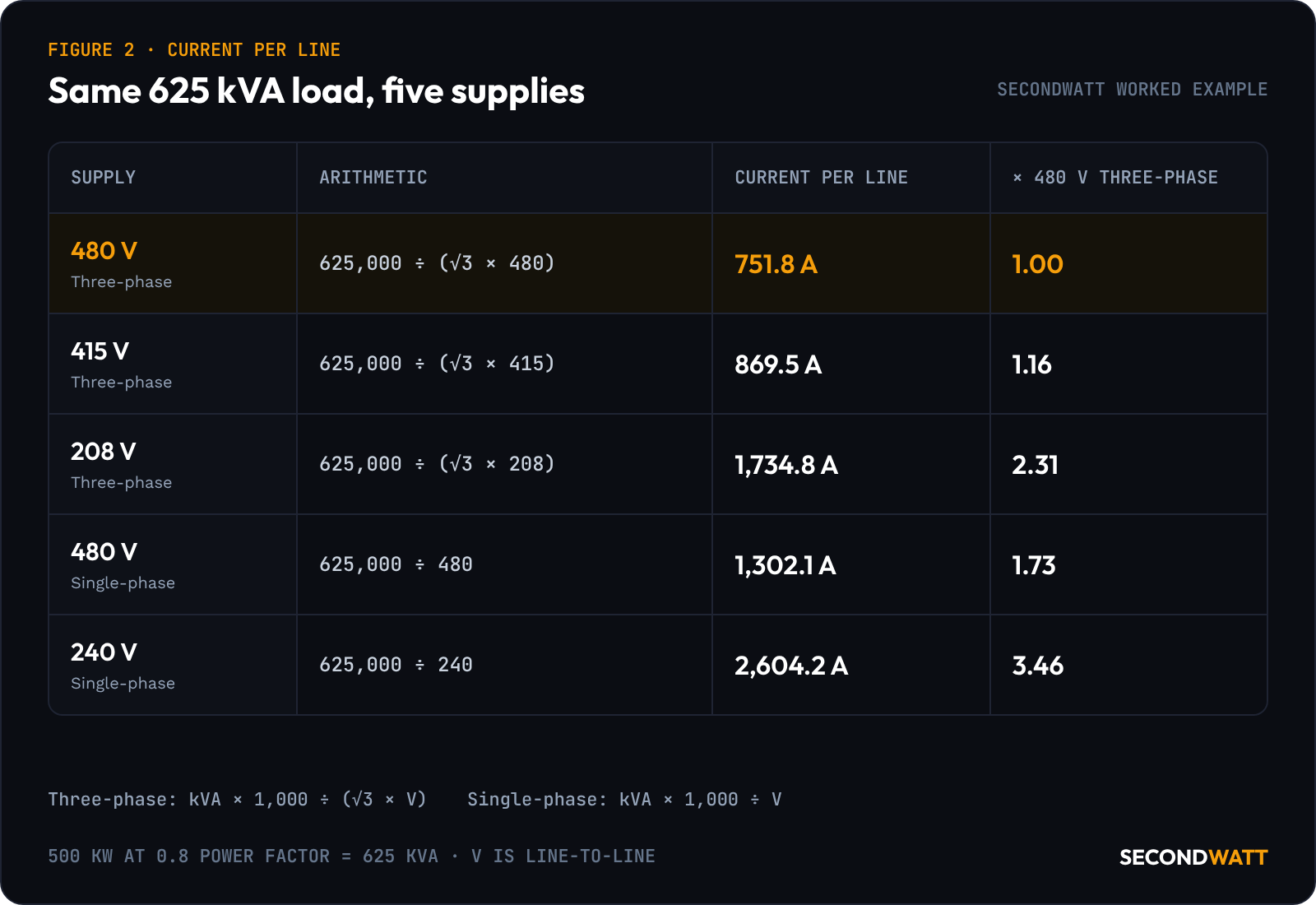
The 240 V single-phase case needs 3.46 times the current of the 480 V three-phase case. A factor of 2 comes from voltage: halving from 480 V to 240 V doubles the current. A factor of 1.73 comes from phase: at the same 480 V, single-phase current is √3 times the three-phase figure. 2 × 1.73 = 3.46.
2,604.2 A — the current a 625 kVA load would draw on a 240 V single-phase supply, against 751.8 A per line at 480 V three-phase.
The ratings on Rehlko's KD1000 specification sheet G5-580, dated 2/26, follow the same formula. The sheet lists 1,504 A at 1,250 kVA, 277/480 V, three-phase, 60 Hz standby, and 1,250,000 ÷ (√3 × 480) = 1,503.5 A. At 120/208 V it lists 3,470 A, and the formula gives 3,469.7 A.
Where each is used#
PPL's and SDG&E's tariff rules each say which service that utility's customers get. PPL Electric Utilities' standard service for residences is three-wire, 120/208 or 120/240 V. Its single-phase, three-wire service "is generally available for residential and general light and power service."
A note headed "Residential Service at 120/208 Volts" in PPL Rule 2, dated 9 Jul 2015, opens with areas where the secondary distribution system is 208Y V. It states that all non-residential services are three-phase, four-wire, except small establishments with limited loads requiring 100 A or less. Those may be served single-phase, three-wire.
PPL provides 480Y V three-phase, four-wire service for commercial and industrial customers when 12 kV service is available. San Diego Gas & Electric lists 120, 120/208, 120/240, 240, 480 and 277/480 V among its standard distribution voltages, "where available and applicable."
SDG&E may supply 277/480 V four-wire wye in underground areas where it maintains 120/208 V or 240 V three-phase mains. The customer must apply in writing and provide space on the premises acceptable to SDG&E for its facilities. The load must also need an individual transformer installation of at least 75 kVA. These conditions come from SDG&E Electric Rule 2, in sheets effective 7 Oct 2002.
SDG&E lists a 400 A main switch as the largest for 120/240 V single-phase service unless it approves more. For 480 V three-phase service it lists a maximum demand of 3,000 kVA. SDG&E may modify these specifications at its option for service conditions at a location. Nominal voltage ratings and operating tolerances for 60 Hz systems above 100 V are set by ANSI/NEMA C84.1-2020, reaffirmed in 2025.
SDG&E's 277/480 V conditions put a utility transformer on the customer's premises. The pad-mount transformer guide covers that equipment, and data center transformers covers the step-downs inside larger sites.
Three-phase generators and their voltages#
Every voltage row on the Rehlko KD1000 sheet is three-phase, and all three-phase units are rated at 0.8 power factor. The Cummins QST30 series sheet lists phase rotation A, B, C and three-phase current metering. The two Caterpillar sheets list voltages and 3-pole or 4-pole breaker options.
Voltage options on four OEM generator set documents (Caterpillar LEHE1209-08, 05/26, and LEHE1351-12, 08/26; Cummins S-1671, 01/18; Rehlko G5-580, 2/26)#
| Generator set | Ratings, 60 Hz | Voltage options listed |
|---|---|---|
| Cat C32B | 1,000 ekW standby and mission critical; 910 ekW prime | 220, 240, 380, 400, 480, 600, 2,400 and 4,160 V |
| Cummins QST30 series (model DQFAH) | 1,000 kW standby; 900 kW prime | 120/208, 139/240, 220/380, 230/400, 240/416, 255/440, 277/480 and 347/600 V |
| Rehlko KD1000 | 1,000 kW standby; 900 kW prime (at 277/480 V) | 120/208 to 347/600 V, every row three-phase |
| Cat 3516E | 2,750 ekW standby and mission critical; 2,500 ekW prime | 416, 480, 600, 4,160, 12,470, 13,200 and 13,800 V |
The Cat C32 row comes from Caterpillar's C32B sheet LEHE1209-08. The Cummins sheet S-1671 adds a note to consult the factory for other voltages; the Cummins QST30 page covers the engine family. The Cat 3516E sheet, Caterpillar LEHE1351-12, lists seven output voltages from 416 V to 13,800 V.
"480 V generator" therefore needs a second look at the sheet. Cummins and Rehlko list it as 277/480, line-to-neutral over line-to-line, the notation of a wye with a neutral. Rehlko gives the KD1000's voltage as "Wye or 600 V". Caterpillar's option lists show "480V" alone, so the connection and neutral arrangement come from the alternator data for the specific set.
Rating types are covered in prime power rating, sets near this article's 625 kVA example in the 500 kW generator guide, and the table's three 1,000 kW standby sets in the 1 MW generator guide.
Single-phase loads on a three-phase generator#
The MIT 6.061 notes say a three-phase set can serve single-phase loads, connected either line-to-line or line-to-neutral. Cummins's 2007 sizing paper, Power topic #7007, says the three-phase selection "permits single-phase loads but the assumption is that the single-phase loads will be balanced across the three phases." It adds that single-phase loads should be distributed as evenly as possible between the three phases "in order to fully utilize generator set capacity and limit voltage imbalance."
An unbalanced load figure can sit on the spec sheet itself: Rehlko's KD1000 sheet G5-580 lists "Unbalanced load capability" as "100% of Rated Standby Current." That is one OEM's figure for one generator set, so the limit for any other set comes from its own sheet or alternator data.
SDG&E applies a balance rule of its own on the service side. It requires loads on three-phase service to be balanced "in accordance with good engineering practice, as determined by the Utility." Section B.5.b of SDG&E Rule 2 adds that "in no case will the load on any one phase exceed twice that on any other phase." A standby set that picks up the same panels inherits whatever imbalance the building carries.
Three-phase power in the data center#
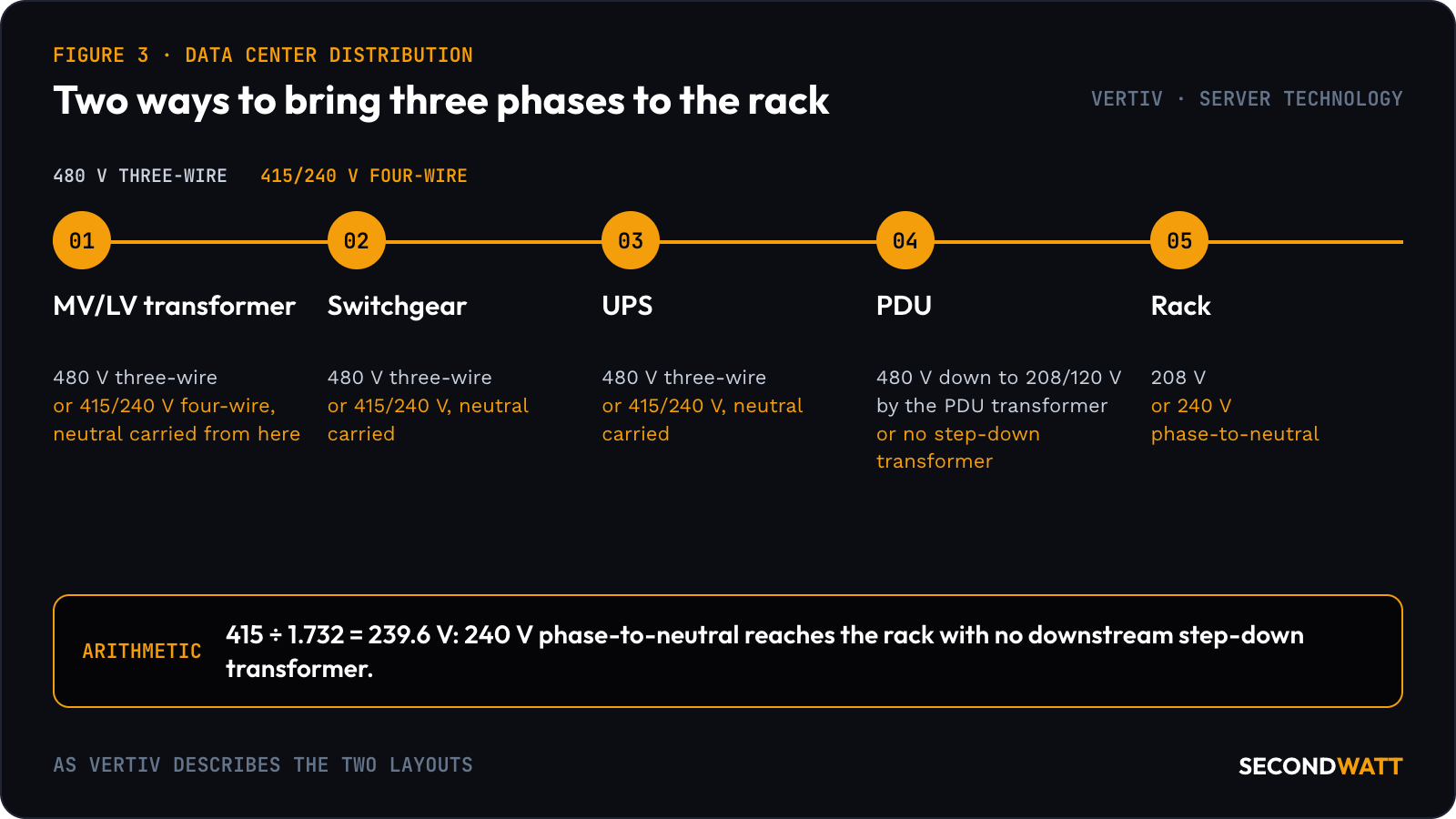
In a data center, power runs from the utility service through the main low-voltage switchgear and the UPS to floor and rack PDUs. A Vertiv article of 10 Aug 2026 describes the long-standing North American layout as 480 V three-wire distribution. A transformer steps 480 V down to 208/120 V, and 208 V goes to the racks. Server Technology calls it the PDU transformer.
The alternative is 415/240 V four-wire distribution. Vertiv says the neutral is carried from the MV/LV transformer through the switchgear and UPS, so 240 V phase-to-neutral reaches the rack with no downstream step-down transformer. The arithmetic matches the wye rule: 415 ÷ 1.732 = 239.6 V.
Server Technology's January 2020 application note PRO2-007 puts the efficiency gain of 415 V over a comparable 208 V system at typically 2% from eliminating the PDU transformer. It adds 2% to 3% from running compatible IT devices at the higher voltage. Both are vendor claims.
The note recommends a 415 V, 30 A rack PDU, model C2W36TE-5CAE2M99, with 17.3 kW of power capacity. Its product page lists an input current of 30 A, a rated input current of 24 A and the same 17.3 kW.
The 24 A is 80% of 30 A, and √3 × 415 V × 24 A = 17,251 VA. Reading the 17.3 kW input power capacity as that figure assumes a power factor of 1, which the page does not state; that reading is SecondWatt's inference. On the same assumption, a 208 V three-phase circuit at 24 A gives √3 × 208 × 24 = 8,646 VA, about 8.6 kW of input power capacity (SecondWatt calculation).
17.3 kW — Server Technology's listed input power capacity for its C2W36TE-5CAE2M99, a 415 V three-phase rack PDU on a 30 A circuit with a 24 A rated input current.
Rack PDUs come in both phase types. The Eaton ePDU G4 universal-input models accommodate "single- and 3-phase power in 208V and 415/240V environments," according to Eaton's Rack PDU G4 page. The Raritan PX4 lists inputs from 100 V to 415 V and supports single-phase and three-phase power, according to Raritan's PX4 page. Sizing the UPS ahead of them is covered in how to size a UPS and UPS topologies, and the PDU range in the PDUs hub.
Choosing phase, voltage and neutral for a standby set#
Start with the service the set backs up. Its phase count, voltage and connection carry straight through to the generator, so a 277/480 V wye service calls for a set connected for 277/480 V wye. The 625 kVA example shows the stakes: at 208 V the set and its feeders carry 2.31 times the current they would at 480 V.
The neutral decision sits in the transfer switch. In Power Systems Topics 107, dated 7/20, Kohler states that the choice between a three-pole and four-pole automatic transfer switch "depends on the grounding scheme for the system." With a 3-pole switch the neutral is solid and bonded to ground at only one location, which Kohler's example puts at the utility service. With a 4-pole switch the neutral is switched, so the generator is a separately derived source with its own neutral-to-ground link.
Cummins's 2006 Power topic #6006 addresses the case of a normal source with ground-fault protection whose neutral is interconnected with the generator through transfer equipment. There, the design "should include consideration of the use of 4-pole transfer switches and grounding the generator as a separately derived system." Cummins leaves the call to engineering judgment for each application. Kohler adds that systems with more than one ATS should use the same 3-pole or 4-pole configuration throughout.
Those choices set the transfer switch's poles and current rating. The ATS sizing and procurement guide covers the current side, and the ATS hub lists switch types.
FAQ: single-phase vs three-phase#
Can a three-phase generator power single-phase loads?#
Yes. On a 277/480 V wye set, a single-phase load can connect line-to-neutral at 277 V or line-to-line at 480 V. On a 120/208 V set the pair is 120 V and 208 V. Each load draws from one or two phases only, which is why the loads are spread across all three.
How do I tell if a building has single-phase or three-phase power?#
Tariff rules such as PPL's describe each service by phase, wires and voltage: "Single Phase, 3 Wire Service" and "Three Phase, 4 Wire, 480Y Volt Service." SDG&E's rule states that "the character of service available at any particular location should be ascertained by inquiry at the Utility's office."
Why is three-phase power more efficient for large loads?#
It uses conductors more economically. In a balanced three-phase load the three currents sum to zero in the neutral. As the MIT 6.061 notes put it, "a wire with no current in it does not have to be very large," and in many cases the neutral can be left out entirely. Without a neutral, three conductors carry three times the power of a two-wire single-phase circuit at the same line-to-neutral voltage and current: 3 × V × I against V × I.
What power factor are three-phase generator sets rated at?#
Cummins's 2007 sizing paper states that three-phase generator sets are rated for 0.8 power factor loads and single-phase sets for 1.0. Lower power factors need larger alternators or sets, the paper adds. The same 0.8 sits behind this article's example: 625 kVA × 0.8 = 500 kW of load.
What is 480Y/277 V?#
It is a three-phase, four-wire wye system with 480 V between any two phase conductors and 277 V from each phase to neutral. The two values differ by √3: 480 ÷ 1.732 = 277.1 V. The same rule gives about 120 V from 208 V and 240 V from 415 V.
Choosing a three-phase generator#
SecondWatt publishes equipment research and helps buyers source power equipment; it earns a fee when a sale it arranges closes. Buyers who know the service voltage, wye or delta connection and transfer-switch poles can request a three-phase generator with those details. Owners with a standby set to sell can start at sell generators.