Hitachi Energy Liquid-filled substation transformers (750-20,000 kVA)
Manufacturer: Hitachi Energy
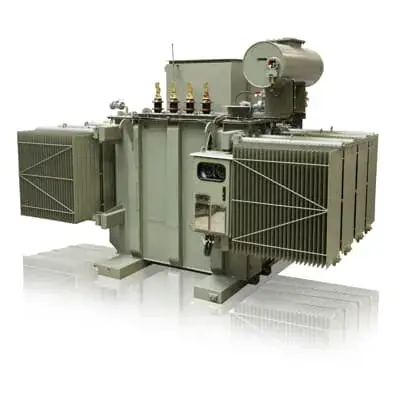
Hitachi Energy liquid-filled substation transformers to 20 MVA and 69 kV, heir to the ABB US distribution line
This model is part of SecondWatt’s transformer research catalogue. Specifications and price observations are included where supported by sources. Equipment availability and commercial terms require confirmation.
Hitachi Energy liquid-filled substation dossier: 750-20,000 kVA to 69 kV, BIL and fluid options, 65-95 week leads, used-market comps, inspection points.
Hitachi Energy's US liquid-filled substation family continues ABB's American distribution transformer business without interruption. Substation units run 750 to 20,000 kVA with high voltage to 69 kV; the wider family adds secondary unit substations at 150-3,000 kVA, primary unit substations at 300-20,000 kVA, network transformers at 300-2,500 kVA, and subsurface vault units at 150-1,500 kVA. Published BIL points include 150 kV and 60 kV on secondary unit substation designs, with LTC available on primary and substation classes.
Fluids are mineral oil or less-flammable ester for indoor service, with UL and FM Global certifications. US units in scope fall under DOE 10 CFR 431 Subpart K efficiency rules, amended in 2024 with 2029 compliance. This class is also the most liquid corner of the ABB/Hitachi secondary market: priced ABB-badged comps ran 6,000 to 95,000 USD per unit at kVA scale in August 2026, while Surplus Record's substation category held 588 listings, nearly all price-on-request. Rebuilders sell reconditioned equivalents with warranties to 3 years.
Why it matters
Substation transformer demand rose 116% from 2019 to 2025 while lead times for the 5-25 MVA class hit 65-95 weeks. A failed unit substation can idle an entire facility, so tested used units with clean DGA histories now clear quickly at 15-45% of new cost. The ABB-to-Hitachi continuity keeps parts, drawings, and service coverage intact across the legacy fleet.
Who buys it
Industrial plants, hospitals, campuses, and data centers buy this class for unit substations feeding MV switchgear; utilities buy network and vault variants. Buyers split between new Hitachi Energy orders at 65-95 week leads and the used/reconditioned channel at days to weeks. Rebuilder stock with 3-year warranties is the standard alternative to a new-build queue.
Role in the data center
Unit substation transformer taking 13.8-34.5 kV campus distribution down to 480 V switchboards, typically paired N+1 per hall, with ester fill specified where the unit sits inside an electrical room rather than in an outdoor yard. The 750-20,000 kVA envelope covers both the hall-level unit substation and the campus-level substation duty.
Key specifications
| Substation kVA range | 750-20,000 kVA |
|---|---|
| HV maximum | 69 kV |
| Secondary unit substation | 150-3,000 kVA |
| Primary unit substation | 300-20,000 kVA |
| Published BIL points | 150 / 60 kV |
| Network transformers | 300-2,500 kVA |
| Subsurface vault units | 150-1,500 kVA |
| Certifications | UL, FM Global |
| Class lead time (5-25 MVA) | 65-95 weeks (2026) |
| Global liquid family top | up to 25 MVA (large distribution) |
Technical summary
Substation transformers: 750-20,000 kVA, HV to 69 kV. Secondary unit substation: 150-3,000 kVA; BIL 150 / 60 kV published. Primary unit substation: 300-20,000 kVA, LTC available. Network transformers: 300-2,500 kVA. Subsurface vault: 150-1,500 kVA. Fluids: mineral oil or less-flammable ester (indoor). Certifications: UL, FM Global. US efficiency: DOE 10 CFR 431 Subpart K (2024 amendment, 2029 compliance).
Major variations
Five sub-families share the platform: substation, secondary unit substation, primary unit substation, network and subsurface vault, with generator step-up and unit-auxiliary designs available on request. The choices that drive price inside the class are fluid, tap control and integration. Mineral oil is the default; less-flammable ester is specified for indoor rooms. Load tap changers are available on the primary unit substation and substation designs and absent from the smaller builds. Close-coupled integration with a switchgear line-up changes the enclosure and the throat detail, and both are engineered per order.
Configurations and options
The family is five sub-lines and the choice between them is the first configuration decision: substation transformers at 750-20,000 kVA with high voltage to 69 kV, secondary unit substations at 150-3,000 kVA with published BIL of 150 kV and 60 kV, primary unit substations at 300-20,000 kVA, network transformers at 300-2,500 kVA and subsurface vault units at 150-1,500 kVA, with generator step-up and unit-auxiliary designs available on request. Inside the class the price movers are fluid, tap control and integration. Mineral oil is the default and less-flammable ester is specified for indoor rooms. Load tap changers are offered on the primary unit substation and substation designs and are absent from the smaller builds. UL and FM Global certifications are order options. Cooling class nomenclature is not printed on the US product page as of August 2026.
Compatibility and dependencies
Unit substation duty is a mechanical problem before an electrical one: the transformer close-couples to primary and secondary switchgear through throats, so throat dimensions, bus arrangement and the switchgear maker have to be agreed at order, and a used unit built for a different line-up needs a transition section. Impedance sets the interrupting duty on the low-voltage switchgear and has to be checked against gear already bought. The published BIL points of 150 kV and 60 kV on secondary unit substation designs have to coordinate with the arrester scheme. A load tap changer needs control power and a cabinet. Indoor siting with mineral oil brings containment and fire separation, which is why the less-flammable ester option with UL and FM Global listing is what makes an indoor electrical room practical. Subsurface vault units need vault ventilation and a submersible design.
Pricing and availability
Comparable secondary-market band: 6000–95000 $ per unit. Trend: rising Electrical Trader's price history, published 2026-04-01, puts power transformer prices up 77% between 2019 and 2026, driven by copper up roughly 70% and grain-oriented electrical steel up 80-100% from 2020 to 2025, together 50-55% of production cost. Wood Mackenzie figures reported by pv magazine USA on 2026-05-11 put substation transformer demand up 116% between 2019 and 2025. Terrapin Construction Group had substation lead times at 65-95 weeks for 5-25 MVA and 85-110 weeks for 25-50 MVA on 2026-06-10. Lead time, new: 65-95 weeks (5-25 MVA class). Lead time, used or refurbished: 2-12 weeks. Warranty, used: 3-year typical from major US rebuilders.
Lifecycle and maintenance
Liquid-filled transformers routinely serve 30-40 years with annual oil screening, DGA on a 1-2 year cadence (or continuous online monitoring on critical units), and gasket or bushing service as tests dictate. Major US rebuilders remanufacture units to like-new condition with warranties up to 3 years (T&R Electric, Sunbelt Solomon), and reconditioned stock ships in days against 65-210 week new-build queues. Remaining paper life, estimated by furan testing, governs end-of-life valuation.
Thermal and emissions profile
Transformers produce no combustion emissions; the regulatory profile is efficiency and fluid. US distribution-class units fall under DOE 10 CFR 431 Subpart K efficiency standards, amended in 2024 with compliance from 2029 requiring 10-30% lower losses than 2016 levels. Fluid choice drives fire and environmental posture: mineral oil versus FR3 natural ester with a 360 C fire point and ready biodegradability. Legacy units require PCB screening, with clean units documented below 2 ppm.
Common failure points
- Bushings — Moisture ingress and partial discharge leading to flashover or tank rupture
- Gaskets and seals — Oil seepage at bushings, valves, and radiator headers
- Tap changer — Contact wear and mechanism faults; leading maintenance component in fleet surveys
- Winding insulation — Dielectric failure, the most common failure mode in CIGRE TB 642 data
- Tank corrosion — Base and cabinet rust on pad-mounted units
- Moisture in oil — Reduced dielectric strength and accelerated paper aging
Inspection checklist
DGA: dissolved gas analysis per IEEE C57.104; combustible-gas trend rise between 2 samples triggers investigation. Oil quality: dielectric breakdown, moisture, acidity, and furan tests; degree of polymerization below 200 marks end of paper life. Insulation resistance: megger HV/LV/ground; polarization index of 2.0 or higher passes. Power factor: insulation power factor testing; values above 1.0% on oil-filled windings warrant investigation. Turns ratio: TTR on all taps; deviation beyond 0.5% from nameplate fails. Winding resistance: three-phase balance within 2% between phases. Bushings: capacitance and power factor test; bushing failure share rises with voltage class per CIGRE TB 642. OLTC: inspect on-load tap changer diverter and selector; OLTCs are a leading failure component in CIGRE TB 642 fleet surveys.
Procurement channels
New units quote through Hitachi Energy. Used and reconditioned supply runs through Surplus Record (588 substation listings), Sunbelt Solomon, T&R Electric, and CTG Power Systems; priced ABB-badged comps at 6,000-95,000 USD per unit were live in August 2026.
Regional notes
This is the North American continuation of ABB's US distribution transformer business and it is built for 60 Hz ANSI practice; the global liquid-filled family, which runs to 25 MVA, is the IEC-market equivalent. US units in scope fall under the DOE distribution transformer rules at 10 CFR 431 Subpart K, amended by the final rule published 2024-04-22 with a 2029 compliance date. The US product page claims compliance with global and regional standards generically rather than citing IEEE C57.12.00, so the standard set has to be confirmed on the order data sheet. Imported content carries the Section 232 50% tariff from 2025-08-18.