Hitachi Energy TXpand rupture-resistant tank system
Manufacturer: Hitachi Energy
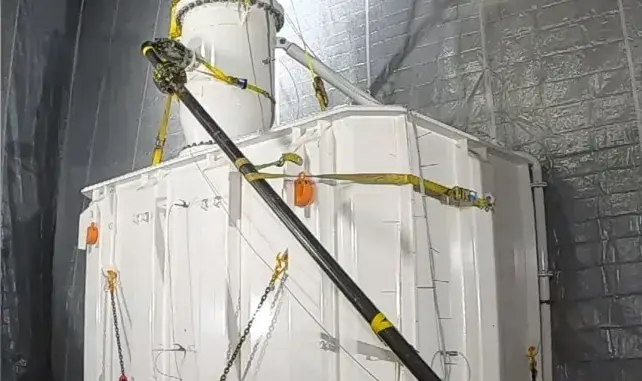
TXpand rupture-resistant tanks for oil-filled power transformers, tested to 20 MJ of arc energy without rupture at 330 kV and above
This model is part of SecondWatt’s transformer research catalogue. Specifications and price observations are included where supported by sources. Equipment availability and commercial terms require confirmation.
Hitachi Energy TXpand dossier: rupture-resistant transformer tanks tested to 20 MJ arc energy, package components, host-unit context, and market notes.
TXpand is a rupture-resistant tank design for oil-filled power transformers, not a standalone transformer model. ABB developed it with Hydro-Quebec and published the methodology in 2019: numerical modeling of tank plastic deformation validated against roughly 40 destructive experiments, with rigid areas made flexible, weak points reinforced, and engineered rupture points added so a catastrophic internal arc vents predictably instead of exploding.
Published results include full-scale withstand of 20 MJ of arc energy without rupture, reported as the highest such result at publication, with simulations showing 66 MJ producing controlled rupture and channeled oil escape. Tested designs include a 330 kV, 210 MVA power transformer and a 650 kV BIL station service voltage transformer per IEC 61869-1. The package combines the optimized tank with dry RIP/RIS bushings, a conservator shutter valve, pressure relief, and an oil deflector.
Hitachi Energy now integrates TXpand across its power transformer range, including the 765 kV EconiQ ester unit tested in May 2025. No used TXpand-equipped transformer has reached the secondary market; the feature's relevance to used-market buyers is as the benchmark that makes conventional-tank legacy units an insurance and siting discount.
Why it matters
Tank rupture and the oil fire that follows is the worst-case transformer failure, and OIP bushing faults remain a leading trigger. TXpand quantifies survivability at 20 MJ, roughly an order beyond typical arc events, changing fire-separation math around each unit. For the used fleet it sharpens the inspection premium on bushing condition and pressure-relief function.
Who buys it
Utilities and data center campuses siting transformers near occupied buildings, dense switchyards, or hydro powerhouses specify TXpand on new orders, often driven by FM Global data sheet 5-4 fire-exposure analysis. Used-market buyers encounter TXpand as a spec-sheet comparison point that shapes how insurers rate legacy conventional tanks.
Role in the data center
A specification option on new campus power transformers sited near occupied space, where it reduces fire-separation distances and the insurer surcharges that follow from tank-rupture risk. It is ordered on transmission-class and substation-class units rather than on the MV pad-mounts and dry-types that sit inside a data hall, so it shows up on the utility-intake side of a campus.
Key specifications
| Demonstrated arc withstand | 20 MJ, no rupture |
|---|---|
| Controlled-rupture simulation | 66 MJ |
| Destructive validation tests | ~40 experiments |
| Tested power transformer | 330 kV / 210 MVA |
| Tested SSVT | 650 kV BIL per IEC 61869-1 |
| Development partner | Hydro-Quebec |
| Package elements | tank, RIP/RIS bushings, shutter valve, PRD, oil deflector |
| Flagship integration | 765 kV EconiQ ester unit (May 2025) |
| Design method published | ABB Review, March 2019 |
| Brand era | Developed by ABB Inc. with Hydro-Quebec; sold by Hitachi Energy |
| Host-unit lead time | 128 weeks average (Q2 2025) |
Technical summary
Type: rupture-resistant tank option for oil-filled power transformers. Development: ABB with Hydro-Quebec; published 2019. Validation: ~40 destructive experiments. Demonstrated withstand: 20 MJ arc energy, no rupture. Simulated: 66 MJ with controlled rupture and channeled oil escape. Tested designs: 330 kV / 210 MVA power transformer; 650 kV BIL SSVT (IEC 61869-1). Package: optimized tank, RIP/RIS dry bushings, shutter valve, pressure relief, oil deflector. Integrated on the 765 kV EconiQ ester unit (2025).
Major variations
TXpand scales with the host transformer rather than existing as a product line of its own: distribution-class through EHV designs, AC and converter duty, mineral oil or ester fill. The engineered-rupture-point geometry is unit-specific, computed from tank dimensions and credible arc energy for each design, so two units of the same rating from different projects do not share a tank drawing. The package around the tank is fixed: dry RIP or RIS bushings, a conservator shutter valve, a pressure relief device and an oil deflector.
Configurations and options
TXpand is an option on a host oil-filled power transformer, priced inside that unit's quote, with no separate part number and no aftermarket retrofit path. The package itself is fixed: an optimized tank, dry RIP or RIS bushings, a conservator shutter valve, a pressure relief device and an oil deflector. What varies is the tank geometry, because the engineered rupture points are computed per unit from tank dimensions and the credible arc energy for that design, so two units of the same rating on different projects do not share a tank drawing and the feature cannot be transferred between units. It is available across distribution through extra-high-voltage designs, on alternating-current and converter duty, and with mineral oil or ester fill; it was integrated on the 765/400 kV EconiQ ester unit tested in May 2025.
Compatibility and dependencies
The package changes what the transformer connects to in three places. Dry RIP or RIS bushings replace oil-impregnated-paper condenser bushings, which removes the leading tank-rupture fire path and changes the bushing test regime a maintenance program has to run. The conservator shutter valve and pressure relief device have to be tied into the transformer's protection and alarm wiring rather than left as passive hardware. And the commercial dependency is the siting case: the design is validated on a 20 MJ arc withstand with 66 MJ simulated as a controlled rupture and channelled oil escape, tested on a 330 kV, 210 MVA power transformer and a 650 kV BIL station service voltage transformer to IEC 61869-1, and that evidence has to be accepted by the fire protection engineer and the insurer before a layout depends on reduced separation under FM Global Data Sheet 5-4.
Pricing and availability
Trend: rising Lead time, new: Follows host power transformer (128 weeks class average). Lead time, used or refurbished: 2-12 weeks. Warranty, used: 3-year typical from major US rebuilders.
Lifecycle and maintenance
Liquid-filled transformers routinely serve 30-40 years with annual oil screening, DGA on a 1-2 year cadence (or continuous online monitoring on critical units), and gasket or bushing service as tests dictate. Major US rebuilders remanufacture units to like-new condition with warranties up to 3 years (T&R Electric, Sunbelt Solomon), and reconditioned stock ships in days against 65-210 week new-build queues. Remaining paper life, estimated by furan testing, governs end-of-life valuation.
Thermal and emissions profile
Transformers produce no combustion emissions; the regulatory profile is efficiency and fluid. US distribution-class units fall under DOE 10 CFR 431 Subpart K efficiency standards, amended in 2024 with compliance from 2029 requiring 10-30% lower losses than 2016 levels. Fluid choice drives fire and environmental posture: mineral oil versus FR3 natural ester with a 360 C fire point and ready biodegradability. Legacy units require PCB screening, with clean units documented below 2 ppm.
Common failure points
- Windings — Dielectric failure; windings dominate major-failure statistics in CIGRE TB 642
- Bushings — Failure share rises with voltage class; OIP bushing faults can rupture tanks
- OLTC — Contact and mechanism wear; prominent failure source on substation units
- Winding deformation — Through-fault or transport damage shifting SFRA signature
- Cooling system — Pump, fan, and radiator degradation derating the unit
- Moisture and paper aging — Furans in oil and reduced degree of polymerization
Inspection checklist
DGA: dissolved gas analysis per IEEE C57.104; combustible-gas trend rise between 2 samples triggers investigation. Oil quality: dielectric breakdown, moisture, acidity, and furan tests; degree of polymerization below 200 marks end of paper life. Insulation resistance: megger HV/LV/ground; polarization index of 2.0 or higher passes. Power factor: insulation power factor testing; values above 1.0% on oil-filled windings warrant investigation. Turns ratio: TTR on all taps; deviation beyond 0.5% from nameplate fails. Winding resistance: three-phase balance within 2% between phases. Bushings: capacitance and power factor test; bushing failure share rises with voltage class per CIGRE TB 642. OLTC: inspect on-load tap changer diverter and selector; OLTCs are a leading failure component in CIGRE TB 642 fleet surveys.
Procurement channels
Ordered as an option on new Hitachi Energy power transformers and priced inside the host-unit quote; there is no separate part number and no aftermarket retrofit channel. No TXpand-equipped unit was listed on the secondary market as of August 2026, which follows from a design introduced in 2019 on units with 30-to-40-year service lives. Legacy fleets buy the equivalent risk reduction through pressure-relief upgrades and fire barriers specified to FM Global Data Sheet 5-4.
Regional notes
TXpand ships as an option on Hitachi Energy power transformers worldwide. The published validation is IEC-anchored and Canadian in origin: the design methodology was developed by ABB with Hydro-Quebec and published in March 2019, and the station service voltage transformer testing was carried out to IEC 61869-1, so a buyer whose specification is written to ANSI and IEEE has to map that evidence across. No equivalent branded rupture-resistant tank from another transformer OEM has been identified; the conventional alternative in every market is pressure-relief devices plus fire barriers specified to FM Global Data Sheet 5-4.