Siemens Energy Sensformer connectivity platform (now within the Noedra portfolio)
Manufacturer: Siemens Energy
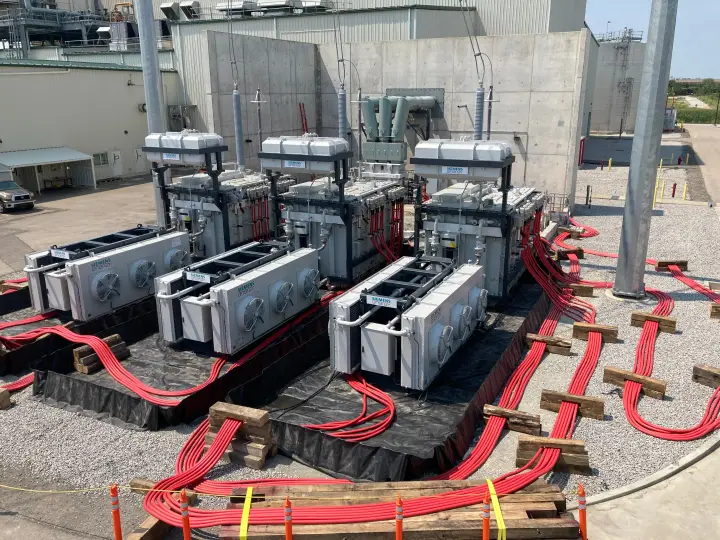
Siemens Energy Sensformer, the born-connected transformer monitoring platform now folded into Noedra
This model is part of SecondWatt’s transformer research catalogue. Specifications and price observations are included where supported by sources. Equipment availability and commercial terms require confirmation.
Siemens Energy Sensformer dossier: born-connected transformer monitoring tiers, digital twin analytics, Noedra transition, and used-market relevance.
Sensformer is not a transformer model: it is the IoT connectivity and monitoring platform Siemens launched at Hannover Messe in April 2018 to make transformers 'born connected,' extended to switchgear as Sensgear in 2019. Base scope monitored oil level, low-voltage winding temperature, and GPS position; the Advanced and Edge tiers added winding current, cooling inlet and outlet temperatures, ambient, weather, and humidity, with Edge processing data locally and connecting only for updates.
Analytics run on a digital twin built from design data: relative aging, 24-hour load simulation, 30-60 minute overload-capability lookahead, anomaly detection, and fleet overview on the Advanced tier. Security spans end-to-end encryption, mTLS 1.2, encryption at rest and in transit, and per-device cryptographic identity.
Branding is in transition: the dedicated Sensformer product page has been retired, and the content lives under Siemens Energy's Noedra digital-grid portfolio as of 2026. No secondary market exists, since Sensformer ships embedded in new Siemens Energy transformers. Its used-market relevance is comparative: monitored units arrive with the DGA and loading history that unmonitored legacy units lack, which is exactly the documentation gap that reprices used transformers.
Why it matters
Condition history is the currency of the used transformer market: 'missing history reprices the unit toward as-is' is the standing rule. Embedded monitoring converts that history into a continuous record, and CIGRE fleet data credits online DGA with preventing major failures. Buyers should treat monitoring data as part of the asset and demand its export at sale.
Who buys it
Utilities and industrial owners specifying condition monitoring on new Siemens Energy transformer orders, and asset managers building a fleet view across multiple sites. Owners of legacy fleets retrofit competing third-party monitors instead, because Sensformer is factory-fitted. On the secondary market the platform is a listing attribute rather than a product: a monitored unit arrives with a continuous operating record, which is the evidence a used-transformer buyer otherwise has to reconstruct from oil tests.
Role in the data center
A specification option on new Siemens Energy transformers serving campus substations, delivering the continuous condition record that de-risks a later redeployment or resale. It sits on the transformer rather than in the data hall, and its value to a data center owner is at the end of the asset life rather than during operation.
Key specifications
| Launch | April 2018, Hannover Messe |
|---|---|
| Base monitoring scope | oil level, LV winding temp, GPS |
| Advanced/Edge tiers | winding current, cooling temps, ambient, weather, humidity |
| Overload lookahead | 30-60 minutes |
| Load simulation window | 24 hours |
| Transport security | mTLS 1.2, end-to-end encryption |
| Sensgear extension | 2019 (substation assets) |
| 2026 status | content under Noedra portfolio |
| Analytics | digital twin from design data, relative aging, anomaly detection |
| Advanced tier additions | GPS, weather, humidity |
| Data protection | encrypted at rest and in transit; per-device cryptographic identity |
| Product page status | dedicated URL retired; content under the Noedra portfolio |
Technical summary
Type: embedded IoT monitoring platform, not a transformer model. Launched: April 2018 (Hannover Messe); Sensgear extension 2019. Base scope: oil level, LV winding temperature, GPS. Advanced/Edge scope: + winding current, cooling in/out temps, ambient, weather, humidity. Edge tier: local processing, connect-for-updates only. Analytics: digital twin, relative aging, 24-hr load simulation, 30-60 min overload lookahead. Security: end-to-end encryption, mTLS 1.2, per-device identity. Status 2026: folded into the Noedra portfolio; dedicated URL retired.
Major variations
Three tiers ship: the base Sensformer, which reports oil level, low-voltage winding temperature and GPS position; Sensformer Advanced, which adds cloud and IoT connectivity with fleet analytics, weather and humidity; and Sensformer Edge, which processes locally and connects only for updates. The 2019 Sensgear extension carried the same approach to other substation assets. The Noedra rebrand reorganises the same capabilities as Noedra Node and Noedra Transformer monitoring, diagnostics and analytics.
Configurations and options
Three tiers ship and the tier is the whole ordering decision. The base Sensformer reports oil level, low-voltage winding temperature and GPS position. Sensformer Advanced adds cloud and IoT connectivity with winding current, cooling inlet and outlet temperatures, ambient, weather and humidity, plus fleet analytics. Sensformer Edge processes locally and connects only for updates. Analytics on the Advanced tier run on a digital twin built from the unit's design data and cover relative aging, a 24-hour load simulation, a 30 to 60 minute overload lookahead, anomaly detection and a fleet overview. The platform is ordered with the host transformer and priced inside that quote; there is no standalone part number and no aftermarket retrofit path for Sensformer itself. The 2019 Sensgear extension carried the approach to other substation assets; the content now sits under the Noedra portfolio.
Compatibility and dependencies
The dependencies here are network and data rather than electrical. The Advanced tier needs an outbound path to Siemens Energy's cloud, while Edge processes locally and connects only for updates, which is usually what a security-restricted substation network will accept, so the tier choice follows the owner's operational technology policy, not the feature list. Transport security is mutual TLS 1.2 with end-to-end encryption, data encrypted at rest and in transit, and a per-device cryptographic identity. The analytics run on a digital twin built from that specific transformer's design data, which means the value is tied to the unit it shipped with and does not transfer to another asset. IEC 62443 and IEEE 1686 certification claims do not appear in the Advanced and Edge flyer. For a legacy fleet the comparable route is Hitachi Energy's TXpert, sold both factory-fitted and as a retrofit.
Pricing and availability
Trend: rising Lead time, new: Ships embedded with host transformer. Lead time, used or refurbished: Not traded separately. Warranty, used: 3-year typical from major US rebuilders.
Lifecycle and maintenance
Liquid-filled transformers routinely serve 30-40 years with annual oil screening, DGA on a 1-2 year cadence (or continuous online monitoring on critical units), and gasket or bushing service as tests dictate. Major US rebuilders remanufacture units to like-new condition with warranties up to 3 years (T&R Electric, Sunbelt Solomon), and reconditioned stock ships in days against 65-210 week new-build queues. Remaining paper life, estimated by furan testing, governs end-of-life valuation.
Thermal and emissions profile
Transformers produce no combustion emissions; the regulatory profile is efficiency and fluid. US distribution-class units fall under DOE 10 CFR 431 Subpart K efficiency standards, amended in 2024 with compliance from 2029 requiring 10-30% lower losses than 2016 levels. Fluid choice drives fire and environmental posture: mineral oil versus FR3 natural ester with a 360 C fire point and ready biodegradability. Legacy units require PCB screening, with clean units documented below 2 ppm.
Common failure points
- Windings — Dielectric failure; windings dominate major-failure statistics in CIGRE TB 642
- Bushings — Failure share rises with voltage class; OIP bushing faults can rupture tanks
- OLTC — Contact and mechanism wear; prominent failure source on substation units
- Winding deformation — Through-fault or transport damage shifting SFRA signature
- Cooling system — Pump, fan, and radiator degradation derating the unit
- Moisture and paper aging — Furans in oil and reduced degree of polymerization
Inspection checklist
DGA: dissolved gas analysis per IEEE C57.104; combustible-gas trend rise between 2 samples triggers investigation. Oil quality: dielectric breakdown, moisture, acidity, and furan tests; degree of polymerization below 200 marks end of paper life. Insulation resistance: megger HV/LV/ground; polarization index of 2.0 or higher passes. Power factor: insulation power factor testing; values above 1.0% on oil-filled windings warrant investigation. Turns ratio: TTR on all taps; deviation beyond 0.5% from nameplate fails. Winding resistance: three-phase balance within 2% between phases. Bushings: capacitance and power factor test; bushing failure share rises with voltage class per CIGRE TB 642. OLTC: inspect on-load tap changer diverter and selector; OLTCs are a leading failure component in CIGRE TB 642 fleet surveys.
Procurement channels
Specified with new Siemens Energy transformer orders and priced inside the host-unit quote; there is no independent secondary market and no standalone part number. Legacy fleets that cannot be retrofitted with Sensformer buy third-party or competing OEM monitors instead, including Hitachi Energy's TXpert ecosystem, which is sold both factory-fitted and as a retrofit.
Regional notes
The platform ships embedded on new Siemens Energy transformers worldwide rather than as a regional product, so voltage and frequency questions do not arise; what varies by region is the buyer's cybersecurity and network mandate. Branding is in transition: the dedicated Sensformer product URL now returns 404 and current content sits under the Noedra portfolio as Noedra Node and Noedra Transformer, so regional Siemens Energy pages are the current reference. Because no IEC 62443 or IEEE 1686 certification claim appears in the published flyer, a buyer operating under a regional certification mandate has to obtain that evidence separately before specifying the connected tier.