Pennsylvania Transformer Technology Power and substation transformers (5-750 MVA, to 765 kV)
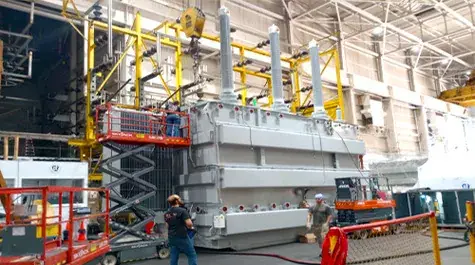
Pennsylvania Transformer power units from 5 to 750 MVA through 765 kV, with a Canonsburg test lab to match
This model is part of SecondWatt’s transformer research catalogue. Specifications and price observations are included where supported by sources. Equipment availability and commercial terms require confirmation.
Pennsylvania Transformer power unit dossier: 5-750 MVA through 765 kV with in-house EHV testing, Quanta ownership, market channels, inspection points.
PTT's power transformer scope is among the widest of any US independent: oil-filled units from 500 kVA to 750 MVA at voltage classes of 69, 138, 345, and up to 765 kV, backed by a 765 kV test laboratory at the Canonsburg campus. The project portfolio spans 5-750 MVA, and specialty lines include unit substation, transit, furnace, zig-zag, and series-multiple designs plus EHV shunt reactors to 150 MVAr at 345 kV. Mobile transformers extend to 50 MVA and 230 kV.
Quanta Services ownership ties this capacity to the largest US utility constructor, and the Raeford, North Carolina plant covers small and distribution units at up to 161 kV test capability.
Buyers should assume brokered channels and quote cycles, with class lead times of 65-110 weeks at 5-50 MVA and up to 4 years at high capacity.
Why it matters
Only a handful of US plants can build and test above 345 kV, and PTT's 765 kV lab puts it in that group alongside Hyosung's Memphis plant and Hyundai's 2027 Montgomery expansion. With imports at 80% of US power transformer supply and 50% Section 232 tariffs on derivative content, domestically tested EHV capacity carries strategic premium.
Who buys it
Utilities and transmission owners buy PTT power units through 765 kV; industrials take furnace and specialty designs; and Quanta's own project pipeline consumes capacity internally. Data center campuses meet PTT at 69-345 kV interconnect substations, where a domestic builder with in-house EHV testing shortens acceptance cycles.
Role in the data center
Interconnect substation transformer at 69-345 kV for large campuses, domestically built and tested. On projects where the critical-path item is a transmission-class transformer, a US plant with in-house 765 kV test capability is the alternative to an import queue carrying both antidumping and Section 232 exposure.
Key specifications
| Power transformer range | 5-750 MVA |
|---|---|
| Voltage classes | 69 / 138 / 345 / to 765 kV |
| Full plant range | 500 kVA-750 MVA |
| EHV test lab | 765 kV (Canonsburg) |
| Shunt reactors | to 150 MVAr / 345 kV |
| Mobile transformers | to 50 MVA / 230 kV |
| Reference unit | 40 MVA / 69 kV project page |
| Class lead time (high capacity) | up to 4 years |
| Specialty designs | unit substation, transit, furnace, zig-zag, series-multiple |
| Raeford NC test capability | 161 kV |
| Canonsburg campus | 1M sq ft, 18 buildings, 90 acres |
| Ownership | Quanta Services company; founded 1929 |
| Class lead time, GSU 50-150 MVA | 100-150+ weeks (2026) |
Technical summary
Power transformers: 5-750 MVA. Voltage classes: 69 / 138 / 345 / up to 765 kV. Full plant range: 500 kVA-750 MVA. Test capability: 765 kV (Canonsburg), 161 kV (Raeford). Specialty: unit substation, transit, furnace, zig-zag, series-multiple. Shunt reactors: to 150 MVAr / 345 kV. Mobile transformers: to 50 MVA / 230 kV. Raeford NC plant: small units, 161 kV test capability. Ownership: Quanta Services; founded 1929.
Major variations
The line splits into standard step-down and generator step-up power units, autotransformers, and a specialty stable that covers transit, furnace, zig-zag and series-multiple designs plus EHV shunt reactors to 150 MVAr at 345 kV. Mobile transformers to 50 MVA and 230 kV sit alongside. Manufacturing splits by plant: Canonsburg builds the large units and tests to 765 kV, while Raeford, North Carolina builds small and distribution units and tests to 161 kV.
Configurations and options
Power transformers run 5-750 MVA at voltage classes of 69, 138 and 345 kV and up to 765 kV, with the full plant range starting at 500 kVA. Beyond the standard step-down, generator step-up and autotransformer builds the line carries a specialty stable that changes the quote entirely: unit substation, transit, furnace, zig-zag and series-multiple designs, plus extra-high-voltage shunt reactors to 150 MVAr at 345 kV and mobile transformers to 50 MVA and 230 kV. Plant assignment is itself a configuration decision, because Canonsburg builds the large units and tests to 765 kV while Raeford builds small and distribution units and tests to 161 kV.
Compatibility and dependencies
For the standard step-down and step-up builds the coordination set is the usual transmission one: impedance against the interrupting duty of the breakers downstream, BIL against the arrester scheme, the winding connection and neutral arrangement against the grounding scheme, tap changer control power where an on-load changer is fitted, and station service for the cooling stages. Zig-zag and series-multiple units are grounding and special-duty transformers rather than step-down units and interface with a grounding scheme or a converter rather than a load bus. Furnace and transit designs are duty-specific and rarely redeployable to a data center. Shunt reactors are not transformers at all and are switched against a bus. The duty has to be read off the nameplate before the rating is. Transport at 10 MVA and above follows IEEE C57.150-2023.
Pricing and availability
Trend: rising Electrical Trader's price history, published 2026-04-01, puts power transformer prices up 77% between 2019 and 2026 and generator step-up transformers up 45% since 2019, on copper up roughly 70% and grain-oriented electrical steel up 80-100% from 2020 to 2025. It records Q2 2025 lead times of 128 weeks for power transformers and 144 weeks for GSUs. PwC figures reported by pv magazine USA on 2026-05-11 put high-capacity units at up to four years, with GSU demand up 274% between 2019 and 2025. Lead time, new: 65-110 weeks (5-50 MVA class); up to 4 years high-capacity. Lead time, used or refurbished: 2-12 weeks. Warranty, used: 3-year typical from major US rebuilders.
Lifecycle and maintenance
Liquid-filled transformers routinely serve 30-40 years with annual oil screening, DGA on a 1-2 year cadence (or continuous online monitoring on critical units), and gasket or bushing service as tests dictate. Major US rebuilders remanufacture units to like-new condition with warranties up to 3 years (T&R Electric, Sunbelt Solomon), and reconditioned stock ships in days against 65-210 week new-build queues. Remaining paper life, estimated by furan testing, governs end-of-life valuation.
Thermal and emissions profile
Transformers produce no combustion emissions; the regulatory profile is efficiency and fluid. US distribution-class units fall under DOE 10 CFR 431 Subpart K efficiency standards, amended in 2024 with compliance from 2029 requiring 10-30% lower losses than 2016 levels. Fluid choice drives fire and environmental posture: mineral oil versus FR3 natural ester with a 360 C fire point and ready biodegradability. Legacy units require PCB screening, with clean units documented below 2 ppm.
Common failure points
- Windings — Dielectric failure; windings dominate major-failure statistics in CIGRE TB 642
- Bushings — Failure share rises with voltage class; OIP bushing faults can rupture tanks
- OLTC — Contact and mechanism wear; prominent failure source on substation units
- Winding deformation — Through-fault or transport damage shifting SFRA signature
- Cooling system — Pump, fan, and radiator degradation derating the unit
- Moisture and paper aging — Furans in oil and reduced degree of polymerization
Inspection checklist
DGA: dissolved gas analysis per IEEE C57.104; combustible-gas trend rise between 2 samples triggers investigation. Oil quality: dielectric breakdown, moisture, acidity, and furan tests; degree of polymerization below 200 marks end of paper life. Insulation resistance: megger HV/LV/ground; polarization index of 2.0 or higher passes. Power factor: insulation power factor testing; values above 1.0% on oil-filled windings warrant investigation. Turns ratio: TTR on all taps; deviation beyond 0.5% from nameplate fails. Winding resistance: three-phase balance within 2% between phases. Bushings: capacitance and power factor test; bushing failure share rises with voltage class per CIGRE TB 642. OLTC: inspect on-load tap changer diverter and selector; OLTCs are a leading failure component in CIGRE TB 642 fleet surveys.
Procurement channels
Direct and Quanta-affiliated channels for new units. The used class trades through brokered dealers including Belyea, CTG Power Systems and Transformer Exchange, universally price-on-request at power scale, and no PTT-badged unit was listed with an open price in August 2026. Surplus Record's substation category held 588 listings with effectively all of them quote-only, which is the structural condition of this class rather than a gap in one vendor's supply.
Regional notes
This is a US ANSI and IEEE product built for 60 Hz service, with in-house test capability to 765 kV at Canonsburg and 161 kV at Raeford, which is the practical answer to a specification that requires witnessed testing. The power class sits above the distribution scope of the DOE rules at 10 CFR 431 Subpart K, so these units carry no DOE efficiency stamp. Domestic manufacture avoids both the Korean large power transformer antidumping order, in force since 2012-08-31 on units of 60 MVA and above, and the import side of the Section 232 50% derivative tariffs effective 2025-08-18.