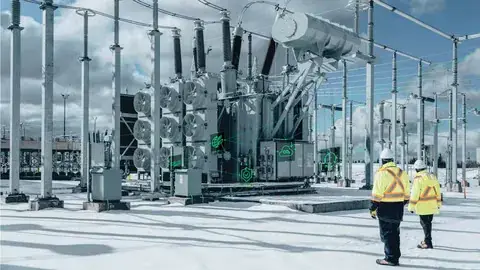
Hitachi Energy EconiQ power transformer portfolio (natural ester)

Hitachi Energy EconiQ ester-filled power transformers, proven to 765 kV with a 250 MVA single-phase world first
Hitachi Energy EconiQ power transformer portfolio (natural ester) is one of 32 data center transformers tracked in the SecondWatt catalogue, each with specifications, lead times and indicative secondary-market pricing.
Hitachi Energy EconiQ dossier: natural-ester power transformers proven at 765 kV and 250 MVA single-phase, fire and lifecycle data, market context, pricing.
EconiQ is Hitachi Energy's eco-efficient transformer portfolio, launched in October 2021 around biodegradable natural-ester insulating fluids and lifecycle-verified designs. The launch-class unit was a 115/21 kV, 40 MVA liquid-filled transformer with a claimed lifecycle CO2 reduction of about 23% versus a conventional equivalent. Ester fluid changes the fire calculus: flash point roughly twice mineral oil, self-extinguishing behavior, and up to 100% biodegradability in 28 days. The portfolio's ceiling moved decisively in May 2025, when Hitachi Energy successfully tested the world's first 765/400 kV single-phase, 250 MVA natural-ester power transformer, built on the TrafoStar platform with the TXpand rupture-resistant tank integrated. The company cites ester experience in more than 40 countries over 20-plus years. No used EconiQ unit exists on the secondary market: the line launched in 2021 and the fleet is retained. For SecondWatt buyers the portfolio matters as the new-build benchmark that used mineral-oil units are priced against, and as the direction insurers and permitting agencies are pushing fluid choice.
Why it matters
Ester-filled transformers reset two cost lines that dominate substation siting: fire separation distances and spill containment. The 765 kV milestone proves ester works at every US voltage class, so specifications are shifting now, during the worst supply crunch on record with power transformer lead times at 128 weeks average. That shift shapes residual values across the mineral-oil fleet SecondWatt trades.
Who buys it
Utilities and transmission operators with fire- and environment-sensitive sites, data center campuses seeking reduced fire separation, and renewable developers with wetland-adjacent substations specify EconiQ. Tata Power took an early ester-fluid power transformer. Buyers comparing used mineral-oil units should weigh ester retrofill as the intermediate option.
Role in the data center
New-build campus intake and distribution transformers where fire separation, insurer requirements, or environmental permitting favor ester fluid over mineral oil.
Key specifications
| Portfolio launch | October 2021 |
|---|---|
| Launch-class rating | 115/21 kV, 40 MVA |
| Lifecycle CO2 reduction | ~23 % |
| Demonstrated top rating | 765/400 kV single-phase, 250 MVA |
| Fluid flash point | ~2x mineral oil |
| Biodegradability | up to 100% in 28 days |
| Tank technology | TXpand rupture-resistant, integrated |
| Ester deployment base | 40+ countries, 20+ years |
| Reference comp: FR3 ester fire point | 360 C |
Technical summary
Portfolio launch: October 2021 Launch-class unit: 115/21 kV, 40 MVA, liquid-filled Lifecycle CO2 reduction claim: ~23% versus conventional Fluid: natural ester; flash point ~2x mineral oil Biodegradability: up to 100% in 28 days Demonstrated ceiling: 765/400 kV single-phase, 250 MVA (tested May 2025) Platform: TrafoStar with TXpand rupture-resistant tank Cooling convention: ester classes KNAN / KNAF Ester experience: 40+ countries, 20+ years
Pricing and availability
Trend: up Lead time, new: 128 weeks class average; project-quoted. Lead time, used or refurbished: 2-12 weeks. Warranty, used: 3-year typical from major US rebuilders.
Lifecycle and maintenance
Liquid-filled transformers routinely serve 30-40 years with annual oil screening, DGA on a 1-2 year cadence (or continuous online monitoring on critical units), and gasket or bushing service as tests dictate. Major US rebuilders remanufacture units to like-new condition with warranties up to 3 years (T&R Electric, Sunbelt Solomon), and reconditioned stock ships in days against 65-210 week new-build queues. Remaining paper life, estimated by furan testing, governs end-of-life valuation.
Common failure points
- Windings — Dielectric failure; windings dominate major-failure statistics in CIGRE TB 642
- Bushings — Failure share rises with voltage class; OIP bushing faults can rupture tanks
- OLTC — Contact and mechanism wear; prominent failure source on substation units
- Winding deformation — Through-fault or transport damage shifting SFRA signature
- Cooling system — Pump, fan, and radiator degradation derating the unit
- Moisture and paper aging — Furans in oil and reduced degree of polymerization
Inspection checklist
DGA — dissolved gas analysis per IEEE C57.104; combustible-gas trend rise between 2 samples triggers investigation Oil quality — dielectric breakdown, moisture, acidity, and furan tests; degree of polymerization below 200 marks end of paper life Insulation resistance — megger HV/LV/ground; polarization index of 2.0 or higher passes Power factor — insulation power factor testing; values above 1.0% on oil-filled windings warrant investigation Turns ratio — TTR on all taps; deviation beyond 0.5% from nameplate fails Winding resistance — three-phase balance within 2% between phases Bushings — capacitance and power factor test; bushing failure share rises with voltage class per CIGRE TB 642 OLTC — inspect on-load tap changer diverter and selector; OLTCs are a leading failure component in CIGRE TB 642 fleet surveys SFRA — sweep frequency response analysis per IEEE C57.149 against baseline to detect winding deformation after transport Transport records — review impact-recorder data per IEEE C57.150 for any relocated unit of 10 MVA and above Core ground — verify a single intentional core ground; inadvertent grounds show as gassing in DGA Cooling — inspect radiators, pumps, and fans; verify stage ratings (ONAN/ONAF) against nameplate Tank and conservator — corrosion survey, gasket inspection, and pressure relief device function Nameplate verification — confirm MVA stages, impedance, BIL, and 55/65 C rise data against the factory test report Records — complete factory test report, DGA history, through-fault history, and loading records from service
Regional notes
Ester units alter DGA interpretation: IEEE C57.104 gas limits were developed for mineral oil, so condition assessment on ester fleets uses fluid-specific baselines. US, EU, and Chinese reference projects exist.