Powersmiths E-Saver OPAL series LV dry-type
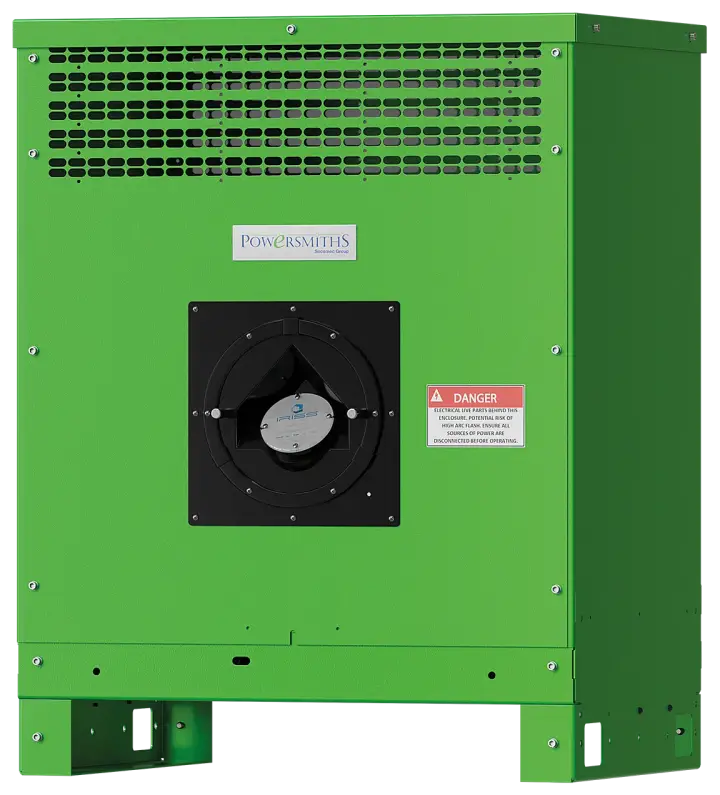
Powersmiths E-Saver OPAL dry-type transformers, beyond-DOE losses with a 32-year pro-rated warranty
This model is part of SecondWatt’s transformer research catalogue. Specifications and price observations are included where supported by sources. Equipment availability and commercial terms require confirmation.
Powersmiths E-Saver OPAL dossier: LV dry-types up to 50% below DOE 2016 losses, 32-year warranty, OPAL-R retrofit line, market context, inspection points.
Powersmiths International of Brampton, Ontario, a Socomec Group member, builds high-efficiency low-voltage dry-type distribution transformers and unveiled a new Brampton factory in June 2024, its third facility in the area. The current lineup centers on the E-Saver OPAL series with OPAL-R retrofit, SOL OPAL, and OPAL EV variants, with cut sheets revised August 2024.
The pitch is losses: up to 25-50% below the DOE 2016 minimum-efficiency requirement, with appropriate K-ratings for non-linear loads, integrated metering options, a patented 360-degree rotatable infrared port, arc-flash options, and a 32-year pro-rated warranty. The OPAL-R retrofit models (80R/81R) target pre-2007 TP-1 units with claimed loss reductions of 80% and more.
No Powersmiths-branded used unit was listed for sale in August 2026, consistent with a premium-efficiency product that owners keep for its operating economics. Powersmiths publishes the kVA range, voltage combinations and temperature-rise tables in the August 2024 OPAL cut sheets rather than on the range page, so a buyer sizing a unit should work from those documents.
Why it matters
At data center duty cycles, transformer losses run around the clock, and a unit 25-50% below DOE 2016 losses compounds into real energy savings across a 32-year warranty life. Powersmiths quantifies the efficiency frontier that used LV dry-type stock must be priced against: a 1990s unit's discount has to cover decades of extra losses.
Who buys it
Sustainability-driven campuses, schools, hospitals, and data centers with 24/7 loads buy OPAL units, where the loss delta pays back against continuous duty. OPAL-R buyers are retrofit programs monetizing the gap against pre-2007 TP-1 stock. Used supply is effectively nil; procurement is a new-build decision.
Role in the data center
Premium-efficiency step-down for 24/7 IT and mechanical loads, where the transformer runs near constant load and loss economics justify the capital premium over a commodity dry-type. At continuous duty the difference between DOE 2016 minimum losses and 25-50% below it compounds into a load the cooling plant does not have to remove.
Key specifications
| Loss reduction vs DOE 2016 | up to 25-50 % |
|---|---|
| Warranty | 32 years pro-rated |
| K-rating | appropriately K-rated |
| IR port | patented 360-degree rotatable |
| OPAL-R retrofit claim | 80%+ lower losses vs pre-2007 TP-1 |
| Variants | OPAL, OPAL-R, SOL OPAL, OPAL EV |
| New factory | Brampton ON, unveiled June 2024 |
| Cut-sheet vintage | August 2024 revisions |
| Corporate group | Socomec Group member |
| Metering | integrated metering options |
| Arc-flash | arc-flash options available |
| OPAL-R target units | models 80R and 81R, sized to replace pre-2007 TP-1 units |
| Quality certification | ISO 9001 |
| Class comp, GE 10 kVA mini unit substation, new | 1,598 USD |
Technical summary
Type: LV dry-type distribution transformers. Efficiency: up to 25-50% lower losses than DOE 2016 minimum. Harmonics: appropriately K-rated for non-linear loads. Warranty: 32-year pro-rated. Monitoring: integrated metering options; patented rotatable IR port. Variants: E-Saver OPAL, OPAL-R (retrofit), SOL OPAL, OPAL EV. OPAL-R claim: 80%+ loss reduction versus pre-2007 TP-1 units. Quality: ISO 9001; new Brampton factory (June 2024).
Major variations
Four variants share the E-Saver OPAL platform: the standard OPAL, the OPAL-R retrofit line whose 80R and 81R models are sized to swap pre-2007 TP-1 units in place, SOL OPAL for solar applications, and OPAL EV for vehicle-charging loads. Metering and arc-flash packages layer onto any of them. The retrofit line is the one with a distinct commercial case: it targets an installed base of units that predate the 2007 efficiency step and claims loss reductions above 80% against them.
Configurations and options
The cut sheet lists 9-1,000 kVA with catalogued sizes from 15 through 750 kVA, primary to 600 V and secondary to 600/347 V, on a 220 deg C NOMEX-based insulation system with an epoxy co-polymer impregnant, 60 Hz as standard. Temperature rise is a model-code choice running from below 130 deg C down to below 65 deg C, and the rise code carries the K rating with it: K7, K1, K9, K13, K20 and K30 by model, with the K rating reduced by one level at 400 kVA and above. Taps are typically six at 2.5%, all front-accessible. Electrostatic shielding is ordered single, dual or triple. The standard enclosure is Type 2 ventilated drip-proof indoor, with Type 3R sprinkler-proof outdoor ventilated and other options. Metering is Express Logger, SMART or Cyberhawk TX. The warranty is 32 years pro-rated. Variants are OPAL, OPAL-R retrofit models 80R and 81R, SOL OPAL and OPAL EV.
Compatibility and dependencies
The unit sits between a 480 V or 600 V switchboard and the panels it feeds, and its distinguishing siting dependency is the UL listing for 2 inch rear clearance, which lets it go into an electrical room that would not take a conventional ventilated dry-type. The standard Type 2 enclosure is ventilated drip-proof indoor and Type 3R is the outdoor option. Front-accessible taps mean the ratio can be set without pulling the unit out of line. Single, dual or triple electrostatic shields are specified against the noise sensitivity of the derived system. The K rating has to match the harmonic profile of the connected load, and it drops one level at 400 kVA and above. Metering options only earn their cost with a comms path to the building system that reads them. On a retrofit the 80R and 81R models are dimensioned to replace pre-2007 TP-1 units in place.
Pricing and availability
Trend: rising Electrical Trader's price history, published 2026-04-01, puts power transformer prices up 77% between 2019 and 2026 with a 45-95% spread by model, and attributes about half the move to materials: copper up roughly 70% and grain-oriented electrical steel up 80-100% between 2020 and 2025, together 50-55% of production cost. The same series shows the annual rate easing, from 34.58% in 2022 to 8-10% in 2025 with 3-5% forecast for 2026. Terrapin Construction Group put dry-type lead times at 0-2 MVA at 20-32 weeks on 2026-06-10. Lead time, new: Quoted; 2024 factory expansion added capacity. Lead time, used or refurbished: No used channel as of August 2026. Warranty, used: 3-year typical from major US rebuilders.
Lifecycle and maintenance
Cast-resin and VPI dry-type transformers typically serve 25-30+ years with minimal maintenance: periodic cleaning, PD testing on critical units, fan service on AF designs, and torque checks. There is no oil system to sample, so temperature and PD are the condition indicators. Rebuild options are limited compared with liquid units; failed coils are usually replaced rather than repaired, which makes pre-purchase PD and visual inspection decisive for used units.
Thermal and emissions profile
Transformers produce no combustion emissions; the regulatory profile is efficiency and fire class. US low-voltage dry-type units fall under DOE 10 CFR 431 efficiency rules (DOE 2016 levels, amended 2024 with 2029 compliance), and EU-market cast-resin units fall under Ecodesign Regulation 548/2014 Tier 2. Dry-type construction removes oil fire and spill risk entirely, which is why cast-resin units carry IEC 60076-11 fire class F1 and serve indoor and environmentally sensitive sites.
Common failure points
- Partial discharge — PD in resin voids degrading insulation toward failure
- Resin cracking — Cracks from thermal cycling or mechanical shock
- Contamination — Dust and conductive debris enabling surface tracking
- Cooling fans — Failed AF fans derating capacity
- Connections — Loose terminations overheating under load
- Overheating under harmonics — Excess temperature on non-linear loads beyond K-rating
Inspection checklist
Partial discharge: PD test per IEC 60270 practice; readings above 10 pC warrant investigation on cast-resin coils. Resin condition: inspect all coils per IEC 60076-11 practice for cracks and crazing from thermal cycling; any through-crack fails. Insulation resistance: megger HV/LV/ground; polarization index of 2.0 or higher passes. Turns ratio: TTR on all tap positions; deviation beyond 0.5% from nameplate fails. Winding resistance: three-phase balance within 2% between phases. Contamination: inspect for dust and conductive debris between coils; contamination is a leading dry-type failure driver. Cooling fans (AF units): run-test all fans and verify temperature controller setpoints. Temperature sensors: verify RTD or thermocouple channels read within 5 C of a reference at ambient.
Procurement channels
The Powersmiths and Socomec channel plus UPS and power resellers for new units, quoted per project. No used Powersmiths unit was listed for sale in August 2026, which is consistent with a premium-efficiency product whose owners keep it. Buyers benchmarking the low-voltage dry class use new stock comps instead: a GE 10 kVA mini unit substation at 1,598 USD and Hammond step-up dry-types at 2,595-9,495 USD across 45-225 kVA.
Regional notes
Powersmiths builds at Brampton, Ontario as a Socomec Group member for the North American market, and the units are 60 Hz as standard with 600 V-class North American voltages. Efficiency is stated against the US DOE 2016 minimum under 10 CFR 431, at 25-50% lower losses, which is a vendor claim rather than a regulatory grade; the DOE amended those standards in a final rule published 2024-04-22 with a 2029 compliance date. The OPAL-R retrofit line targets the installed base of units predating the 2007 TP-1 step. Cross-border shipment into the US carries the Section 232 50% tariff on non-US steel and aluminum content in transformer derivatives, effective 2025-08-18.